Conversational AI Platform vs Point Solution Voice Agent

Dialflo: AI Voice Agent
August 20, 2026
Businesses evaluating voice AI often start with a simple question:
"Which AI voice agent should we buy?"
But that question can become misleading as soon as a company wants to automate more than one workflow.
A point solution voice agent may be excellent at solving one specific problem, such as lead qualification, appointment reminders, or candidate screening.
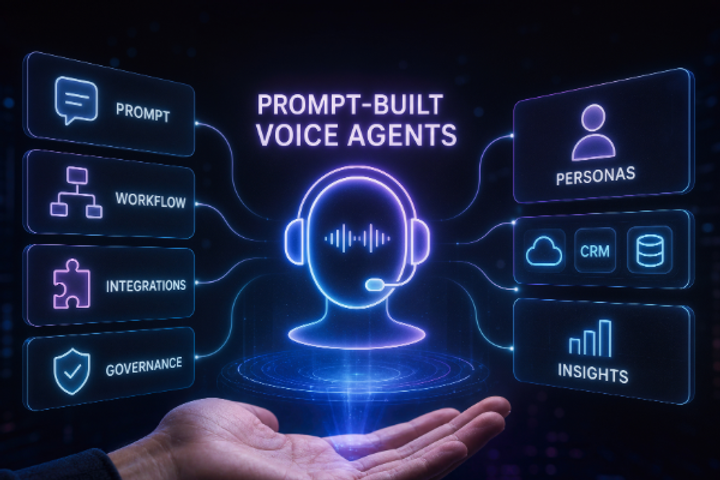
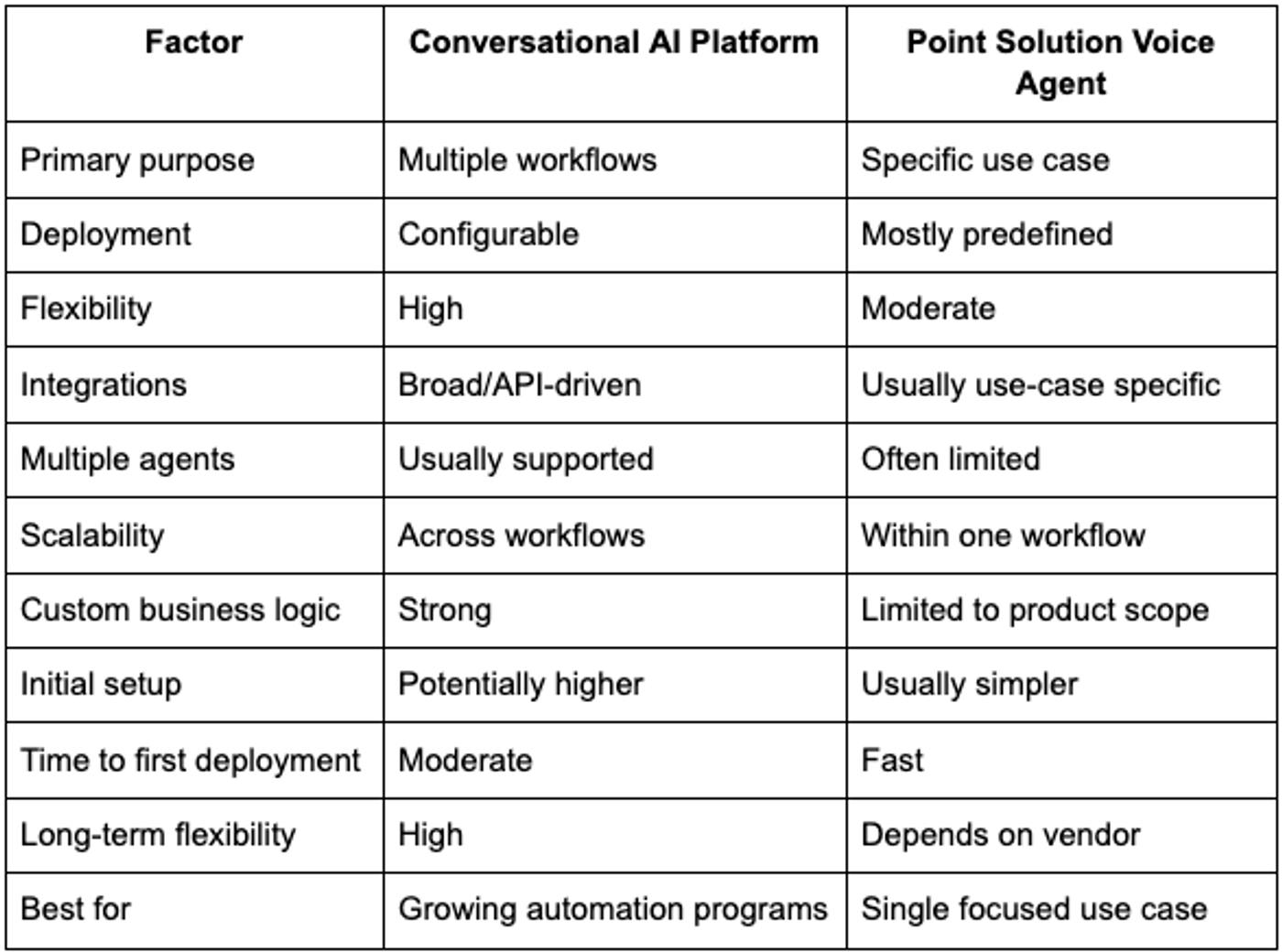
A conversational AI platform takes a broader approach. It provides the underlying infrastructure, integrations, workflows, agent configuration, analytics, and controls needed to deploy voice AI across multiple business processes.
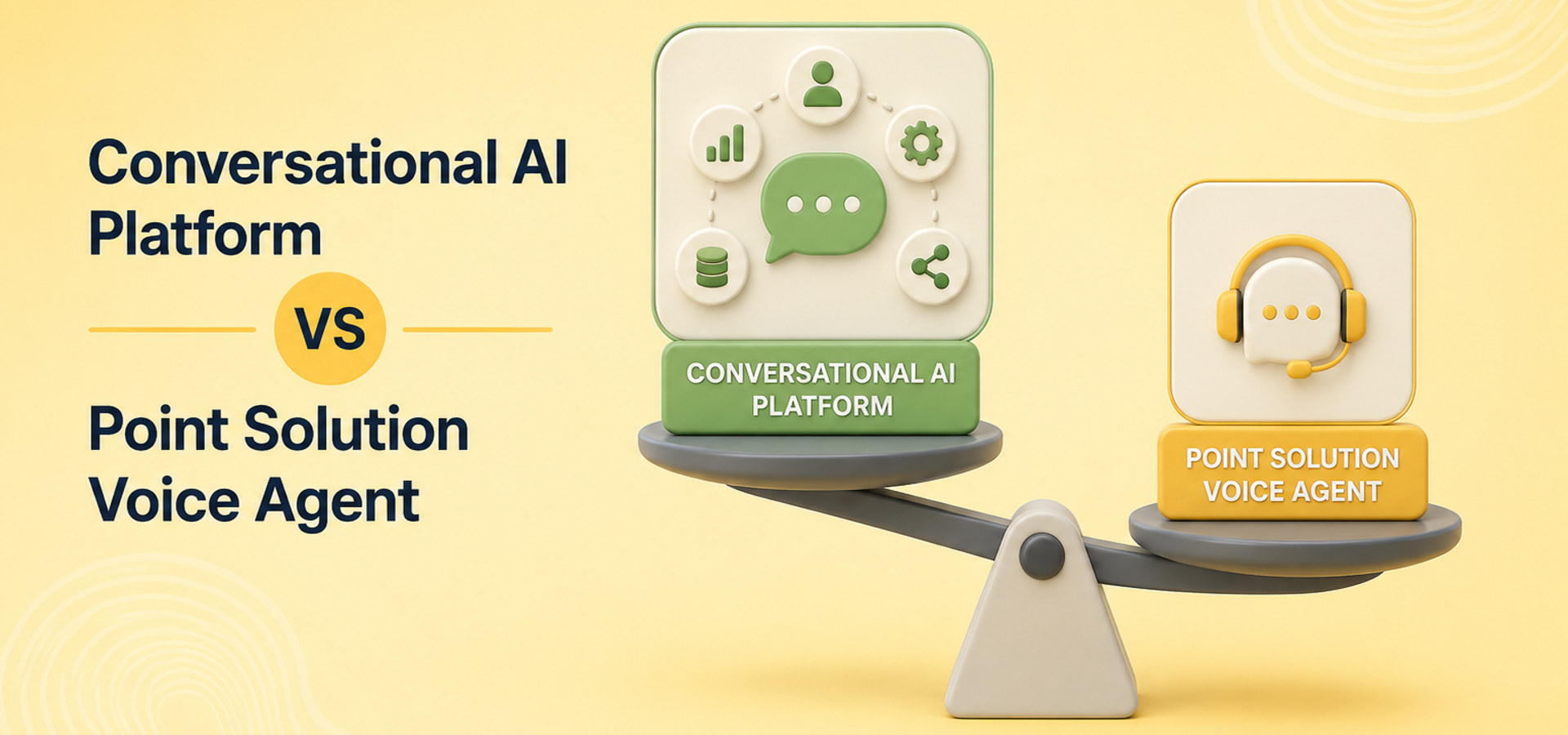
That makes the comparison between a conversational AI platform vs point solution voice agent primarily an architecture decision.
The right choice depends on whether you are solving one isolated problem or building voice automation that needs to work across your organization.
What Is a Point Solution Voice Agent?
A point solution voice agent is designed around a specific use case.
For example:
- Appointment booking
- Lead qualification
- Recruiting phone screening
- Customer support
- Payment reminders
- Order confirmation
The vendor typically provides a ready-to-use workflow.
You configure a few settings, connect your data, and deploy the agent.
This approach can be attractive because implementation is relatively simple.
If your only requirement is:
"Call new leads and qualify them."
A specialized voice agent may be all you need.
But problems can emerge when the business wants to expand beyond that initial workflow.
What Is a Conversational AI Platform?
A conversational AI platform provides a broader architecture for creating and operating multiple AI agents and workflows.
Instead of purchasing a separate solution for every use case, the company can use a shared platform.
A typical architecture might look like:
Business systems
↓
Conversational AI platform
↓
AI agents
↓
Voice / phone / messaging channels
↓
Customers, candidates, suppliers, or prospects
The platform can provide common infrastructure for:
- Agent creation
- Voice models
- Telephony
- Workflows
- Knowledge bases
- APIs
- CRM integrations
- Webhooks
- Analytics
- Call recording
- Transcription
- Human handoffs
- Security
- Monitoring
Dialflo positions its voice AI around customizable business workflows rather than a single narrowly defined conversation.
Its documentation includes APIs for outbound calls, agent configuration, call context, structured insights, and webhook events. (docs.dialflo.ai)
That architecture becomes more valuable as the number of use cases increases.
1. Architecture Comes Before Features
A common mistake is comparing vendors feature by feature.
One vendor has:
- 30 voices
Another has:
- 50 integrations
Another has:
- 100 templates
But features don't tell you how the system fits into your architecture.
Instead, ask:
Where does the AI layer sit in our technology stack?
A point solution might look like:
CRM → Voice Agent
A broader platform may look like:
CRM + ATS + TMS + Help Desk + Calendar + APIs
↓
Conversational AI Platform
↓
Multiple AI Agents
↓
Multiple workflows
The second architecture can support a larger automation strategy.
2. One Use Case vs Multiple Use Cases
This is the most important distinction.
Imagine a company starts with sales.
It wants an AI agent to qualify inbound leads.
A point solution may work perfectly.
Six months later, the company wants to automate:
- Lead qualification
- Customer support
- Appointment scheduling
- Payment reminders
- Recruiting calls
- Follow-ups
Now the company has two options.
Option A: Multiple Point Solutions
Each department buys its own AI product.
That can create:
- Multiple vendors
- Multiple billing systems
- Separate integrations
- Different analytics
- Different security policies
- Duplicated implementation work
Option B: Shared Conversational AI Platform
The company deploys multiple agents using the same underlying infrastructure.
This can simplify:
- Integration
- Administration
- Monitoring
- Data flows
- Governance
- Scaling
For companies planning multiple AI workflows, the platform architecture becomes more attractive.
3. Integration Architecture
Voice AI becomes significantly more useful when it can interact with business systems.
For example:
CRM → AI agent → CRM
The AI can retrieve customer information, make a call, and write the outcome back to the CRM.
But more advanced workflows can involve several systems.
For example:
Lead source → CRM → AI voice agent → Calendar → CRM → Sales team
Or:
TMS → AI voice agent → Carrier → TMS
Or:
ATS → AI voice agent → Candidate → ATS → Recruiter
A platform architecture is generally better suited to these interconnected workflows.
Dialflo's API documentation supports programmatic call initiation and structured call information, while webhooks can be used to receive real-time events from calls. (docs.dialflo.ai)
That makes API capability an important architecture consideration.
4. Point Solutions Can Be Better for Simple Problems
A platform isn't automatically the better choice.
If your business has one clearly defined workflow, a point solution may be faster and cheaper.
For example:
Use case: Appointment reminders
Requirements:
- Call customer
- Confirm appointment
- Reschedule if necessary
- Update calendar
If that's all you need, buying a large conversational AI platform may introduce unnecessary complexity.
A point solution can make sense when:
- The use case is narrow.
- The workflow is predictable.
- You don't need extensive customization.
- You don't expect many additional AI workflows.
- You want fast deployment.
Architecture should match the size of the problem.
5. Platforms Become More Valuable With Workflow Complexity
Now consider a logistics company.
It wants to automate:
- Carrier check calls
- Shipment status calls
- Delivery appointment scheduling
- Exception notifications
- Payment reminder calls
- Customer status calls
These workflows share common infrastructure.
They may need the same:
- TMS integration
- Telephony infrastructure
- Business data
- Authentication
- Call analytics
- Security controls
Building each as a separate point solution can duplicate infrastructure.
A platform lets the business create multiple workflows on top of the same foundation.
Dialflo has content covering automated carrier check-call logging, automated load-status updates, and 3PL customer follow-up automation.
The architecture becomes:
One platform
→ Carrier agent
→ Customer support agent
→ Appointment agent
→ Payment reminder agent
Instead of:
Four disconnected voice products
6. Shared Knowledge and Business Context
A platform architecture can also centralize business knowledge.
Suppose a company has information about:
- Products
- Policies
- Customers
- Pricing
- Locations
- Service rules
- Escalation policies
Multiple agents may need access to the same underlying information.
A shared conversational AI platform can make it easier to maintain common knowledge while giving individual agents different instructions.
For example:
Sales Agent
Focus: qualification and demos
Support Agent
Focus: troubleshooting and FAQs
Billing Agent
Focus: payment and account questions
All three can operate within the same organizational architecture.
That is harder to manage when every workflow is purchased from a different point-solution vendor.
7. Agent-to-Human Handoffs
AI doesn't need to handle every conversation.
A mature conversational architecture should allow the AI to recognize when a human should take over.
For example:
AI receives call
↓
Identifies intent
↓
Handles routine request
↓
Customer raises complex issue
↓
AI transfers to human
The transfer can include context such as:
- Customer identity
- Reason for call
- Conversation summary
- Information already collected
- Recommended next action
This prevents customers from repeating the same information after being transferred.
For businesses considering AI customer support, see best AI voice agents for customer support.
8. Build vs Buy
Architecture decisions often lead to another question:
Should we build our own conversational AI stack?
Building can provide maximum control, but it also means managing infrastructure such as:
- Telephony
- Speech recognition
- Text-to-speech
- LLMs
- Prompt management
- Conversation state
- Call routing
- Recording
- Transcription
- Monitoring
- Security
- Integrations
For an SMB, maintaining all of this internally may not make economic sense.
A conversational AI platform provides a managed layer over much of this infrastructure.
Dialflo's own resources compare building vs buying a voice AI stack, which is useful for businesses evaluating whether to build the architecture internally or use a platform.
9. Scaling Is More Than Call Volume
When people say a voice AI system needs to scale, they often mean more concurrent calls.
But enterprise scaling has several dimensions.
Volume scaling
Can the system handle more calls?
Workflow scaling
Can you add new use cases?
Integration scaling
Can it connect to more systems?
Geographic scaling
Can it support additional regions and languages?
Organizational scaling
Can multiple teams use the same infrastructure?
Governance scaling
Can administrators control access and monitor activity?
A point solution may scale well within its specific use case.
A conversational AI platform is generally designed to scale across multiple workflows.
10. Multilingual and Multi-Market Architecture
Companies operating across multiple regions may need agents that can communicate in different languages.
This can become difficult when every department uses a different vendor.
A centralized conversational AI platform can potentially provide a shared voice and language layer.
For example:
Sales Agent
English + Hindi
Recruiting Agent
English + Marathi + Hindi
Support Agent
English + Spanish
The exact capabilities depend on the platform, but the architectural advantage is clear: language support becomes part of the shared AI infrastructure rather than a separate capability for every use case.
Dialflo also covers multilingual voice AI and global sales growth.
11. Analytics and Observability
When AI becomes part of business operations, monitoring becomes important.
A company should be able to understand:
- Number of calls
- Call duration
- Completion rates
- Escalation rates
- Conversion rates
- Failed conversations
- Customer intents
- Common questions
- Workflow errors
A platform can provide centralized visibility across multiple agents.
For example:
Sales Agent
5,000 calls
18% qualified
7% booked demos
Support Agent
8,000 calls
72% automated resolution
12% human escalation
Recruiting Agent
3,000 calls
35% qualified candidates
This creates a management layer for conversational automation.
Instead of asking individual vendors for separate reports, the organization can analyze its AI operations more systematically.
12. Security and Governance
As the number of AI agents increases, governance becomes more important.
A business should know:
- Which agents exist?
- Who created them?
- Which systems can they access?
- What data can they retrieve?
- Who can modify their instructions?
- Who can view transcripts?
- How long is call data retained?
- What happens when an agent makes an error?
With multiple point solutions, these questions may need to be answered separately for each vendor.
A centralized platform can make governance easier by providing shared controls.
For companies operating in regulated or sensitive environments, this should be evaluated before deployment rather than after the system is live.
13. Total Cost of Ownership
Point solutions often look cheaper at first.
You may see:
$X per month for one AI agent
That can be attractive.
But if the company eventually needs five different agents, it may end up paying for:
- Five platforms
- Five integrations
- Five dashboards
- Five contracts
- Five sets of implementation work
A platform may have a higher initial cost but lower long-term complexity.
The correct calculation is:
Total cost of ownership = platform + usage + integrations + implementation + maintenance + administration
Not simply:
Monthly subscription price
Which Architecture Should You Choose?
Choose a Point Solution When:
- You have one narrow use case.
- You need to launch quickly.
- The workflow is simple.
- You don't need extensive integrations.
- You don't expect additional voice automation.
- A specialized product already solves the problem well.
Choose a Conversational AI Platform When:
- You plan to automate multiple workflows.
- Several departments need voice AI.
- You need custom business logic.
- You need API integrations.
- You want centralized analytics.
- You need shared security and governance.
- You expect call volume to grow.
- You need multilingual capabilities.
- You want to avoid vendor fragmentation.
A Practical Architecture for SMBs
An SMB doesn't need to automate everything on day one.
A sensible architecture can start small.
Phase 1: One Workflow
Choose one high-volume, repetitive process.
For example:
Inbound support calls
Phase 2: Integration
Connect:
CRM + voice platform
Phase 3: Human Escalation
Add:
AI → Human transfer
Phase 4: Analytics
Track:
- Automation rate
- Resolution rate
- Escalation rate
- Cost per interaction
Phase 5: Expand
Once the workflow works, deploy additional agents.
For example:
Support Agent
↓
Sales Agent
↓
Recruiting Agent
↓
Follow-Up Agent
The company now has a conversational AI architecture rather than a collection of disconnected experiments.
Where Dialflo Fits
Dialflo is positioned as a voice AI platform for business workflows across areas such as sales, recruiting, logistics, support, and other operational use cases.
Its architecture includes AI agents, outbound calling capabilities, customizable workflows, APIs, structured call insights, and integrations.
That makes it more relevant for companies that want to move beyond one isolated voice automation use case.
For example, a logistics company could build:
Carrier Agent
Handles check calls
Customer Agent
Handles shipment-status questions
Collections Agent
Handles payment reminders
Operations Agent
Handles internal calls
All of these can be treated as different conversational workflows rather than separate technology projects.
For companies starting with sales automation, AI voice agents for sales provides an example of how voice AI can support lead and sales workflows.
For teams evaluating competing architectures, best AI voice agent platforms can also help frame the broader vendor-selection process.
The Key Architecture Question
The simplest way to make the decision is to ask:
"Are we buying an AI agent, or are we building a voice automation layer for our business?"
If you only need one agent for one task, a point solution may be the better option.
If you expect voice AI to become part of several business workflows, a conversational AI platform is usually the more strategic architecture.
The difference becomes increasingly important as adoption grows.
One agent becomes three.
Three becomes ten.
And eventually, the business needs a consistent way to manage all of them.
Final Verdict
The conversational AI platform vs point solution voice agent decision ultimately comes down to architectural ambition.
A point solution is optimized for solving one problem quickly.
A conversational AI platform is optimized for building and managing multiple AI-powered conversations across the business.
Neither approach is inherently better.
For a simple, isolated workflow, buying a specialized voice agent can be the fastest path to value.
For companies planning multiple AI workflows, deeper integrations, centralized analytics, and long-term automation, a platform architecture can reduce duplication and create a stronger foundation for scaling.
The best approach is to start with one measurable use case, prove the ROI, and then decide whether the business needs another isolated solution—or whether it is time to build a broader conversational AI layer.
Frequently asked questions
What is a point solution voice agent?
A voice agent built for one job, such as booking appointments or answering FAQs. It is quick to deploy but usually has its own integrations, data, and reporting.
What is a conversational AI platform?
A shared foundation for many voice agents, with common integrations, knowledge, analytics, governance, and human handoff, so each new use case does not start from zero.
When is a point solution the better choice?
When you have one well-defined use case, low integration needs, and no plan to add more automated workflows soon.
Is Dialflo a platform or a point solution?
Dialflo is a platform. Teams usually start with one measurable use case and then add agents for sales, support, recruiting, or logistics on the same integrations and reporting.
Starting with one measurable use case? Book a Dialflo demo to plan a pilot you can later grow into more workflows on the same platform.