Best AI Voice Agent Platforms for Enterprises

Dialflo: AI Voice Agent
July 15, 2026
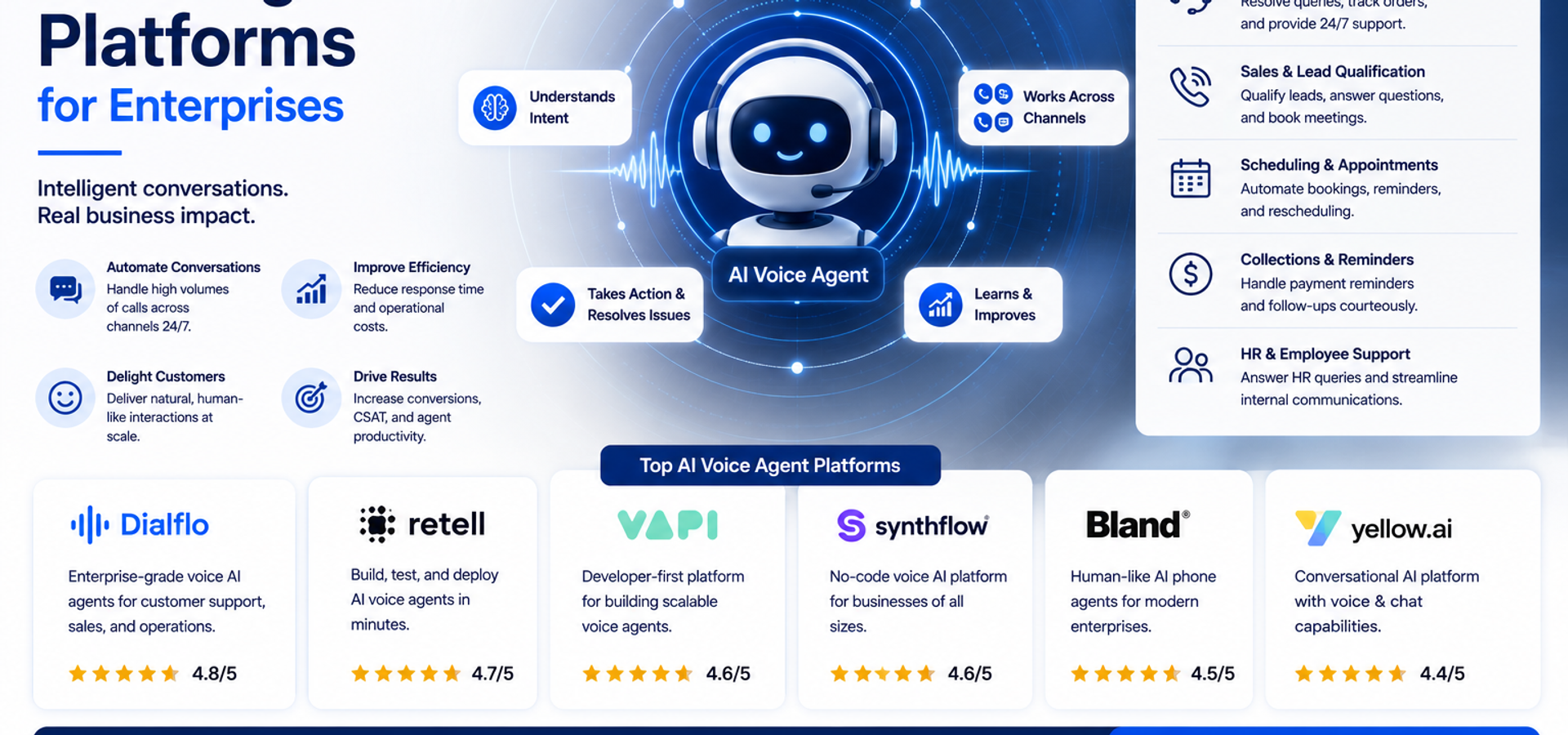
Your RFP has twelve vendors. Every deck says “human-like,” “enterprise-grade,” and “infinite scale.” Then you put a real customer on the line, and the “best” platform misreads a shipment ID, stalls for two seconds, and dumps a confused caller into voicemail. That is the real buying moment for the best AI voice agent platforms: not a feature matrix, but a call that does not embarrass your brand.
This guide is for IT, CX, and ops leaders who need to shortlist platforms that survive production. You will get a stack map (what “platform” actually means), evaluation criteria that outlive a vendor demo, and a clear place to put DIY builders versus managed agents. For adjacent category context, start with conversational services and the build vs buy voice AI stack decision.
What “best” means for enterprise voice agents
Enterprises do not buy “a chatbot that talks.” They buy a system that can:
- answer or place calls at peak load without melting latency
- pull and push truth from CRM, TMS, ATS, or billing systems
- escalate cleanly when judgment is required
- log every turn for compliance, QA, and dispute resolution
- prove ROI in agent minutes saved and containment, not vanity demos
Gartner has projected that conversational AI will cut contact center agent labor costs by $80 billion in 2026 as AI agents take more routine volume. That only holds when containment is real and write-back is trustworthy.
McKinsey’s generative-AI research points to large automation potential inside customer operations, exactly the high-volume phone workflows enterprises want voice agents to own. Source: McKinsey: The economic potential of generative AI.
Unique angle: buy layers, not a mythical all-in-one
Most enterprise scorecards treat every logo as interchangeable. High-performing buyers split the stack:
- Telephony / CCaaS layer: numbers, SIP, recording, routing, workforce tooling
- Orchestration / builder layer: prompts, tools, turn-taking, model choice (Vapi-class DIY)
- Managed voice-agent layer: production agents, monitoring, playbooks, industry workflows
- System-of-record layer: CRM, TMS, ATS, ERP, where outcomes must land
Chasing one product to “do voice AI” usually creates a fragile bot nobody trusts. The strongest enterprise designs pick a spine, then attach a voice execution layer that write-backs cleanly. Compare builder trade-offs in Vapi vs Bland vs Retell (India) and Retell vs Dialflo vs Vapi.
Platform categories enterprises actually shortlist
1. DIY voice builders (control-first)
Best when you have platform engineers who will own latency, tools, evals, and on-call. Fast to prototype; easy to under-invest in QA and monitoring. If you are evaluating this lane for India, also read Vapi alternatives for India.
2. Managed / production voice agents (ops-first)
Best when revenue or CX leaders need time-to-value on shipping status, lead qualification, screening, or appointment loops, and want someone accountable for live call quality. Dialflo sits here for recruiting, logistics, and high-volume qualification use cases.
3. Contact-center AI inside CCaaS
Best when you already live inside a major contact-center suite and need virtual agents tied to skills-based routing. Watch for rigid workflows and weak custom tool calling outside that vendor’s universe.
4. Horizontal “assistants” bolted onto CRM
Fine for simple FAQ. Weak when you need multi-step logistics, financing, or hiring workflows with custom APIs. Treat as an assist layer, not a full voice ops platform, unless integrations are proven.
Evaluation checklist for the best AI voice agent platforms
Run every shortlisted vendor through the same live scenario:
- Latency under load: Does turn-taking stay conversational when concurrency rises?
- Tool calling truth: Can it fetch a real record and act, not invent an answer?
- Write-back: Does CRM/TMS/ATS update without humans re-keying notes?
- Escalation quality: Warm transfer, context handoff, and clear stop conditions
- Observability: Transcripts, recordings (where legal), failure rates, versioned prompts
- Compliance posture: Consent, retention, PII handling, regional data requirements
- Language & accent coverage: Especially critical for India and multi-country ops
- Cost model clarity: Minutes, seats, concurrency, overages, see how teams compare Retell vs Dialflo pricing
If a vendor refuses a live pilot on your data (or a masked subset), they are selling slides.
Enterprise use cases that pay back fastest
- Logistics / 3PL status and appointments: high repetition, clear system truth , see AI in logistics use cases
- Lead qualification and scheduling: speed-to-lead without burning SDRs
- Recruiting screens and confirmations: volume spikes with structured outcomes , related: AI agents for recruitment comparison
- Collections and invoice follow-ups: scripted outreach with human takeover on disputes
Horizontal “talk about anything” demos rarely clear legal, brand, or accuracy bars. Narrow intents win first.
Failure modes that make “best” platforms look mediocre
- Second inbox syndrome: outcomes stuck in vendor UI, not the system of record
- IVR cosplay: rigid menus sold as conversational AI
- No eval harness: prompt edits ship to production without regression tests
- Telephony afterthought: beautiful LLM, terrible call quality or recording gaps
- Migration lock-in: if you may leave a builder, plan exit early , migrate Retell to Dialflo without downtime covers the practical version of that problem
How to shortlist without getting stuck in RFP hell
Week 1: Pick one measurable intent (status, screen, or qualification). Define success: containment %, latency budget, write-back fields, escalation rules.
Week 2–3: Pilot two vendors max, one DIY builder if you have eng capacity, one managed agent platform if ops owns the KPI.
Week 4: Compare exceptions-per-agent-hour and cost per resolved call. Kill the tool that creates babysitting work. For India-focused Retell comparisons, see Retell vs Dialflo and best Retell alternative for India.
FAQ: Best AI voice agent platforms
What are the best AI voice agent platforms for enterprises?
The stack that clears real calls with auditable write-back. Categories include DIY builders, managed voice agents, CCaaS-native bots, and CRM-bolted assistants, picked by layer, not by hype.
How should we evaluate vendors?
Live pilot on one intent. Score latency, containment, write-back, escalation, compliance, and unit economics.
DIY or managed?
DIY if engineering will own production. Managed if ops needs speed and accountability. Many enterprises use both for different workflows.
What risks matter most?
Wrong answers, weak escalation, compliance gaps, latency, and lock-in. Treat voice AI like production software, not a marketing demo.
How do we avoid shelfware?
Tie purchase to a KPI owner, ship one workflow to production in 30 days, and drop tools that create a second inbox.
Where does Dialflo fit?
As a production voice-agent layer for high-volume enterprise and India ops workflows, complementing your CRM/TMS/ATS rather than replacing them.
Closing: pick platforms that survive Tuesday at 11 a.m.
The best AI voice agent platforms are not the ones with the slickest sample call. They are the ones that hold up when concurrency spikes, systems are messy, and a human must take over without losing context. Buy layers, pilot hard, and score write-back as harshly as voice quality.
Ready to pressure-test a production voice layer? Explore Dialflo for enterprise voice agents built around live call outcomes, not slideware.