Best AI Voice Agents for Customer Support

Dialflo: AI Voice Agent
July 24, 2026
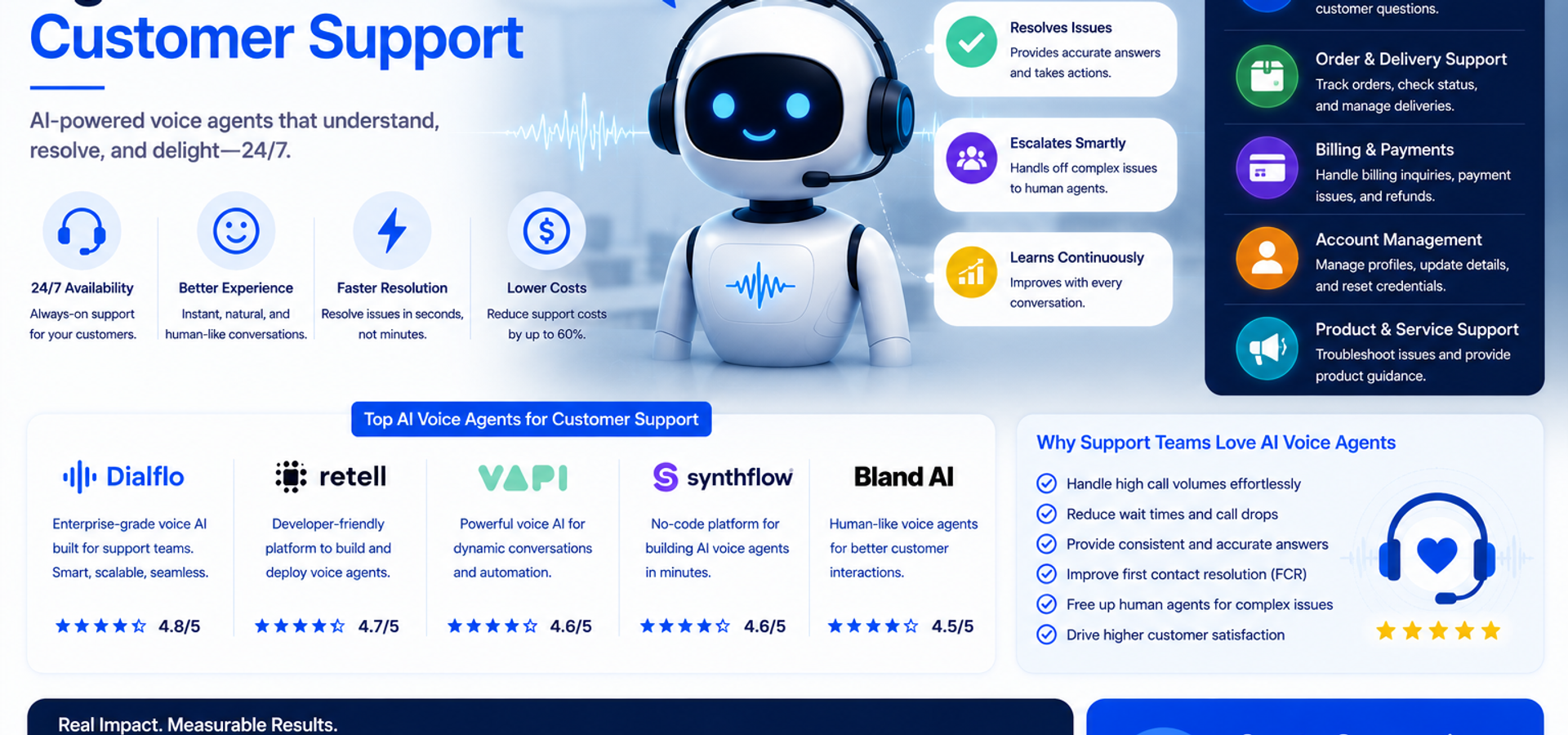
“Press 1 for billing. Press 2 for status. Press 0 for a human who will ask you to repeat everything.” That is still the default support experience, and why buyers hunting the best AI voice agents for customer support are really hunting for resolution, not novelty.
This guide shows how to evaluate AI customer support on the phone, which intents to automate first, and how to compare platforms without falling for sandbox theater.
What “best” means for AI customer support
Best is not the most human-sounding voice. Best is the agent that:
- contains routine intents without trapping callers
- writes outcomes into helpdesk or CRM
- warm-transfers with context when judgment is required
- stays stable when volume spikes
- proves ROI in abandon rate, ASA, and cost per resolved contact
If a vendor wins the accent demo and loses the write-back test, they are not “best” for support, they are best for slide decks.
Why voice still matters in AI customer support
Contact centers continue to shift routine interactions toward conversational AI. Gartner has projected that this will cut agent labor costs by $80 billion in 2026, which raises the bar for phone automation that can actually finish work.
McKinsey estimates that customer operations is one of four business functions that together account for about 75% of generative AI's potential value, much of it from automating repetitive status, FAQ, and confirmation work that clogs support queues.
Chatbots help digital-first users. Voice agents meet the customers who still call, and the ops teams measured on phone SLAs.
The phone is not going away either. In McKinsey's customer service research, 71% of Gen Z respondents and 94% of baby boomers said live calls are the quickest and easiest way to reach customer care, and 57% of care leaders expect call volumes to rise.
Unique angle: score agents on closed-loop support, not open chat
Open-ended “talk about anything” bots entertain demos. Support leaders need closed loops:
- detect intent
- authenticate or identify within policy
- fetch truth from CRM, OMS, TMS, or helpdesk
- resolve or capture a structured ticket
- escalate with a summary when rules say stop
That loop is the difference between AI customer support and a smarter IVR. For the IVR contrast, see how resolution differs from routing in production phone stacks, and demand the same discipline when you shortlist voice agents.
High-ROI support intents for voice AI
Pilot where volume is high and ambiguity is low:
- Order / shipment status: especially logistics-heavy brands; see AI in logistics use cases
- Appointment confirm / reschedule: clinics, services, field teams
- Ticket or case lookup: “what’s the status of my request?”
- Simple billing FAQs: due date, last payment, portal pointers (not disputes)
- After-hours intake: capture issue, urgency, callback window
- Peak overflow: when queues breach wait thresholds
Adjacent high-volume phone work in hiring and screening uses the same pattern, structured questions, write-back, escalate exceptions. Lessons transfer from AI in recruitment and AI applicant screening.
Evaluation checklist for the best AI voice agents
- Containment by intent: not blended vanity rates
- Helpdesk/CRM write-back: ticket created or updated every time
- Warm transfer quality: agent hears context, not a cold dump
- Barge-in & latency: real mobile networks, real accents
- Identity & policy guardrails: no improvising refunds
- Overflow triggers: wait time, occupancy, after-hours schedules
- Analytics: failure reasons you can act on weekly
- India / local calling fit: if that is your market reality
Run this checklist live. Category comparisons like Vapi vs Bland vs Retell for India and Retell vs Dialflo vs Vapi help you see which layers are productized versus left as homework.
Build, buy, or assemble for support?
Support teams rarely have spare MLOps capacity when CSAT is on fire. Assembling STT + LLM + TTS + CPaaS yourself maximizes control and incident load.
Buying a production platform maximizes time-to-SLA recovery, if write-back and escalation are native. Use build vs buy as the decision frame, then pressure-test pricing only after capability is proven (Retell vs Dialflo pricing).
Operating model: hybrid or it fails
The best deployments treat voice AI as a frontline for repetitive volume and humans as the judgment layer. Design stop conditions before go-live:
- customer asks for a person twice
- sentiment / abuse thresholds
- auth failure
- policy exceptions (refunds, cancellations, legal)
- unknown intent after one clarify turn
Agentless fantasies create viral complaints. Hybrid models protect brand and burnout.
30-day pilot plan for AI customer support
Week 1: Pick one intent, map data fields, define transfer rules and success metrics.
Week 2: Shadow or limited hours; compare outcomes to agent truth.
Week 3: Turn on for one queue or after-hours window; watch abandon and containment.
Week 4: Fix prompts and data gaps; decide scale, pause, or stop.
One resolved intent beats ten half-wired “AI support” experiments.
What to avoid when buying
- Accent demos without CRM write-back
- No warm-transfer path on day one
- Automating angry retention before status FAQs
- Scaling minutes before containment is stable
- Ignoring consent and recording rules in your market
FAQs
What are the best AI voice agents for customer support?
Those that resolve routine phone intents with write-back, warm transfer, low latency, and clear containment metrics. Score production loops, not sandbox voices.
How is AI customer support different from chatbots?
Voice agents must handle telephony, interruptions, identity, and live handoff for callers who never open the app. Chat covers digital; voice covers the phone SLA.
Which support calls should AI handle first?
Status, confirms, simple FAQs, ticket lookup, after-hours intake, and overflow. Keep disputes, retention saves, and irreversible actions with humans.
Can voice AI replace support agents?
No. Hybrid wins: AI clears repetitive volume; humans keep empathy and exceptions. Escalation is part of the product, not an afterthought.
How do we evaluate vendors fairly?
Live call, real systems, forced transfer, latency on your network, containment by intent. Reject demo-only proof.
How does Dialflo help?
Dialflo runs production support and ops voice agents with structured write-back and human escalation, so after-hours and peaks stop breaking SLAs.
A light next step
If you are shortlisting the best AI voice agents for customer support, ignore the accent contest and run the closed-loop checklist on one real intent. When you want that pilot production-ready, with overflow, write-back, and warm transfer, talk to Dialflo and ship one queue that finally resolves.