Automated Load Status Updates in Your TMS via Phone Bots

Dialflo: AI Voice Agent
June 11, 2026
Your TMS shows the load in transit. The shipper’s portal still says “picked up yesterday.” The carrier called with a new ETA twenty minutes ago, but nobody logged it yet because three coordinators are on hold with other status checks. Operations teams spend hours on repetitive calls that should end as structured data inside the TMS, not sticky notes and memory.
Automated load status updates inside logistics TMS via phone bots close that loop: conversational voice agents place and receive calls, pull load truth from the TMS, and write location, ETA, and appointment updates back, without a human retyping every conversation. This guide covers what to automate, how TMS integration works across platforms, and how to pilot without losing exception judgment.
What “load status update” means inside a logistics TMS
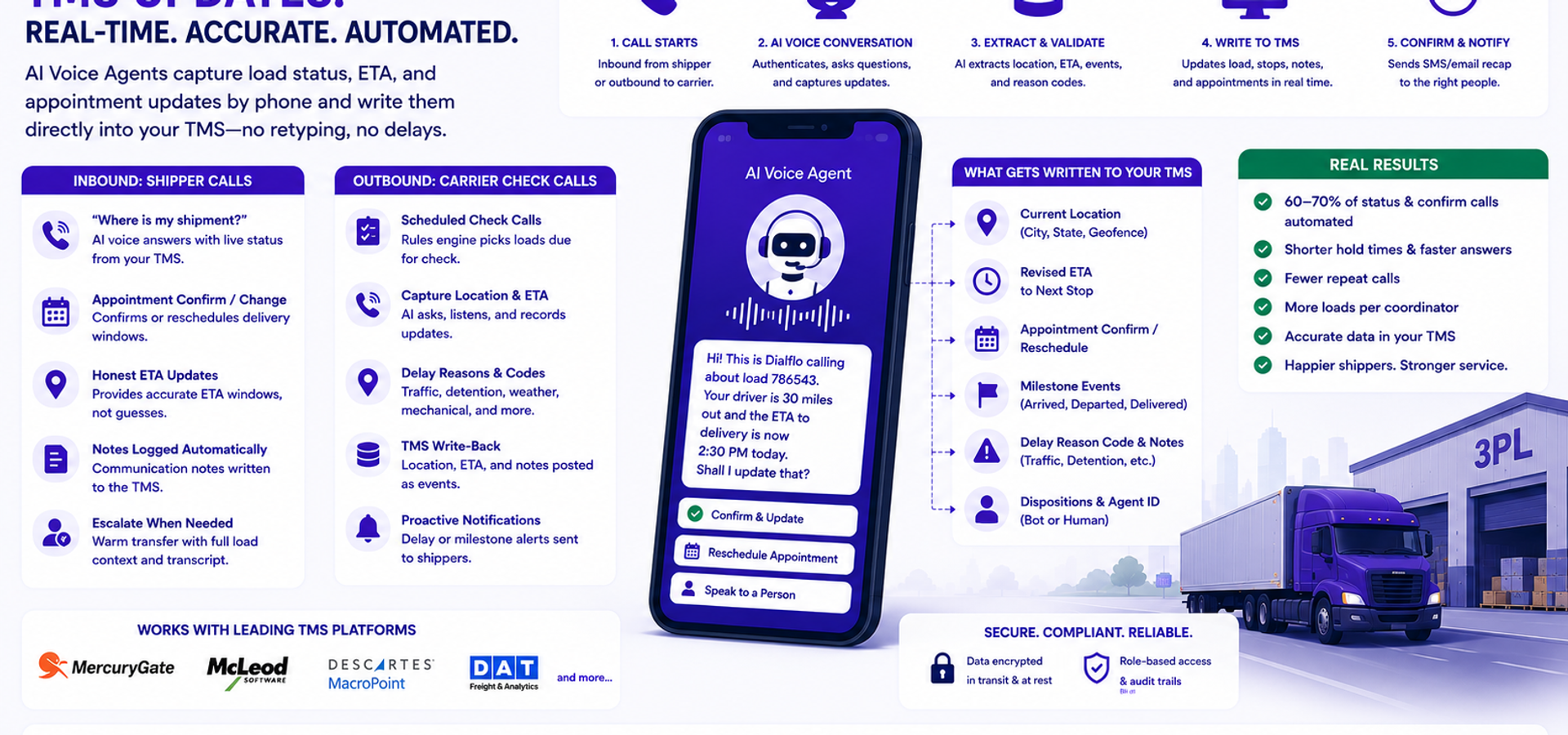
A load status update is any change to what the TMS knows about freight in motion:
- current location (city, state, geofence event)
- revised ETA to next stop
- pickup or delivery appointment confirm / reschedule
- milestone events (arrived shipper, departed consignee, delivered)
- delay reason codes (traffic, detention, weather, mechanical)
- communication notes from shipper or carrier calls
When updates live only in phone conversations, portals lag, shippers call again, and dispatch enters a dial-and-log spiral. Phone bots make the call and the TMS record the same event.
Why manual status logging breaks at volume
Status calls scale faster than headcount because:
- every shipper expects proactive ETA when appointments slip
- carriers call inbound with updates coordinators must re-enter
- check-call schedules multiply with lane count and stop count
- after-hours rings become morning backlog
- notes typed late are notes shippers never saw on the portal
Broader call-volume context: AI voice agents for thousands of routine logistics calls, where is my shipment calls, and reducing dispatcher call load by 70%.
Inbound vs outbound: two halves of TMS status automation
Inbound (shipper or customer calls): Phone bot authenticates by PRO, BOL, PO, or account number, reads stop sequence and last event from TMS, states honest ETA window, logs communication note, escalates on stale data or VIP flag.
Outbound (carrier check calls): Rules engine pulls loads due for check from TMS, bot calls carrier or driver, captures location and ETA in natural language, writes check-call note and revised ETA to load or stop record.
Proactive outbound reduces inbound storms, that is core dispatch automation. Exception design: reducing delivery exception calls before ops. 3PL follow-up scale: scaling 3PL customer follow-ups.
TMS integration patterns phone bots use
Most logistics TMS platforms support integration via REST/SOAP APIs, web services, or middleware. Phone bot adapters typically implement:
Read paths: load ID, stops, appointments, carrier contact, current status, last tracking event, shipper references.
Write paths: tracking event, check-call note, ETA revision, appointment confirm flag, delay code, disposition metadata.
Platform-specific depth varies. Examples from dedicated integration guides:
Stack planning: build vs buy voice AI stack, technology used in supply chain management, and the logistics decision gap.
Status update tiers: what phone bots automate first
Tier 1: full automation: Inbound “where is my load,” appointment confirm readout, outbound in-transit location/ETA check, standard delay notification.
Tier 2: triage then transfer: Delivery exception intake, partial OS&D report, angry caller de-escalation start.
Tier 3: human only: Detention negotiation, re-power, safety events, contract disputes, strategic accounts.
Conversational layer: conversational services use cases and replacing phone trees with conversational voice AI.
Fields phone bots should write into the TMS
Automation only works if the TMS stays the system of record. Minimum write-back set:
- event or note timestamp
- disposition code (confirmed, delayed, no-answer, transferred)
- current location or last known city/state
- revised ETA to next stop
- appointment confirm or requested new window
- delay reason code + short narrative
- agent ID (human or bot) for reporting
- optional transcript or recording reference
If write-back lags, repeat caller rate spikes, that is a data signal, not a voice-quality signal. Related: hidden cost of missed calls in logistics.
Architecture: phone bot ↔ logistics TMS
- Telephony: Inbound lines and outbound dialer for scheduled check calls.
- Voice orchestration: Scripts, NLU, authentication, warm transfer.
- TMS adapter: API client with field mapping, rate limits, retry logic.
- Rules engine: Which loads trigger outbound; which statuses block auto-answer.
- Observability: Containment, note lag, API errors, repeat callers.
Broader AI map: AI in logistics use cases and AI supply chain technology trends.
Four-week pilot for TMS status phone bots
Week 1: Baseline and TMS discovery
Count inbound status vs outbound check-call volume. Document available TMS read/write endpoints. Pick one high-volume, low-complexity lane.
Week 2: Read-only inbound
Phone bot answers status from TMS lookup. Humans review suggested notes before write-back is enabled.
Week 3: Outbound check calls + write-back
Enable one scheduled check-call type with structured TMS posting. Warm transfer on detention, breakdown, refused.
Week 4: Expand or fix data
If repeat callers spike, fix carrier update sources. If containment holds, add lanes or after-hours inbound.
Peak surge patterns: peak season call volume without hiring dispatchers.
Metrics for automated TMS status updates
- TMS API read/write success rate
- time from call end to status event or note posted
- tier-one containment (no human transfer)
- repeat caller rate within two hours
- inbound answer rate and average handle time
- loads or orders per coordinator
- shipper status-call complaint volume on pilot lane
Industry context: J.D. Power business research on transportation customer experience; freight data from BTS statistical products.
Common failure points (and fixes)
Stale TMS data: Phone bots amplify bad inputs, fix carrier check-call cadence and ELD feeds upstream.
Custom field mapping drift: Version your adapter when TMS tenants add shipper-specific fields.
Over-automating exceptions: Detention and re-power need humans, script escalation keywords early.
No after-hours handoff: Night bot updates must appear in morning queue with clear transfer flags.
Notes without structure: Use disposition codes plus short text for reporting and billing audit.
AR and billing: adjacent TMS phone workflows
Status calls are not the only TMS-adjacent phone load. Payment reminder bots reduce coordinator overlap: automating freight payment reminder calls and manual AR follow-up hidden costs.
Where Dialflo fits
Dialflo delivers automated load status updates inside logistics TMS via phone bots, inbound shipper status, outbound carrier check calls, appointment confirm, and proactive delay, with TMS API read/write, warm transfer, and structured audit trails.
Pilot one lane on dialflo.ai when call volume outpaces note entry and your TMS holds the truth but shippers still call because portals lag.
FAQ: TMS load status automation via phone bots
What gets updated in the TMS?
Location, ETA, appointments, delay codes, and communication notes on load or stop records.
Which TMS platforms work?
Most with API or web-service access, integration depth varies by tenant.
What automates first?
Inbound status and outbound in-transit check calls on high-volume lanes.
Do phone bots replace dispatch?
No, tier-one automation; humans on exceptions.
How long to pilot?
Often 2–4 weeks with read-only before write-back.
How does Dialflo help?
Phone bots with TMS integration for load status, see dialflo.ai.
Closing: calls should become TMS events
Logistics operators do not win by answering the same status question five hundred times a month and typing notes an hour later. They win when every conversation becomes an automated load status update TMS records immediately, phone bots for tier-one volume, humans for detention, re-powers, and the loads that actually cost margin.
Ready to automate status updates inside your TMS? Explore Dialflo for phone bots built for logistics operations at scale.