Dialflo vs Call Center BPO for Tier-1 Support

Dialflo: AI Voice Agent
August 20, 2026
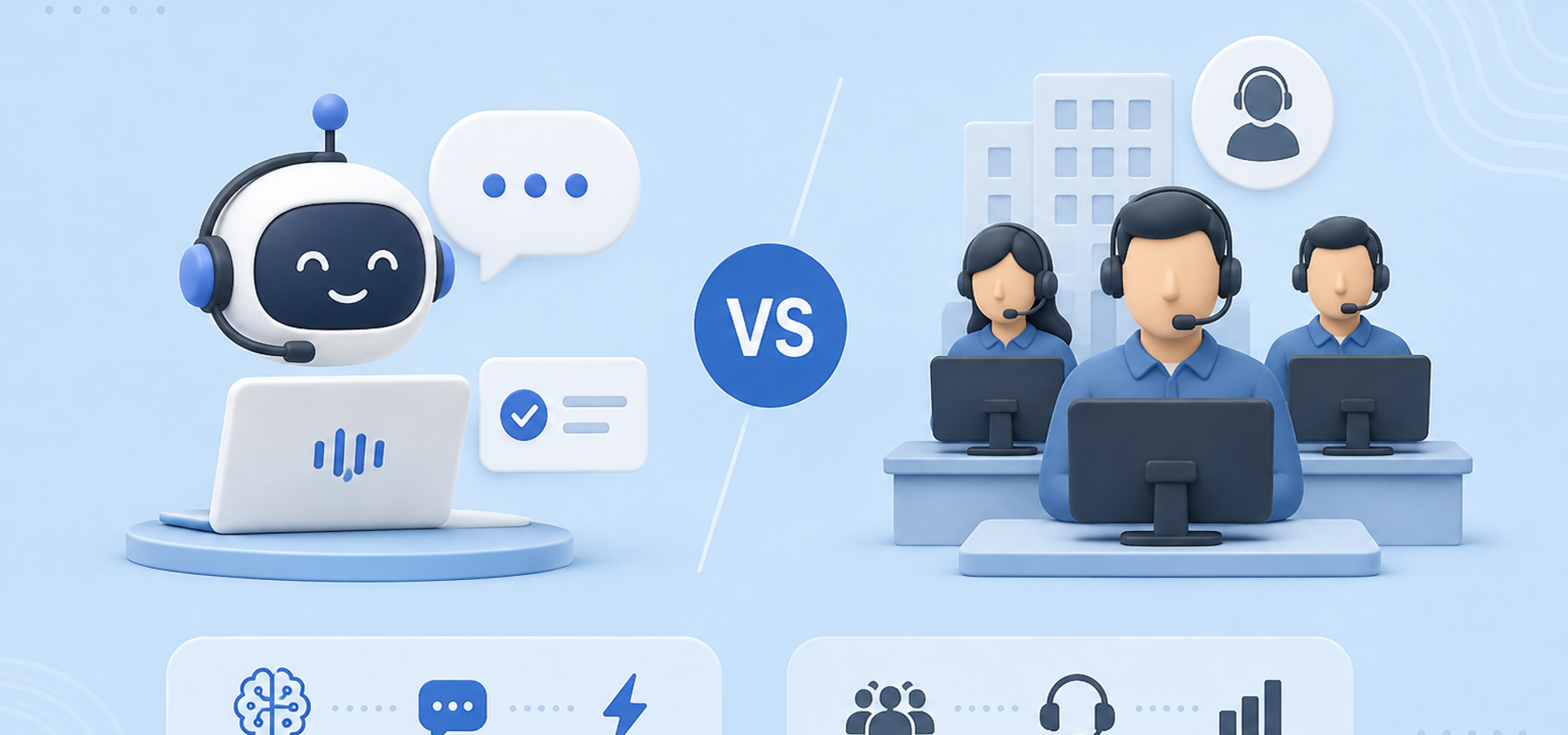
For many businesses, Tier-1 customer support is still handled the traditional way: hire an internal team or outsource the work to a call center BPO.
That model works, but it becomes difficult when call volumes fluctuate, customers expect faster responses, or the business needs support outside standard working hours.
AI voice agents introduce another option.
Instead of hiring more agents or increasing BPO capacity, businesses can automate repetitive Tier-1 phone conversations with an AI voice agent and route complex issues to human teams.
This makes the comparison between Dialflo vs call center BPO less about choosing between "AI and humans" and more about deciding which tasks should be automated and which require human intervention.
For businesses evaluating the two approaches, the right choice depends on call volume, conversation complexity, operating hours, integration requirements, and the cost of each resolved interaction.
What Is Tier-1 Support?
Tier-1 support generally handles the first level of customer interaction.
Typical requests include:
- Order or shipment status
- Appointment confirmations
- Basic account questions
- Frequently asked questions
- Service availability
- Information requests
- Basic troubleshooting
- Call routing
- Status updates
- Scheduling
- Follow-up calls
These conversations are often repetitive and follow predictable workflows.
For example, a logistics customer might call:
"Where is my shipment?"
A Tier-1 agent can check the relevant system, provide the status, and escalate the issue if something has gone wrong.
A similar workflow can be automated using an AI voice agent.
This is where Dialflo becomes an alternative to traditional call center outsourcing.
Dialflo vs Call Center BPO: The Basic Difference
A call center BPO primarily provides people to handle conversations.
Dialflo provides AI voice agents that automate conversations and business workflows.
That distinction affects almost every part of the buying decision.
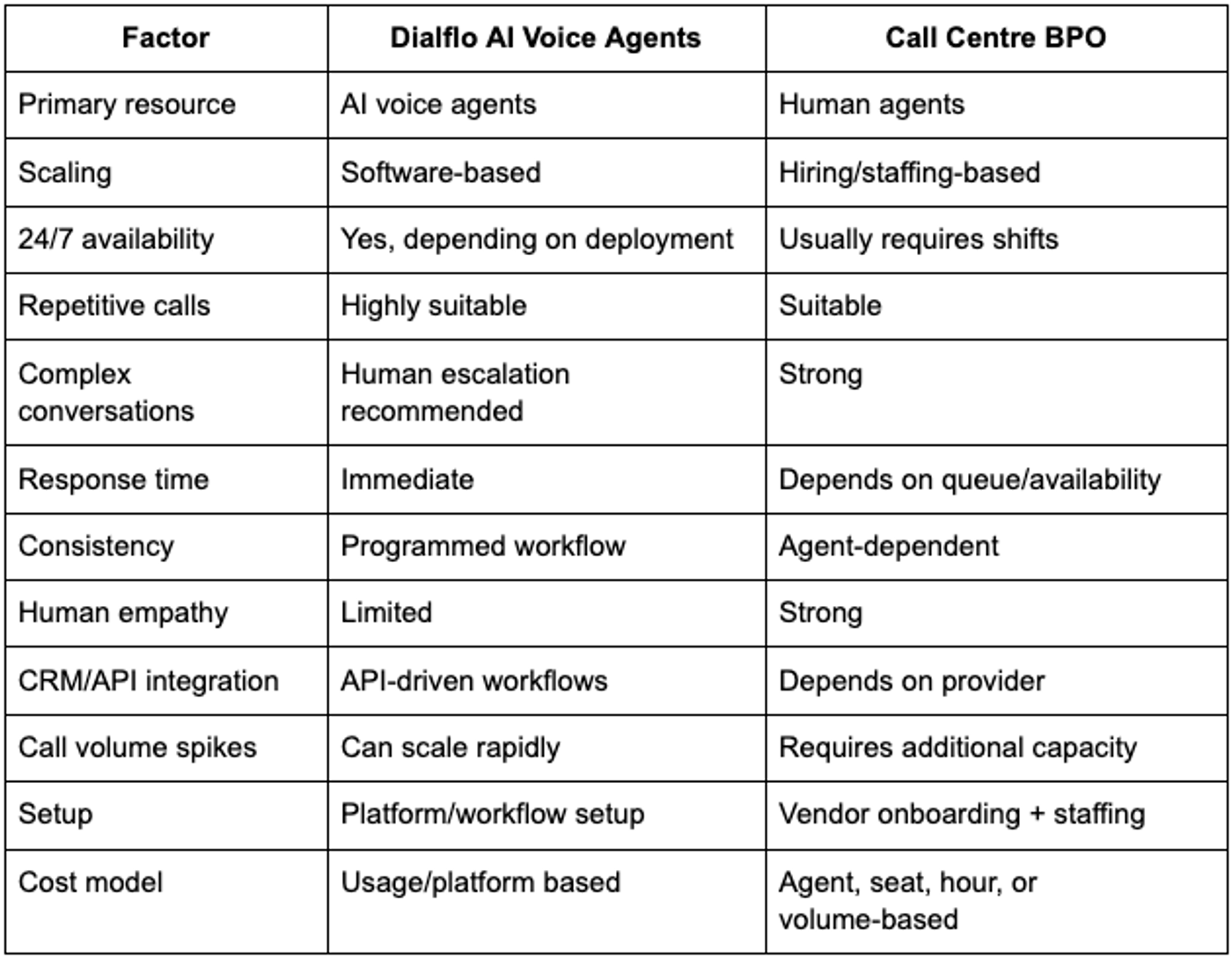
The biggest difference is that a BPO scales by adding people, while AI voice automation can scale by increasing software capacity.
1. Cost: AI vs Human Agents
Cost is usually the first reason businesses investigate outsourcing.
But comparing the hourly cost of a BPO agent with the per-minute cost of an AI voice agent doesn't tell the whole story.
A BPO contract can include:
- Agent salaries
- Recruitment
- Training
- Team management
- Quality assurance
- Workforce management
- Infrastructure
- Shift premiums
- Management fees
- Vendor margins
AI voice automation has a different cost structure.
Depending on the platform and implementation, businesses may pay for:
- Voice minutes
- AI processing
- Telephony
- Platform usage
- Integrations
- Development or setup
The important metric is therefore not simply:
Cost per minute
It is:
Cost per successfully resolved support interaction
For highly repetitive Tier-1 calls, automation can make the economics attractive because the same workflow can handle many conversations without requiring another human agent for every additional interaction.
Gartner has projected that conversational AI will cut contact center agent labor costs by $80 billion in 2026, mostly by taking over routine interactions like these.
2. Scalability During Call Spikes
BPOs are effective when call volume is reasonably predictable.
The problem comes when demand suddenly increases.
Examples include:
- Product launches
- Holiday periods
- Shipping peaks
- Billing cycles
- Service outages
- Marketing campaigns
- Seasonal demand
A BPO may need additional agents, overtime, or temporary staffing.
AI voice agents can handle increased call volume without requiring the same recruitment and training cycle.
This is particularly relevant for logistics and operations teams.
Dialflo's content covers how businesses can use voice AI to manage peak-season call volumes without continuously expanding their dispatcher or support teams. See how to handle peak season logistics call volume without hiring dispatchers.
The underlying principle is applicable beyond logistics:
Don't build permanent headcount around temporary call-volume spikes.
3. Response Time
A customer calling a support number generally wants one thing:
A response now.
With a BPO, customers may encounter:
- Queues
- Hold times
- Agent availability issues
- Shift limitations
- Call transfers
AI voice agents can answer immediately when properly deployed.
There is no traditional queue of human agents waiting to become available.
This makes AI particularly useful for straightforward requests where customers don't necessarily need to speak with a person.
For example:
"Can you confirm my delivery appointment?"
If the AI can securely access the relevant information, the conversation can be resolved without placing the customer into a support queue.
Businesses looking to reduce wait times can also explore how to reduce hold times without expanding headcount.
4. 24/7 Support
A BPO can provide round-the-clock support, but doing so typically requires multiple shifts and additional staffing.
AI voice agents can operate continuously without traditional shift scheduling.
This can be useful for businesses with:
- International customers
- After-hours inquiries
- Overnight operations
- Weekend demand
- Emergency notifications
- Global logistics
For example, a logistics company may receive a shipment-status call at 2 AM.
Instead of forcing the customer to wait until the next business day, an AI voice agent can potentially handle a routine status request immediately.
Dialflo has explored this use case in how logistics companies use 24/7 voice AI for after-hours shipment status calls.
5. Consistency of Responses
Human agents can deliver excellent customer service.
But humans can also vary in how they handle the same question.
One agent may explain a policy in detail.
Another may provide a shorter answer.
A third may forget to collect an important piece of information.
An AI agent can follow the same approved workflow every time.
For Tier-1 support, this can be a significant advantage.
The business can define:
- What the AI should ask.
- What information it can provide.
- Which systems it can access.
- Which actions it can perform.
- When it should escalate.
- What information should be recorded.
That creates a more standardized support experience.
6. Human Empathy and Complex Problems
This is where BPOs have a clear advantage.
Some customer interactions require judgment, empathy, negotiation, or nuanced problem-solving.
Examples include:
- Angry customers
- Complex billing disputes
- Service complaints
- Sensitive account issues
- Escalations
- Exceptions to company policy
- High-value customer conversations
A human agent can understand emotional context and make decisions that fall outside a predefined workflow.
An AI voice agent should therefore not be viewed as a replacement for every Tier-1 or Tier-2 conversation.
A better model is:
AI handles predictable conversations → Human handles complex conversations
The AI can also transfer a conversation when predefined escalation criteria are met.
7. Integration With Business Systems
A BPO may require access to the company's systems, training, documentation, and workflows.
An AI voice platform can instead integrate directly with business applications through APIs and other integrations.
This is especially useful when the support call requires real-time information.
For example:
Customer calls → AI identifies customer → checks CRM → retrieves shipment status → provides answer → records outcome
For logistics organizations, this can connect voice conversations directly to TMS workflows.
Dialflo provides content around automating inbound carrier tracking queues for freight brokerages and automated load-status updates using logistics TMS phone bots.
The more structured the underlying workflow, the stronger the case for automation.
8. Training and Knowledge Management
BPO agents need to be trained before handling customer conversations.
When policies or products change, training materials may also need to be updated.
This creates an ongoing knowledge-management requirement.
With an AI voice agent, the business can update the agent's knowledge and workflow instructions centrally.
For example, if a company changes its:
- Return policy
- Delivery process
- Appointment rules
- Pricing information
- Escalation criteria
The AI workflow can be updated without conducting a traditional training session with every agent.
However, this doesn't mean AI knowledge management is automatic.
Businesses still need processes for:
- Reviewing information
- Testing responses
- Approving changes
- Monitoring conversations
- Preventing incorrect answers
Automation reduces the operational burden, but governance remains important.
9. Quality Assurance
BPO quality assurance often involves supervisors reviewing a sample of recorded calls.
AI systems can provide a different approach.
Every automated conversation can potentially generate structured data such as:
- Call outcome
- Duration
- Intent
- Customer response
- Escalation reason
- Sentiment indicators
- Workflow completion
- Extracted fields
This makes it easier to identify patterns across large volumes of conversations.
Instead of asking:
"How did our agents perform this week?"
The business can ask:
"What are customers calling about most often?"
"Which workflows are failing?"
"How many calls required human escalation?"
"Which questions are not being answered successfully?"
That information can improve both the AI workflow and the underlying support process.
10. Customer Experience
The biggest mistake businesses can make is assuming that AI is automatically better for customers.
It isn't.
The customer experience depends on the use case.
AI works well when the customer wants:
- A quick answer
- A status update
- A confirmation
- A simple change
- Basic information
- Appointment scheduling
Human agents are often better when the customer needs:
- Empathy
- Negotiation
- Detailed troubleshooting
- A complex explanation
- An exception
- Escalation
The best Tier-1 support strategy combines both.
Customers still want the phone for this. In McKinsey's customer service research, 71% of Gen Z respondents and 94% of baby boomers said live calls are the quickest and easiest way to reach customer care.
Where Dialflo Fits
Dialflo is built around AI-powered voice automation for business workflows, allowing organizations to automate repetitive inbound and outbound conversations while integrating voice interactions with business systems.
Its platform is particularly relevant for workflows where conversations are structured and repetitive.
Examples include:
- Shipment tracking
- Carrier calls
- Appointment scheduling
- Customer follow-ups
- Lead qualification
- Payment reminders
- Recruiting calls
- Support requests
Businesses can also explore AI voice agents for customer support to understand where conversational voice automation can fit into support operations.
For businesses already using traditional call-center processes, the question doesn't have to be whether to replace the BPO completely.
A hybrid model can often make more sense.
The Hybrid Model: AI + BPO
One of the strongest approaches is to use AI and human agents together.
Consider this workflow:
Customer call
↓
AI answers
↓
AI identifies intent
↓
Routine request?
→ Yes: AI resolves it
→ No: Transfer to human
This changes the role of the BPO.
Instead of paying human agents to handle every call, the business can send them the calls that actually require human intervention.
For example, an AI agent could handle:
- Shipment status
- Delivery confirmation
- Appointment scheduling
- Basic FAQs
- Order updates
While human agents handle:
- Complaints
- Exceptions
- Escalations
- Complex account issues
- High-value customers
This can reduce the volume reaching the BPO without eliminating the human support layer.
The direction of travel is clear: Gartner predicts that agentic AI will autonomously resolve 80% of common customer service issues without human intervention by 2029, which leaves human agents with the harder 20%.
When Should You Choose Dialflo?
Dialflo is potentially a stronger fit when:
- A large percentage of calls are repetitive.
- Call volume changes significantly throughout the day.
- Customers need 24/7 access.
- Your workflows are well-defined.
- Your systems have APIs or integrations.
- You want to automate routine calls.
- You want to reduce human agent workload.
- You need faster response times.
- You want structured call data.
- You want to scale without adding equivalent headcount.
When Should You Choose a BPO?
A traditional BPO can make more sense when:
- Calls require significant human judgment.
- Customers frequently need empathy.
- Workflows are unpredictable.
- Your business has complex exception handling.
- Customers regularly negotiate or dispute issues.
- Human interaction is central to your brand.
- You need agents to perform tasks that cannot yet be reliably automated.
BPOs also remain useful when a business does not have sufficiently structured processes to automate.
When Should You Use Both?
For many companies, this is the most practical answer.
Instead of:
AI vs BPO
Think:
AI + BPO
AI becomes the first layer of support.
The BPO becomes the escalation layer.
This can create a more efficient operating model:
Tier-1 repetitive calls → AI
Complex Tier-1 calls → Human
Tier-2 issues → Specialist
Critical issues → Internal team
This approach allows businesses to automate volume without sacrificing human support where it matters.
The Bottom Line
The Dialflo vs call center BPO decision isn't really about whether AI is better than people.
It is about matching the right resource to the right conversation.
If your support team spends a large part of its day answering repetitive questions, checking statuses, scheduling appointments, making follow-up calls, or routing customers, AI voice automation can take a significant amount of that workload off human agents.
If the conversation requires empathy, judgment, negotiation, or complex problem-solving, humans still have a major advantage.
For many SMBs and mid-market businesses, the strongest model is therefore:
AI for volume. Humans for complexity.
That approach can reduce repetitive workload, improve response times, provide support outside traditional working hours, and allow human support teams to spend more time on conversations where their expertise actually matters.
The goal isn't to eliminate the call center.
The goal is to make sure your human agents aren't spending their day answering calls that an AI voice agent could resolve in seconds.
Frequently asked questions
What is tier-1 support?
The first line of customer support: order status, account questions, appointment changes, basic troubleshooting, and other routine requests that follow a known script or policy.
Is an AI voice agent cheaper than a BPO for tier-1 calls?
For routine, repetitive calls it usually is, because AI costs scale with usage rather than headcount and training. Complex, emotional, or high-value conversations still justify trained human agents.
Can Dialflo work alongside our existing BPO?
Yes. Many teams use a hybrid model: Dialflo answers routine tier-1 calls and transfers complex ones to BPO or in-house agents with the conversation context attached.
How do we decide which calls to move to AI first?
Pull a month of call data, group calls by intent, and start with high-volume intents that have clear answers in your systems, such as order status or appointment confirmation.
Want to see which tier-1 calls an AI agent could resolve for you? Book a Dialflo demo.