Handle Peak Season Logistics Calls Without More Dispatchers

Dialflo: AI Voice Agent
June 4, 2026
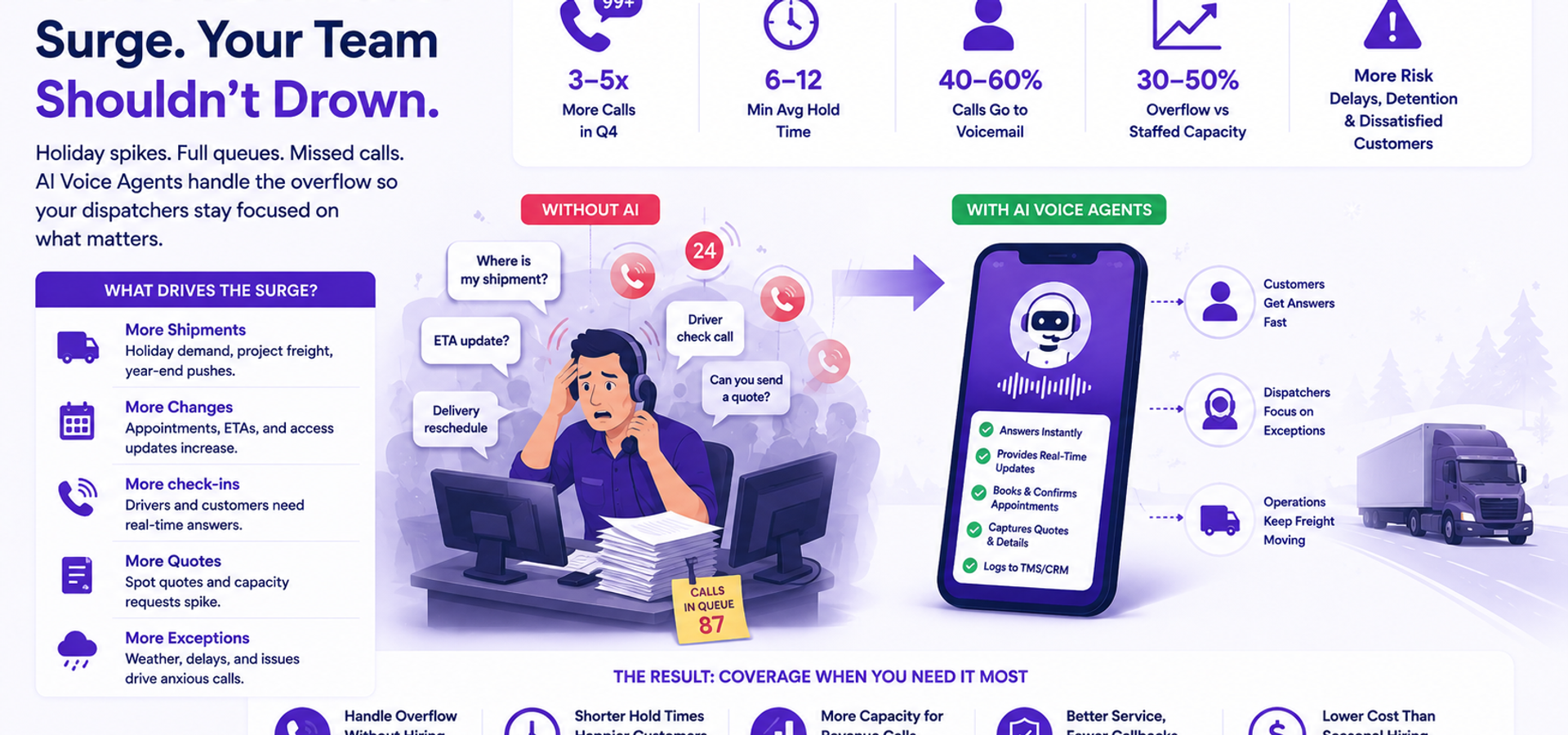
Black Friday week hits and your hold music plays longer than your safety briefing. A coordinator answers three where is my shipment calls while a driver waits on line four. Sales forwards a spot quote that will ring busy signal in twenty minutes. That is peak season logistics calls in the wild, not a training issue, a math issue.
Holiday spikes and seasonal surges overwhelm dispatch teams every year. The default fix is seasonal hiring, but recruiting, onboarding, and TMS access for temp coordinators takes weeks you do not have in Q4. This guide explains why logistics staffing challenges peak in transportation operations, how freight dispatch automation absorbs logistics call overflow, and how voice AI logistics lets you handle surges without adding dispatcher headcount.
Why peak season breaks the phone queue first
Freight volume rises in predictable waves, retail holidays, produce seasons, fiscal year-end project pushes. The National Retail Federation tracks holiday consumer demand that ripples into LTL, parcel, and dedicated lanes. More loads mean more status checks, more appointment changes, and more driver check calls per coordinator.
At the same time, transportation operations get less forgiving: detention clocks run, warehouses compress dock windows, and weather stacks delays. Portals lag; customers call. If your desk was sized for average Tuesday volume, November and December become logistics call overflow, even when trucks are moving.
The staffing trap: hiring dispatchers for a twelve-week spike
Logistics staffing challenges in peak season follow a painful pattern:
- Slow hiring: Experienced coordinators are scarce; temps need weeks to trust your TMS.
- Quality risk: New hires misquote accessorials or misread appointment rules under pressure.
- January cliff: You pay for seats that go quiet when volume normalizes.
- Knowledge drain: Seasonal staff leave; repeat callers relearn your process next year.
The American Trucking Associations notes ongoing driver and operations workforce pressure across the freight economy, adding phone staff does not add trucks, but it does add payroll and training load. See context in ATA news and insights. Many leaders need capacity for peak season logistics calls without a permanent headcount step-change.
What drives peak season logistics calls (the repeat offenders)
Not every ring is unique. During surges, the same intents dominate, similar to the breakdown in why dispatch spends half the day on where is my shipment calls:
- ETA and status: “Is it still on track for today?”
- Appointment confirm or change: Dock reschedules, lumper questions, access codes.
- Driver check calls: Location, hours, next stop instructions.
- Quote and capacity intake: Spot freight, especially for brokers.
- Exception anxiety: Weather, customs, missed pickup, needs calm facts fast.
These are exactly the calls that drown humans during peaks, and the best candidates for freight dispatch automation when tied to TMS truth.
The overflow layer: how voice AI logistics absorbs surge calls
Think of coverage in two tiers:
Tier one (automate): Read status from TMS, confirm windows, log check calls, intake quotes with structured fields, send SMS recap.
Tier two (humans): Claims, hazmat, rate exceptions, angry escalations, carrier negotiations, anything safety-critical.
That is how voice AI logistics absorbs logistics call overflow without pretending AI runs your network. Dispatchers stay on judgment; automation eats the repetitive rings that multiply when volume spikes. Deeper patterns live in AI in logistics use cases and conversational services use cases.
Freight dispatch automation that actually helps coordinators
Automation fails when it is only voicemail with extra steps. Useful freight dispatch automation during peak:
- answers on your published line with clear disclosure and instant human transfer
- looks up load, PRO, or account in TMS before asking redundant questions
- states ETA windows honestly when data is stale, escalates instead of guessing
- books or confirms appointments within your rules
- captures spot quote fields for sales callback with priority flags
- writes disposition and notes to CRM/TMS, not a personal cellphone
Upstream planning AI does not answer a driver at the gate. Pair forecasting tools discussed in machine learning supply chain optimization with voice at the edge, see the logistics decision gap in AI operations for why coordination breaks when only dashboards improve.
Peak season playbook: four weeks before the surge
Week 1: Measure overflow, not vanity answer rate
Count abandoned calls, average hold time, and voicemail left during last year’s peak week if you have logs. Add morning callback queue depth, often the hidden tax described in the hidden cost of missed calls in logistics.
Week 2: Script tier-one flows
Pick three intents: status/ETA, appointment confirm, driver check call. Connect read-only TMS lookups first; validate accuracy before automating writes.
Week 3: Route overflow to voice AI
Send busy-queue or after-hours traffic to the agent. Keep coordinators on exceptions. Compare answer rate and repeat caller rate within two hours, repeat rings usually mean wrong ETAs, not tone.
Week 4: Load-test before Black Friday
Simulate concurrent calls; confirm warm-transfer context reaches humans. Expand to quote intake only if dispositions land in CRM cleanly.
Integration: peak automation must survive Monday morning
Overflow fails if coordinators re-ask every question at shift start. Define before peak:
- which call types AI resolves vs escalates
- which TMS fields update automatically
- how sales receives quote intake tickets
- how safety events bypass scripts immediately
Broader stack context: technology used in supply chain management, AI supply chain technology trends, and AI inventory optimization for planning layers that should not compete with dispatch phones for budget.
Metrics that prove peak coverage worked
- overflow answer rate vs baseline hold time
- tier-one containment rate (resolved without human)
- morning callback queue depth at day shift start
- repeat caller rate within two hours
- OTIF and detention (ensure automation did not hurt service)
- coordinator hours on status readouts vs exceptions
The U.S. Bureau of Transportation Statistics publishes freight and transportation indicators useful for benchmarking seasonal volume, see BTS newsroom and data releases when you set year-over-year call targets.
Build vs buy for peak voice coverage
Holiday week is the wrong time to stitch telephony APIs in production. If engineering is tempted to DIY, read build vs buy voice AI stack for maintenance reality, latency, carrier changes, and prompt regressions do not pause for retail calendars.
Where Dialflo fits: AI absorbs overflow calls
Dialflo provides AI voice agents built for logistics overflow: tier-one peak season logistics calls, status, check calls, appointments, quote intake, with structured write-back to your ops stack. It is not a TMS replacement; it is the layer that answers when coordinators are on exception calls or when volume exceeds staffed lines.
Use Dialflo when seasonal hiring cannot keep pace, when logistics call overflow drives hold times and voicemail, and when you want transportation operations to enter January without a dispatcher layoff cycle. Confirm integrations and pilot scope on dialflo.ai. Sustainable service expectations also push always-on coordination, see how AI makes supply chains more sustainable.
FAQ: peak season logistics calls
Why do logistics calls spike in peak season?
More shipments, more ETA changes, and more portal distrust drive status and appointment calls at once, often faster than hiring can fix.
Can we handle peak volume without hiring dispatchers?
Yes, with an overflow layer for tier-one calls and humans on exceptions, automation plus judgment, not automation alone.
What is logistics call overflow?
Inbound volume your staffed lines cannot answer without long holds or voicemail, common when load count jumps but headcount stays flat.
Does voice AI replace dispatchers?
No. It absorbs repetitive first responses and logs outcomes; coordinators keep routing, negotiation, and safety escalations.
How fast can we deploy before holidays?
Many teams run a 2–4 week pilot on one queue or after-hours lane, then expand for peak windows.
How does Dialflo help?
AI voice agents absorb overflow with TMS-aware answers and write-back, see dialflo.ai.
Closing: peak season is a coverage design problem
Peak season logistics calls will always outrun spreadsheets and heroic overtime. The winning pattern is not always more dispatchers, it is freight dispatch automation that absorbs logistics call overflow while your team protects service on the hard rings. Enter the surge with an overflow layer, measure morning callbacks, and keep humans on the exceptions that actually move freight.
Ready to pilot overflow coverage before the next holiday spike? Explore Dialflo for voice AI logistics that answers tier-one calls with context, so coordinators stop losing peak season to hold music.