Voice AI for Manufacturing Supply Chain and Logistics

Dialflo: AI Voice Agent
June 15, 2026
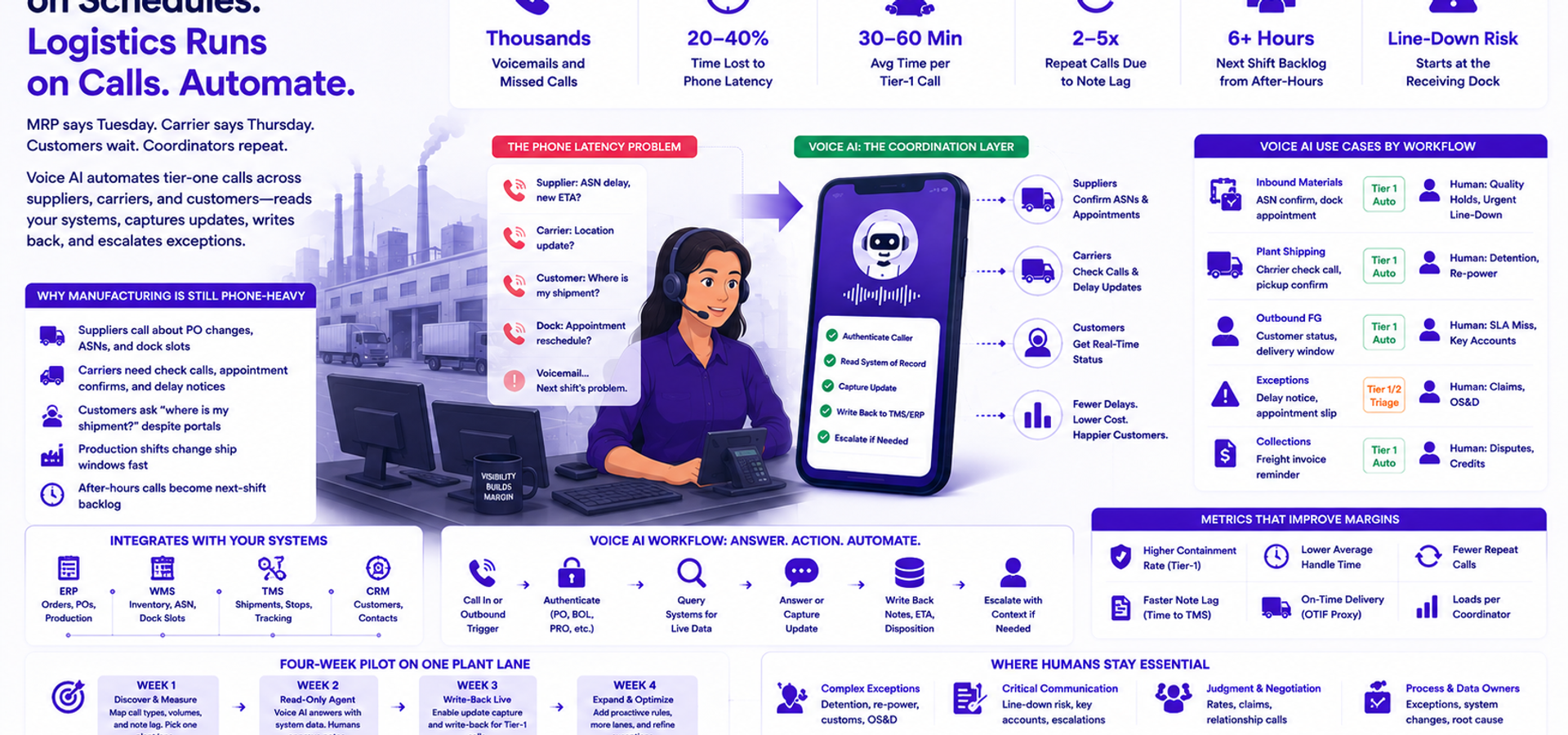
Your MRP says raw material arrives Tuesday. The carrier voicemail says Thursday. Customer service is on hold asking for finished-goods ETA while the shipping desk replays the same check-call script for the forty-first time this week. Manufacturing runs on schedules, but supply chain and logistics in manufacturing still breaks on phone latency: supplier confirms, dock appointments, carrier updates, and customer status that never lands in the system of record on time.
That is why manufacturers deploy voice AI, not to replace planners or logistics leads, but to automate tier-one calls that eat coordinator hours. This guide covers where voice AI transforms manufacturing supply chain logistics, what to integrate, how to pilot on one plant lane, and where humans stay in the loop.
Why manufacturing logistics is still phone-heavy
Plants added ERP, WMS, and TMS years ago. Yet supply chain & logistics in manufacturing volume grows faster than headcount because:
- inbound suppliers call about PO changes, ASN timing, and dock slots
- outbound carriers need check calls, appointment confirm, and delay notice
- customers and distributors ask “where is my shipment?” despite portals
- production slips reshape ship windows, someone must notify downstream fast
- after-hours rings become next-shift backlog at the shipping desk
Dashboards show plans; phones execute reality. Broader context: supply chain automation with AI, the logistics decision gap, and technology used in supply chain management.
Where voice AI fits in the manufacturing logistics stack
Voice AI is a coordination layer, not a replacement for planning or inventory optimization. It sits between telephony and execution systems:
Read: order, shipment, stop, appointment, carrier contact, last event from ERP/WMS/TMS.
Speak: inbound customer or supplier questions; outbound carrier check calls.
Write: communication notes, ETA revisions, disposition codes, exception flags.
Escalate: warm transfer with transcript to humans on detention, customs, or production-critical holds.
Planning and inventory AI: supply chain planning software, AI inventory optimization, machine learning in supply chain optimization. Voice AI closes the last mile, calls that plans assume happen instantly.
Voice AI use cases by manufacturing logistics workflow
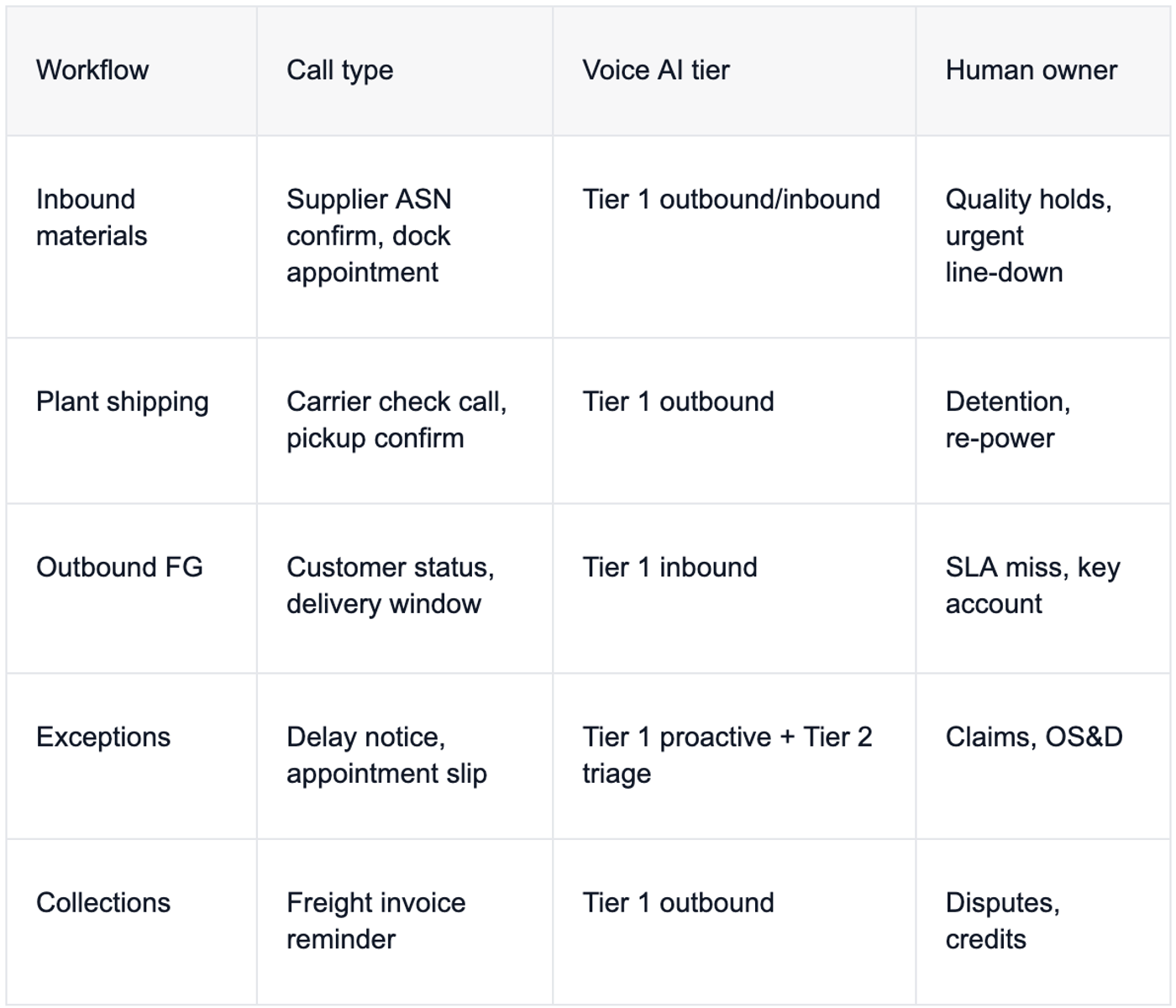
TMS write-back patterns: automated load status updates in TMS via phone bots and AI voice agents for routine logistics calls.
Inbound supplier and dock coordination
Line-down risk starts at the receiving dock. Voice AI can place outbound supplier calls to confirm ASN arrival windows, capture delay reasons, and post notes to WMS or ERP, before planners learn from silence. Inbound supplier rings route to voice AI for appointment reschedule intake with structured write-back.
That is manufacturing supply chain logistics speed without hiring one coordinator per shift per dock door.
Outbound carrier check calls and FG customer status
Finished-goods shipping multiplies check-call volume across LTL, FTL, and parcel lanes. Voice AI runs location-and-ETA scripts, logs to TMS, and sends proactive delay notices when production or warehouse pushes ship time.
Inbound “where is my order?” calls authenticate by PO or BOL, read TMS truth, and escalate when data is stale, cutting repeat rings within two hours. Exception design: reducing delivery exception calls before ops and where is my shipment calls.
Integration architecture for manufacturing plants
- Telephony: Plant line, toll-free customer service, outbound dialer for check calls.
- Voice orchestration: Scripts, NLU, authentication, multilingual if needed.
- System adapters: ERP/WMS/TMS API clients with field mapping per site.
- Rules engine: Trigger outbound on ship-date risk, ASN due, or appointment slip.
- Observability: Containment rate, note lag, repeat caller rate, API errors.
Build vs buy telephony: build vs buy voice AI stack. Conversational patterns: conversational services use cases and replacing phone trees with conversational voice AI.
Tier framework: automate calls, keep judgment human
Tier 1: voice AI: Status readouts, appointment confirm, standard delay notice, payment reminder scripts.
Tier 2: triage then transfer: Delivery exceptions, partial claims intake, angry customer de-escalation start.
Tier 3: human only: Production-critical line-down escalations, customs holds, contract freight disputes, safety events.
Dispatch load: how logistics teams cut dispatcher call load. Peak surge: peak season call volume without hiring dispatchers.
Four-week pilot for one manufacturing lane
Week 1: Call audit and system map
Tag inbound status vs outbound check-call hours on one FG lane or inbound supplier route. Document ERP/TMS read paths.
Week 2: Read-only voice agent
Inbound status from TMS lookup; humans review AI-suggested notes before write-back.
Week 3: Outbound check calls + write-back
Scheduled carrier check calls with disposition posting. Warm transfer on detention, breakdown, refused keywords.
Week 4: Measure and expand
Track OTIF proxy, repeat callers, coordinator hours. Add second lane or after-hours inbound if containment holds.
Metrics for voice AI in manufacturing logistics
- time from call end to ERP/TMS note posted
- tier-one containment without human transfer
- inbound answer rate and hold time
- repeat caller rate within two hours
- check calls completed per coordinator hour
- OTIF or appointment-hit rate on pilot lane
- line-down minutes avoided (qualitative log with planning)
AI logistics map: AI in logistics use cases and AI supply chain technology trends. Sustainability angle: how AI makes supply chains more sustainable, fewer expedites when delay notice goes out early.
Common failure points in manufacturing deployments
Stale TMS after production changes: Voice AI amplifies bad ETAs, sync ship-window updates from MES or planning first.
Per-plant field mapping drift: Version adapters when sites customize ERP screens.
Over-automating line-down calls: Production-critical escalations need humans on keyword or account flag.
No after-hours handoff: Night bot notes must appear in morning queue with clear transfer flags.
Missed-call cost: hidden cost of missed calls in logistics. AR adjacent: automating freight payment reminder calls.
Where Dialflo fits
Dialflo helps manufacturers transform supply chain and logistics in manufacturing with AI voice agents, inbound customer and supplier calls, outbound carrier check calls, appointment confirm, proactive delay, with ERP, WMS, and TMS-aware context and structured write-back.
Pilot one plant lane on dialflo.ai when phone coordination bottlenecks OTIF and planners cannot wait for morning note entry.
FAQ: Voice AI and manufacturing supply chain logistics
What calls automate first in manufacturing?
Inbound FG status and outbound carrier in-transit check calls on high-volume lanes.
Does voice AI replace logistics staff?
No, tier-one automation; humans on exceptions and production-critical escalations.
Which systems must integrate?
ERP, WMS, and/or TMS for read lookup and disposition write-back.
How long to pilot?
Often 2–4 weeks on one lane with read-only before write-back.
Multi-plant rollout?
Pilot one site; reuse adapters with per-plant field maps and scripts.
How does Dialflo help?
Voice AI for manufacturing logistics coordination, see dialflo.ai.
Closing: plans need phone execution
Manufacturing digitized planning and inventory, but supply chain & logistics in manufacturing still wins or loses on whether calls become system events in real time. Voice AI transforms that layer: tier-one phone work automated, exceptions with humans, ERP/TMS truth on every conversation. That is how plants scale logistics without scaling hold music.
Ready to automate manufacturing logistics calls? Explore Dialflo for voice agents built for supply chain execution at the plant edge.