24/7 Voice AI for After-Hours Shipment Status Calls

Dialflo: AI Voice Agent
June 25, 2026
10:42 p.m.: a shipper calls about a line-down part on tomorrow's delivery. 11:18 p.m.: a receiver asks if the truck is still on schedule for the 6 a.m. dock slot. 1:05 a.m.: a driver checks in at a rest stop with a revised ETA. Your dispatch line rings. Voicemail answers. By 7:30 a.m., your coordinators open forty-two callbacks, and every one starts with "where is my shipment?"
Freight moves around the clock. Phones do too. After hours shipment status calls are a daily logistics pain point: shippers, carriers, and 3PLs either leave them unanswered or dump them on an already overloaded dispatch team the next morning. This guide shows how logistics companies use 24/7 voice AI for after-hours shipment tracking, delivery status requests, and always-on phone support, without staffing a full overnight control tower.
Why after-hours shipment status calls are different from daytime volume
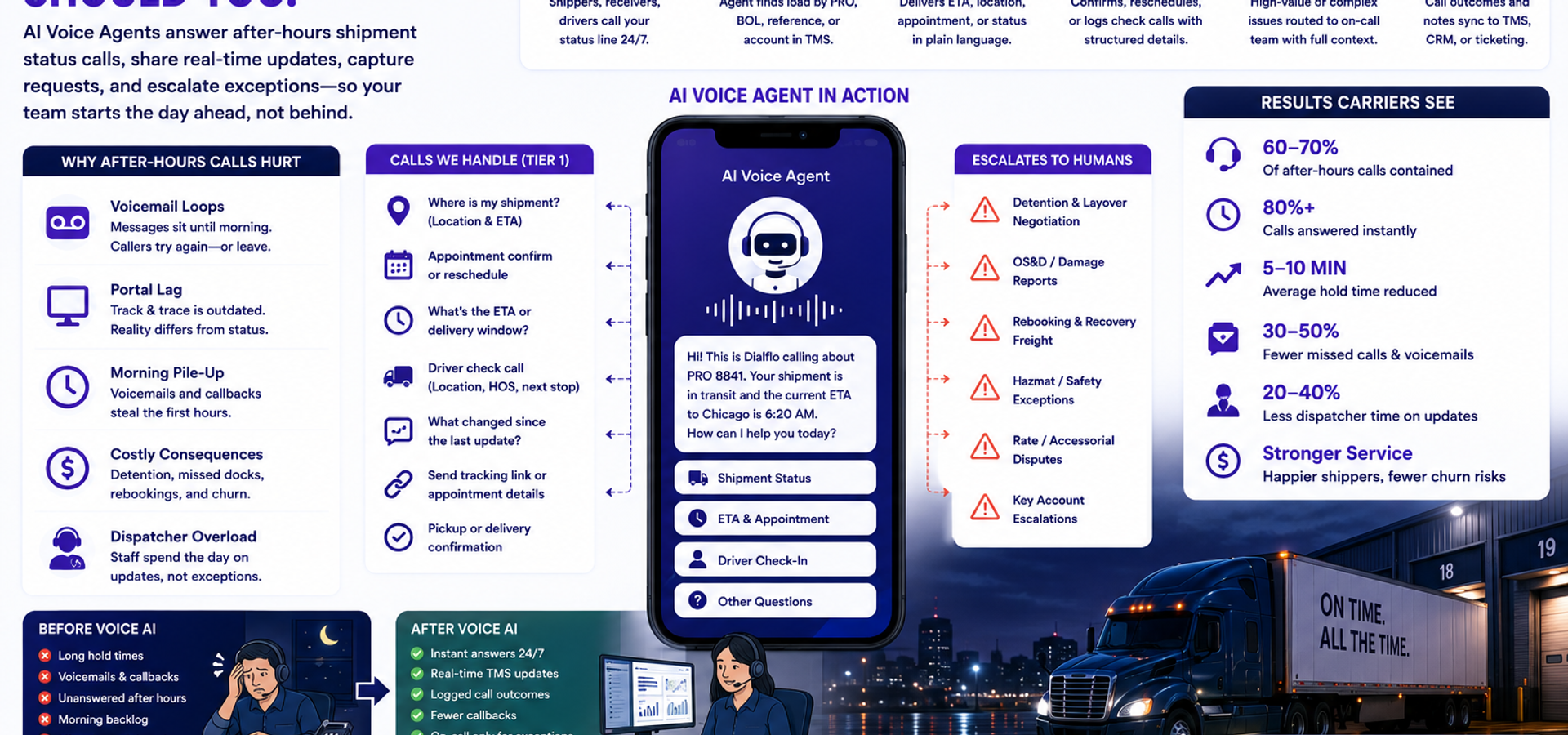
Daytime dispatch teams expect status calls. After hours, the same question hits a dead line. The caller is often more urgent, a production line waiting, a warehouse crew staying late, a driver deciding whether to hold or roll. After hours shipment status calls fail in three predictable ways:
- Voicemail loops: Callers leave messages; nobody listens until morning.
- Portal lag: Track-and-trace shows "in transit" while reality moved two hours ago.
- Morning pile-up: Unanswered night calls become the first task list, before routing, detention, and carrier work.
Commercial freight activity does not follow office hours, the Bureau of Transportation Statistics publishes freight flow data that underscores how much movement happens outside the 9-to-5 window. Source: BTS freight analysis. Logistics context: AI in logistics: use cases, benefits & tools.
Who calls for shipment status after business hours
After hours shipment status calls are not one audience. Logistics companies hear from:
- Shippers and buyers: production schedules, customer commitments, line-down parts
- Receivers and warehouses: dock staffing, appointment windows, detention risk
- Drivers and carriers: revised ETAs, check calls, gate instructions
- 3PL client teams: end-customer escalations passed through after their desk closed
- Internal ops: cross-dock handoffs and exception alerts when the control tower is thin
Each needs a fast answer, not a callback tag for tomorrow. FMCSA hours-of-service rules keep many drivers on the road when dispatch is dark, another reason phones ring when desks are empty. Source: FMCSA hours of service.
What unanswered after-hours status calls cost operations
When delivery status requests go unanswered overnight, costs show up as:
- detention and layover from drivers waiting without instructions
- missed dock appointments and redelivery fees
- shipper churn when a competitor answered at 11 p.m.
- coordinator overtime clearing morning callback queues
- repeat calls because nothing was logged in the TMS
Decision discipline for ops leaders: logistics decision gap in AI operations.
How 24/7 voice AI handles after-hours shipment status calls
24/7 voice AI is not a phone tree that says "press 1." On after hours shipment status calls, AI voice agents:
- answer inbound lines immediately, no hold queue until morning
- authenticate callers by account, PRO, BOL, or reference number
- look up load status from TMS, WMS, or carrier API data
- read ETA windows, last scan location, and appointment status in plain language
- confirm delivery or capture reschedule requests with structured notes
- text tracking links or appointment details via SMS when useful
- escalate exceptions to on-call staff with transcript and load context
- write call outcomes to TMS notes, CRM, or ticketing
Voice layer primer: conversational services: what they are & use cases. Supply chain stack: technology used in supply chain management.
Delivery status requests voice AI resolves without a dispatcher
Strip most after hours shipment status calls and you hear repeatable intents:
- Is the load picked up and moving?
- What is the ETA or delivery window?
- Did anything change since the last update?
- Can we confirm or move the appointment?
- Where is the driver now relative to the dock?
None require a senior dispatcher at midnight, if TMS data is current and the voice layer speaks it clearly. Tier-one delivery status requests belong on automation; detention, OS&D, and rebooking belong on humans.
Voicemail vs 24/7 voice AI for after-hours logistics support
Voicemail: caller leaves a message, hangs up uncertain, calls again, or books another provider. Morning dispatch replays forty similar threads.
24/7 voice AI: caller gets status in sixty seconds, disposition logged, on-call notified only on exceptions.
Voicemail: no TMS write-back; next shift starts blind.
24/7 voice AI: notes and outcomes sync overnight, morning team plans, not recovers.
Overnight staffing: two coordinators on graveyard shift, expensive and hard to hire.
24/7 voice AI plus thin on-call: always-on tier-one coverage without a full night crew.
Trend backdrop: AI supply chain technology trends.
How logistics companies deploy after-hours voice AI (step by step)
Step 1: Route after-hours overflow first
Pilot on nights and weekends before replacing business-hour lines. Measure answer rate and callback volume reduction.
Step 2: Connect TMS or WMS as source of truth
Voice agents need live load lookup, PRO, reference, account match. Stale data kills trust faster than voicemail.
Step 3: Script tier-one status intents
ETA readout, pickup confirm, appointment confirm, tracking link SMS, callback request with promised time.
Step 4: Define escalation rules
Temperature alarm, missed appointment, high-value account, legal or damage claim, warm transfer to on-call with context.
Step 5: Log every call to ops systems
Morning dispatch sees overnight activity in the TMS, not a sticky note pile.
Step 6: Expand coverage
After after-hours success, add lunch-hour overflow, peak season, or proactive outbound ETA updates.
Peak volume context: machine learning in supply chain optimization for planning; voice coverage is the execution layer customers feel.
What to automate vs what stays on-call after hours
Automate: where-is-my-shipment answers, ETA and appointment readouts, tracking link delivery, simple reschedule intake, check-call logging.
On-call human: detention negotiation, OS&D and damage, rebooking and recovery freight, credit-sensitive shipper escalations, compliance exceptions.
Always-on phone support does not mean zero humans, it means humans handle judgment, not readouts.
Metrics logistics teams track on after-hours voice AI
- After-hours answer rate: answered vs sent to voicemail
- Average time to status answer: seconds, not hours
- Morning callback queue size: should shrink week over week
- Escalation rate: what percent need on-call
- Repeat call rate: same load, same question, same night
- Customer satisfaction on status lines: post-call or account-level
Efficiency tie-in: how AI makes supply chains more sustainable, fewer wasted miles from missed instructions.
Where Dialflo fits for always-on logistics phone support
Dialflo provides 24/7 voice AI built for logistics phone work, natural language, TMS-aware shipment lookup, delivery status answers, exception escalation, and write-back to your operations stack. Logistics companies use Dialflo to handle after hours shipment status calls without staffing a full overnight dispatch desk, so morning teams start on exceptions, not forty voicemails asking the same question.
FAQ: after-hours shipment status automation
Will customers accept AI after hours?
They accept accurate answers fast. Clear disclosure and easy escalation beat hold music until 8 a.m.
Do we need a full TMS API?
Start with reliable load lookup, even scheduled exports beat voicemail. Improve integration as volume grows.
What about drivers calling in?
Voice AI can log check calls and capture ETAs; detention and instructions may still need on-call judgment.
Can this cover weekends only?
Yes. Many teams pilot Saturday–Sunday overflow before weeknight coverage.
How does this differ from a traditional call center?
Voice AI reads your TMS in real time and logs outcomes, call centers read scripts without load context.
How does Dialflo help?
24/7 voice agents for shipment status and delivery requests, see dialflo.ai.
Closing: freight moves 24/7, your status line should too
After hours shipment status calls will not wait for Monday. Logistics companies that use 24/7 voice AI answer delivery status requests when shippers, receivers, and drivers actually call, log every outcome, escalate only what matters, and give dispatch a morning that starts with planning instead of replaying voicemail.
Ready for always-on phone support without overnight headcount? Explore Dialflo for voice agents that handle after-hours shipment status with TMS lookup, escalation, and write-back to the systems you already run.