Best Voice AI for Reducing Average Handle Time

Dialflo: AI Voice Agent
July 30, 2026
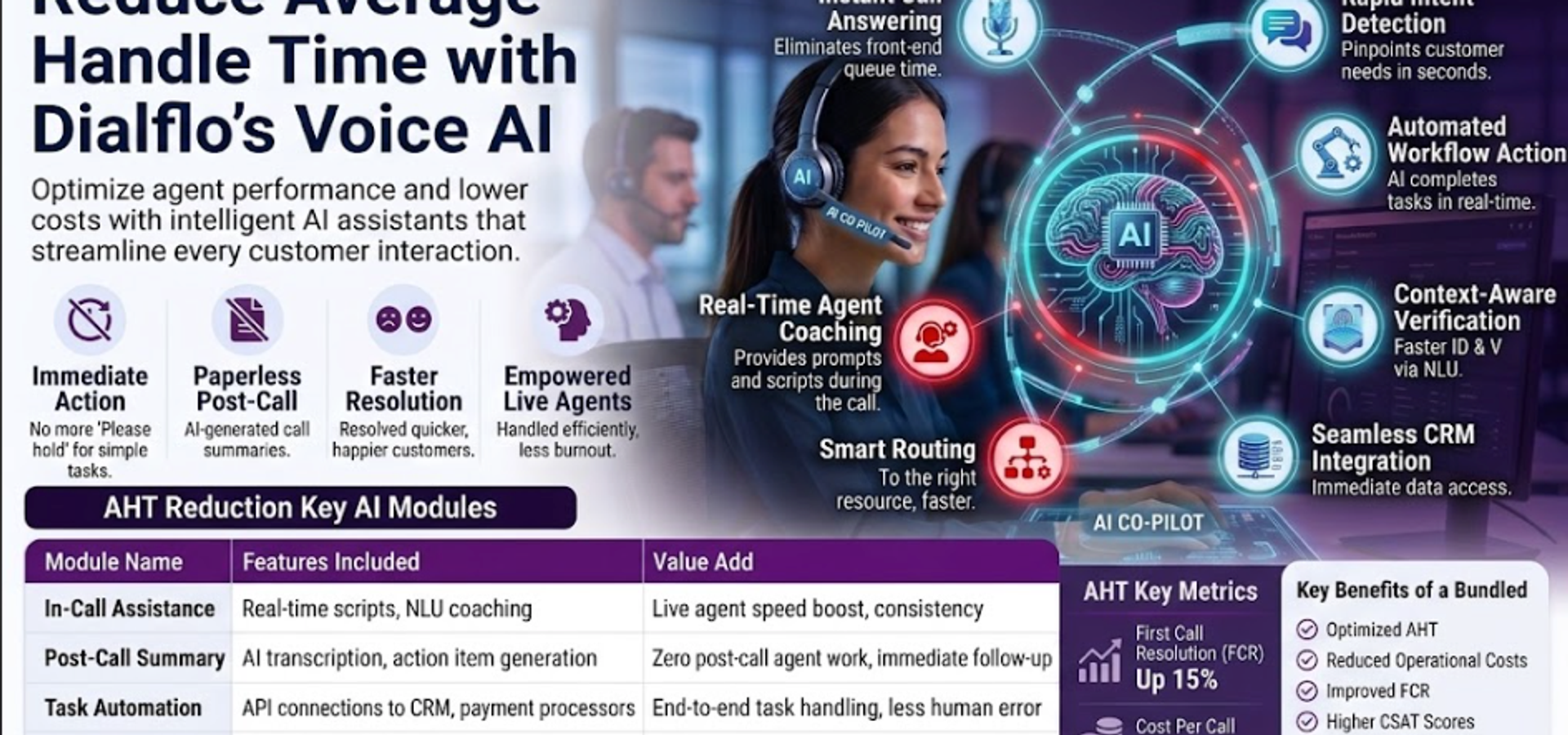
Your queue is not drowning because agents are lazy. It is drowning because every status check, address update, and “where is my order?” call still burns talk time, hold time, and after-call work. If you want to reduce average handle time, the winning move is not a pep talk, it is voice AI that either finishes the call or shortens the human path with receipts.
This guide shows what “best voice AI” actually means for AHT, how to measure progress without fooling yourself, and which buying signals separate demos from queue relief. For stack context, start with conversational services and build vs buy voice AI in India.
What average handle time really includes
AHT is usually talk + hold + after-call work (ACW). Cut any of those and AHT moves. Cut none of them and your “AI project” is theater.
Most AHT waste hides in three places:
- repeat questions that should have been resolved before a human joined
- holds while agents search five systems
- ACW typing the same CRM notes the bot already knew
Voice AI that only sounds polite does not move those levers. Voice AI that resolves, retrieves, and writes back does.
Why voice AI can cut AHT now (not just in decks)
McKinsey reports that generative AI in customer service can raise issue resolution per hour while reducing time spent handling issues, roughly a 14% resolution lift and about a 9% handle-time drop in studied agent populations. Source: McKinsey on gen AI agents in the enterprise.
In broader service operations work, McKinsey also documents programs where average handle time fell by more than a quarter when journey redesign and AI guidance removed painful steps from common calls. Source: McKinsey: real results from gen AI in services.
The category math is real. Your AHT math still needs discipline.
Unique angle: chase productive AHT, not vanity AHT
Here is the trap most buyers miss: if voice AI contains the short, easy calls, remaining human AHT can look worse. The blend shifts toward hard cases. Ops panics. Finance asks why AHT rose. Someone kills the pilot.
Productive AHT means you track three numbers together:
- containment rate by intent (calls that never need a human)
- AHT by intent for human-handled contacts
- cost per resolved contact for the whole channel
If containment rises and cost per resolution falls, you won, even if complex-case AHT ticks up. Blended AHT alone is a bad north star.
Two ways voice AI reduces average handle time
1) Containment: remove the call from the human queue
Status checks, OTP resets, appointment confirms, shipment ETAs, payment reminders, these intents inflate AHT when humans own them. A capable voice agent finishes the loop, writes the outcome, and frees the seat.
This is usually the fastest way to reduce average handle time at the org level, because zero human handle time beats a shorter human handle time.
2) Assist: shrink talk, hold, and ACW on human calls
For judgment-heavy calls, voice AI (or real-time assist) should surface the right record, propose next steps, and draft wrap-up. Less hunting. Less dead air. Less post-call typing.
McKinsey’s contact-center work emphasizes the mix: automation for volume, humans for complexity, not a fantasy of zero agents tomorrow. Source: McKinsey: humans and AI in contact centers.
What “best voice AI for reducing AHT” looks like in a buy
Skip the accent contest. Score vendors on AHT mechanics:
- Intent containment: can it close your top 3 repetitive reasons without a warm body?
- Latency and barge-in: dead air inflates talk time and kills trust
- System write-back: CRM, ATS, TMS, or ticketing updates without agent typing
- Context-rich transfer: when escalation happens, the human does not restart the call
- ACW automation: summaries and disposition codes that actually stick
- Analytics by intent: AHT and containment broken down, not one vanity average
If you are comparing builders and platforms in India, read Retell vs Dialflo vs Vapi for India and best Retell alternative for India for deployment reality, not feature checklists alone.
Where AHT drops fastest (start here)
Pick intents that are frequent, structured, and already documented:
- order / shipment status
- appointment confirm / reschedule
- balance, due date, or simple billing FAQs
- password / OTP / verification flows with clear policy
- inbound “where is my driver / load?” logistics loops
Logistics and supply-chain phone load is a classic AHT sink, dispatchers repeating the same answers. See AI in logistics use cases and the logistics decision gap for ops framing.
How to prove you reduced average handle time
Run a 30-day pilot on one intent:
- Baseline: AHT, volume, FCR, abandon rate, cost per resolved contact
- Deploy voice AI with write-back and escalation
- Report containment, human AHT for residual calls, and total handled volume
- Only then expand to the next intent
Do not celebrate a 20-second AHT dip if first-contact resolution collapsed. Short angry calls are not efficiency.
Mistakes that fake AHT improvement
- measuring only talk time and ignoring ACW
- forcing callers through rigid trees that create repeat contacts
- automating ambiguous intents that need empathy or exceptions
- no CRM write-back, so humans re-enter everything after transfer
- judging success on blended AHT while ignoring containment
FAQ: reduce average handle time with voice AI
How does voice AI reduce average handle time?
By containing repetitive calls entirely and by shortening remaining human work, faster retrieval, cleaner handoffs, and less after-call typing. Containment usually moves org-level AHT more than shaving seconds off complex calls.
What is average handle time?
AHT is the average time spent on a contact: talk + hold + after-call work. It is an efficiency metric. Pair it with resolution and CSAT so you do not reward rushed, incomplete calls.
Can AHT rise after voice AI goes live?
Yes, if easy calls disappear into automation. That can still be a win when containment and cost per resolution improve. Always read AHT by intent.
What should I look for in voice AI to cut AHT?
Containment on your real intents, low latency, write-back, warm transfer with context, ACW automation, and intent-level analytics. Demos without production metrics are not proof.
Is agent assist or full automation better?
Use full automation for repetitive, data-clean intents. Use assist for complex judgment. Most high-performing centers run both.
How fast can AHT improve?
One well-chosen intent with clean integrations can move within weeks. Multi-intent rollouts without measurement drag for months.
A short closing note
The best voice AI for reducing average handle time is the one that removes dead minutes from your actual queue, not the one with the flashiest demo. Start with productive AHT: containment, intent-level handle time, and cost per resolved contact.
If you want a production pilot built around those metrics, not a vanity bot, talk to the team at Dialflo.