Why Logistics Is Won in the Decision Gap, Not the Plan

Dialflo: AI Voice Agent
April 23, 2026
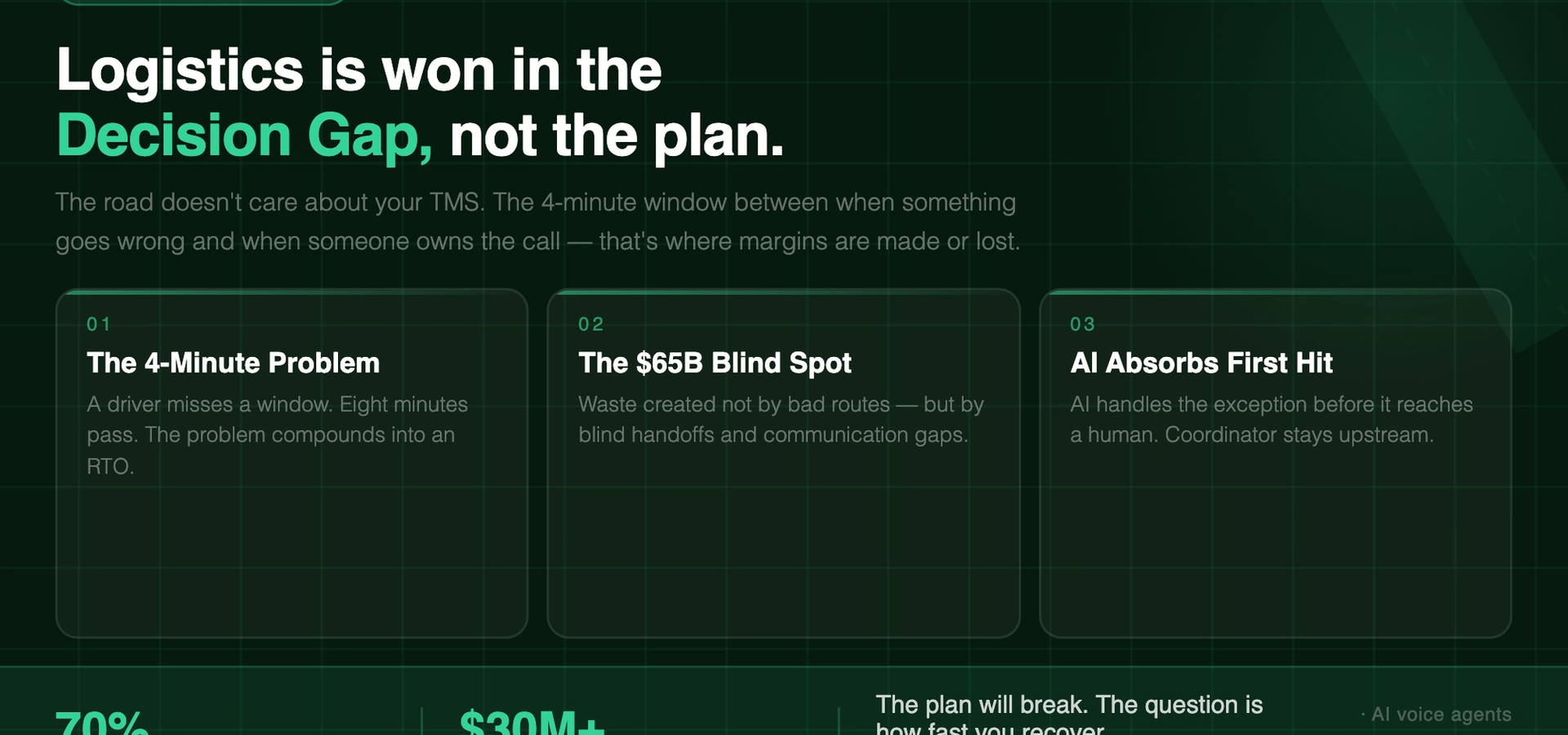
The noisy road doesn't care about your TMS.
It doesn't care about the route your ops team signed off on Friday afternoon. It doesn't care about the SLA your sales team promised. It just shows up. Every day. Louder than yesterday.
And the leaders who are winning in logistics right now, the ones who are actually cutting costs, reducing failed deliveries, and scaling without hiring ten new coordinators, are not winning because they built the perfect plan. They're winning because they built operations that absorb what the road throws at them and make the right micro-decision in the four minutes before the problem compounds.
That window, the gap between when something goes wrong and when someone owns a decision, is where logistics margins are made and lost.
The Four-Minute Problem
Every logistics operation has a version of this moment. A driver misses a pickup window. A COD customer doesn't answer. A coordinator is on three calls at once. An alert fires in the TMS. And then: nothing. Four minutes pass. Then eight. Then the driver has moved on, the customer has cooled off, the delivery window has closed, and what should have been a recoverable situation has become a failed delivery, an RTO, an angry client, and a cost that nobody budgeted for.
McKinsey's research on mid- and last-mile logistics puts a sharp number on this problem: between $65 billion and $95 billion of waste is generated annually at interaction points between shippers, dispatchers, 3PLs, and carriers, waste created not by bad routes or broken trucks, but by blind handoffs and communication gaps. McKinsey also estimates that around 70% of dispatcher time goes to resolving problems caused by those handoffs.
This is not a technology problem. It is a decision speed problem. And it has a different solution than most logistics leaders are currently buying.
What Ops Leaders Get Wrong About AI in Logistics
The dominant conversation in logistics AI is about the backend: route optimisation algorithms, demand forecasting models, warehouse robotics, digital twins. All of it is real, all of it delivers value, and none of it touches the moment when the road gets noisy.
McKinsey's analysis of distribution operations found that embedding AI in logistics can reduce costs by 5–20% and cut inventory by 20–30%. Those are meaningful numbers. But they represent value captured in structured, plannable parts of the operation, forecasting windows, routing batches, warehouse throughput.
The unstructured, real-time layer, the calls, the confirmations, the reroutes, the customer pings, is still handled manually at most operators. A coordinator still picks up the phone. A driver still waits for a callback. A customer still gets silence while two people figure out who owns the problem.
This is the gap. And it is not solved by a better TMS.
Building for the Road, Not Against It
The ops leaders who are winning have stopped trying to eliminate variability. Variability in logistics is not a failure of planning, it is the nature of the work. Traffic doesn't negotiate. Customers are unpredictable. Weather doesn't file a report.
What they have built instead is an operation where the first hit, the alert, the failed attempt, the missed call, is absorbed by AI before it reaches a human decision-maker. The human is upstream, designing the rules AI plays by. The AI is downstream, executing against those rules in real time, without a queue, without a delay, without a coordinator choosing between three simultaneous problems.
McKinsey's research on gen AI in supply chains documents one last-mile operator with a fleet of over 10,000 vehicles that deployed virtual dispatcher agents and saved $30–35 million, from an investment of just $2 million. A second carrier saved $3.5 million by implementing an AI-driven three-way messaging platform connecting drivers, dispatchers, and customers in a single conversation thread. The ROI in both cases was not from better planning. It was from faster decisions in the moment the plan broke down.
This is the architecture that matters. Not smarter routes at midnight. Smarter responses at 2 pm on a Tuesday when everything is moving at once.
The Communication Layer Nobody Is Solving
Most AI logistics platforms are excellent at the backend. They forecast, route, and track. What they do not do is make phone calls.
And in Indian logistics, where COD orders account for over 60% of e-commerce transactions, where drivers operate across linguistically diverse regions, and where customers often need to be reached by voice rather than app notification, the phone call is still the primary operational tool. It is also the most expensive one, per unit of coordinator time.
Delivery confirmation calls. Driver check-in calls. RTO follow-up calls after a failed attempt. Customer rescheduling calls. These are not strategic conversations. They do not require a skilled coordinator. They require presence, consistency, and the ability to happen at volume without anyone dropping the thread.
This is where Dialflo was built to operate.
Dialflo's AI voice agents handle the call layer of logistics operations, outbound confirmations before delivery windows, driver check-ins during the day, proactive follow-up calls after failed attempts, RTO reschedule conversations, in multiple Indian languages, without tying up a single member of your coordination team. Across its client base of D2C brands, regional logistics operators, and healthcare chains, Dialflo automates 70–80% of routine coordination call volume.
What separates Dialflo from generic voice automation is how it listens. Most voice AI systems interrupt. They miss hesitation. They force callers through scripts that do not adapt. A driver who is two kilometres from the wrong address and needs five seconds to think gets talked over and gives up. Dialflo's agents are designed around the opposite principle: detect the cue, hold the space, respond with context. The call completes. The outcome is logged. The coordinator sees a resolved exception, not an incoming problem.
The Human Stays Upstream
None of this is about removing people from logistics operations. It is about repositioning them.
The coordinator who spends six hours a day making confirmation calls and chasing drivers for ETAs is not doing coordination, they are doing execution. When AI absorbs that execution layer, the coordinator becomes what the role was always supposed to be: the person who sees the patterns, escalates the real exceptions, manages the client relationships, and designs the rules that AI runs against tomorrow.
Oliver Wyman's analysis of 25 real-world logistics AI use cases found that AI-powered chatbots can handle up to 30% of inquiries end-to-end and cut agent handling time by approximately 50%. That is not headcount reduction. That is capacity reallocation, the same team, handling more volume, with fewer dropped threads.
For logistics businesses operating on average margins of 3–5%, that reallocation is a structural advantage. The competitor who still runs manual coordination at volume is not just slower. They are structurally more expensive per delivery, permanently.
What the Winning Playbook Actually Looks Like
The ops leaders building for the road, not against it, are working from a consistent playbook.
They have accepted that the plan will break. Not sometimes, regularly. So they stop investing in the plan's perfection and start investing in the organisation's response speed.
They have separated decision types. Decisions that require context, relationships, and judgement, those stay human. Decisions that require speed, consistency, and volume, those go to AI. The split is not 50/50. At most well-run operators, 70–80% of operational communications are routine. That is the AI layer. The 20–30% that genuinely needs a human gets one, faster, because the AI absorbed the rest.
They have built for their actual market. In India, that means multilingual. It means voice-first, not app-first. It means being present in the communication channel where your driver and your customer actually operate, not the one that is easiest to integrate.
And they have stopped measuring success by whether the plan held. They measure it by how fast the operation recovered when it didn't.
The Road Is Not Going to Quiet Down
Logistics complexity in India is increasing, not decreasing. E-commerce volumes are growing. Customer expectations for delivery speed and communication are rising. The global logistics AI market is growing from $17.96 billion in 2024 toward $707.75 billion by 2034, and the operations that move fastest to build the right infrastructure, not just the backend algorithms, but the real-time communication layer, will be the ones with the margin to compete.
The noisy road is not a problem to solve. It is the environment you operate in.
The question is whether your operation is built for it.
FAQ: AI in the logistics decision gap
What is the decision gap in logistics?
It is the time between something going wrong on the road, such as a missed pickup or an unanswered COD call, and someone owning the decision. Small delays in that window turn recoverable problems into failed deliveries, RTOs, and unplanned cost.
Why doesn't a better TMS or routing tool close the gap?
Planning tools optimise the structured part of the operation. The gap sits in the unstructured, real-time layer: calls, confirmations, reroutes, and customer pings that coordinators still handle by hand.
Which logistics calls can AI voice agents take over?
Delivery confirmations, driver check-ins, failed-attempt and RTO follow-ups, and rescheduling calls. They are high-volume and routine, so they suit automation, while exceptions and client relationships stay with your coordinators.
How does Dialflo help logistics teams?
Dialflo's AI voice agents run confirmation, check-in, and follow-up calls in multiple Indian languages, log each outcome, and hand real exceptions to a coordinator with the context attached.