AI Voice Agent Pilot: KPI Contract Template for SMBs

Dialflo: AI Voice Agent
August 25, 2026
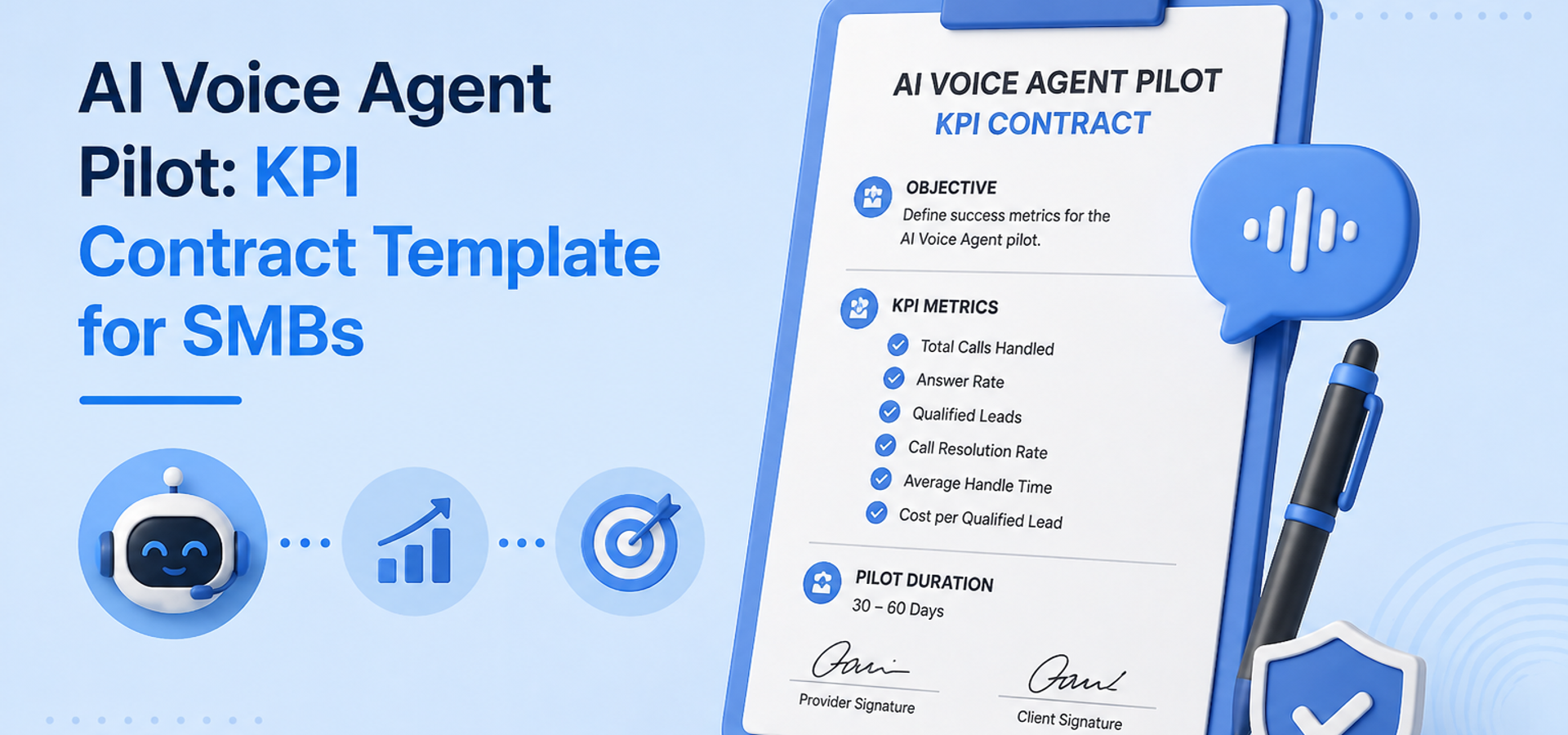
Short answer: An AI voice agent pilot KPI contract template is the one-page agreement that forces baselines, numeric success thresholds, pricing rules, and a go/no-go date before anyone connects your phone line. Without it, SMBs buy a polished demo and still cannot answer the only question that matters: did this workflow earn the right to scale?
Week three of the pilot. The vendor deck says “98% intent accuracy.” Your office manager says callers still repeat their order number twice. Finance asks why the minute bill jumped during a no-answer retry week. Sales says “it feels better.” Nobody can prove a single business outcome moved. The renewal conversation starts with vibes. That is how voice AI pilots die inside SMBs: not because the model failed in a lab, but because nobody contracted the scoreboard.
This post gives you a copy-ready AI voice agent pilot KPI contract template built for small and mid-sized teams: what to measure, how to define pass/fail, how to price the pilot, and how to kill or scale without drama. For context on conversational systems and stack choices, see conversational services use cases and build vs buy voice AI stack in India.
Why SMBs need a KPI contract before any voice AI pilot
AI adoption is common. Scaled impact is not. McKinsey’s State of AI research keeps showing the same gap: most organisations use AI in at least one function, while the hard part remains moving from pilots to workflows that create measurable value. Source: McKinsey: The state of AI (rewiring to capture value).
For phone workflows, the failure mode is sharper. Voice agents touch revenue, staffing, and customer trust in the same week. If you do not lock KPIs in writing, three things happen:
- vendors optimise for demo moments you will never hear again
- internal owners argue about “quality” with no shared definition
- finance cannot compare cost per successful outcome against humans or an answering service
A KPI contract is not a 40-page MSA rewrite. It is a short exhibit: scope, baseline, thresholds, measurement, commercial rules, and exit. Treat it as board-grade measurement for one workflow.
What “good” looks like for an SMB voice agent pilot
One workflow. One owner. One primary metric. One numeric threshold. One decision date.
Examples of primary metrics that work for SMBs:
- inbound lead qualification rate to CRM-ready status
- appointments booked per 100 connected calls
- after-hours answer rate within 20 seconds
- dispatcher ticket deflection on in-scope shipment status intents
- cost per successful outcome versus the current process
Guardrail metrics (must not get worse):
- escalation handoff completeness
- complaint or repeat-call rate on handled intents
- CRM field accuracy on sampled calls
- average handle time only if it does not punish thorough qualification
Speed still matters on inbound revenue lines. Classic lead-response research found contact odds collapse when first outreach slips from minutes to half an hour. Source PDF: InsideSales.com / MIT Lead Response Management study. If your pilot is inbound sales or service booking, put speed-to-first-response in the contract.
AI voice agent pilot KPI contract template (copy and fill)
Paste this into a Google Doc or Notion page. Fill every bracket before kickoff. Do not start traffic until both sides sign or email-confirm.
1. Parties and pilot owner
- Customer: [Company legal name]
- Vendor: [Vendor legal name]
- Customer pilot owner (single accountable person): [Name, role, email]
- Vendor pilot owner: [Name, role, email]
- Executive sponsor (go/no-go signer): [Name, role]
2. Scope (one workflow only)
- Workflow name: [e.g. After-hours inbound lead qualification for residential HVAC]
- Channel: [Inbound DID / outbound list / both]
- Languages: [English / Hindi / other]
- In-scope intents: [list 3 to 7]
- Out-of-scope intents (must escalate): [list]
- Systems in scope: [CRM, calendar, ticketing, telephony]
- Explicit non-goals: [e.g. no full IVR replacement, no collections, no multilingual expansion]
3. Baseline period (measure before you change anything)
- Baseline window: [14 calendar days ending on kickoff minus 1]
- Baseline sample: [N calls or 100% of workflow volume]
- Baseline metric A: [definition + current number]
- Baseline metric B: [definition + current number]
- Baseline cost: [labor + answering service + missed opportunity estimate, method stated]
- Baseline owner who certifies numbers: [Name]
No baseline, no pilot. You cannot claim a 30% lift from a number you never captured.
4. Primary success KPI (one sentence)
Fill this exact sentence:
This pilot succeeds if [metric] improves from [baseline] to at least [threshold] within [timeframe], measured by [method], on at least [minimum sample size] in-scope calls.
Example: This pilot succeeds if CRM-ready qualified inbound leads rise from 18% to at least 35% of answered after-hours calls within 28 days, measured by CRM disposition audit of 100% of handled calls, on at least 250 in-scope answered calls.
5. Secondary KPIs and hard guardrails
- Secondary KPI 1: [definition, baseline, target]
- Secondary KPI 2: [definition, baseline, target]
- Guardrail (must not worsen beyond X): [e.g. escalation missing-context rate < 5%]
- Guardrail: [e.g. caller complaint tickets tagged “bot” < Y per week]
6. Measurement method and audit rights
- Source of truth: [CRM fields / call log export / shared dashboard]
- Reporting cadence: [weekly 30-minute review]
- Human audit sample: [e.g. 25 random calls per week scored on a shared rubric]
- Dispute process: [48-hour written challenge; joint re-score]
- Customer may export raw call metadata and transcripts used for scoring during the pilot
7. Commercial terms for the pilot window
- Pilot fee: [fixed fee / capped usage / outcome-linked]
- Included minutes or concurrent lines: [number]
- Overage rule: [rate + approval threshold]
- Telephony and third-party pass-throughs: [listed explicitly]
- Primary commercial comparison metric: cost per successful outcome = all-in pilot spend / successful outcomes
- No automatic renewal into annual contract without written go decision
If a vendor only wants to compete on published per-minute rates, force the outcome math. Related reading: Retell AI pricing vs Dialflo pricing and Retell vs Dialflo India pricing.
8. 30 / 60 / 90 decision gates
- Day 7: integration and call-path smoke test complete; traffic may start only after checklist sign-off
- Day 14: mid-pilot review; adjust prompts/routing once; do not expand scope
- Day 28 to 30: go / revise-once / stop decision by executive sponsor
- Day 60 (only if revise-once chosen): second measurement against the same KPI sentence
- Day 90: scale plan or full stop; no endless “soft launch”
9. Kill criteria (stop early without blame)
- Primary KPI is more than [X%] below baseline after [N] answered calls with no recoverable root cause
- Guardrail breach for [2] consecutive weeks
- CRM write-back accuracy below [Y%] on audited sample
- Vendor misses weekly reporting for [2] cycles
- Security or recording-consent breach
10. Data, recordings, and exit
- Customer owns caller data, CRM records, and business outcomes
- Recording retention: [days] then delete or export on request
- On stop: vendor returns or deletes customer data within [14] days and confirms in writing
- Prompt libraries trained solely on customer proprietary scripts remain customer IP unless otherwise agreed
- Transition assistance hours included on exit: [N hours]
11. Signatures
- Customer sponsor signature / date
- Vendor signature / date
- Attached: baseline worksheet, call rubric, architecture diagram, security questionnaire
How to fill the template without overengineering
SMBs lose weeks drafting enterprise legal language. Keep the KPI contract short and operational.
Step 1: Pick the painful, high-frequency workflow you already measure somehow (missed calls, unbooked leads, status callbacks).
Step 2: Pull two weeks of baseline from CRM, call recordings, or answering-service logs. Rough and honest beats precise and imaginary.
Step 3: Write one success sentence a skeptical CFO would accept.
Step 4: Cap scope. If the vendor wants “all inbound,” cut it to one DID or one after-hours block.
Step 5: Agree the weekly review invite before kickoff. No review cadence means no learning loop.
If you are comparing platforms while contracting KPIs, keep evaluation criteria consistent across vendors. Useful comparisons: Retell vs Dialflo vs Vapi India and Dialflo vs Retell for real estate lead qualification calls.
Sample KPI pack by SMB use case
Local services / home services inbound
- Primary: booked jobs or quote appointments per 100 answered calls
- Guardrail: wrong-suburb bookings under 2%
- Cost metric: cost per booked appointment including telephony
B2B demo / sales qualification
- Primary: SQL or demo-ready rate on connected conversations
- Guardrail: false-qualified rate on AE audit under 10%
- Speed: median time from form submit or first ring to first live conversation
Logistics / operations status line
- Primary: in-scope status intents contained without dispatcher
- Guardrail: incorrect ETA or POD statements on audit under 1%
- Cost metric: dispatcher minutes saved on contained calls
Recruiting / screening
- Primary: completed screens with required fields in ATS/CRM
- Guardrail: candidate drop-off or complaint rate
- Secondary: time-to-screen versus human baseline
Common pilot contract mistakes that waste the quarter
- Success defined as “sounds natural” with no numeric threshold
- Changing the workflow mid-pilot so baselines become meaningless
- Measuring only minutes used instead of outcomes completed
- Letting the vendor own the only dashboard copy
- Skipping kill criteria, then soft-launching a bad workflow for months
- Expanding to five languages and three CRMs in week two
Harvard Business Review’s classic lead-follow-up audit showed slow response is normal even when companies intend to reply. Source: HBR: The Short Life of Online Sales Leads. A voice pilot that does not hard-code speed and CRM write-back into the KPI sentence often recreates that same delay with nicer audio.
Next step: run the contract, then run the pilot
The AI voice agent pilot KPI contract template above is deliberately boring. That is the point. Boring contracts create clear scale decisions. Exciting demos create slide decks.
If you want help turning one phone workflow into a measurable pilot with CRM outcomes and a written go/no-go, talk to Dialflo. Bring your baseline numbers. We will help you fill the success sentence before the first production call.
Frequently asked questions
What is an AI voice agent pilot KPI contract?
A short commercial exhibit that defines workflow scope, baselines, success thresholds, measurement, pricing, decision gates, and exit rules for an SMB voice AI pilot.
How long should an SMB AI voice agent pilot run?
Three to four weeks on one workflow with real traffic is usually enough for a first go/no-go. Extend once only for fixable integration blockers.
Which KPIs matter most in a voice AI pilot?
Business outcomes: qualification or booking rate, containment on in-scope intents, speed-to-response, cost per successful outcome, escalation quality, and CRM accuracy.
What must be written before day one?
Baseline, one primary success sentence, guardrails, owners, sample size, reporting cadence, pricing formula, data ownership, and kill criteria.
Should pilot pricing be per minute?
Prefer capped fees or cost per successful outcome, with telephony pass-throughs listed. Per-minute alone hides retries and failed conversations.
How does Dialflo support KPI-led pilots?
Dialflo helps SMBs scope one workflow, instrument outcomes, and judge pilots on operational results. Start at dialflo.ai.