AI Applicant Screening: How It Works & Top Tools

Dialflo: AI Voice Agent
May 14, 2026
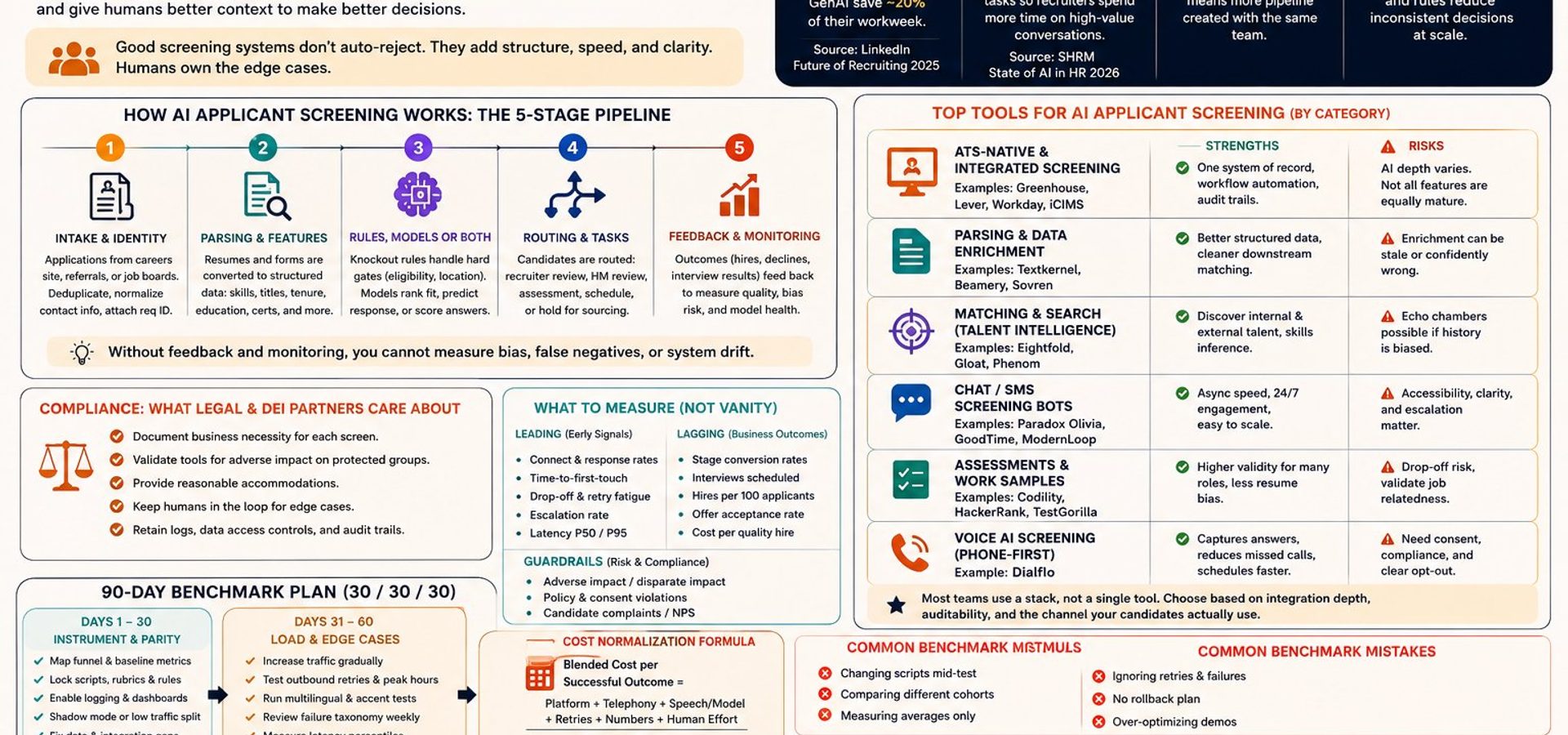
If you’re evaluating AI applicant screening, you’re usually trying to solve one problem: too many applicants and not enough recruiter hours. The worst implementations auto-reject people from a black box. The best ones route work: structured data, clear knockouts, and a human who owns exceptions.
This guide explains how AI applicant screening works end-to-end, which tool categories buyers actually deploy, what compliance teams care about, and how to measure quality without destroying candidate trust. For broader context, see our guides on artificial intelligence in recruitment and machine learning in recruiting. If your bottleneck is phone screens, we’ll also point to Dialflo as a voice-first layer that writes structured answers back to your process.
What “AI applicant screening” means (and what it is not)
AI applicant screening is not a single button in your ATS. It is a bundle of capabilities: parsing resumes into fields, matching candidates to reqs, scoring rubric answers, running eligibility checks, and sometimes conversational or voice interviews that produce transcripts and scores.
What it is not: a legal guarantee that hiring is “objective.” Models learn from history, and history can encode bias. Treat AI applicant screening as decision support with logging, not autonomous hiring without review.
How AI applicant screening works: a simple pipeline
Most production systems look like a pipeline with five stages. If you document these stages, audits get easier and engineering knows what to test.
1) Intake and identity
Applications arrive from the careers site, referrals, or job boards. The system deduplicates profiles, normalizes email/phone, and attaches the req ID. Messy intake breaks everything downstream.
2) Parsing and feature extraction
Resumes and forms become structured features: skills, titles, tenure, education, certifications, and custom questions. Parsing quality determines whether matching and ranking mean anything.
3) Rules, models, or both
Knockout rules handle hard gates (work authorization, location, license). ML models may rank “fit” or predict response likelihood. The policy layer should define what cannot auto-reject without human review.
4) Routing and tasks
Outputs become tasks: “recruiter review,” “hiring manager review,” “schedule screen,” “send assessment,” or “hold for sourcing.” This is where speed wins, if routing is instant, time-to-first-touch drops.
5) Feedback and monitoring
Hires, declines, and interview outcomes close the loop. Without feedback, you cannot measure disparate impact or false negatives. For a deeper ML lens on stages and metrics, read machine learning in recruiting: how it works.
Why teams adopt AI applicant screening (with evidence)
Adoption is driven by volume and latency. LinkedIn’s Future of Recruiting research found that talent professionals already using generative AI reported saving about 20% of their workweek on average, time that can be reinvested in higher-signal conversations. Source: LinkedIn: Future of Recruiting 2025.
SHRM’s State of AI in HR research discusses how AI is being applied to recruiting tasks such as resume screening and candidate communications, exactly the band where AI applicant screening products concentrate. Source: SHRM: State of AI in HR 2026.
Translation for operators: if you deploy screening AI, you should see faster first touch and cleaner funnel data, if your ATS fields and rubrics are disciplined.
Top tools for AI applicant screening (by category, not hype)
Buyers rarely pick “one AI screening tool.” They assemble a stack. Below are the categories that show up in real RFPs, verify every vendor against your ATS, region, and accessibility requirements.
1) ATS-native and integrated screening
Major ATS platforms (examples: Greenhouse, Lever, Workday, iCIMS) offer parsing, structured applications, scorecards, and workflow automation. Strength: one system of record. Risk: “AI” features vary; some are rules-first.
2) Parsing and candidate data enrichment
Vendors specialize in turning PDFs into structured profiles and enriching skills. Strength: better downstream matching. Risk: stale or wrong enrichment creates confident mistakes.
3) Matching and search (“talent intelligence”)
These tools rank internal and external candidates against reqs. Strength: discovery across databases. Risk: echo chambers if historical hires skew demographically.
4) Chat and async messaging screens
Chatbots collect knockout answers and schedule screens. Strength: async speed. Risk: accessibility and clarity, candidates need plain language and escalation paths.
5) Assessments and structured tests
Skills tests and work samples add signal beyond resumes. Strength: higher validity for some roles. Risk: extra time drops completion rates; validate job-relatedness.
6) Voice AI screening (phone-first workflows)
When candidates call or recruiters need phone knockouts, voice agents capture structured answers and schedule next steps. Strength: reduces missed-call leakage in high-volume hiring. This is where Dialflo fits: AI voice agents for recruitment that handle first-touch calls without replacing human judgment on final decisions.
For a faster hiring playbook across channels, pair this article with hire candidates faster with AI tools and HR software solutions: features, types, and tools.
Compliance: what legal and DEI partners ask first
In the United States, selection tools, including algorithmic screens, must comply with federal nondiscrimination laws. The EEOC publishes technical guidance on assessing adverse impact for software, algorithms, and AI used in employment selection procedures under Title VII. Read: EEOC: Assessing adverse impact in AI selection procedures.
Also review EEOC disability-related resources on algorithmic tools, reasonable accommodations, and screening that can exclude qualified applicants with disabilities. Read: EEOC: Artificial Intelligence and the ADA.
Practical takeaway: your team should document the business necessity for each screen, validate tools, offer accommodations, and retain override paths, especially when AI applicant screening influences who advances.
Implementation checklist (30 days, no heroics)
Week 1: Map current funnel metrics (time-to-first-touch, pass-through by stage, source quality). Inventory which decisions are automated today, even if “automation” is a spreadsheet.
Week 2: Define prohibited auto-actions. Example: “No auto-reject based on degree alone.” Publish internal rubrics recruiters already use, then encode them.
Week 3: Pilot one req family with logging enabled. Compare cohorts for stage conversion and candidate NPS or survey snippets.
Week 4: Review with legal/DEI. Decide scale, rollback triggers, and vendor DPAs. If phones are the bottleneck, pilot voice intake with clear opt-out language.
Unique angle: treat AI screening as a service-level agreement with candidates
Most posts list vendors. Fewer posts define the SLA candidates experience: how fast they get a decision, what data you store, and how they appeal a wrong score.
Publish a short candidate FAQ: “We use automation to route applications; a human reviews borderline cases within X days.” That single paragraph reduces distrust and supports employer brand when you scale AI applicant screening.
For hiring teams: where Dialflo helps
Email-based screening breaks when candidates call, work irregular hours, or need quick reschedules. Dialflo provides AI voice agents that answer applicant calls, collect structured screening answers, and help schedule interviews, so recruiters spend less time on phone tag and more time on decisions that need judgment.
If AI applicant screening is your goal, pair any score in the ATS with a channel strategy: async where candidates prefer text, voice where phones drive conversion in your market.
FAQ: AI applicant screening
What is AI applicant screening?
It is software-assisted evaluation or routing after apply, parsing, scoring, knockout questions, and prioritization, with humans typically responsible for final decisions and exceptions.
How does AI applicant screening work in practice?
Applications become structured data; rules and/or models produce scores or labels; workflows route candidates to the next step; outcomes feed monitoring and model governance.
Is AI applicant screening legal?
Tools must comply with discrimination laws and disability accommodation rules. Follow EEOC guidance, validate tools, and document business necessity and less discriminatory alternatives where required.
What are the main risks?
Disparate impact, lack of transparency, bad candidate experience, privacy issues, and over-automation that removes human judgment from edge cases.
What are top tools for AI applicant screening?
Most stacks combine ATS workflow with parsing/matching, chat or SMS, assessments, and optionally voice AI. Choose based on integration depth, auditability, and the channel your candidates actually use.
How does Dialflo relate to AI applicant screening?
Dialflo focuses on voice-first intake and structured phone screens that feed your hiring process, useful when call volume, not email, limits throughput.
Closing: speed without a black box
AI applicant screening works when it compresses latency, improves data quality, and keeps humans accountable for outcomes that affect careers. Pick categories that match your funnel, cite compliance guidance early, and measure what candidates feel, not only what recruiters save.
For voice-heavy programs, explore Dialflo as a layer that turns missed calls into structured answers and scheduled next steps.


