AI Sourcing: How to Find Candidates Faster

Dialflo: AI Voice Agent
May 16, 2026
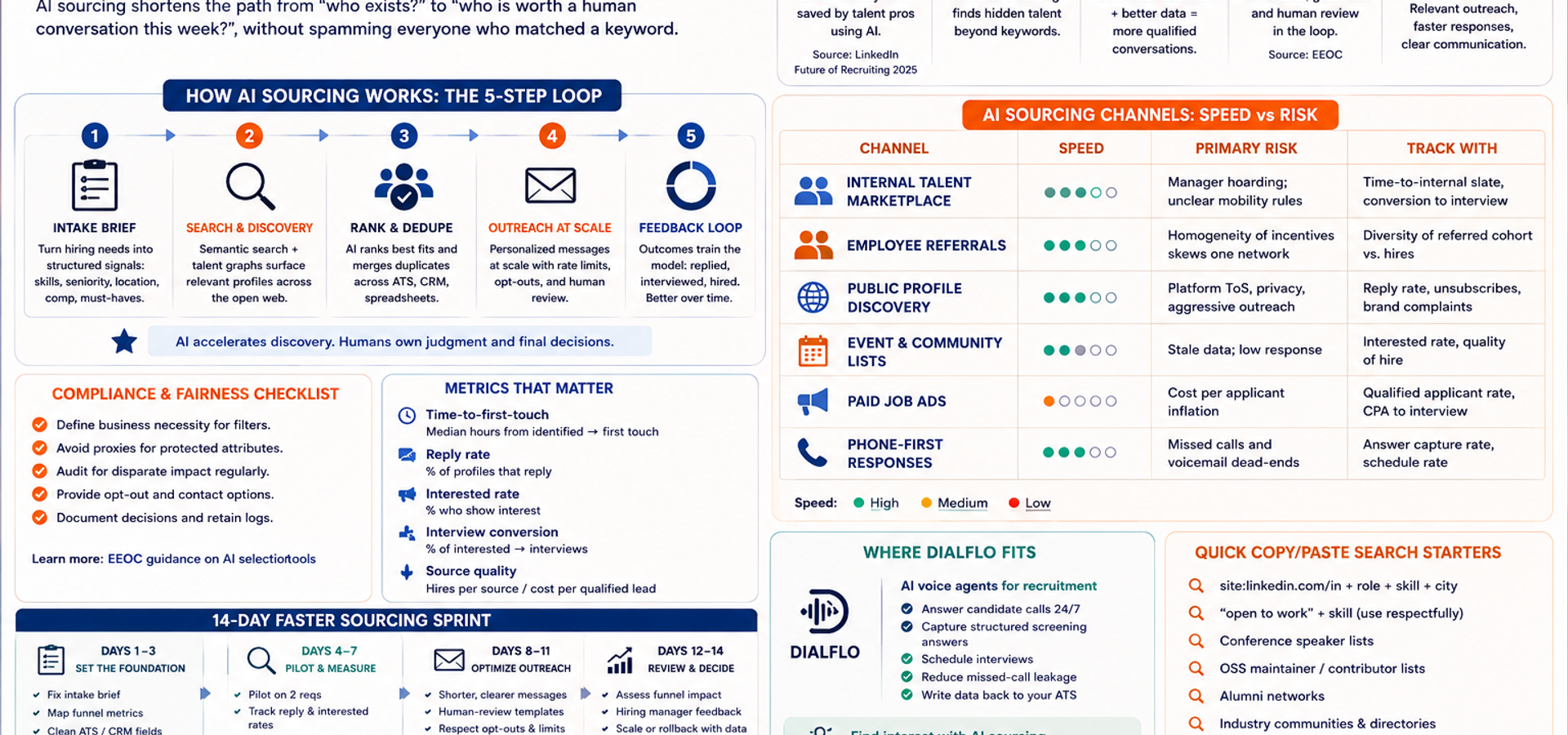
If you’re responsible for reqs that never close, the bottleneck is rarely “not enough internet.” It’s signal under noise. AI sourcing helps recruiters and sourcers compress search time by using semantic models, talent graphs, and ranking, but only when your intake brief, data hygiene, and outreach discipline match the tech.
This guide explains how AI sourcing works in practice, which plays actually speed up hiring, what to measure, and where compliance and candidate experience trip up fast programs. For adjacent funnel stages, read artificial intelligence in recruitment, hire candidates faster with AI tools, and AI applicant screening: how it works & top tools. When sourced candidates call back instead of emailing, Dialflo can handle structured voice intake so interest does not die in voicemail.
What AI sourcing means (in one sentence)
AI sourcing is software-assisted discovery and prioritization of potential candidates, usually before they apply, using search, matching, enrichment, and sometimes generative drafting for outreach that a human still owns.
It is not “set and forget recruiting.” It is a productivity layer on top of judgment, relationships, and compliance guardrails.
How AI sourcing finds candidates faster: the five-step loop
Fast teams treat sourcing as a loop, not a one-time export.
1) Intake brief becomes structured signals
You translate hiring manager language into skills, seniority, domain, location, comp band, and must-have knockouts. AI sourcing tools work better when this brief is structured, free-text paragraphs alone produce noisy matches.
2) Semantic search replaces brittle Boolean-only search
Classic Boolean strings still help, but semantic search maps “distributed systems + payments + leadership” to profiles that never typed your exact keywords. That is usually where speed jumps.
3) Ranking and deduplication reduce review drag
Models suggest who to contact first and merge duplicates across ATS + CRM + spreadsheets. If dedupe fails, candidates get double messaged and your brand pays the tax.
4) Outreach sequences run with personalization at scale
Generative drafts can accelerate first messages, but the best programs require human templates, tone review, and ban lists (competitors, do-not-contact, alumni rules).
5) Feedback retrains what “good” looks like
Mark outcomes: replied, interested, interviewed, hired. Without labels, AI sourcing optimizes for vanity metrics like “profiles viewed.”
Copy/paste search starters (still useful in 2026)
Even with semantic AI sourcing, Boolean and site filters remain handy for edge cases and audits. Mix these with your tool’s natural-language search.
- site:linkedin.com/in + role + skill + city (verify compliance with platform terms)
- “open to work” + skill (treat sensitively; many candidates dislike being filtered only this way)
- Conference speaker lists, OSS maintainer pages, niche community directories
- Alumni networks and internal mobility lists (often highest conversion)
Speed tip: time-box search sessions. Thirty focused minutes with a ranked shortlist beats three hours of tab hoarding.
Evidence: why AI-assisted recruiting work actually accelerates
LinkedIn’s Future of Recruiting research reports that talent professionals already using generative AI save about 20% of their workweek on average, time that can be reinvested in sourcing conversations and closing. Source: LinkedIn: Future of Recruiting 2025.
SHRM’s State of AI in HR research discusses AI applied to recruiting workflows including sourcing and communications, useful context when you build the business case for budget. Source: SHRM: State of AI in HR 2026.
Top tool categories for AI sourcing (what buyers actually assemble)
Rarely does one SKU solve sourcing end-to-end. Most teams combine:
- Talent search / graph products for discovery and ranking across the open web and licensed datasets.
- ATS + CRM as the system of record for sequences, compliance, and pipeline stages.
- Enrichment for email/phone accuracy (validate consent and retention policies).
- Outbound automation with rate limits and domain health (do not torch your company email reputation).
- Internal mobility + referrals, often the highest ROI “sourcing channel” once you surface it with search.
For ATS-level sourcing capabilities and evaluation criteria, see Gem ATS review: features, pricing, and sourcing capabilities and AI agents for recruitment: best tools compared (2026).
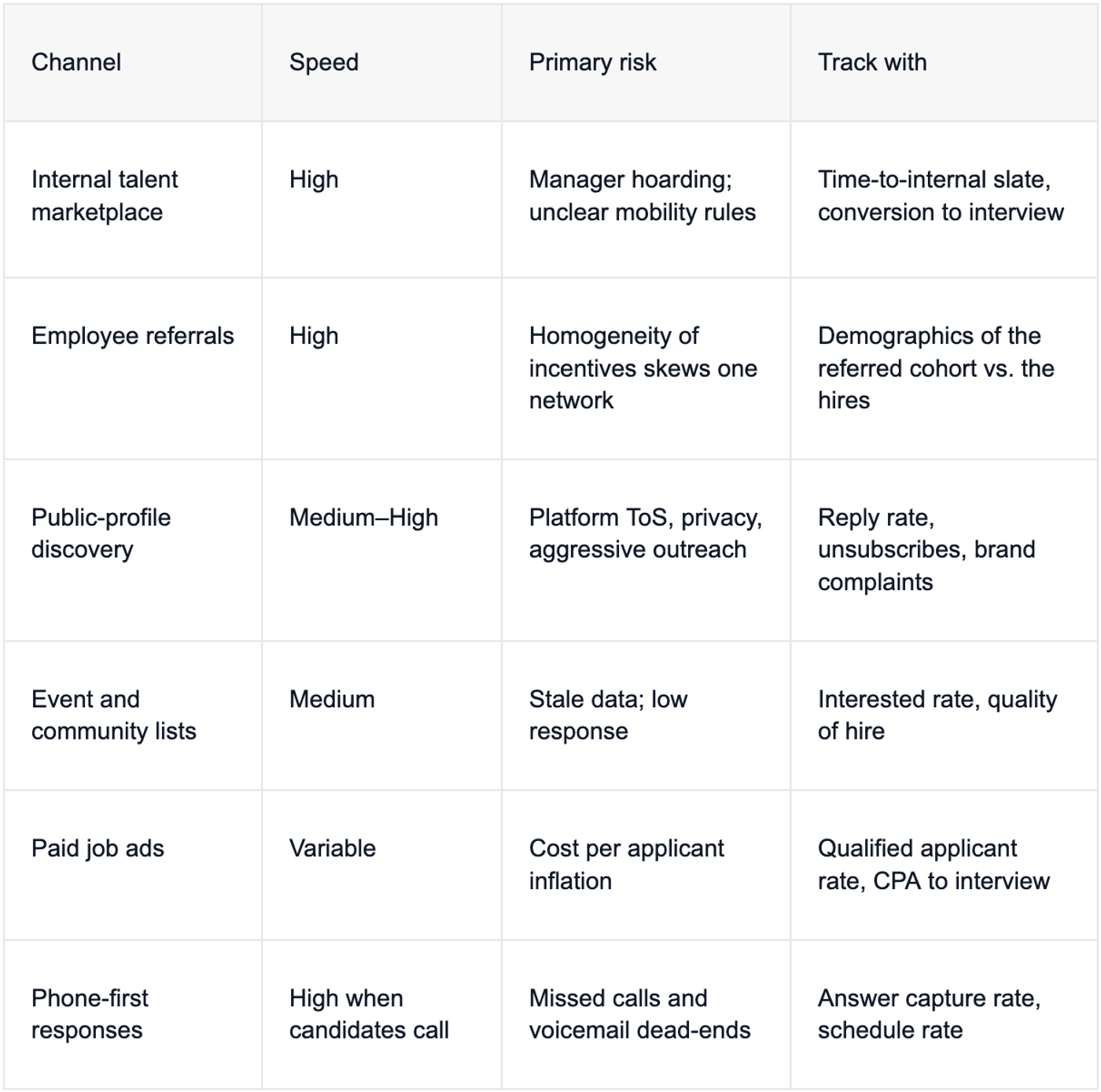
Comparison table: AI sourcing channels, speed vs. risk
Use this table in stakeholder meetings when someone asks “which channel first?”
Compliance and fairness: do this before you scale outreach
If your AI sourcing model learns from “who we hired before,” it can replicate historical skew. U.S. teams should understand EEOC guidance on adverse impact for selection procedures, including algorithmic tools, and run appropriate analyses when sourcing feeds into selection. Read: EEOC: Assessing adverse impact in AI selection procedures.
Operational habits matter: document business necessity for filters, audit lookalike cohorts, and give candidates clear opt-out and contact paths.
A 14-day “faster sourcing” sprint (no new headcount required)
Days 1–2: Fix the brief. One page: must-haves, nice-to-haves, compensation realism, locations, sponsorship policy.
Days 3–5: Clean ATS/CRM fields used for search. If recruiters keep truth in side channels, AI sourcing will confidently recommend the wrong people.
Days 6–9: Pilot one tool on two reqs. Compare reply rate and interested rate vs your baseline week.
Days 10–12: Tighten outreach: shorter messages, one clear CTA, human-reviewed templates.
Days 13–14: Review funnel parity and hiring manager satisfaction. Decide scale or rollback with data, not vibes.
Unique angle: “speed” is time-to-first-touch, not messages sent
Many teams celebrate outbound volume. Candidates celebrate clarity. Reframe KPIs: median hours from identified profile to first meaningful human or approved-bot touch.
When candidates respond by phone, that KPI breaks if nobody answers. That is where voice automation can help, without replacing sourcer judgment on who to target.
Where Dialflo fits after AI sourcing generates interest
Dialflo provides AI voice agents for recruitment that can answer inbound calls from sourced candidates, capture structured screening answers, and schedule next steps. AI sourcing creates leads; voice intake prevents leads from dying when the channel is the phone, not the inbox.
FAQ: AI sourcing
What is AI sourcing?
Software-assisted discovery and prioritization of potential candidates, often using semantic search, matching models, enrichment, and templated outreach with human review.
How does AI sourcing help you find candidates faster?
It reduces manual search time by ranking relevant profiles, deduplicating records, and accelerating first messages, provided your brief and data are clean.
Is AI sourcing the same as AI applicant screening?
No. Sourcing targets pre-applicant discovery and engagement; screening evaluates applicants already in the funnel.
What are the main risks?
Bias amplification, spammy outreach, privacy issues, inaccurate contact data, and over-reliance on volume metrics instead of qualified pipeline.
What metrics should you track?
Time-to-first-touch, reply rate, interested rate, interview conversion, source quality, cost per qualified lead, and demographic parity checks.
How does Dialflo help?
Dialflo focuses on voice-first candidate coordination after interest exists, screening questions, scheduling, and reducing missed-call leakage.
Closing: faster sourcing is a system, not a scraper
AI sourcing helps you find candidates faster when you pair models with crisp intake, ethical outreach, and metrics that reflect candidate experience, not just lead counts.
If phone response is part of your funnel, explore Dialflo to keep conversations moving after your sourcers do the hard part: finding the right humans in the first place.


