AI Candidate Matching: How It Improves Hiring Accuracy

Dialflo: AI Voice Agent
May 27, 2026
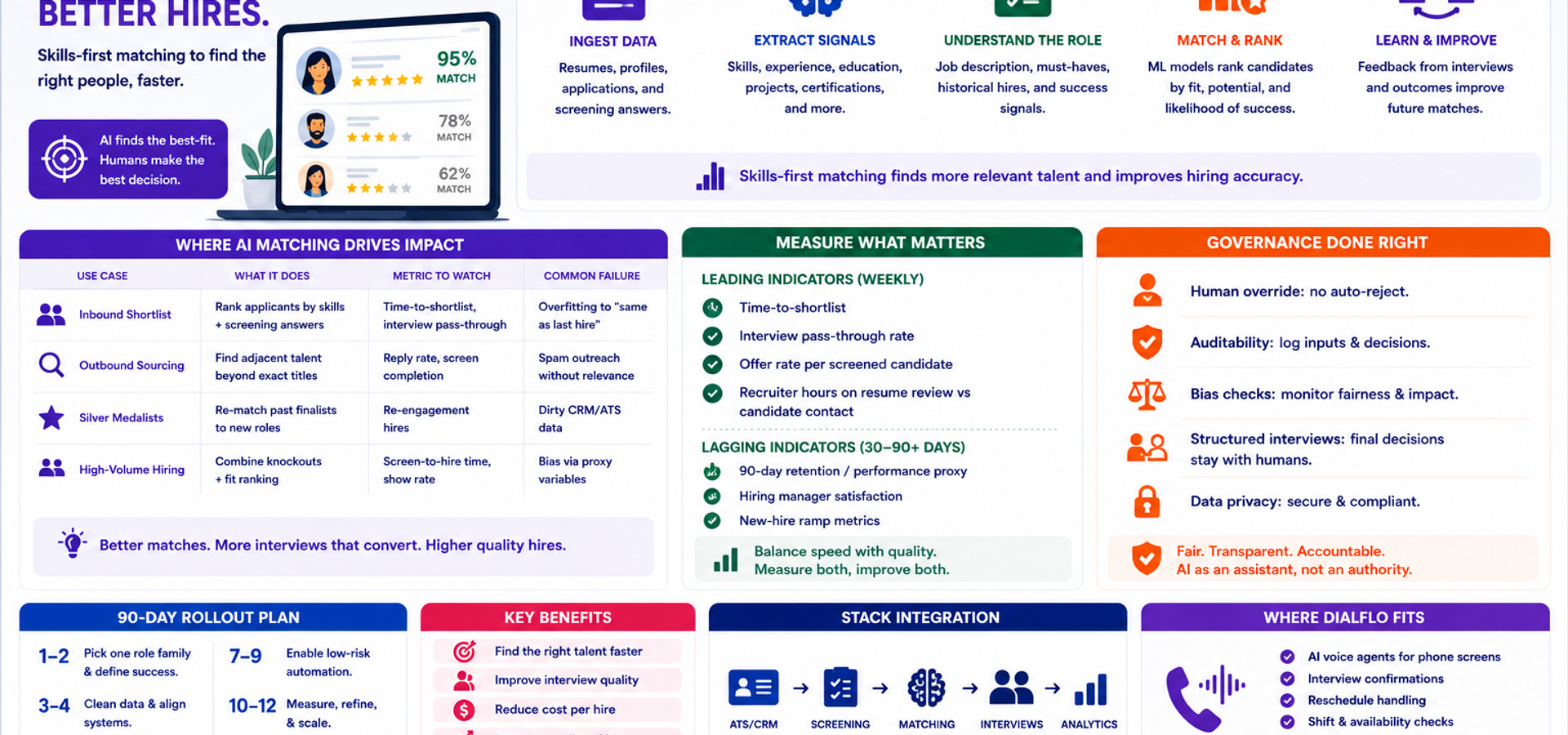
Most hiring accuracy problems are not “we didn’t get enough applicants.” They’re “we can’t tell who will succeed fast enough.” Recruiters and hiring managers drown in resumes, rely on keywords, and then wonder why interviews don’t convert. AI candidate matching is one of the biggest attempts to fix that gap: use skills signals, structured screening, and feedback loops to rank candidates more reliably than “Ctrl+F for Java.”
This guide explains what AI matching actually does, where it improves accuracy (and where it doesn’t), what to measure, and how to roll it out without creating bias or a shadow pipeline. For broader context, read artificial intelligence in recruitment, how AI agents are transforming recruiting, and recruitment analytics software.
What AI candidate matching is (and what it isn’t)
AI candidate matching typically combines:
- Skills extraction from resumes, profiles, and screening answers
- Role understanding from job descriptions and historical hires
- Ranking / recommendations that prioritize candidates for recruiter review
- Feedback loops from interview outcomes and downstream signals
It is not a guarantee of performance. It is not a replacement for structured interviews. And it should not be treated as a “black box yes/no.” The best teams use it as a shortlist accelerator inside governed workflows.
Why matching accuracy improves when you move from keywords to skills
Keyword search misses real talent: alternative titles, adjacent skills, non-traditional paths, or resume wording differences. Skills-based matching tries to normalize that variation.
LinkedIn’s Future of Recruiting 2025 report ties skills-based approaches to quality-of-hire improvements: companies with the most skills-based searches are reported as 12% more likely to make a quality hire. Source: LinkedIn: Future of Recruiting 2025.
Where AI candidate matching helps the most (practical use cases)
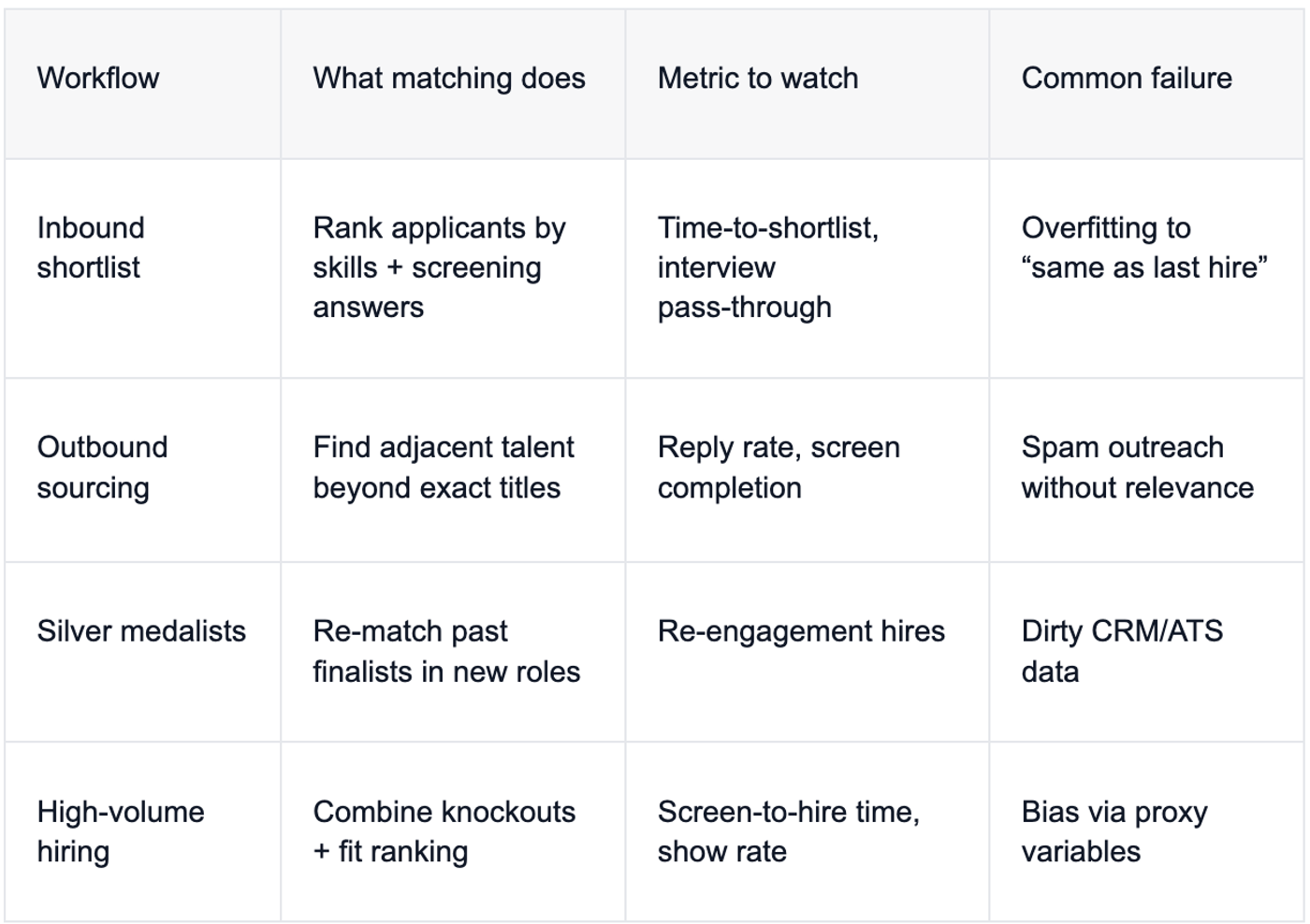
Related reads: AI sourcing, AI applicant screening, and candidate relationship management system (for silver medalist and nurture pipelines).
How to measure “hiring accuracy” (without fooling yourself)
If you only measure time saved, you can ship faster bad hires. If you only measure quality-of-hire, you’ll wait too long to learn. Use a two-layer scorecard:
Leading indicators (weekly):
- time-to-shortlist
- interview pass-through rate by stage
- offer rate per screened candidate
- recruiter hours spent on resume review vs candidate contact
Lagging indicators (30–90+ days):
- 90-day retention proxy
- hiring manager satisfaction
- new-hire ramp metrics (role-specific)
Use a clean system of record so the numbers are trustworthy. Stack integration guidance: integrate recruiting software with existing systems.
Governance: accuracy without fairness is not accuracy
Matching models can create adverse impact if they bake in historical bias, use proxy features, or overfit to past hires. Your governance baseline should include:
- Human override: no auto-reject from matching score alone
- Auditability: keep score inputs and decision logs
- Bias checks: monitor selection rates across groups where lawful and appropriate
- Structured interviews: matching gets you a better shortlist; structured evaluation decides
Practical structured hiring guidance: SHRM: Transform interviewing into strategic talent selection. For AI + discrimination risks, see the EEOC’s overview: EEOC: What is the EEOC’s role in AI?.
Rollout plan: AI candidate matching in 60–90 days
- Pick one role family (not your entire org) and define “good hire” signals.
- Clean your ATS / CRM data: stages, dispositions, duplicate candidates.
- Define the matching contract: what signals count (skills, screen answers), what never counts.
- Pilot with a control group: recruiters can compare matches vs baseline process.
- Measure weekly and review fairness / false negatives monthly.
- Scale only after adoption and after the matching output is used in real decisions (not ignored).
For an “AI-first operating model” mindset, see agentic hiring organization and AI agents for recruitment comparison.
Unique angle: matching improves when execution data is clean
Matching accuracy improves when you have better outcome labels: who completed the screen, who showed up, who passed, who declined, and why. Many teams lose this signal because it lives in phone calls and coordinator notes, not in structured fields.
Where Dialflo fits: voice screens that feed matching and ATS truth
Dialflo is an AI voice execution layer for phone-heavy steps, first-touch screens, confirmations, reschedules, with structured outcomes synced to ATS/CRM. For high-volume and phone-first candidates, this improves the data your matching layer relies on and reduces the coordination bottleneck. Context: hire candidates faster with AI tools and machine learning in recruiting.
FAQ: AI candidate matching
What is AI candidate matching?
ML- and skills-based ranking or recommendations to prioritize candidates for a role beyond keyword matching.
Does it replace recruiters?
No, recruiters still own relationship, judgment, and closing. Matching removes manual sorting and improves shortlist signal.
How do I prove it improves accuracy?
Track time-to-shortlist plus downstream conversion and quality proxies (90-day retention/performance), not just “time saved.”
Is it risky?
Yes if treated as auto-selection. Keep human override, audit logs, and structured interviews.
Do I need a CRM?
If you do outbound sourcing and silver-medalist nurture, yes, see candidate relationship management systems.
How does Dialflo help?
Voice screens and confirmations produce structured outcomes that improve ATS truth and matching inputs.
Closing: better shortlists, better decisions
AI candidate matching improves hiring accuracy when it pushes teams from keyword filtering to skills signals, keeps outputs inside the ATS, and uses structured evaluation to make final decisions. Start with one role family, measure conversion and quality, govern fairness, and scale only what recruiters actually use.
Want to tighten phone-screen execution so your matching layer has cleaner outcomes? Explore Dialflo for recruiting voice workflows.


