AI in Executive Search: How It's Changing Hiring

Dialflo: AI Voice Agent
May 22, 2026
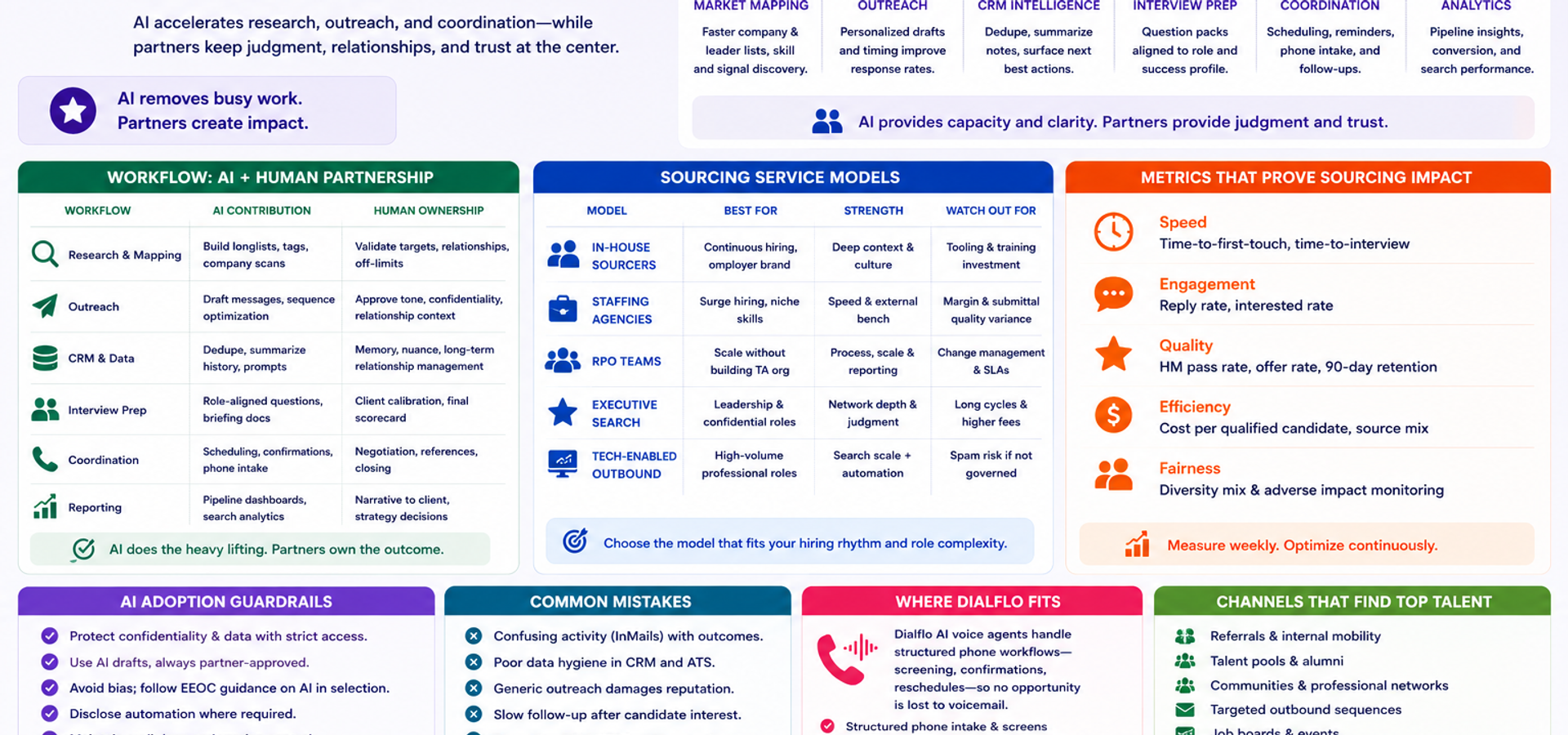
Retained search was always a relationship business: partners, whisper networks, and judgment under confidentiality. Now clients ask whether your firm uses AI, and candidates notice when outreach feels generic. If you are evaluating artificial intelligence executive search workflows, the real question is not “replace consultants” but what work should machines accelerate without breaking trust.
This guide explains how AI in executive search is changing hiring: what firms automate today, what stays human, governance for leadership roles, and where voice coordination fits. For general recruiting AI context, read artificial intelligence in recruitment and how AI agents are transforming recruiting.
What executive search is (and why AI lands differently here)
Executive search targets leadership and specialist roles, often retained, confidential, and relationship-driven. Cycle times are longer than high-volume hiring. A single placement can define a firm’s year.
That means artificial intelligence executive search adoption looks different from hourly hiring automation:
- fewer candidates, higher stakes per name
- confidentiality and brand risk on every message
- assessment is qualitative, track record, culture, board dynamics
- CRM memory spans years, not one req
AI helps most when it removes research and coordination drag, not when it pretends to “score” a CEO in a black box.
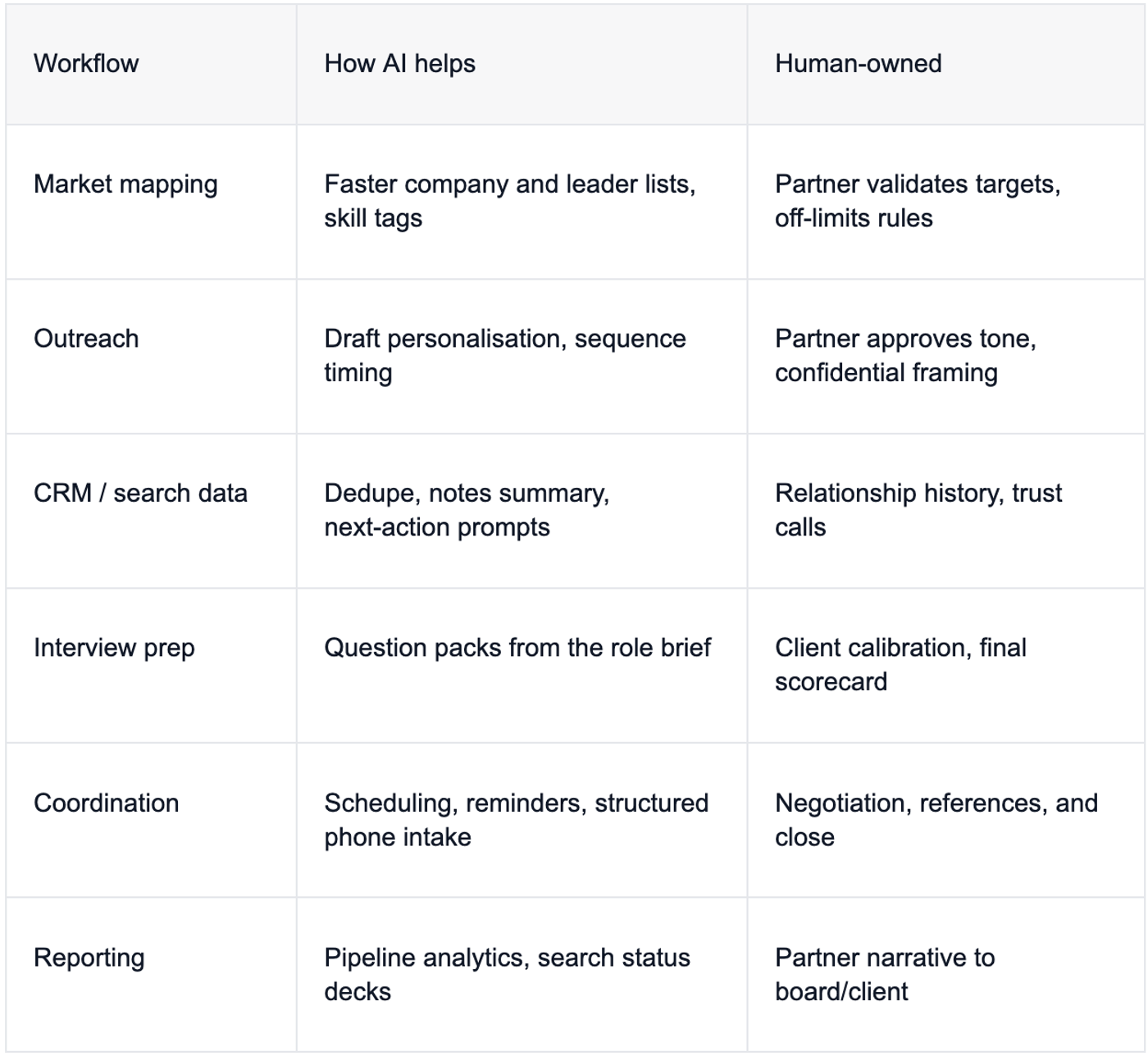
How AI is changing executive search: six shifts
1) Research and market maps compress from days to hours
Associates once spent nights building longlists in spreadsheets. AI-assisted research speeds company scans, title patterns, and public signal gathering, humans still verify accuracy, conflicts, and “do not approach” lists.
Pair disciplined sourcing with candidate sourcing services thinking and AI sourcing, executive search is outbound-first at the highest level.
2) Talent CRM becomes non-optional
Search firms live on memory: who met whom, who said “not now,” who refers leaders in a sector. Artificial intelligence executive search only works if data lives in a governed CRM, not personal inboxes.
See candidate relationship management system and enhancement layers in GEM ATS review for how sourcing CRM sits beside core ATS/search systems.
3) Outreach quality separates firms (AI can help or hurt)
Leaders ignore templated blasts. AI drafts can save time if a partner edits for context, confidentiality, and respect. LinkedIn’s talent research stresses candidate experience and relevant engagement, executive search is the extreme case where one bad message travels fast. Source: LinkedIn: Future of Recruiting 2025.
4) Interview preparation scales without dumbing assessment
Structured question packs from role briefs help consultants and clients align before first meetings, see generate interview questions from job description using AI and interview intelligence. Scoring algorithms rarely replace partner judgment at C-suite; notes and themes matter more.
5) Analytics move search partners from gut to pipeline truth
Partners need conversion by stage, time-in-search, and source quality, not only placement count. Layer recruitment analytics software on clean CRM data. SHRM’s talent acquisition toolkit applies to in-house executive hiring teams as well as search firms supporting clients. Source: SHRM: Talent acquisition toolkit.
6) Coordination, calls, confirmations, scheduling, still leaks placements
Even in executive search, candidates drop when callbacks go to voicemail or calendars stall. AI voice and agent workflows can run structured intake and confirmation if outcomes sync to CRM, without replacing the partner call that builds trust.
Governance for artificial intelligence executive search
Leadership hiring carries reputational and legal weight. Before scaling AI:
- Confidentiality: no public LLM pastes with client or candidate identifiers without enterprise controls
- Access: role-based CRM permissions, audit logs
- Selection AI: if used, document adverse-impact review, US clients may expect alignment with EEOC guidance on AI in selection
- Disclosure: tell candidates when automation is material
- Partner sign-off: on outreach and shortlists presented to clients
Gartner’s HR technology research emphasizes governance and adoption, not feature lists, as ROI drivers. Source: Gartner: HR technology.
Rollout playbook for search firms and in-house executive hiring
- Pick one bottleneck: longlist time, CRM hygiene, or scheduling drag.
- Centralize data in search CRM/ATS, integrate recruiting software with research tools.
- Pilot on one search with partner review gates on all AI drafts.
- Measure: hours to longlist, candidate response rate, time-to-first client interview.
- Scale only workflows consultants actually use.
Compare agent options in AI agents for recruitment comparison and operating models in agentic hiring organization.
Unique angle: executive search sells judgment, AI sells capacity
Clients pay for pattern recognition, discretion, and close. Artificial intelligence executive search wins when associates and researchers get capacity back, deeper maps, faster follow-up, cleaner CRM, while partners stay on relationship and assessment work. Firms that market “fully automated C-suite hiring” misunderstand the category.
Where Dialflo fits: phone coordination without replacing the partner call
Dialflo is AI voice execution for structured phone steps, confirmations, scheduling, intake questionnaires, that should write outcomes to your search CRM or ATS. It supports AI in executive search operations where phones still matter; it does not replace partner judgment or client advisory conversations. Broader funnel context: hire candidates faster with AI tools and machine learning in recruiting.
FAQ: artificial intelligence executive search
How is AI used in executive search?
Research, CRM, outreach drafts, prep, analytics, coordination, human partners own assessment and close.
Will AI replace executive recruiters?
No for retained leadership search; yes for parts of research and admin when governed.
Main risks?
Confidentiality, bad data, generic outreach, opaque scoring, govern and require partner review.
Need a talent CRM?
Yes for most firms, relationship memory is the product.
Confidential searches?
Tight access controls; no public AI tools on identifiable data; partner approves outreach.
How does Dialflo help?
Structured voice workflows with CRM/ATS write-back for coordination steps.
Closing: faster maps, same trust bar
AI in executive search is changing hiring by compressing research and coordination while raising the bar on data hygiene and candidate experience. The firms that win use artificial intelligence executive search tools to deepen judgment capacity, not to avoid the hard conversation that closes a leader.
Improving search operations? Explore Dialflo for voice workflows that keep CRM pipelines current when every callback counts.


