TCPA-Compliant AI Outbound Calling for SMBs: What to Buy

Dialflo: AI Voice Agent
August 18, 2026

AI outbound calling has moved from an experimental technology to a practical sales and operations tool for small and mid-sized businesses. AI voice agents can qualify leads, follow up with prospects, confirm appointments, collect information, conduct recruiting screens, and handle repetitive customer conversations.
But there is an important distinction between automating outbound calls and automating outbound calls responsibly.
For SMBs in the United States, an AI voice agent can create compliance risk if it calls the wrong people, lacks appropriate consent, ignores Do Not Call requests, or fails to maintain proper records. The FCC has confirmed that AI-generated voices fall under the TCPA's restrictions on artificial or prerecorded voices. For telemarketing calls using AI-generated or artificial voices, prior express written consent may be required. (FCC Docs)
That means the right buying decision is not simply:
"Which AI voice platform has the most natural voice?"
The better question is:
"Which AI outbound calling platform gives my business the automation, controls, integrations, and compliance processes needed to operate calls responsibly?"
This guide explains what SMBs should evaluate before buying.
What Does TCPA-Compliant AI Outbound Calling Mean?
The Telephone Consumer Protection Act (TCPA) regulates certain calls and communications, including calls using artificial or prerecorded voices. In February 2024, the FCC clarified that AI technologies that generate or simulate human voices fall within the TCPA's artificial or prerecorded voice restrictions. (FCC Docs)
For businesses, this means an AI voice agent should not be treated as fundamentally different from other automated calling technologies simply because the conversation sounds natural.
Compliance can involve several areas:
- Obtaining the appropriate consent before making covered calls
- Maintaining accurate consent records
- Respecting Do Not Call requests
- Screening calling lists against applicable suppression lists
- Providing appropriate identification and disclosures
- Honoring opt-out requests
- Controlling calling frequency
- Restricting calls to appropriate hours
- Maintaining records of campaigns and interactions
- Understanding state-level telemarketing requirements
The FTC's Telemarketing Sales Rule also contains requirements around calling times, caller ID, Do Not Call requirements, prerecorded messages, disclosures, and recordkeeping. (Federal Trade Commission)
Importantly, no software platform can automatically make every campaign legally compliant. Your business, campaign purpose, target audience, consent process, scripts, data sources, and calling practices all matter.
The platform should instead give your team the controls needed to build and operate a compliant calling workflow.
Why SMBs Are Buying AI Voice Agents
The business case for AI outbound calling is straightforward.
Sales representatives may spend hours calling leads who never answer. Recruiters repeatedly contact candidates for initial screening. Logistics teams make routine calls to carriers and customers. Service teams follow up on appointments and unresolved issues.
These tasks are important but often repetitive.
AI voice agents can automate parts of these workflows while allowing human employees to focus on conversations that require judgment.
For example, a sales team could use an AI agent to:
- Call a qualified lead.
- Confirm basic requirements.
- Ask predefined qualification questions.
- Capture responses.
- Identify buying intent.
- Schedule a meeting.
- Transfer high-intent conversations to a human.
Dialflo positions its platform around AI-powered voice agents for sales, recruiting, logistics, customer support, and other business workflows. Its platform supports both inbound and outbound calling, integrations with CRM and ATS systems, multilingual conversations, custom workflows, and API-based integrations. (Dialflo Documentation)
For SMBs, this makes workflow fit more important than simply buying the cheapest minutes.
1. Start With Consent Management
Consent should be one of the first things you evaluate when purchasing an AI calling platform.
Do not begin with voice quality or the number of available AI models. Begin with the question:
Can the platform help my business control who is eligible to be called?
Your system should ideally allow you to associate contacts with information such as:
- Source of the lead
- Date consent was obtained
- Type of consent
- Phone number associated with consent
- Campaign or purpose
- Opt-out status
- Previous contact history
For telemarketing calls involving AI-generated voices, the FCC states that prior express written consent is required where its rules call for that level of consent. (FCC Docs)
Your legal requirements can vary depending on the type of call, recipient, relationship, and purpose, so SMBs should have their specific campaign reviewed by qualified counsel where appropriate.
2. Look for Do Not Call Controls
A compliant outbound calling system needs more than a dialer.
It needs suppression controls.
The FTC states that covered telemarketers must honor consumers' National Do Not Call Registry status and company-specific Do Not Call requests, subject to applicable rules and exemptions. The FTC also recommends maintaining written procedures and entity-specific Do Not Call lists. (Federal Trade Commission)
When evaluating a platform, ask:
- Can contacts be suppressed automatically?
- Can a customer request be added to a company-specific DNC list?
- Does the system prevent future calls after an opt-out?
- Can suppression lists be imported and exported?
- Can administrators audit changes?
- Can campaigns use different suppression rules?
An AI agent that remembers what a prospect said but continues calling after an opt-out is not a useful automation system.
3. Evaluate Call-Time Controls
Calling someone at the wrong time can create both customer-experience and compliance problems.
The FTC's Telemarketing Sales Rule generally restricts outbound telemarketing calls to a consumer's home outside 8 a.m. to 9 p.m. local time unless prior consent permits otherwise. (Federal Trade Commission)
Your AI calling platform should therefore support:
- Recipient-local time zones
- Calling windows
- Campaign schedules
- Weekend controls
- Holiday restrictions
- Retry limits
- Maximum attempts per contact
This is particularly important for SMBs operating across multiple states or time zones.
A prospect in California should not be treated the same way as a prospect in New York simply because they were uploaded into the same CRM list.
4. Check AI Disclosure and Caller Identification
Natural-sounding AI creates a new challenge.
If a recipient cannot tell who is calling or why, the experience can quickly become deceptive.
The FCC has confirmed that its rules require artificial or prerecorded voice messages generated by AI technologies to provide certain identification and disclosure information for the entity responsible for initiating the call. (FCC Docs)
When evaluating a platform, ask whether you can configure:
- Business identification
- Agent identity
- Purpose of the call
- Appropriate opening disclosures
- Opt-out instructions
- Transfer-to-human workflows
The exact disclosure requirements depend on the campaign and applicable law, so businesses should not simply copy a generic script.
5. Choose Workflow Automation Over a Simple AI Dialer
A basic AI dialer makes calls.
A business-grade AI voice platform should do more.
For example, an SMB sales workflow could look like:
CRM lead → eligibility check → AI call → qualification → CRM update → meeting booking → human handoff
That eliminates multiple manual steps.
The same concept works in logistics:
Shipment event → AI call → carrier response → status captured → TMS updated → exception escalated
Dialflo supports custom business logic, knowledge bases, integrations, APIs, and connections with CRM, ATS, scheduling, and telephony systems. (dialflo.ai)
For companies evaluating AI voice agents, workflow integration should therefore be a major buying criterion.
You can also read about how sales teams use AI voice agents to save hours and AI voice agents for sales.
6. Make CRM Integration a Requirement
Your AI agent should not create another data silo.
Every call can generate valuable information:
- Call outcome
- Qualification status
- Customer responses
- Follow-up date
- Appointment status
- Objections
- Call transcript
- Next action
If that information stays inside the voice platform, employees may still have to manually update the CRM.
Look for integrations or APIs that can push call outcomes into your existing systems.
For example, a B2B sales team might want:
AI call completed → qualification score → CRM field updated → task created → meeting scheduled
That is much more valuable than simply increasing the number of calls made per day.
7. Review Integrations Before Buying
An AI voice platform should fit into your existing technology stack.
Depending on your business, this could include:
- Salesforce
- HubSpot
- Zoho
- ATS platforms
- Recruiting software
- Calendars
- TMS platforms
- Help desks
- Telephony providers
- Webhooks
- Internal APIs
If you operate a logistics business, integrations can become particularly important because outbound calls may need to trigger updates inside transportation management systems.
For example, Dialflo content covers workflows such as automated carrier check-call logging, automated load-status updates, and connecting conversational AI voice agents with TMS APIs.
8. Don't Ignore Security and Data Handling
AI voice calls can contain sensitive business and personal information.
Depending on your use case, conversations may include:
- Names
- Phone numbers
- Addresses
- Employment information
- Customer details
- Account information
- Business-sensitive data
Ask the vendor:
- How is call data encrypted?
- Where is data stored?
- How long are transcripts retained?
- Who can access recordings?
- Can retention periods be configured?
- Are access controls available?
- What compliance certifications or frameworks apply?
- Does the platform support private deployment where required?
Dialflo states that it provides encrypted transcript storage, access controls, enterprise security capabilities, and support for private/on-premise deployment options. (dialflo.ai)
For an SMB, this doesn't necessarily mean you need the most complex enterprise security stack. It means the vendor should clearly explain how your data is handled.
9. Compare Pricing by Completed Outcomes, Not Just Minutes
Per-minute pricing is easy to compare but can be misleading.
Suppose Platform A costs less per minute but requires separate charges for:
- Telephony
- Speech-to-text
- Text-to-speech
- LLM usage
- Call recording
- Transcription
- Integrations
- Number provisioning
Platform B may have a higher headline price but include more of the infrastructure.
Dialflo currently states that its voice AI pricing starts at INR 6 per minute, with volume-based discounts available. (dialflo.ai)
When comparing vendors, calculate:
Total monthly cost ÷ completed business outcomes
For sales, the outcome could be qualified meetings.
For recruiting, it could be completed screens.
For logistics, it could be successfully resolved calls.
This gives you a much better view of ROI than raw minutes.
For additional vendor research, SMB buyers can compare Retell AI pricing vs. Dialflo pricing, Retell vs. Dialflo, or evaluate Vapi alternatives.
10. Test the Platform With a Small Pilot
Don't deploy AI outbound calling across your entire database on day one.
Start with a controlled pilot.
A practical SMB pilot could include:
Week 1: Define the use case, audience, consent requirements, script, escalation rules, and success metrics.
Week 2: Test calls internally and with a small approved contact group.
Week 3: Analyze pickup rates, conversations, qualification rates, transfers, opt-outs, and errors.
Week 4: Improve the workflow and expand only if the results justify it.
Dialflo also has a guide covering how to run a four-week voice AI pilot for a US SMB.
This approach reduces technical and operational risk while giving your team real performance data.
What Should an SMB Buy?
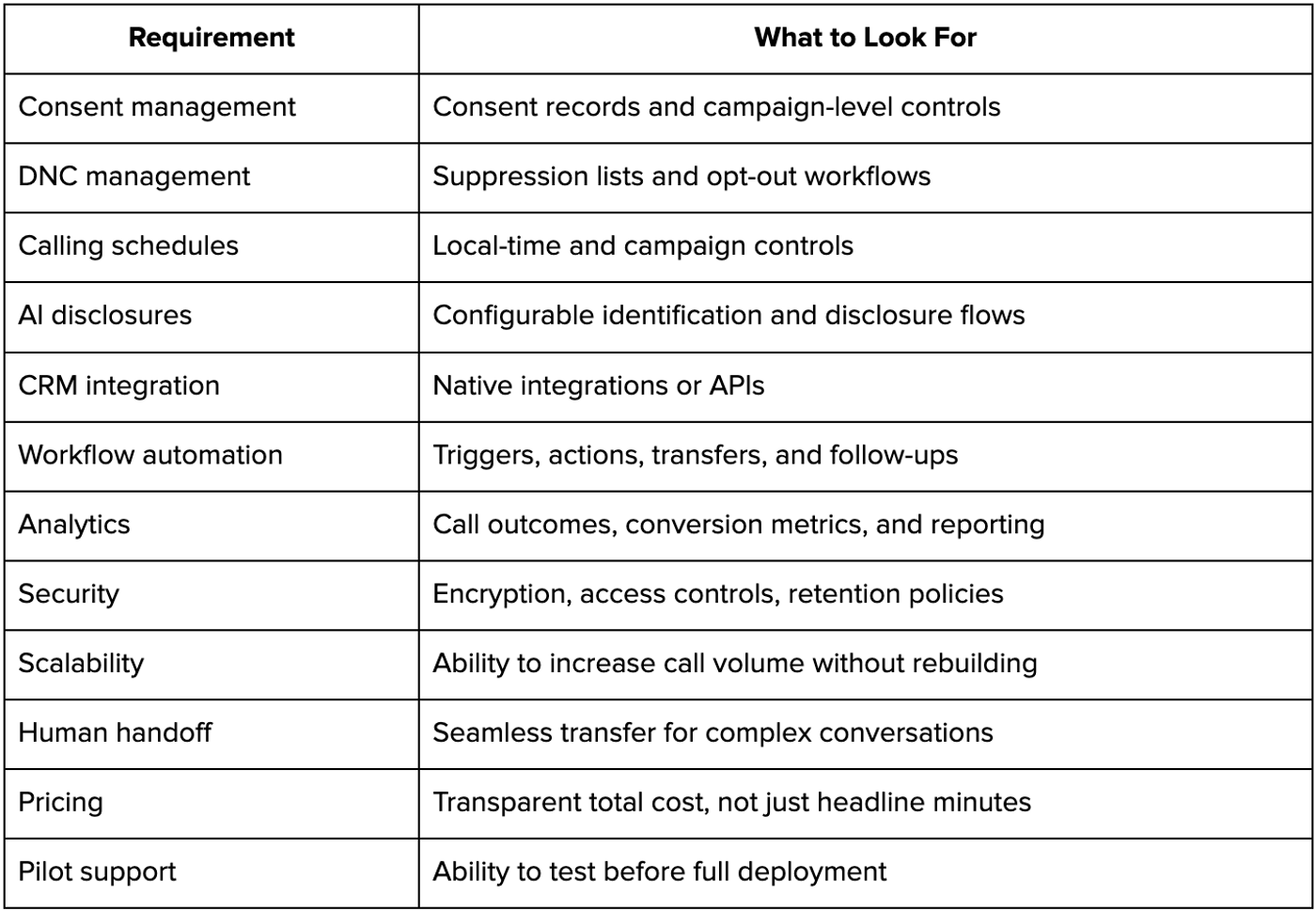
For most SMBs, the ideal TCPA-conscious AI outbound calling platform should include these capabilities:
What You Should Not Buy
Avoid choosing a platform solely because it has:
- The cheapest per-minute rate
- The most realistic voice
- The largest voice library
- The highest concurrency
- The longest feature list
Those features can matter, but they don't solve the core business problem.
A platform that makes thousands of calls but gives you weak consent controls, poor integrations, limited analytics, or unreliable handoffs can create more operational problems than it solves.
The goal is controlled automation, not maximum automation.
Dialflo for SMB AI Outbound Calling
Dialflo provides AI voice agents designed for business workflows including sales, recruiting, logistics, support, and D2C operations. The platform supports inbound and outbound calls, multilingual conversations, integrations, custom workflows, knowledge bases, and API-based deployment. (Dialflo Documentation)
Its platform is also designed to support high call concurrency and real-time conversations, which can be useful for SMBs that need to scale outbound workflows without proportionally increasing headcount. (dialflo.ai)
For businesses evaluating different voice AI architectures, Dialflo also provides resources on building vs. buying a voice AI stack and the best AI voice agent platforms.
Final Checklist Before You Buy
Before launching an AI outbound calling campaign, ask five questions:
1. Do we have the right permission to make these calls?
2. Can our system automatically suppress people who should not be called?
3. Can we control when and how frequently the AI calls?
4. Can every call outcome flow back into our CRM or business system?
5. Can we measure business outcomes and audit what happened?
If the answer to all five is yes, you are evaluating the technology in the right way.
AI outbound calling can help SMBs increase sales activity, accelerate recruiting, reduce repetitive operations work, and handle customer follow-ups at scale. But the strongest implementations don't treat compliance as an afterthought.
They build consent, suppression, disclosure, scheduling, security, human escalation, and reporting into the workflow from the beginning.
For SMBs, TCPA-compliant AI outbound calling is ultimately less about buying an AI that can make phone calls and more about buying an automation system that can make the right calls, to the right people, under the right conditions, with the right controls.
Frequently asked questions
Does the TCPA apply to AI voice agents?
Yes. The FCC confirmed in February 2024 that AI-generated voices count as artificial voices under the TCPA, so automated outbound calls that use them need the same prior express consent as other robocalls.
What should an SMB check before buying an AI outbound calling tool?
Consent records, Do Not Call scrubbing, calling-hour controls by time zone, AI disclosure, CRM write-back, and security. A tool that only dials, without workflow and compliance controls, puts the risk back on your team.
Is AI disclosure required on outbound calls?
Rules vary by state and are changing, so disclose that the caller is an AI agent at the start of the call and identify your business. It is the safer default and it builds trust with the person you are calling.
How should we pilot TCPA-compliant AI calling?
Start with one consented list and one workflow, such as appointment reminders or inbound lead callbacks, review recordings and opt-outs weekly, and expand only once the compliance checks hold up.
Evaluating platforms against this checklist? Book a Dialflo demo and test each control on your own outbound campaign.
This article is for general informational purposes and is not legal advice. TCPA, FTC, state telemarketing, privacy, and AI-related requirements can vary by campaign, recipient, jurisdiction, and calling purpose. Businesses should obtain qualified legal advice for their specific outbound calling program.