Connecting AI Voice Agents to the MercuryGate TMS API

Dialflo: AI Voice Agent
June 11, 2026
A shipper calls at 4:47 p.m. asking for stop-two ETA on a six-stop milk run. Your coordinator alt-tabs out of MercuryGate, reads the transport order, checks the carrier note from two hours ago, and types an update while three more lines ring. Chicago 3PLs run dense multi-shipper books on MercuryGate, and voice traffic grows faster than coordinator headcount.
Connecting conversational AI voice agents to the MercuryGate TMS API closes that gap: inbound and outbound calls pull live shipment truth from MercuryGate, run natural-language scripts, and write structured dispositions back, so humans focus on detention, re-routes, and account exceptions. This guide covers what to integrate, which call types automate first, and how to pilot on one shipper lane without breaking SLA trust.
Why Chicago 3PLs run MercuryGate, and hit the same wall
MercuryGate is common among 3PLs and managed transportation providers because it supports multi-client operations, rating, tendering, tracking, and shipper portals in one TMS. Chicago operators add regional pressure:
- high warehouse appointment density south and west of the city
- Midwest linehaul volatility (weather, detention, rail handoffs)
- dozens of shipper accounts with different status-call SLAs
- after-hours rings that become next-morning backlog
- carrier check calls that must log before shipper portals update
The TMS is not the bottleneck, repetitive phone work is. Background: scaling 3PL customer follow-ups, AI voice agents for thousands of routine logistics calls, and where is my shipment calls.
What the MercuryGate TMS API enables for voice AI
MercuryGate exposes integration paths, REST/SOAP web services, partner connectors, and event-driven workflows depending on your deployment. For voice agents, the practical split is:
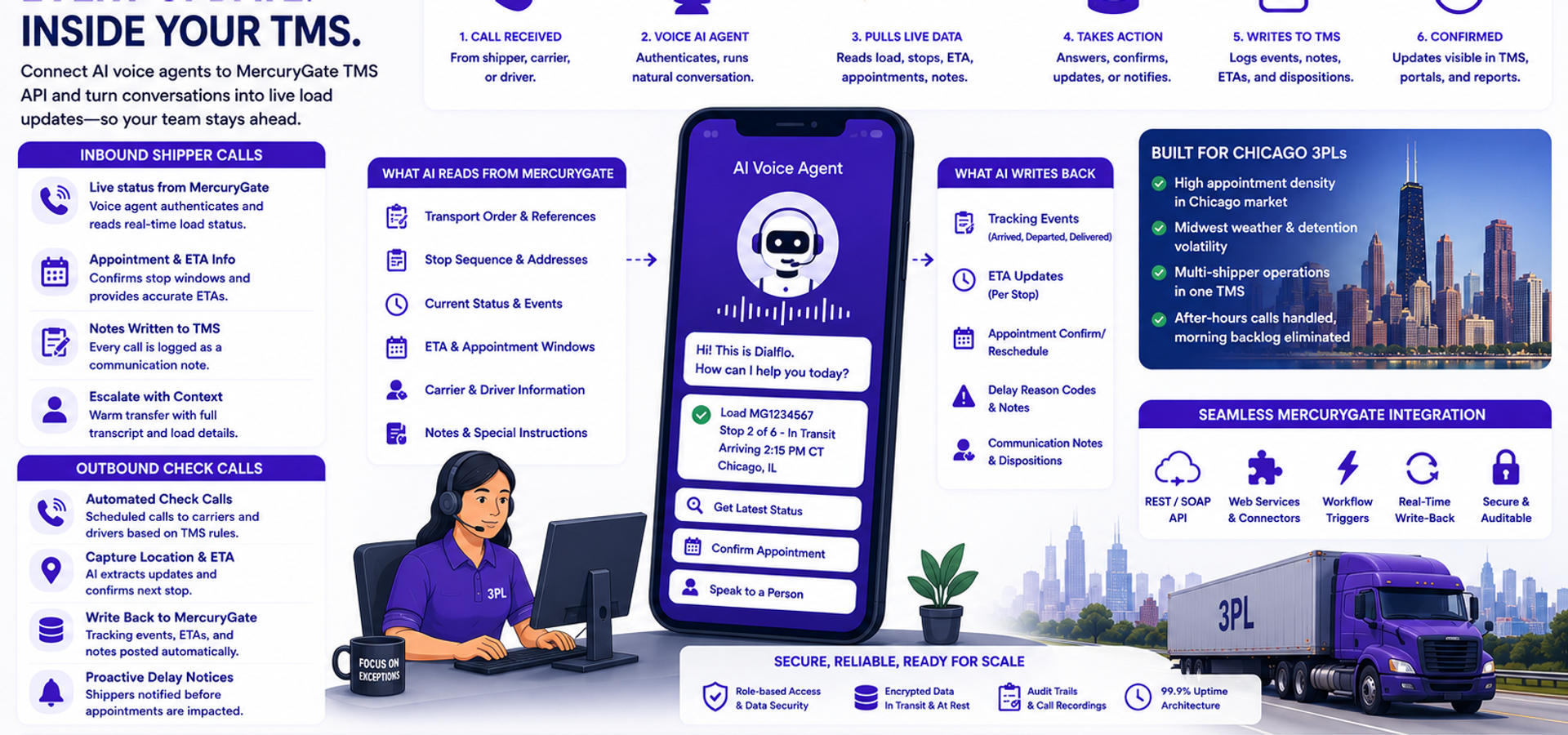
Read paths (lookup before speaking):
- transport order / shipment ID and shipper reference numbers
- stop sequence, addresses, appointment windows
- current status, last tracking event, carrier assignment
- contact numbers for carrier, driver, or consignee
- shipper-specific rules (call before delivery, appointment confirm required)
Write paths (log after the call):
- status or tracking event with timestamp
- check-call or communication note on order or stop
- revised ETA or appointment confirm flag
- delay reason code and short narrative
- disposition metadata for reporting (AI-handled vs transferred)
Exact endpoints depend on your MercuryGate version and integration tier, pilot read-only first, then enable controlled write-back on one event type. Integration planning: build vs buy voice AI stack and technology used in supply chain management.
Architecture: conversational AI ↔ MercuryGate TMS API
A production integration typically runs five layers:
- Telephony: Inbound DIDs per shipper or pooled overflow; outbound for check calls and proactive delay.
- Voice AI orchestration: Script, NLU, authentication (PRO, BOL, shipper ref), warm transfer.
- MercuryGate adapter: API client with rate limits, retry, and field mapping to your tenant schema.
- Rules engine: Which orders trigger outbound; which statuses block auto-answer.
- Observability: Containment rate, repeat caller rate, API error log, note lag time.
Conversational layer design: conversational services use cases and replacing phone trees with conversational voice AI. Broader ops context: the logistics decision gap.
Inbound shipper calls with live MercuryGate context
When a shipper asks “where is my freight,” generic hold music fails. With MercuryGate TMS API lookup, the voice agent:
- authenticates by shipper account number, PO, or BOL
- reads current stop, last scan, and honest ETA window
- states appointment status for pending deliveries
- logs a communication note with call summary
- transfers with transcript if data is stale or account is flagged VIP
That is tier-one 3PL customer communication at scale, same desk, more orders, shorter queues. Exception triage: reducing delivery exception calls before ops.
Outbound check calls and proactive updates
MercuryGate status only helps shippers if someone logs carrier truth first. Outbound voice AI triggered from TMS rules:
- pre-pickup arrival check within two hours of window
- in-transit location and ETA on long Midwest legs
- pre-delivery confirm for appointment-required stops
- proactive delay when appointment risk flag fires in MercuryGate
Each completed call writes tracking or communication events, cutting repeat inbound within two hours. Dispatch load reduction: reducing dispatcher call load by 70%.
Multi-shipper configuration on one MercuryGate tenant
Chicago 3PLs rarely serve one brand. Voice integration must respect:
- Per-shipper scripts: Greeting, reference number format, escalation phone.
- SLA tiers: Auto-answer vs immediate human for strategic accounts.
- Branding: Some shippers require named coordinator transfer even when AI resolves.
- Data scope: API credentials scoped so Agent A never reads Shipper B orders.
- Reporting: Containment and note lag per shipper for QBR evidence.
Start with one mid-volume shipper lane, enough call volume to measure, not enough risk to sink a relationship if pilot tuning takes a week.
Chicago 3PL pilot patterns on MercuryGate
Pattern 1: Inbound overflow 3–7 p.m.: Voice AI answers status queue when coordinators are on appointment-chase duty.
Pattern 2: Outbound check calls on I-55 / I-80 lanes: High repetition, structured write-back to stop notes.
Pattern 3: Weather burst: Extra proactive delay calls when MercuryGate exception rules fire, absorbs spike without temp staff.
Pattern 4: After-hours: Night moves still need logged notes; morning queue shows AI dispositions for human review.
Surge playbooks: peak season call volume without hiring dispatchers. Missed-call cost: hidden cost of missed calls in logistics.
Metrics for MercuryGate + voice AI deployments
- MercuryGate API success rate (read and write)
- time from call end to note or event posted
- tier-one containment without human transfer
- repeat caller rate within two hours (data quality signal)
- inbound answer rate and average handle time
- orders per coordinator on pilot shipper
- shipper satisfaction or status-call complaint volume
AI logistics context: AI in logistics use cases, AI supply chain technology trends, and machine learning in supply chain optimization. Regional freight data: BTS statistical products.
Common integration failure points
API rate limits during burst: Queue writes and cache last-known status for read-heavy hours.
Field mapping drift: MercuryGate custom fields per shipper, version your adapter when tenants change.
Stale tracking events: Repeat callers mean bad carrier data, not bad voice tone, fix upstream check calls.
Over-automating VIP accounts: Flag strategic shippers for human-first or instant transfer.
No audit trail: Attach transcript or recording ID to communication notes for billing disputes.
Where Dialflo fits
Dialflo connects conversational AI voice agents to the MercuryGate TMS API for Chicago 3PLs, inbound shipper status, outbound carrier check calls, appointment confirm, and proactive delay, with structured write-back, warm transfer, and per-shipper script configuration.
Pilot one shipper lane on dialflo.ai when MercuryGate holds the truth but your coordinators cannot keep notes current with call volume.
FAQ: MercuryGate TMS API and voice AI for Chicago 3PLs
Can voice agents read and write MercuryGate?
Yes, via TMS API or approved web services; start read-only, then enable notes and events.
What calls automate first?
Inbound shipper status and outbound in-transit check calls on high-volume lanes.
How do multi-shipper 3PLs configure scripts?
Per-shipper greeting, auth fields, escalation rules, and scoped API access.
Does integration replace coordinators?
No, tier-one automation; humans on exceptions and key accounts.
How long to pilot?
Often 2–4 weeks with read-only week two and write-back week three.
How does Dialflo help?
Voice AI + MercuryGate TMS API integration for 3PL ops, see dialflo.ai.
Closing: MercuryGate stays the system of record
Chicago 3PLs do not need another portal, they need every call to land in MercuryGate as fast as it happens. Connecting conversational AI voice agents to the MercuryGate TMS API makes shipment truth available on the phone and on the record at the same time, while coordinators handle detention, re-routes, and the shippers who still want a named human on line one.
Ready to connect voice agents to MercuryGate? Explore Dialflo for TMS-integrated conversational AI built for Chicago 3PL operations.