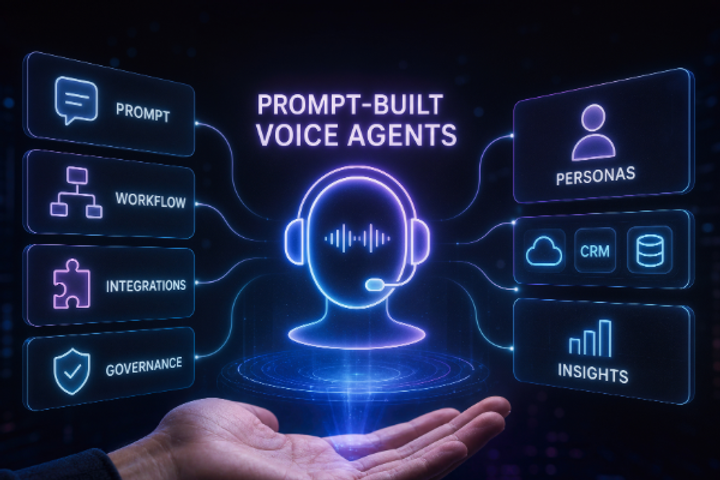
What's Bundled in a Voice AI Platform

Dialflo: AI Voice Agent
July 27, 2026
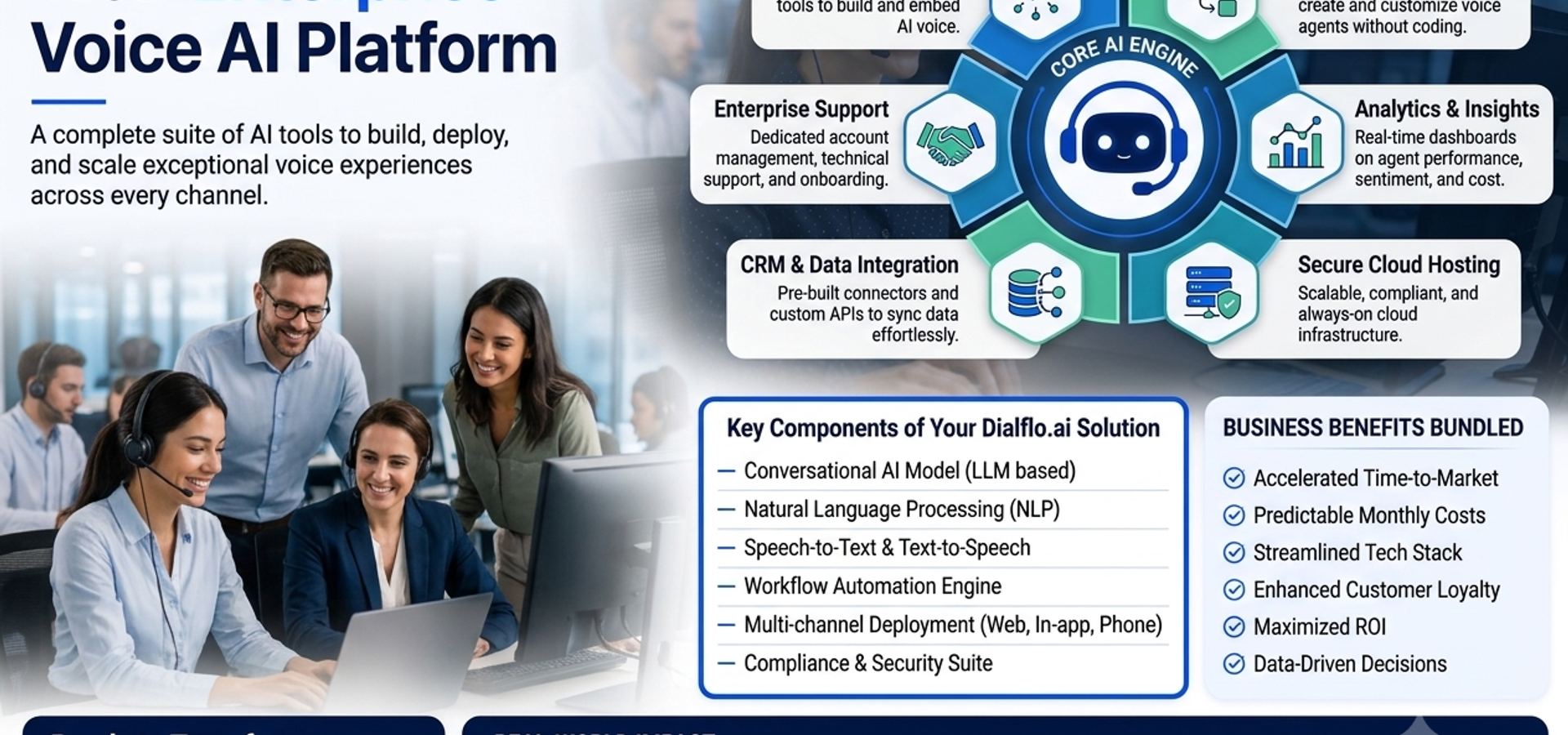
Buyers hear “voice AI” and picture one brain that talks. Then the pilot starts, and someone asks who owns PSTN minutes, barge-in, CRM fields, and what happens when the caller swears and demands a human. That is the real question behind what's bundled in a voice AI platform—not which logo demos the smoothest accent.
This guide unpacks the layers you should expect inside a production voice AI platform, what is usually bolted on later, and a buyer checklist so “all-in-one” does not become “you glue it.” For adjacent decisions, read build vs buy voice AI and conversational services.
Why “bundled” matters more than the model name
Contact centers are already shifting routine interactions toward conversational AI, which raises the bar for platforms that can run at scale—not just in a sandbox. Source: CX Today on conversational AI in contact centers.
McKinsey likewise frames generative AI as able to automate a large share of customer-operations hours—the repetitive phone work platforms claim to absorb. Source: McKinsey: The economic potential of generative AI.
If those hours never leave the queue, the problem is rarely “the LLM was dumb.” It is missing telephony, tools, write-back, or escalation inside the platform you bought.
Unique angle: buy closed-loop layers, not open chat
The useful mental model is not “chatbot + microphone.” It is a closed loop:
- call arrives or is dialed
- speech becomes text in near real time
- an orchestrator decides next action
- tools fetch or write business truth
- speech answers the caller
- outcome lands in CRM, ATS, or TMS
- exceptions warm-transfer to a human
Anything sold as a voice AI platform that skips write-back and escalation is a demo engine. Production teams need the loop.
Layer 1: Telephony and call control
This is the unglamorous foundation: inbound and outbound numbers, SIP trunks or CPaaS, call recording hooks, DTMF when needed, and transfer semantics.
Ask vendors what is native versus pass-through. “We integrate with Twilio” is fine—until you need India DID coverage, local compliance for recording consent, or parallel dialing limits. Bundle clarity here prevents surprise invoices.
Layer 2: Speech-to-text (STT)
STT turns audio into tokens the orchestrator can reason over. Production needs low latency, barge-in (caller interrupts the bot), accent robustness, and noise tolerance on mobile networks.
A polished English demo can hide weak performance on Hindi-English code-switching or warehouse floor background noise. Test on your real callers, not the vendor’s studio sample.
Layer 3: LLM orchestration and guardrails
This is where intents, prompts, tool policies, and stop conditions live. The model proposes; the orchestrator constrains.
Good platforms expose versioned prompts, test suites, and hard rules—“never invent a tracking number,” “never cancel without OTP.” Weak platforms let the model freestyle until a customer escalation lands on LinkedIn.
Layer 4: Text-to-speech (TTS) and voice UX
TTS is how your brand sounds on the phone: latency to first audio, natural prosody, SSML or style controls, and interruption handling.
Buyers obsess over “human-like.” Operators should obsess over time-to-first-byte and whether the agent stops talking when the caller starts. Those details decide containment more than celebrity voice clones.
Layer 5: Tools, connectors, and CRM write-back
This is the layer that turns conversation into operations. Status lookups, slot booking, lead scoring fields, screen dispositions—all live here.
If the platform cannot write a structured outcome into your system of record, you have created a polite transcript machine. Closed-loop write-back is what separates shelfware from staffing relief—especially in recruiting and logistics queues covered in our AI in recruitment and AI in logistics guides.
Layer 6: Analytics, logging, and evaluation
Expect call recordings (where lawful), transcripts, latency traces, containment rates, escalation reasons, and prompt/version attribution.
Without this layer, you cannot improve week over week. With it, you can kill bad prompts, spot data gaps, and prove ROI in language finance will accept.
Layer 7: Human escalation and hybrid ops
Every serious voice AI platform needs a warm handoff: context summary, disposition so far, and a clear trigger (“customer angry,” “policy exception,” “identity failed”).
Agentless fantasies fail. Hybrid models win—AI clears repetitive volume; humans keep judgment and empathy. Design the handoff on day one, not after the first viral complaint.
What is usually NOT bundled (and still on you)
- Clean data — stale ATS or TMS truth breaks even perfect speech
- Business rules — refunds, discounts, and edge cases need owners
- Consent & recording policy — market-specific; legal must sign off
- Staffing for escalations — someone must answer when the bot defers
- Change management — scripts, training, and QA rituals
Platforms sell rails. You still run the railroad.
Bundled platform vs DIY stack: a quick buyer frame
DIY (mix STT + LLM + TTS + CPaaS yourself) maximizes control and engineering load. Platforms maximize time-to-production.
If you lack a team to own uptime across five vendors, buy a platform and demand receipts on each layer above. Category comparisons like Vapi vs Bland vs Retell for India and Retell vs Dialflo vs Vapi help you see which layers are productized versus left as homework.
Buyer checklist: prove the bundle before you sign
- Live inbound and outbound call on your number range
- Barge-in and recovery after interruption
- Tool call that updates a real CRM/ATS/TMS field
- Warm transfer with context to a human
- Dashboard showing containment, latency, and failure reasons
- Written list of native vs third-party components
- Pilot success metrics agreed in one page—no vanity demos
If a vendor cannot run that checklist in a week, the “bundle” is a slide.
FAQs
What is bundled in a voice AI platform?
Expect telephony, STT, LLM orchestration, TTS, tool connectors, analytics, and human escalation. Marketing highlights the model; production lives or dies on write-back and handoff.
Is a voice AI platform just an LLM on a phone number?
No. Carriers, streaming audio, tools, compliance hooks, and escalation are separate systems. A platform is supposed to productize that glue.
What is usually not included?
Your data quality, policy decisions, escalation staffing, and local consent rules. Budget time for those even when software looks “all-in-one.”
Should we build or buy?
Build only if you will own multi-vendor uptime. Most teams move faster buying a platform and proving one closed-loop use case first. See build vs buy.
How do we compare vendors fairly?
Score them on the seven layers and the live checklist—not accent demos. Pricing pages without write-back proofs are incomplete; use comparisons like Retell pricing vs Dialflo only after capability is clear.
Where should we pilot first?
High-volume, low-ambiguity intents with a system of record: screening, status, confirmations, lead qualification. Save empathy-heavy and irreversible actions for humans.
A light next step
If you are mapping what's bundled in a voice AI platform for a real queue—not a slide deck—start with one closed-loop intent and demand every layer above in writing. When you want that stack production-ready for Indian calling patterns without assembling five vendors, talk to Dialflo about a focused pilot with CRM write-back and human escalation from day one.