How to Automate Stock Management Using AI

Dialflo: AI Voice Agent
May 27, 2026
Inventory is where supply chains quietly bleed cash: too much stock ties up working capital, too little stock creates stockouts and firefighting. Most teams try to solve this with spreadsheets and “planner intuition,” then spend every week explaining why service dropped or inventory ballooned. If you want to automate stock management using AI, the path is surprisingly consistent: fix data, pick one workflow, integrate into execution systems, and measure service + cost together.
This guide breaks down what to automate, which AI techniques matter, a data checklist, KPIs, risks, and a 90‑day rollout plan. For adjacent context, read AI inventory optimization tools & strategies and machine learning in supply chain optimization.
What to automate in stock management (the real levers)
Most “inventory automation” projects fail because they automate the wrong thing, dashboards instead of decisions. High-impact automation targets:
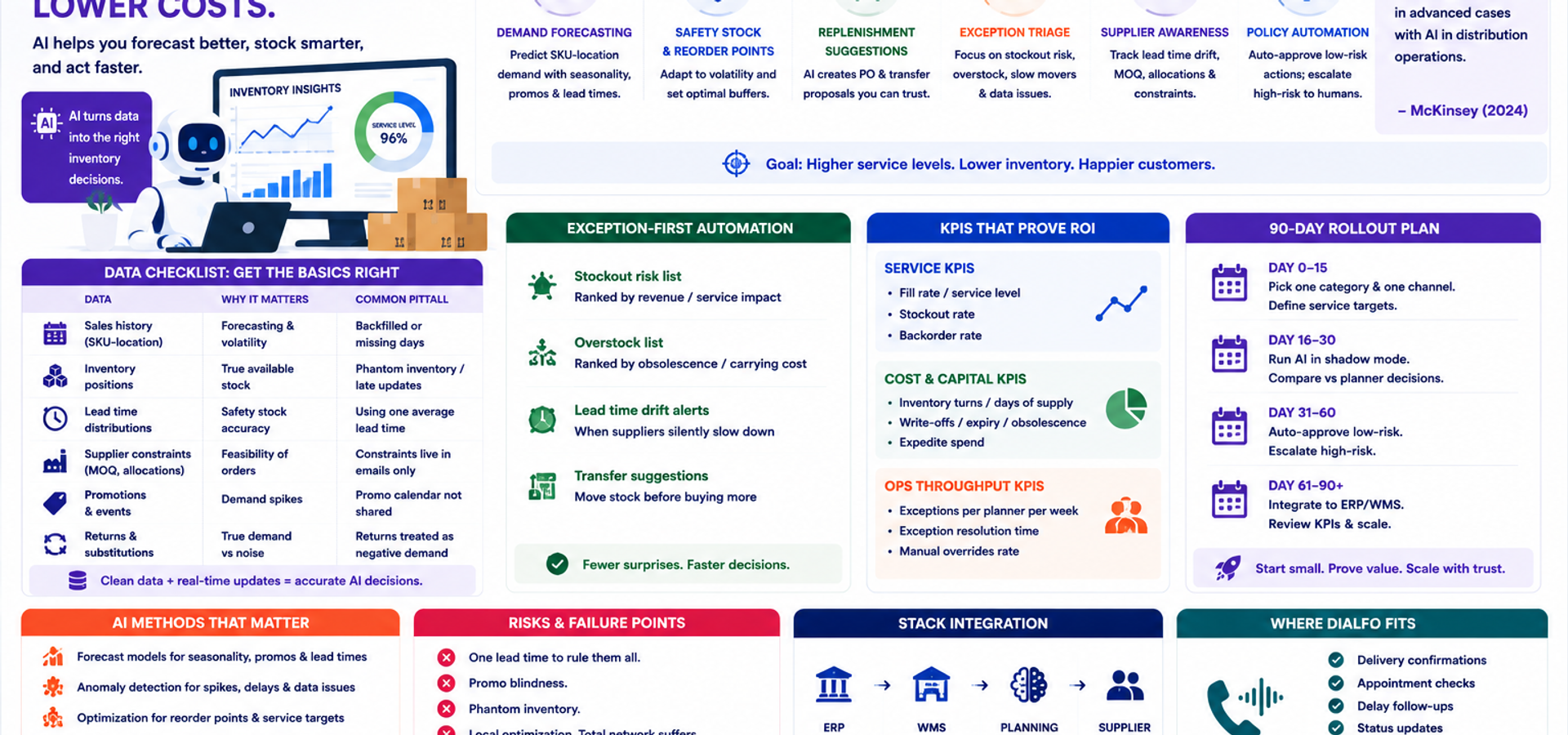
- Demand forecasting at the SKU-location level
- Safety stock and reorder points that adapt to volatility
- Replenishment suggestions (PO proposals, transfer proposals)
- Exception triage (stockout risk, slow movers, overstocks)
- Supplier constraint awareness (lead time drift, MOQ, allocation)
McKinsey reports that embedding AI in distribution operations can create reductions of 20–30% in inventory in advanced cases. Source: McKinsey: AI in distribution operations (2024).
The AI methods that actually matter (no buzzwords)
You don’t need to be a data scientist to run this well. But it helps to know what’s under the hood:
- Forecast models that learn seasonality, promotions, and lead time effects
- Dynamic segmentation (ABC/XYZ-style, but learned and updated)
- Anomaly detection for demand spikes, supply delays, and data issues
- Optimization for reorder points given service targets and cost constraints
- Policy automation (approve low-risk reorders automatically; route high-risk to humans)
For a practical landscape view, see AI supply chain technology trends.
Data checklist: what you need before you automate stock management
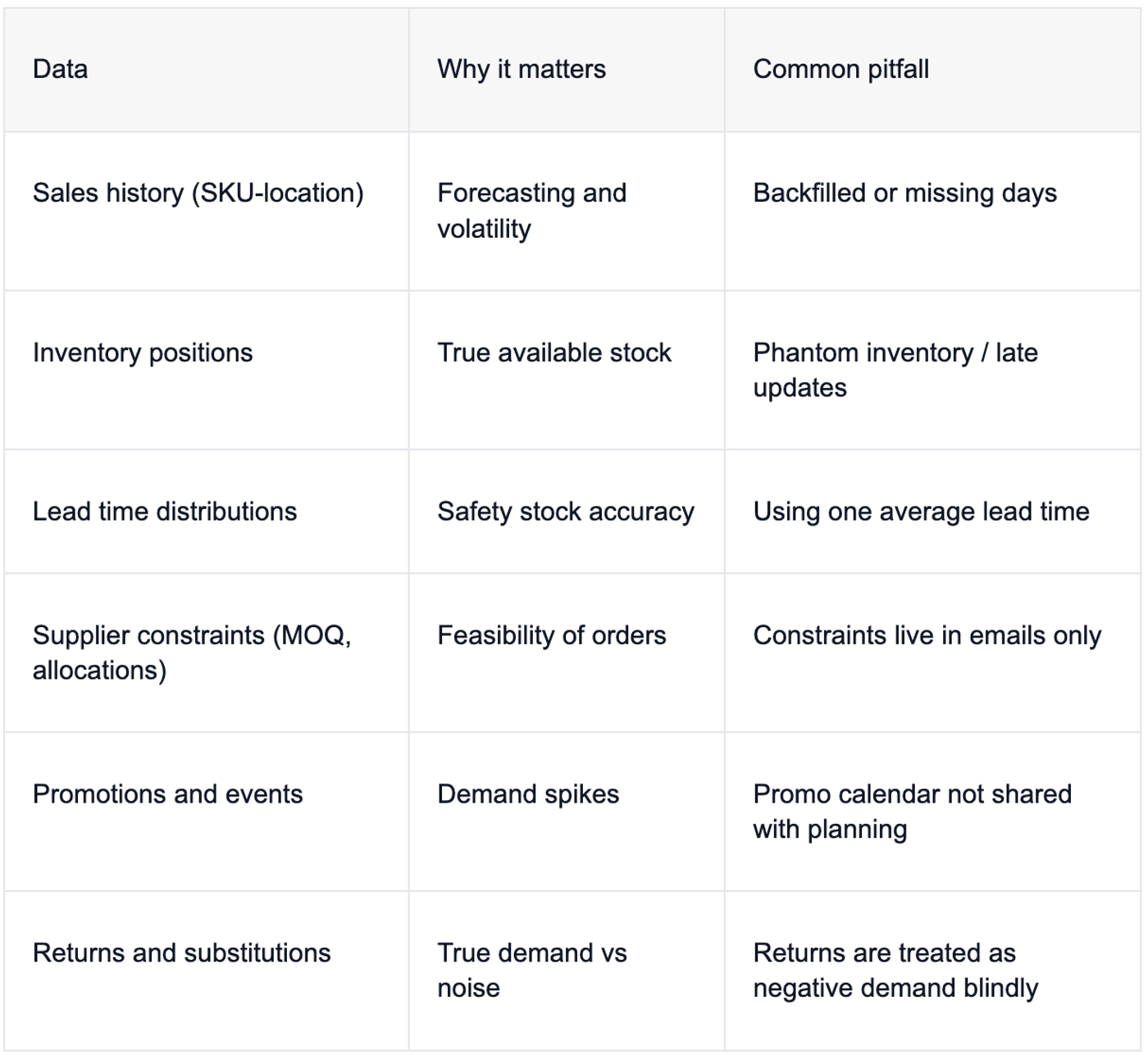
If you’re unsure what “systems” should hold these fields, see technology used in supply chain management for how ERP/WMS/TMS/control towers typically split responsibilities.
Exception-first automation: where the real throughput wins come from
Inventory automation isn’t only about better forecasts. It’s about reducing planner overload by triaging exceptions:
- Stockout risk list ranked by revenue/service impact
- Overstock list ranked by obsolescence/carrying cost risk
- Lead time drift alerts when suppliers silently slow down
- Transfer suggestions across DCs/stores before buying more
This is the same “decision gap” concept applied to inventory: signals exist, humans can’t act fast enough. Related: logistics decision gap: AI operations.
KPIs: how to prove automation stock management ROI
Use a balanced scorecard, inventory projects fail when teams optimize one metric at the expense of another.
Service KPIs
- fill rate / service level
- stockout rate
- backorder rate
Cost and capital KPIs
- inventory turns / days of supply
- write-offs / expiry / obsolescence
- expedite spend
Ops throughput KPIs
- exceptions per planner per week
- exception resolution time
- manual overrides rate (should drop over time)
90-day rollout plan (simple, repeatable)
- Pick one category and one channel (e.g., top 200 SKUs for one region/DC).
- Define service targets (not “reduce inventory” without a service goal).
- Run AI in “shadow mode” for 2–3 weeks: compare suggestions vs planner decisions.
- Start with low-risk automation (auto-approve small reorders; escalate large or constrained orders).
- Integrate into ERP/WMS so actions are executed and logged.
- Review weekly with finance + ops + planners; publish KPI changes.
As you automate more decisions, governance matters. Gartner predicts that by 2031, 60% of supply chain disruptions will be resolved without human intervention, starting with low-risk decisions and building data and governance foundations. Source: Gartner newsroom (2026).
Risks and failure points (what breaks automation stock management)
- One lead time to rule them all. Use distributions; volatility matters.
- Promo blindness. If promotions aren’t in the system, AI forecasts will be wrong.
- Phantom inventory. If on-hand isn’t real, “automation” becomes automated confusion.
- Local optimization. One DC looks great while total network inventory worsens.
- No audit trail. You need to explain why a reorder happened.
Also consider sustainability: better stock placement can reduce wasted miles and waste from obsolescence, see how AI makes supply chains more sustainable.
Unique angle: the last mile of inventory automation is supplier communication
Even the best reorder model fails if supplier confirmations, delivery appointments, and delays live in phone calls and WhatsApp threads. Inventory “automation” needs reliable, structured status updates, especially for SMEs and fragmented supplier networks.
Where Dialflo fits: phone-based coordination as structured data
Dialflo can automate phone-heavy coordination tied to stock operations: delivery confirmations, appointment checks, and follow-ups when shipments slip. The goal is not “more calls”, it’s structured outcomes that keep your planning system current so AI reorder logic uses fresh reality. Learn more via conversational services use cases.
FAQ: automate stock management
Can AI really automate stock management?
Yes, especially forecasting, reorder suggestions, and exception triage. Full autonomy should start with low-risk orders and expand with governance.
What’s the best first step?
Pick one category and define service targets, then run AI in shadow mode to validate suggestions before auto-approving anything.
Do I need a control tower?
Not always. Many teams start by improving data feeds and adding ML forecasting + reorder optimization inside existing planning tools.
How do I avoid stockouts while reducing inventory?
Use service-level targets and safety stock tuned to lead time variability, don’t cut inventory blindly.
How long until ROI?
Teams often see operational signals in 4–8 weeks; bigger working capital shifts take longer and require adoption.
How does Dialflo help?
By automating phone-based confirmations and follow-ups so inventory and lead-time signals stay current as structured data.
Closing: automate the math, focus humans on exceptions
To automate stock management with AI, start with clean item/location data, automate decision support first, triage exceptions, and only then expand autonomy. Measure service and capital together, and make sure supplier reality is captured in systems, not only in calls.
Exploring operational coordination automation? Review Dialflo for conversational workflows that reduce manual calling and keep supply chain data fresh.