Buyer's Guide: AI Voice Agents That Write to Your CRM

Dialflo: AI Voice Agent
August 26, 2026
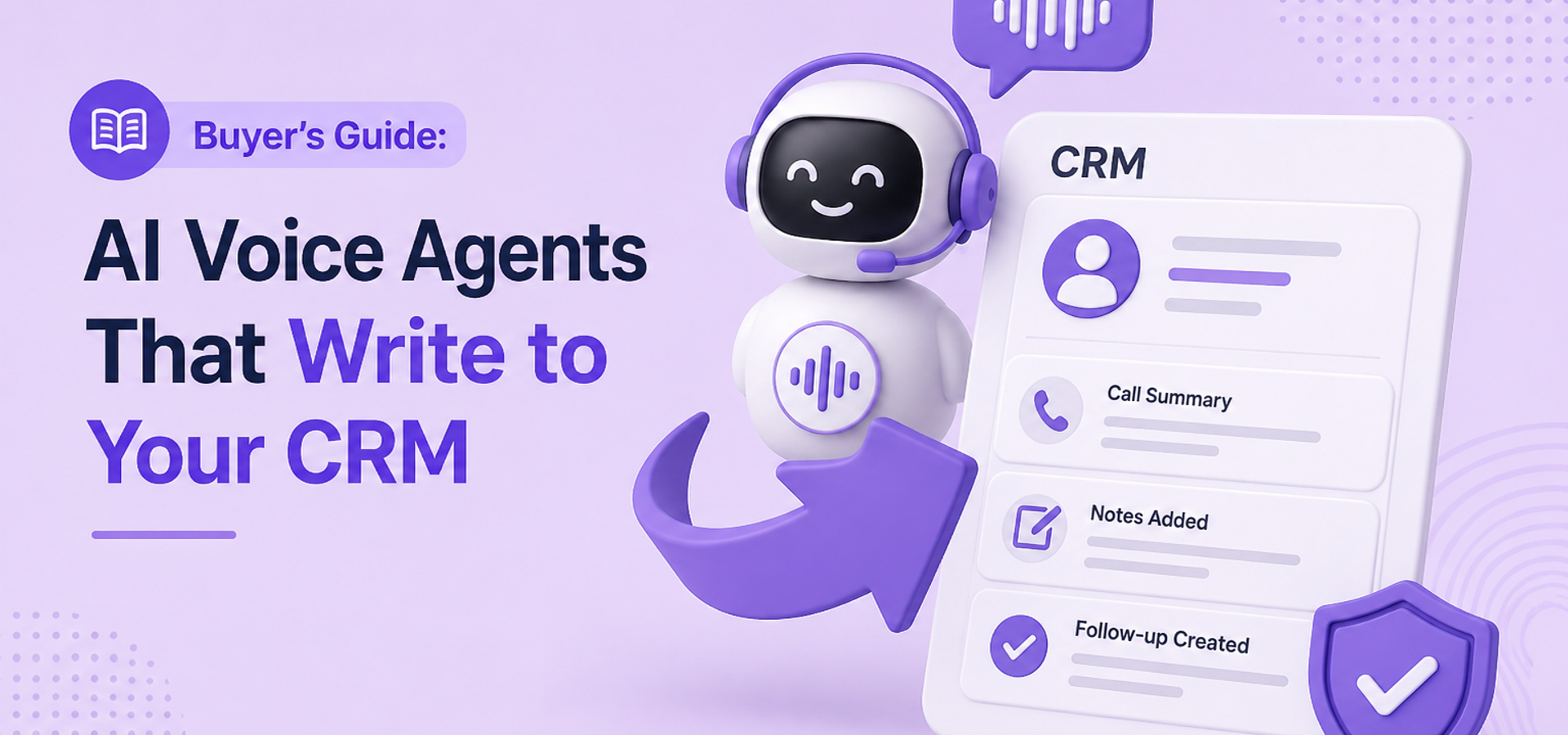
Short answer: Buy AI voice agents that write to your CRM, not agents that only “sound human.” The buying test is simple: after a live call, can you open the CRM and see the right record updated with disposition, answers, owner, and next step, without a human retyping notes?
Friday vendor demo. The bot books a Tuesday slot on the call. Everyone smiles. Monday morning the AE asks where the lead is. Nobody knows. The meeting lives in a vendor portal. The CRM still says “New - Webform.” Your team will not trust the channel again. That failure is not a voice problem. It is a CRM write-back problem, and it should have killed the deal in evaluation.
This buyer’s guide shows how to evaluate AI voice agents that write to your CRM: required fields, integration patterns, security checks, demo scripts, and red flags. For adjacent context, see conversational services use cases and build vs buy voice AI stack in India.
Why CRM write-back is the real product
Voice AI without CRM write-back recreates the answering-service trap: activity happened, system of record did not change. Pipeline, SLAs, and coaching all depend on structured fields.
Bad CRM data is expensive. Gartner has estimated that poor data quality costs organizations an average of $12.9 million a year. Source: Gartner on data quality.
Speed still matters on inbound phone and form-to-call workflows. Lead-response research found contact and qualification odds collapse when first outreach slips from five minutes toward thirty. Source PDF: InsideSales.com / MIT Lead Response Management study. An agent that answers fast but never updates CRM ownership and stage still leaves the revenue team blind.
What “writes to your CRM” must mean in the contract
Require the vendor to define write-back as structured object updates, not “we can email a summary.”
Minimum viable write-back:
- match or create the correct Contact / Lead / Candidate / Account record
- log a Call or Activity with timestamp, direction, duration, recording link
- set a required disposition from your approved picklist
- map answers to named fields (budget band, service area, role, invoice ID, and so on)
- create or update the next action (task, meeting, opportunity stage, ticket)
- assign or preserve owner according to your routing rules
- surface failed writes with retry and alert, not silent loss
Nice-to-have write-back:
- idempotent updates so retries do not duplicate activities
- human override without the bot overwriting AE notes blindly
- multi-object updates in one transaction (lead + deal + task)
- custom objects for logistics loads, jobs, or interview screens
Buyer scorecard: evaluate vendors on these eight criteria
1. Object coverage on your CRM, not a generic demo CRM
Ask them to write to your sandbox objects: Salesforce, HubSpot, Zoho, Dynamics, GoHighLevel, or your ATS/CRM hybrid. Recruiting teams should pressure-test candidate and job objects the same way. Related: candidate relationship management systems and integrate recruiting software with existing systems.
2. Field mapping quality
Can they map to constrained picklists, not only free text? Free-text “notes” destroy reporting.
3. Identity resolution and dedupe
How do they match phone numbers to existing records? What happens on duplicates? Who wins on conflicting owners?
4. Failure handling
If the CRM API is down mid-call, does the platform queue, retry, and alert ops? Or drop the outcome?
5. Latency to system of record
Write should land in seconds, not “batch tonight.” Same-day follow-up depends on immediate visibility.
6. Permissions and security
OAuth scopes, least-privilege service users, audit logs, data residency, retention of recordings and transcripts.
7. Admin ownership
Can your RevOps person change mappings without a vendor engineering ticket every time?
8. Total cost with integration included
Ask for all-in cost of connector, middleware, maintenance, and failed-write support. Minute rates alone hide the real bill. See Retell AI pricing vs Dialflo pricing and Retell vs Dialflo India pricing.
Integration patterns buyers should recognize
Native connector
Best when mature and maintained. Demand a live object list and changelog.
Middleware (Zapier, Make, n8n)
Fast for pilots. Watch rate limits, fragile field renames, and unclear ownership when zaps break at 11 p.m.
Direct API / webhook
Most control. Requires your engineering time and monitoring.
Hybrid
Native for core activity logging, webhook for custom objects. Common in logistics and staffing stacks.
Platform comparisons help when the stack is still open: Retell vs Dialflo vs Vapi India and Dialflo vs Retell for real estate lead qualification calls.
The live demo script every vendor must pass
Do not accept a recorded demo. Run this on your sandbox:
- Create a known test lead with a unique phone and owner.
- Place or receive one call that asks three qualification questions.
- Book or refuse a next step on purpose.
- While on the call, force one wrong answer and one correction.
- Hang up, then open CRM within 60 seconds.
- Confirm activity, disposition, three fields, owner, and next task.
- Repeat the call and confirm no duplicate junk activities (idempotency).
- Revoke API access mid-write in a second test and ask how failure is surfaced.
If the vendor cannot finish that script, you do not have CRM write-back. You have a chatbot with a phone number.
Field checklist by use case
Inbound sales / local services
- service type, location or ZIP, urgency, budget band if used
- appointment time or callback window
- disposition: qualified / unqualified / booked / escalated
B2B demo qualification
- company size, role, use case, timeline
- meeting booked on AE calendar
- lead status and MQL/SQL reason codes
Recruiting screens
- role match answers, notice period, compensation band
- candidate stage move
- recruiter task created
Analytics context: recruitment analytics software.
Collections reminders
- invoice ID, promise-to-pay date, dispute reason
- suppression flag when paid or legal-hold
Red flags that should stop the purchase
- “We send a transcript to Slack” presented as CRM integration
- Only free-text notes, no picklists
- No sandbox test on your objects
- No explanation of dedupe or owner conflicts
- No failed-write alerting
- Vendor needs three weeks of professional services before any field can change
- Contract silent on data deletion and recording retention
Security and governance questions to ask in writing
- Where are recordings and transcripts stored, and for how long?
- Can we use a least-privilege CRM integration user?
- Are writes audited with before/after values?
- How do you prevent the bot from overwriting human AE notes?
- What is the subprocessors list for STT/LLM/TTS if the stack is composed?
- How do you handle subject-access or deletion requests?
Pilot success definition for CRM-connected voice AI
Write one sentence before kickoff:
This pilot succeeds if at least [X%] of handled in-scope calls create a correct CRM activity and disposition within [N] seconds, with field accuracy of [Y%] on a 25-call weekly audit, over [Z] calls in [28] days.
Secondary guardrails: duplicate activity rate, owner misroute rate, and AE override rate.
Next steps
The market is full of agents that converse. Buyers need agents that commit outcomes to CRM. Choose AI voice agents that write to your CRM with proof on your objects, your picklists, and your failure modes.
If you want a voice workflow judged by CRM truth, not demo polish, talk to Dialflo. Bring your sandbox and field list. We will run the write-back test before anyone talks about annual seats.
Frequently asked questions
What does CRM write-back mean for a voice agent?
Structured create/update of CRM records from the call: match, disposition, fields, activity, and next step. Not an email summary.
Why is it a must-have?
Without it, phone work does not feed pipeline, routing, or coaching. You get conversations with no system of record.
Which fields are mandatory?
Record match, disposition, timestamp, key answers, next action, owner, and recording/transcript link.
How do integrations usually work?
Native connectors, middleware, or direct APIs. Test all three failure modes on your sandbox before buying.
What are common red flags?
Transcript-only “integrations,” free-text notes, no dedupe rules, no failed-write alerts, and heavy services dependency for mapping changes.
How does Dialflo help?
Dialflo builds phone workflows around structured CRM outcomes sales and ops can trust. Start at dialflo.ai.