How Mid-Sized Carriers Cut Dispatcher Call Load During Peak Shipping Spikes With Voice AI

Dialflo: AI Voice Agent
June 22, 2026
Tuesday before Thanksgiving: a winter system stalls eighty loads across three states. Your six dispatchers answer shipment status calls while drivers hold on line four. Two shippers get voicemail. A receiver books a competitor because nobody picked up. You run ninety trucks, not nine hundred, but peak season and bad weather hit the same lean desk at once.
That is the mid-sized carrier squeeze. Dispatcher call load doubles when volume spikes, ETAs shift, and portals lag, yet hiring seasonal coordinators takes weeks you do not have. This guide shows how mid-sized trucking companies cut dispatcher call load during peak shipping spikes with voice AI that absorbs repetitive shipment status questions, missed-call overflow, and driver check calls without expanding the back office.
Why mid-sized carriers feel peak call spikes hardest
Large fleets staff overflow desks and after-hours teams. Small operators know every caller. Mid-sized asset carriers sit in the middle, big enough for serious volume, too lean for surge staffing. When peak shipping spikes arrive, dispatcher call load breaks because:
- dispatch desks are sized for average Tuesday, not Q4 plus a storm
- every coordinator already owns routing, detention, and driver support
- seasonal hiring is slow, expensive, and risky for TMS accuracy
- weather multiplies status calls faster than trucks can update EDI
- missed calls become morning callback piles that steal the whole shift
Freight context: AI in logistics: use cases, benefits & tools. The American Trucking Associations tracks freight economy pressure on operations teams. Source: ATA news and insights.
What drives dispatcher call load during peak shipping spikes
Call volume rises from three forces that often stack together:
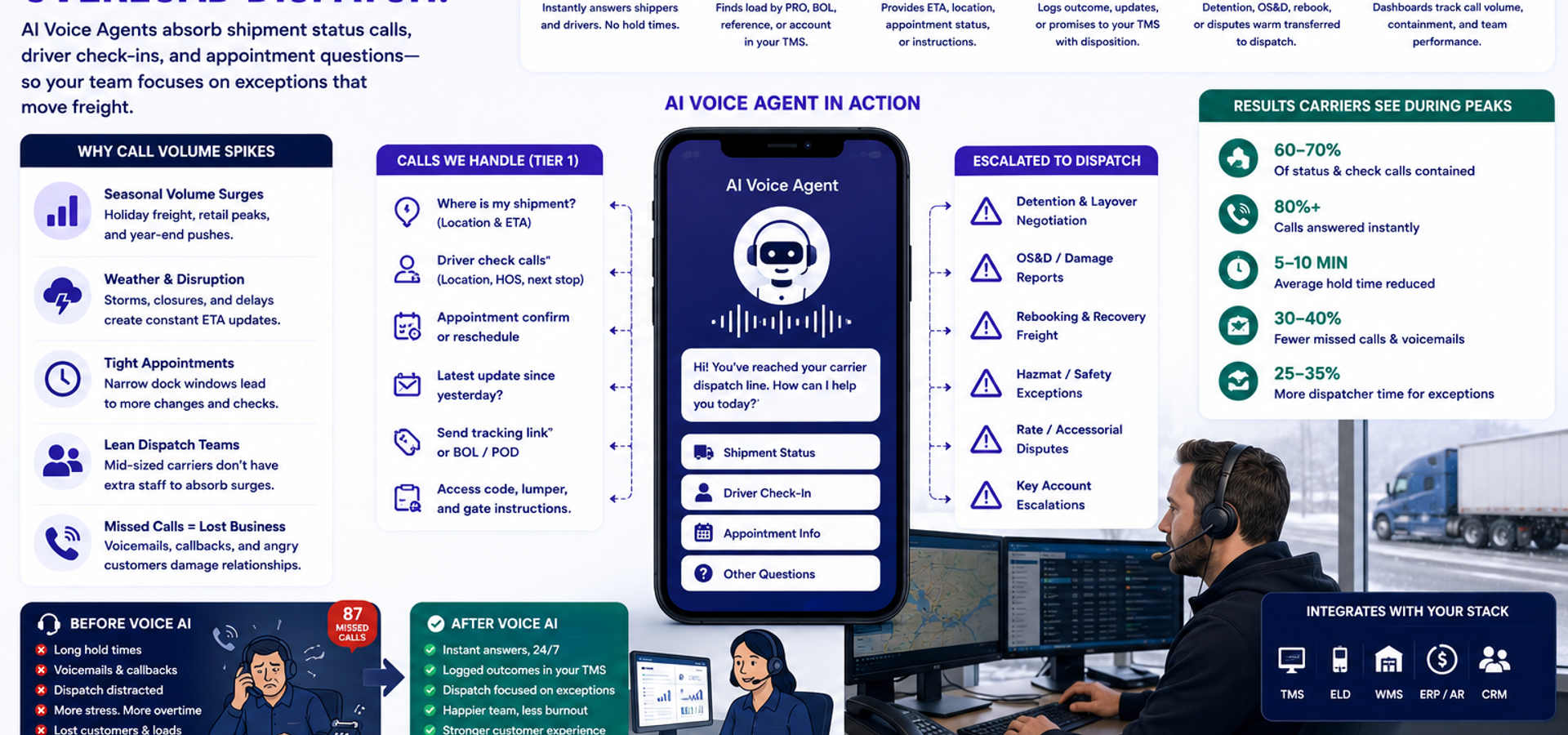
1. Seasonal volume surges
Retail holidays, produce season, and fiscal year-end pushes add loads, and every load generates two or three status checks from shippers and receivers.
2. Weather and network disruption
Storms, road closures, and terminal delays shift ETAs hourly. Portals show green; reality is red. Customers call dispatch because calling works. The National Weather Service documents how severe weather disrupts transportation corridors nationwide. Source: National Weather Service safety resources.
3. Appointment compression
Warehouses tighten dock windows during peaks. More reschedule calls, more "is the truck still coming?" rings, more driver check calls at gates.
Supply chain trend context: AI supply chain technology trends.
Dispatcher overload: how you know call load broke
Before trucks stop moving, phones stop working. Warning signs during peak shipping spikes:
- hold times exceed five minutes on status lines
- voicemail boxes fill before lunch
- coordinators answer the same PRO number three times without logging notes
- driver check calls wait while someone reads tracking to a shipper
- detention and rebooking work batches to end of day, too late
- missed calls show up as angry emails from key accounts
That is dispatcher call load eating exception talent, the work only humans should own. Decision discipline: logistics decision gap in AI operations.
The repetitive shipment status calls drowning mid-sized dispatch
During spikes, most rings are not unique. Carriers hear the same intents on repeat:
- Where is my shipment?: pickup confirm, in-transit location, delay reason
- What is the ETA?: delivery window, appointment still valid?
- Did anything change since yesterday?: weather hold, relay, cross-dock handoff
- Driver check call: location, hours, next stop instructions
- Appointment confirm or change: dock time, access code, lumper question
These are tier-one calls. They do not need a senior dispatcher every time, if TMS data is current and a voice layer can speak it clearly. That is where voice AI earns its place during busy periods.
How mid-sized carriers use voice AI to absorb spike call volume
Voice AI is not a replacement dispatch team, it is overflow capacity that scales with ring volume. During peak shipping spikes, AI voice agents:
- answer inbound status lines immediately, no hold queue during surges
- look up loads by PRO, BOL, reference, or account in TMS
- read ETA windows, last scan events, and appointment status
- handle driver check calls with structured location and hours capture
- text tracking links or appointment details via SMS
- escalate detention, OS&D, and rebooking to dispatch with full context
- write call outcomes to TMS notes so the next caller does not restart the thread
Voice layer primer: conversational services: what they are & use cases. Stack context: technology used in supply chain management.
Overtime staffing vs voice AI during peak spikes
Seasonal coordinators: weeks to hire and train, quality risk on quotes and appointments, January payroll cliff when volume drops.
Voice AI overflow: live in weeks, scales with call volume, no seat count to unwind after peak.
Dispatcher overtime: burnout rises, exception work still waits, same repetitive status readouts all night.
Voice AI plus core dispatch: humans on judgment, automation on readouts, sustainable through Q4 and storm weeks.
Voicemail during spikes: missed loads, shipper churn, morning callback avalanche.
Voice AI with TMS lookup: answered rings, logged outcomes, smaller morning queue.
What to automate vs what dispatch keeps during busy periods
Route to voice AI during spikes: shipment status, ETA readouts, appointment confirm, driver check calls, tracking link resend, simple reschedule intake.
Keep on human dispatch: detention negotiation, OS&D and damage, weather rebooking and recovery freight, hazmat and safety exceptions, key-account escalations, rate and accessorial disputes.
The goal is cutting dispatcher call load on repeat questions, not removing the people who protect margin when the network breaks.
Pre-peak deployment playbook for mid-sized carriers
Weeks 1–2 (before spike): Map top call intents from last peak. Connect TMS read access for load lookup. Define escalation rules for weather and detention.
Weeks 3–4 (pilot): Route overflow or after-hours status line to voice AI. Measure answer rate, containment rate, and morning callback depth.
At spike onset: Expand to business-hour overflow when hold times climb. Add driver check-call line if that queue spikes first.
During storm weeks: Proactive outbound ETA updates on delayed lanes reduce inbound panic calls, voice AI can run those too when TMS flags exceptions.
Planning context: machine learning in supply chain optimization helps forecast volume; voice coverage handles the calls forecast creates.
Metrics mid-sized carriers track during peak spikes
- Answer rate: inbound rings answered vs missed
- Containment rate: calls resolved without human transfer
- Average hold time: should fall when overflow routes to voice AI
- Morning callback queue: size and age of unresolved voicemails
- Dispatcher hours on status readouts: reclaimed time for exceptions
- Repeat call rate: same load, same question, same day
Efficiency tie-in: how AI makes supply chains more sustainable, fewer wasted miles when drivers get instructions without hour-long holds.
Where Dialflo fits for mid-sized carrier dispatch
Dialflo provides AI voice agents built for logistics phone work, TMS-aware shipment lookup, driver check-call logging, exception escalation, and write-back to your operations stack. Mid-sized carriers use Dialflo to cut dispatcher call load during peak shipping spikes and weather disruptions without seasonal hiring, so coordinators protect the network instead of reading tracking aloud all day.
FAQ: peak-season voice AI for carriers
How much can voice AI reduce dispatcher call load?
Teams often contain 60–70% of tier-one status and check calls when TMS data is accurate and escalation paths are clear. Measure your own containment rate in pilot.
Should we deploy before or during peak?
Before. Pilots need 2–4 weeks; deploying mid-storm means learning under fire.
Will shippers accept AI during busy weeks?
They accept accurate answers fast. Invoice-aware, load-aware voice beats twenty-minute hold music.
What about drivers calling in?
Voice AI logs check calls and captures ETAs; detention and gate instructions may still need human judgment.
Do we need a full TMS API?
Start with reliable load lookup, even scheduled exports beat voicemail during spikes.
How does Dialflo help?
Voice agents for carrier dispatch overflow, see dialflo.ai.
Closing: peak spikes are predictable, dispatcher overload does not have to be
Peak shipping spikes and weather disruptions will multiply shipment status calls every year. Mid-sized carriers that cut dispatcher call load with voice AI absorb tier-one volume when rings spike, answer shippers and drivers, log every outcome, and keep humans on detention, rebooking, and the exceptions that actually move freight.
Ready to handle the next surge without seasonal hiring? Explore Dialflo for voice agents that absorb shipment status calls during peak spikes, with TMS lookup, escalation, and write-back to the systems your dispatch desk already runs.