Best Voice Agents for Call Centers

Dialflo: AI Voice Agent
July 17, 2026
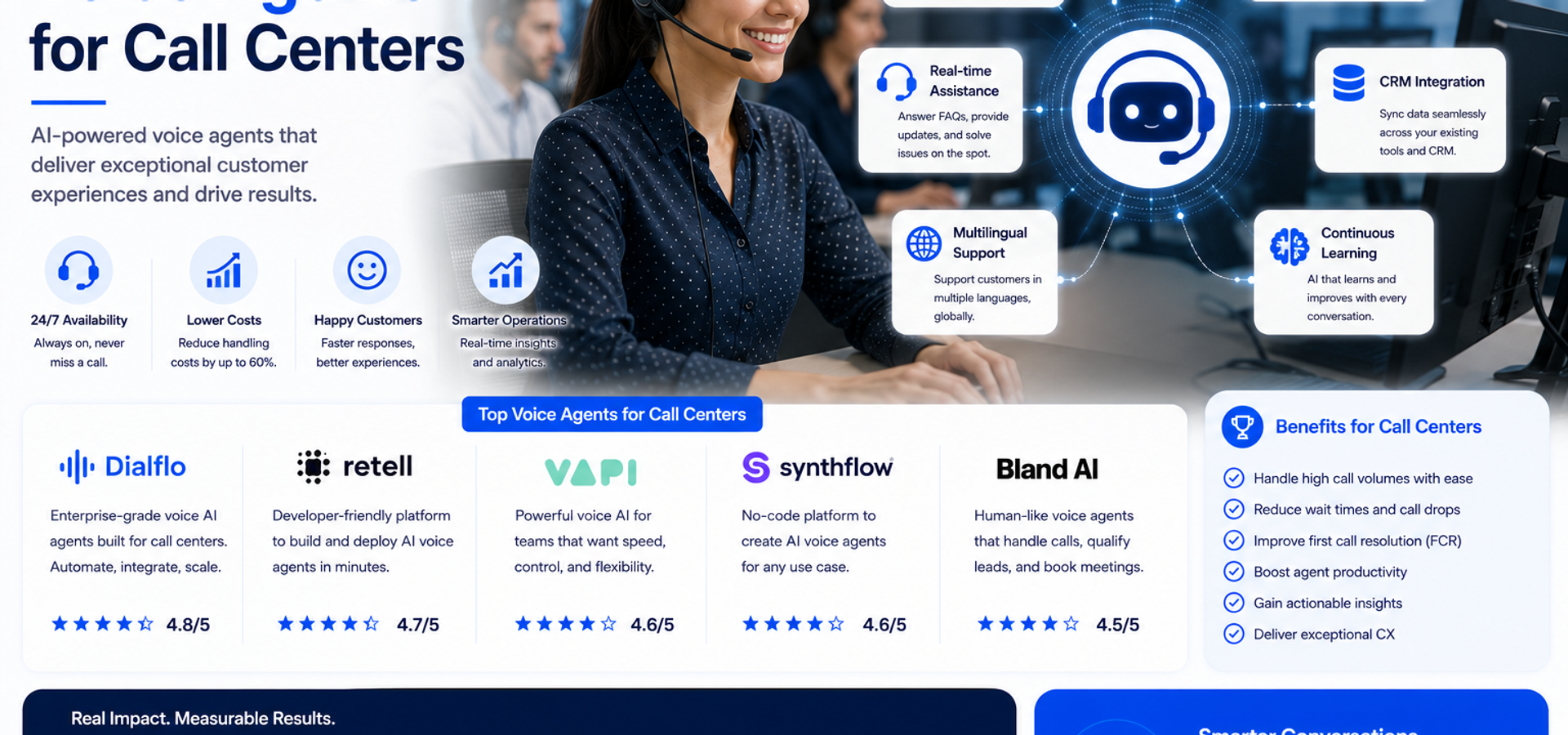
ASA is red. Hold music is winning. Your best agents are burning out on “Where is my order?” for the hundredth time today. That is the real buying moment for voice agents for call centers, not a demo that sounds charming for ninety seconds, but a production agent that clears volume and still knows when to shut up and transfer.
This guide is for contact-center and CX leaders who need a shortlist that survives peak season. You will get a clear definition of “best,” a stack map (what to buy vs skip), an evaluation checklist, and a hybrid design that keeps humans where empathy and judgment matter. For category context, start with conversational services and the build vs buy voice AI decision.
What “best” means for voice agents for call centers
Contact centers do not optimize for novelty. They optimize for service level, cost per contact, CSAT, and agent attrition. So the best voice agents for call centers must:
- contain routine intents without trapping callers in loops
- keep latency low enough that turns feel conversational
- warm-transfer with full context, not “please repeat your account number”
- write dispositions into CRM, helpdesk, or WFM tools
- prove ROI in containment and handle-time, not vanity demo scores
McKinsey frames the contact center of the future as a hybrid of AI and humans, not an all-bot fantasy. Leaders who chase “agentless” often reverse course; the winners design the right mix. Source: McKinsey: The right mix of humans and AI in contact centers.
Industry analyses also cite large projected labor-cost reductions from conversational AI in contact centers as automation absorbs repetitive volume, another reason voice is now a P&L lever, not a science project. Source: CX Today summarizing Gartner conversational AI cost-impact projections.
Unique angle: buy containment with a clean handoff, not “human-like” theater
Most vendor decks compete on how natural the voice sounds. High-performing centers compete on whether the bot finishes the job, or prepares the human to finish it in one pass.
That means your scorecard should punish:
- false containment (caller hangs up angry)
- context-free transfers
- outcomes stuck in a vendor dashboard
- agents babysitting a second inbox after every “automated” call
Sound quality matters. Permissioned tools and CRM write-back matter more. The same lesson shows up when teams compare builders in Vapi vs Bland vs Retell and Retell vs Dialflo vs Vapi.
Categories of voice agents call centers actually shortlist
1) CCaaS-native virtual agents
Built into your contact-center suite. Fast if you already live there. Watch for rigid flows and weak custom tool calling outside that vendor’s universe.
2) DIY voice builders
Maximum control for engineering-led teams. You own latency, evals, and on-call. India-focused shortlists often start with Vapi alternatives for India.
3) Managed / production voice agents
Ops-led centers that need time-to-value on status, screening, qualification, or appointment loops. Dialflo sits here, production agents with structured write-back, not a science kit you babysit forever.
4) Agent-assist (not full automation)
Live coaching, summarization, and next-best action for human agents. Useful, but do not confuse assist with queue-clearing voice agents for call centers.
Call types that pay back first
Automate high volume + low ambiguity first:
- order, ticket, or shipment status
- appointment confirm / reschedule
- FAQ within a strict knowledge boundary
- payment reminders and simple collections nudges (with escalation on dispute)
- outbound lead qualification and interview screens, see AI agents for recruitment and how AI agents are transforming recruiting
- logistics and ops status loops, see AI in logistics use cases
Keep humans on complaints, complex billing, vulnerable customers, and anything irreversible without step-up auth. Treat tool permissions and audit logs as part of the buy, not an afterthought when Legal shows up.
Evaluation checklist for voice agents for call centers
Run every vendor through the same live queue slice:
- Containment quality , resolved correctly, not just “deflected”
- Latency under concurrency , peak hour, not empty lab
- Escalation UX , warm transfer + context packet to the human
- Write-back , CRM/ticket fields updated without re-keying
- Language & accent coverage , especially India and multilingual queues
- Observability , transcripts, failure rates, prompt versions, QA sampling
- Compliance , recording consent, retention, redaction, audit export
- Unit economics , cost per resolved call vs human path; see pricing comparisons like Retell vs Dialflo pricing
If a vendor refuses a production-like pilot, they are selling slides. Migration risk matters too, plan exit paths early (migrate Retell to Dialflo without downtime).
Hybrid operating model that protects CSAT
Design the queue in layers:
- Layer 1 , AI voice: routine intents with clear tools and stop conditions
- Layer 2 , assisted humans: summaries and suggested replies on complex calls
- Layer 3 , specialists: VIP, legal, medical-adjacent, high-value accounts
Retrain floor coaches on when to override automation. Publish a weekly “automation autopsy”: top failure intents, false containments, and prompt fixes. That operating rhythm beats any single model upgrade.
Failure modes that make “best” agents look average
- IVR cosplay , menus sold as conversational AI
- Second inbox syndrome , outcomes never reach CRM
- Over-automation , forcing empathy calls into bots
- No eval harness , prompt edits ship without regression tests
- Ignoring agent experience , humans inherit messy handoffs and quit faster
For India Retell comparisons when shortlisting, see Retell vs Dialflo and best Retell alternative for India.
30-day pilot plan (how buyers become believers)
Week 1: Pick one intent that burns 15%+ of volume. Define success: containment %, CSAT delta, transfer rate, write-back completeness.
Week 2–3: Run Dialflo (or your shortlisted agent) on a controlled percentage of traffic. Shadow QA every failed call.
Week 4: Compare cost per resolved contact and agent minutes returned. Expand only what moved a KPI, kill what created babysitting work.
That is how voice agents for call centers earn budget: evidence on your queue, not a feature matrix.
FAQ: Voice agents for call centers
What are the best voice agents for call centers?
Those that contain routine volume, escalate cleanly, and write back to your system of record. Categories include CCaaS-native bots, DIY builders, and managed production agents.
Will AI replace my agents?
No. Hybrid is the durable model, AI on repetition, humans on judgment and empathy.
What should we automate first?
Status, scheduling, bounded FAQs, simple reminders, and structured outbound screens.
DIY or managed?
DIY if engineering will own production. Managed if ops owns the KPI and needs speed.
How do we protect CSAT?
Strict stop conditions, warm transfers with context, and weekly failure reviews, not blind containment targets.
How does Dialflo help call centers?
Production voice agents that clear phone-heavy routine work and sync outcomes so your human floor handles what actually needs a human.
Closing: pick agents that survive Monday morning volume
The best voice agents for call centers are not the ones that win a demo bake-off. They are the ones that hold when ASA spikes, write the truth into CRM, and hand off without making your callers, or your agents, repeat themselves.
Ready to pilot on a real queue? Explore Dialflo for voice agents built for contact-center load, containment with a clean human handoff, not another IVR in disguise.