Hire vs AI Voice Agent: True Cost for a 10-Person Sales Team

Dialflo: AI Voice Agent
August 6, 2026
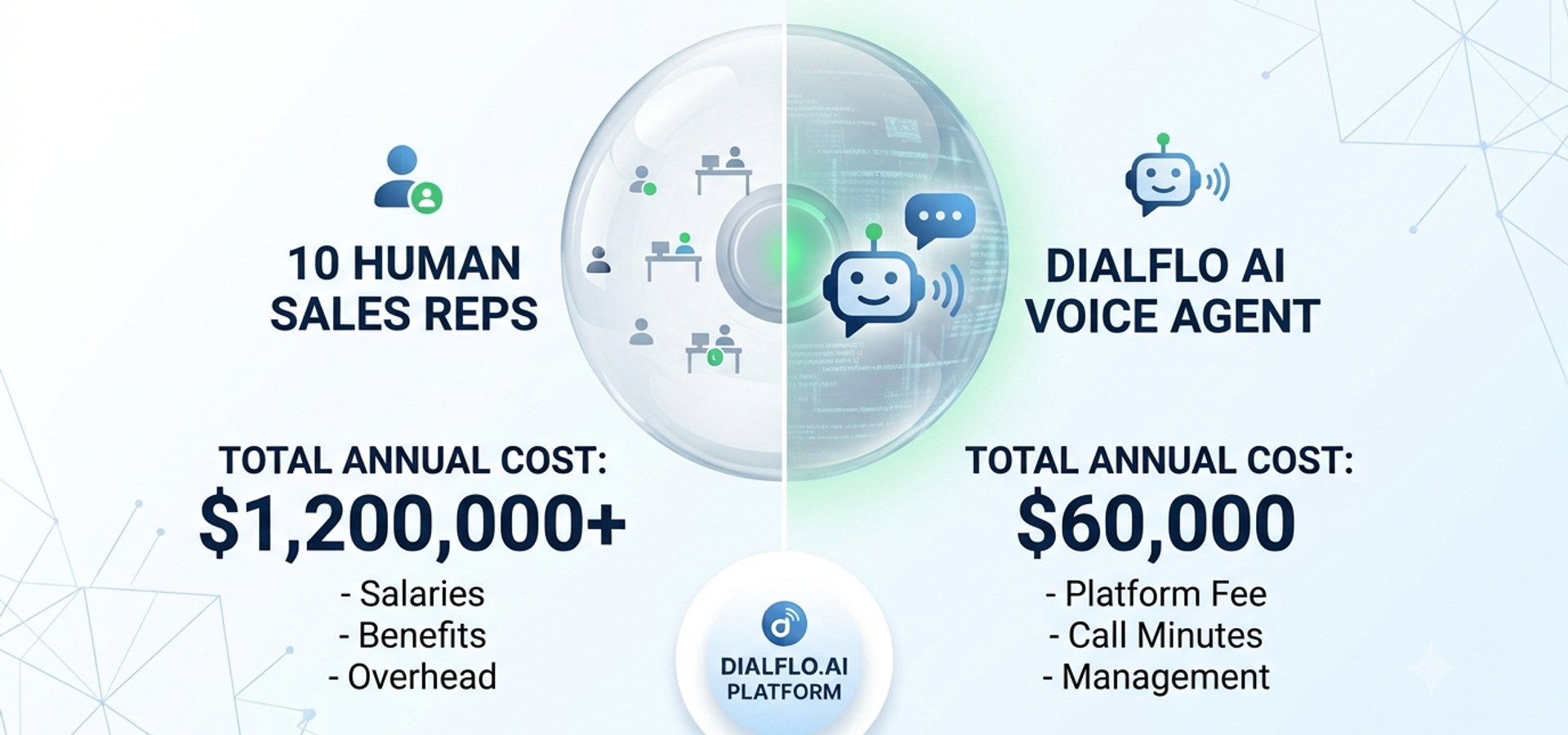
Your 10-person sales team is missing meetings, not because the ICP is wrong, but because first-touch is slow. Leadership’s instinct is the oldest lever in revenue ops: “Let’s hire another SDR.” The new pitch is the other lever: “Deploy an AI voice agent.” Both can waste money. Only one model wins for your mix of volume, ACV, and after-hours chaos.
This article is a field calculator for hire vs AI voice agent cost on a 10-person team. You will see fully loaded headcount math, voice-stack economics most decks hide, a worked hybrid scenario, and the three metrics that make the decision honest. Category context: conversational services, what they are and use cases. For platform TCO patterns, see Retell AI pricing vs Dialflo pricing.
What a 10-person sales team actually spends time on
A typical small revenue pod is not ten identical sellers. More often it is 3–5 AEs, 1–2 SDRs/BDRs, a sales manager, plus CS or founders still jumping on calls. Pipeline pressure hits the same bottleneck: responses to inbound, follow-ups after no-show, and outbound cadences that expire while humans sleep.
Classic research still frames urgency. Online leads decay fast when response lags hours, not minutes, see Harvard Business Review: The Short Life of Online Sales Leads. Recent HBR coverage describes companies using AI to accelerate sales and marketing decisions rather than wait for weekly pipeline archaeology, see HBR: AI for faster sales and marketing decisions.
So the hire vs AI voice agent question is really: where do you pay to reclaim speed without destroying meeting quality?
Side A , True cost of hiring one more human
Base salary is the least honest line in the model. For a US or high-cost market SDR/BDR, finance should model fully loaded annual cost:
- base + variable (OTE split)
- employer taxes and benefits
- laptop, phone, CRM seat, dialer, enablement tools
- manager time (interview, coaching, performance debt)
- recruiting fee or internal TA time
- ramp unproductivity (often 2–4 months of partial output)
- attrition risk and re-hire cost if tenure is short
Illustrative US order-of-magnitude (not a salary promise, benchmark your region):
- Base around mid-market SDR bands often lands tens of thousands annually; OTE is higher
- Benefits and taxes commonly add ~20–30%+ to cash comp depending on market
- Tools and dialer stack easily add four figures per year per seat
- Recruiting fees or replacement cycles can add 15–25% of year-one cash if churn is high
The US Bureau of Labor Statistics publishes wage and employment data you can use as a starting point for sales-role compensation research in your geography, always localise. Reference: BLS Occupational Employment and Wage Statistics.
Hidden cost that decks skip: capacity is not flat across the clock. One new hire buys roughly one concurrent conversation thread during business hours, with vacations, meetings, and PTO. Your inbound form fill at 9:40 p.m. still waits.
Side B , True cost of an AI voice agent
AI voice agents fail finance reviews when you compare “list price per minute” to “salary.” Blended cost has layers:
- platform / orchestration subscription
- telephony (inbound + outbound, country rates, DID rental)
- speech-to-text, LLM, text-to-speech (if unbundled)
- retries and no-answer attempts that still burn dials
- integration work into CRM and calendars
- prompt and QA labor (human review of transcripts and disqualifies)
- compliance and recording review for outbound
- escalation load when humans clean bad meetings
For how operators should normalize stack economics, use Dialflo’s pricing comparison framing, not brochure minutes: Retell vs Dialflo India pricing patterns, Retell vs Dialflo vs Vapi (India), and Retell vs Dialflo overview. Build-vs-buy choices change CapEx and run risk: build vs buy voice AI stack India.
Illustrative monthly shape for a 10-person team pilot (scenario math, replace with your vendor quotes):
- Platform + minutes band: often a few hundred to a few thousand dollars depending on concurrent load and region
- Telephony at production dialing rates can rival or exceed “AI” line items if connect rates are poor
- Internal QA: plan weekly human hours or agent notes go stale inside CRM
- One-time integration: 20–80 hours of operator or engineering time is common for CRM + calendar write-back
When connect rates are healthy and scripts stay short, AI voice agent cost per qualified meeting can undercut a fully loaded human, especially overnight and across peak form-fill days. When qualification is fuzzy, humans pay for “cheap minutes” by cleaning garbage pipeline later.
The only fair unit economics: cost per outcome
Salary vs minutes is a false fight. Normalize both options to the same outcomes your AE team cares about:
- speed-to-first-touch (median minutes)
- connect rate of answered conversations
- qualified meetings booked per 100 leads
- held (show) rate
- pipeline dollars created per 100 leads
- cost per held qualified meeting
A new hire with slow ramp and 60-day recruiting lag can lose more opportunity cost than their first-year salary, especially when competitors respond while your team waits for offers to clear. An AI voice agent that books 40 “qualified” demos AEs immediately discard is not cheaper; it is deferred labour with interest.
Real-estate-style qualification patterns (volume + appointment discipline) show why outcome KPIs beat vanity dials, see Dialflo vs Retell: real estate lead qualification calls.
Worked scenario: 10-person sales team, one bottleneck role
Assume a 10-person team that needs either (A) one additional SDR-equivalency capacity or (B) AI voice coverage on inbound + no-show recovery, or (C) hybrid.
Scenario A , Hire one SDR
Year-one fully loaded economic cost often looks like cash OTE + benefits + tools + recruiting + ramp drag. Use your P&L, not internet averages. Capacity: business-hours concurrency of one. Weekend and late-night leads remain thin.
Best when: inbound volume is moderate, conversations are consultative, brand risk is high, and a human can also own complex account research.
Scenario B , AI voice agent for first-touch + qualify
Spend is mostly variable with call volume, plus fixed platform and QA. Capacity: multi-thread concurrent calls (subject to concurrency caps and dialer rules). Coverage: nights, peaks, multi-timezone.
Best when: high lead volume, clear BANT-style scorecard, CRM fields must be clean, and AEs only want held meetings, not every form fill.
Scenario C , Hybrid (usually the honest winner)
Voice agent handles speed-to-lead, no-show reschedule, and simple outbound reactivation. Human SDR owns named accounts, multi-thread deals, and nuanced objections. Manager owns QA calibration and weekly disqualify audits.
This hybrid is the real hire vs AI voice agent answer for most 10-person teams: automation buys time; humans buy judgment. Teams comparing stack options can shortlist with Vapi alternatives for India or best Retell alternative for India if switching platforms, not as a substitute for cost math, but for execution fit.
Unique angle: “True cost” is queue cost, not sticker cost
On a 10-person sales team, the expensive line is rarely the tool. It is queueing:
- Form-fills waiting in a shared inbox
- AEs jumping on unqualified calls because SDRs are underwater
- Managers hiring “one more body” as a process bandage
Queue cost is opportunity: hours of delayed response multiplied by conversion decay (HBR’s lead response literature still reasons correct even when absolute conversion rates change by industry). When you price hire vs AI voice agent, put a dollar value on median response time before you open the vendor tab.
That is the founder lens: a headcount hire purchases effort. A voice agent purchases concurrency and latency reduction, if, and only if, CRM write-back and escalation keep humans high-trust of the meetings that result.
Five questions that end the endless debate
1. What percent of revenue pipeline starts with phoneable inbound or callbacks? Low phone intensity weakens the agent case.
2. Can you write a one-page qualification definition AEs will defend? Fuzzy scorecards punish automation harder than humans.
3. What is your after-hours lead fraction? High fractions favor agents or outsourced BDR pods over one day-shift hire.
4. How long is your real SDR ramp to full quota? Slow ramps inflate true hire cost.
5. Will you staff weekly QA? Un-reviewed transcripts become brand and CRM debt.
Implementation cost: the first 30 days
Hiring timeline often includes weeks of sourcing, interview loops, notice periods, and ramp. Agent timeline includes script design, number provisioning, compliance checks, CRM fields, and a controlled pilot week.
Budget for both ramp risks. Migration patterns from existing voice stacks (even if you stay on a vendor class) follow the same ops discipline: no downtime, clear cutover owners, parallel CRM logging, see migrate Retell to Dialflo without downtime for cutover thinking you can reuse on any vendor switch.
Vendor reviews from India-centric teams (latency, support, execution) still affect blended cost, support that needs tickets for every prompt change burns managers: Retell review for Indian teams.
Decision matrix without a table
Choose hire (or human-heavy expansion) when: ACV is high and monthly lead count is low; complex multi-stakeholder deals dominate; compliance forbids or heavily restricts automated outbound; your brand voice cannot risk misspoken product claims.
Choose AI voice agent expansion when: lead volume exceeds human speed-to-lead; response-time decay is killing conversion; after-hours fraction is material; qualification is scorecardable; managers will staff QA.
Choose hybrid when: you are a real 10-person sales org living in both worlds, which is most of them.
Where Dialflo fits (brief)
Dialflo builds AI voice agents for production calling workflows, lead qualification, high-volume first-touch, and structured CRM outcomes. It is not a substitute for AEs closing, and it is not “free hiring.” Use Dialflo when your bottleneck is phone concurrency and latency, after you define qualification and cost-per-held-meeting KPIs. Compare stack economics with Retell AI vs Dialflo pricing and run a pilot against your own lead mix.
Frequently asked questions
How do you compare hire vs AI voice agent fairly?
Normalize both to cost per held qualified meeting (or cost per pipeline dollar), including fully loaded headcount and fully blended voice stack cost, not base vs per-minute list rates.
Is an AI voice agent always cheaper than an SDR hire?
No. Agents often win on high-volume, scriptable first-touch dollars. Humans win on complex discovery and messy accounts. Hybrid usually wins on 10-person teams.
What fully loaded costs do teams miss on hires?
Benefits, employer taxes, tools, manager coaching load, recruiting/replacement fees, and ramp unproductivity.
What fully loaded costs do teams miss on voice agents?
Telephony retries, model/platform layers, integration build, QA hours, bad-meeting cleanup, and compliance review.
How long should a cost pilot run?
Three to four weeks of production-like lead volume, including peaks and after-hours, then recompute cost per held meeting.
Should pricing per minute decide the vendor?
No. Cheap minutes with dirty CRM notes and low show rates are expensive. Outcome unit economics decide.
Where do sales teams start this week?
Export last 30 days of lead response times, held demos, and source mix. Build the hire and voice scenarios on those numbers. Then pilot one workflow, inbound first-touch is the usual lowest-risk start.
If you want help turning this into a pilot charter with concurrency targets and outcome KPIs, start at dialflo.ai, bring your lead volume curve and AE show-rate pain, not a feature wishlist.