Why "Where Is My Shipment?" Calls Eat Your Dispatch Day

Dialflo: AI Voice Agent
June 3, 2026
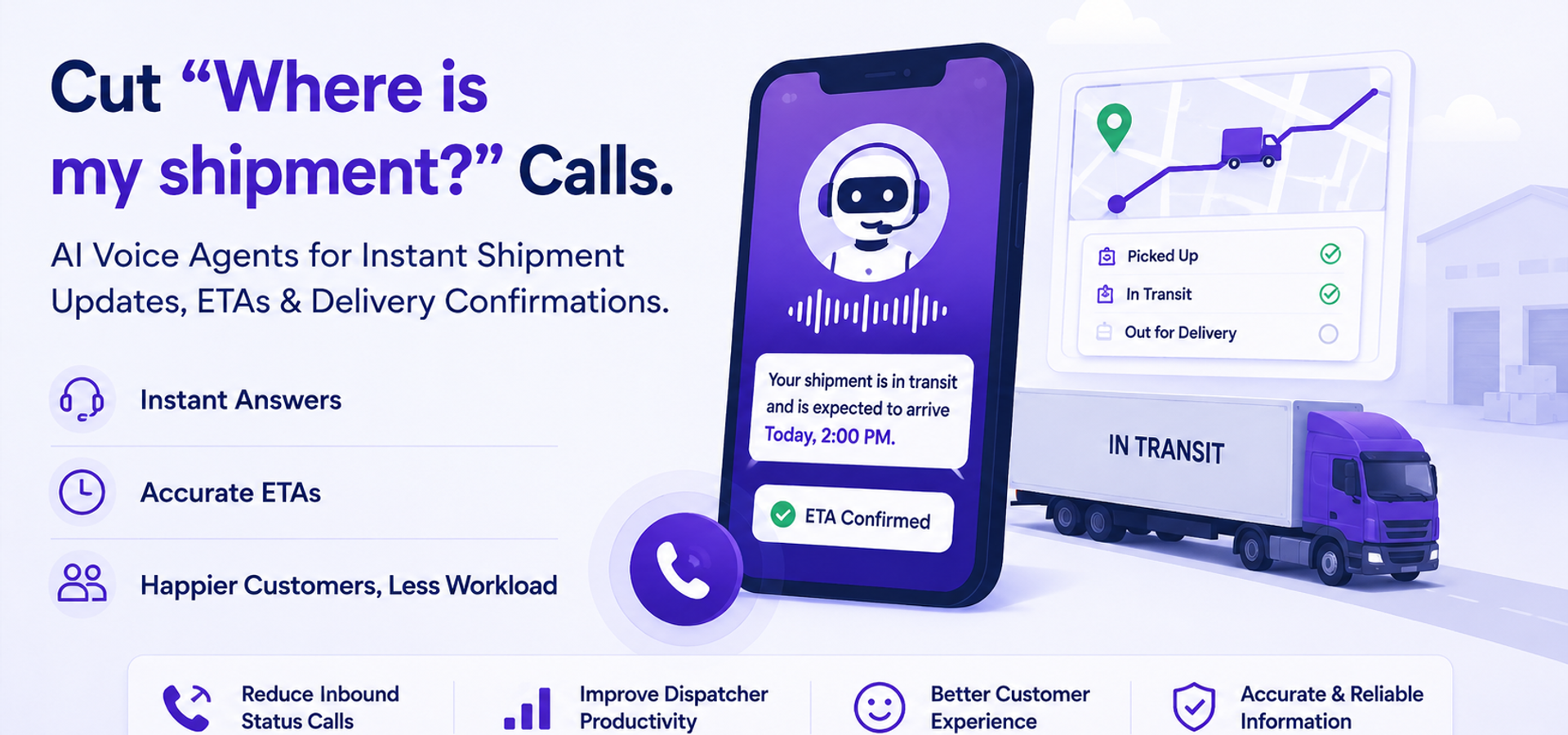
Your TMS shows green statuses. Your carriers are moving freight. Yet the phone keeps ringing with the same question: "Where is my shipment?" If where is my shipment calls eat half your dispatch day, you are not alone. Logistics coordinators across LTL, FTL, last-mile, and 3PL desks lose hours to repetitive shipment status calls that portals and emails were supposed to prevent.
This article explains why dispatch workload breaks on status requests, what callers actually need, why adding headcount rarely fixes the loop, and how AI voice agents can automate ETA answers, delivery confirmations, and structured handoffs, so humans focus on exceptions, not readouts.
The hidden math behind where is my shipment calls
Picture a desk with eight coordinators and four hundred active loads. Two status checks per load weekly, four minutes each, that is fifty-plus hours burned before routing, detention, or carrier communication. Peak season multiplies the pain when ETAs shift faster than portals refresh.
Operations leaders call it a training problem or a portal policy problem. Buyers call dispatch because calling works when a line waits on parts. That drives freight tracking calls, stale self-service plus no proactive voice when plans change.
The industry numbers point the same way. McKinsey estimates that between $65 billion and $95 billion of waste is generated each year at the handoffs between shippers, dispatchers, 3PLs, and carriers, much of it from blind spots about who knows what, and when.
Why portals, email, and chatbots still leave gaps
Most shippers invested in track-and-trace links years ago. They help, until they do not. Common failure modes include:
- Lag: Carrier EDI or API updates arrive hours after reality on the road.
- Context missing: A status says "in transit" but not whether delivery is still today or slipped to Monday.
- Multi-leg blind spots: Consolidation, cross-dock, and handoffs break the single-link story customers expect.
- Appointment nuance: Windows, accessorials, and dock constraints rarely show in a one-line scan event.
Chatbots pull the same stale JSON. Email asyncs the question but keeps it in queue. Voice is synchronous trust for high-value freight, why logistics customer service still centers on phones.
For broader automation context, see AI in logistics use cases, technology used in supply chain management, and the logistics decision gap in AI operations.
What callers actually want in sixty seconds
Strip the emotion from most where is my shipment calls and you hear five repeatable intents:
- Confirm the load is picked up and moving
- Get a realistic ETA or appointment window
- Learn what changed since yesterday
- Reschedule or confirm delivery access
- Escalate a miss or damage with a human who can act
None of these require a senior dispatcher every time, if your systems expose clean answers and your voice layer can speak them clearly. The expensive mistake is letting tier-one status pulls consume tier-three exception talent.
How dispatch workload breaks your operation
When coordinators live on status phones, downstream work stalls:
- Exception response slows: Detention, OS&D, and rebooking wait while someone reads tracking aloud.
- Carrier communication slips: Check calls and appointment confirmations batch to end of day, too late for drivers.
- Data never gets logged: Answers happen in conversation but not in the TMS note field, so the next caller repeats the thread.
- Burnout rises: Skilled ops people quit when the job feels like a call center readout role.
That is the true cost of unchecked shipment status calls, not just minutes, but misprioritized dispatch workload across the whole control tower. Trends in AI supply chain technology and machine learning in supply chain optimization focus on planning and inventory, but voice-heavy coordination remains under-automated on many desks.
Why hiring more dispatchers is not a durable fix
Adding coordinators scales cost linearly, not consistency. New hires need months to learn carrier quirks while freight tracking calls grow with every account. Tier handling instead: automate status flows, reserve humans for customs holds, claims, and escalations, what AI voice execution enables when integrated to your stack.
AI voice agents for shipment status, ETA, and delivery confirmation
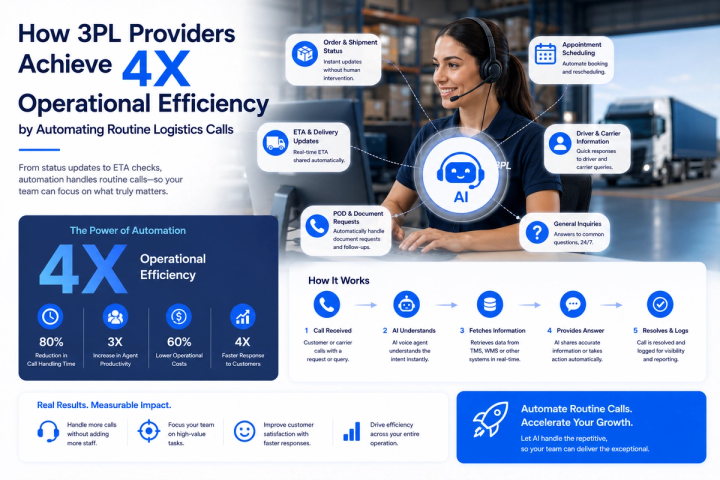
Modern AI voice agents differ from old phone trees. They can:
- answer on your business line with natural dialogue, not "press 1 for tracking"
- authenticate with order, PRO, BOL, or account number
- pull live or near-live status from TMS, WMS, or carrier APIs
- state ETA windows in plain language and offer SMS or email recap
- book or confirm delivery appointments when rules allow
- escalate to a live coordinator with transcript and lookup context
- log every outcome back to the system of record
That is how you drain repetitive status volume without draining service quality. Customers get instant answers; dispatch gets time back for carrier communication that moves freight, check calls, detention negotiation, and dock scheduling that portals never handle well.
Explore execution patterns in conversational services use cases and inventory-adjacent ops in AI inventory optimization. Sustainability and customer expectations also push proactive updates, see how AI makes supply chains more sustainable.
Who feels the pain first on your desk
The symptoms show up in predictable places. Customer service forwards every angry shipper email to dispatch "because they know you." Account managers ping Slack for PRO numbers instead of opening the portal. Night shift leaves sticky notes for morning coordinators about callbacks that never got logged. Each path ends at the same screen: tracking events that do not answer the question behind where is my shipment calls.
Supervisors then report odd metrics, high answer rates but slipping OTIF, rising detention minutes, missed appointment confirmations. The team is busy all day yet nothing feels under control. That is the signature of a dispatch workload crisis driven by status volume, not lack of effort. Fixing it requires separating readout work from decision work, then measuring repeat callers to prove the split worked.
Integration: your TMS is the truth; voice is the interface
Voice automation fails when dispatch still maintains a shadow spreadsheet. Before you pilot, map:
- which fields define status, ETA, and appointment state
- which exceptions always require human approval
- how notes and dispositions write back after each call
- which customers or lanes pilot first (high call volume, low complexity)
Build versus buy matters for telephony latency and maintenance, read build vs buy voice AI stack and compare stacks in Retell vs Dialflo or Vapi alternatives if you evaluate raw infrastructure versus logistics-ready workflows.
Four-week pilot to cut shipment status calls
Week 1: Measure the noise
Tag inbound lines for one week. Count status calls, handle time, and repeat callers on top lanes.
Week 2: Script and connect data
Write prompts for the five intents above. Connect read-only TMS lookups first.
Week 3: Route a slice of traffic
Send after-hours overflow to the voice agent with warm transfer to live staff.
Week 4: Expand or fix
Scale only if repeat call rate drops. Bad data, not bad AI, drives "agent" bypass.
Metrics that prove ROI on logistics customer service automation
Track both service and ops, not vanity deflection alone:
- inbound shipment status calls per load per week
- average handle time for tier-one status pulls
- repeat caller rate within 24 hours (signals bad answers)
- coordinator hours reclaimed for exceptions
- OTIF and appointment confirmation rate (ensure automation does not hurt delivery)
- escalation rate and escalation resolution time
If repeat callers spike, your ETA source is wrong, not your voice tone. Fix data before you tune scripts.
For a sanity check on targets, Oliver Wyman's review of 25 logistics AI use cases found AI tools can handle up to 30% of customer inquiries end-to-end and cut agent handling time by about half. Your own numbers will depend on data quality and how many of your calls are pure status pulls.
Proactive voice: stop waiting for the angry call
Inbound tracking calls are reactive. Outbound ETA shifts and delivery confirmations cut volume before it forms, same TMS write-back, less dispatch workload. Proactive ETA updates often remove a large share of status calls before you automate inbound at all, so measure that drop on your own lanes first.
Compliance, recording, and brand trust
Disclose automation where required. Follow recording consent rules for your states and countries. Never guess on customs, hazmat, or claim liability, escalate. Logistics buyers forgive AI when answers are right and humans appear quickly when not.
Where Dialflo fits
Dialflo is AI voice execution for ops-heavy teams: ETA readouts, delivery confirmations, reschedule flows, and escalation with CRM or TMS write-back, not a TMS replacement. Confirm integrations on dialflo.ai and pilot one high-volume lane first.
FAQ: where is my shipment calls and dispatch automation
Why do customers call instead of using tracking links?
Portals lag, context is missing, and stakes are high. Voice confirms reality in seconds when self-service feels uncertain.
How much of dispatch time goes to status calls?
Many desks lose several hours per coordinator daily in peak season, often half the day on repetitive status and ETA requests.
Can AI answer where is my shipment accurately?
Yes when TMS or carrier data is accurate and fresh. Garbage in still means garbage out, fix feeds before scaling voice.
What should we automate first?
Inbound status and ETA on your busiest lanes, after-hours overflow, and appointment confirmation, high volume, lower risk.
Will shippers accept automated voice?
They accept fast correct answers. Offer instant human transfer and SMS recap; disclosure builds trust.
How does Dialflo help?
Voice agents for shipment updates and confirmations with ops system write-back, see dialflo.ai.
Closing: reclaim dispatch for dispatch work
Status calls fade when answers are instant and logged. Automate tier-one pulls, escalate with context, and let coordinators move freight, not reread tracking aloud. Explore Dialflo for logistics voice workflows built to integrate.