The Hidden Cost of Missed Calls in Logistics Operations

Dialflo: AI Voice Agent
June 3, 2026
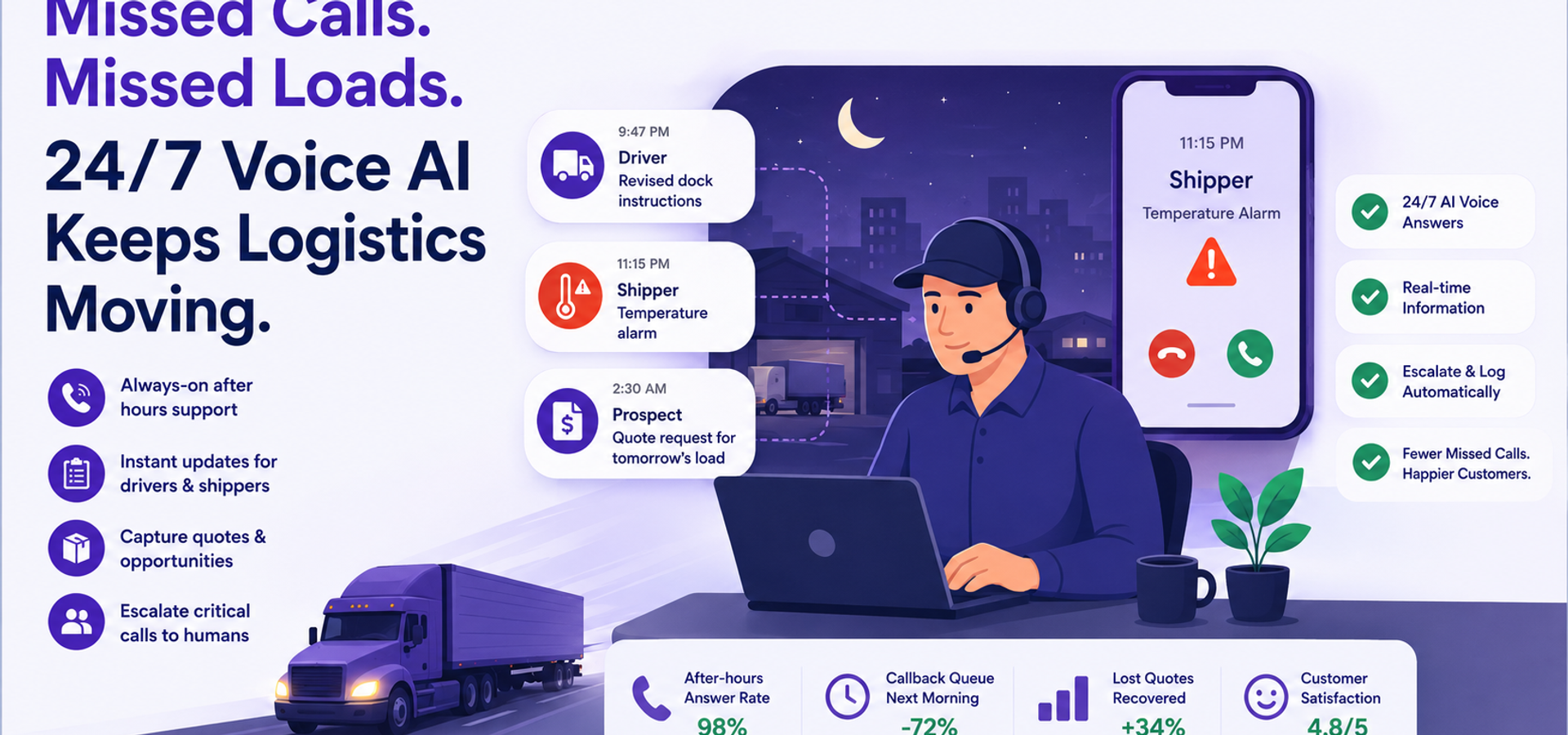
At 9:47 p.m., a driver calls dispatch for revised dock instructions. At 11:15 p.m., a shipper rings about a temperature alarm. At 2:30 a.m., a prospect requests a quote on tomorrow's load. The line rings. Voicemail answers. By morning, the driver waited at the wrong gate, the shipper booked another broker, and your logistics call center starts the day in recovery mode, not planning mode.
Missed calls in logistics are one of the most under-measured leaks in transportation operations. Dashboards track OTIF and cost per mile; few leaders track how many inbound calls go unanswered after hours, or what each silence costs in lost margin, detention, and trust. This guide breaks down that hidden math, who suffers first, and why after hours logistics support with 24/7 AI voice coverage beats "we'll call you back Monday."
What a missed call actually costs
Operations teams often treat unanswered phones as annoyance, not P&L. That is a mistake. A single missed calls in logistics event can trigger:
- Lost revenue: A prospect's freight broker calls go to the competitor who picked up.
- Detention and layover: A driver without instructions waits; clocks start billing you.
- Missed appointments: Warehouses close slots; redelivery fees follow.
- Compliance risk: Check calls and hours-of-service questions unanswered create audit gaps.
- Customer churn: Shippers remember who answered when a line went down.
Multiply by nightly volume across LTL, FTL, brokerage, and 3PL desks. The line item never appears as "missed call expense", it hides in expedite charges, lower win rate, and coordinator overtime returning callbacks.
Detention alone shows how fast this adds up. The American Transportation Research Institute found drivers were detained at 39.3% of stops in 2023, costing the trucking industry $3.6 billion in direct expenses and $11.5 billion in lost productivity.
Who is calling when nobody answers
After hours is not quiet in logistics. Common callers include:
- Drivers and owner-operators: Directions, lumper issues, breakdowns, check calls.
- Shippers and consignees: ETA anxiety, accessorial approvals, damage reports.
- Prospects and sales: Spot quotes, capacity checks, new lane requests.
- Carriers and partners: Handoffs, cross-dock coordination, documentation.
- Internal teams: Night warehouse staff escalating to dispatch.
Each group expects transportation customer service in the moment, not an email ticket at dawn. When your logistics call center closes at six, you have not stopped demand; you have deferred it to voicemail, and to rivals with live coverage.
For automation context across the stack, read AI in logistics use cases and the logistics decision gap in AI operations.
A driver waiting at a gate for instructions is also using on-duty time under the FMCSA's hours-of-service rules, so one unanswered call can push a load into a rest break nobody planned for.
Why voicemail and "on-call" fail at scale
Voicemail rarely recovers urgency. Drivers hang up; prospects dial the next broker. On-call rotations burn senior dispatchers at 3 a.m. for readouts automation could handle. Generic outsourced nights desks take messages without TMS context, they cannot confirm appointments or warm-transfer with load detail.
The compounding effect on dispatch communication
Missed calls do not expire overnight, they infect the next shift:
- Morning teams return callbacks instead of planning routes.
- Notes live on personal phones, not in the TMS.
- Drivers learn to bypass process and call whoever answered last time.
- Sales hears "your phones go dead" on lost deals.
That is how missed calls in logistics become structural dispatch communication debt. Trends in AI supply chain technology and technology used in supply chain management focus on planning and visibility, but voice coordination at the edge still breaks when coverage stops at business hours.
Freight broker calls: where speed wins or loses margin
Brokerage is call-sensitive, spot markets move in minutes. When freight broker calls hit voicemail, you lose loads you never knew you had. Loyal shippers still test backups when misses stack up.
Speed matters for every inbound enquiry, not only freight. Research published in Harvard Business Review found that companies contacting online leads within an hour were nearly seven times as likely to qualify them as those that waited even one hour longer.
Transportation customer service after hours is a coverage problem, not a headcount problem
Hiring a full night shift is expensive and hard to fill. Rotating day staff into nights creates burnout and errors. The gap is not willingness, it is economics. You need tier-one coverage without tier-three cost for every ring.
That is where 24/7 AI voice agents change the equation: always-on first response, structured data capture, escalation to humans when judgment is required. Not a replacement for your logistics call center, an extension that never sleeps.
What 24/7 voice AI can handle on the first ring
Modern voice agents go far beyond IVR hell. In logistics they can:
- answer on your published business line with natural dialogue
- authenticate drivers, shippers, or prospects by load, PRO, MC, or account
- read shipment status and ETA from TMS or carrier feeds
- confirm or reschedule delivery appointments within rules
- intake spot quote requests with lane, weight, and equipment fields
- run driver check-call scripts and log outcomes
- warm-transfer exceptions with transcript and lookup context
- write notes and dispositions back to CRM or TMS, not sticky notes
Explore patterns in conversational services use cases and adjacent ops in AI inventory optimization. Sustainability and service expectations also push always-on coordination, see how AI makes supply chains more sustainable.
After hours logistics support without losing brand voice
Shippers judge the first ten seconds. AI must disclose automation where required and offer instant human escalation. SMS recap after calls cuts repeat rings.
Integration: stop replaying the same callback at 8 a.m.
Night automation fails if morning dispatch re-asks every question. Before pilot, define:
- which call types AI resolves vs escalates
- which TMS or CRM fields update automatically
- how sales quote intake routes to reps
- how driver emergencies bypass scripts to on-call supervisors
Build versus buy affects latency and maintenance, read build vs buy voice AI stack and compare infrastructure in Retell vs Dialflo or Vapi alternatives if you evaluate raw stacks versus logistics-ready execution.
The morning-after tax on your dispatch team
Every unanswered night call becomes a morning task with interest. Coordinators replay voicemails at double speed while drivers hold on hold. Sales learns about lost quotes from shippers who never left a message. Account managers firefight before standup ends. None of that work shows up as "missed call recovery" in your labor report, it hides inside regular dispatch communication hours until someone maps callback volume to headcount.
Leaders who measure only daytime answer rate miss the bleed. Track after hours abandoned calls and time-to-first-callback separately. The gap between those metrics and customer retention often surprises finance once it is visible.
Four-week pilot for after hours coverage
Week 1: Count the silence
Measure missed calls in logistics after hours: abandoned rings, voicemail volume, average callback delay, and known lost loads tied to no answer.
Week 2: Script tier-one flows
Start with status, check call, appointment confirm, and quote intake. Connect read-only TMS lookups; defer writes until accuracy proves out.
Week 3: Route overflow to voice AI
Send after hours traffic to the agent. Keep human on-call for escalations only. Compare answer rate and morning callback queue depth.
Week 4: Expand or fix
Add business-hour overflow if metrics hold. Kill flows with high bypass-to-human rates, that usually means bad data, not bad tone.
Metrics that prove ROI beyond "we answered"
Track outcomes, not vanity answer stats:
- after hours answer rate vs baseline
- missed call rate by hour and lane
- callback queue depth at shift start
- quote-to-book ratio on freight broker calls
- driver check-call compliance rate
- OTIF and detention minutes (ensure automation does not hurt service)
- repeat caller rate within two hours
If repeat callers spike, fix ETA sources before tuning scripts. Wrong answers answered quickly still damage trust.
Machine learning upstream, voice at the edge
Planning AI does not help a driver at the gate with no one to call. Machine learning in supply chain optimization improves forecasts; voice AI closes coordination when humans are off shift.
Compliance and escalation guardrails
Follow recording consent rules. Never let AI commit on claims, hazmat, or rate concessions outside policy. Escalate safety events immediately.
Where Dialflo fits
Dialflo provides 24/7 AI voice agents for logistics operations: after hours logistics support, driver check calls, shipment updates, quote intake, and structured escalation with write-back to your ops stack. It is voice execution, not a TMS. Use it when missed calls in logistics cost you loads, detention, and trust.
Confirm integrations, languages, and pricing on dialflo.ai. Pilot one line or lane after hours, measure morning callback depth, then expand.
FAQ: missed calls in logistics and 24/7 coverage
How much do missed calls cost brokers?
Varies by lane, but lost spot quotes and shipper churn often exceed the cost of coverage, especially when misses repeat weekly.
Should we staff humans or use AI after hours?
Blend both: AI for tier-one volume and data capture; humans for exceptions and high-value negotiations.
Will drivers talk to AI?
Yes when they get dock codes and ETAs fast. Always offer immediate transfer for breakdowns and safety.
What integrates with voice automation?
TMS, CRM, load boards, and ticketing, every outcome should log automatically for day shift.
How long until ROI?
Many teams see lower morning callback queues within 2–4 weeks on after hours pilots.
How does Dialflo help?
24/7 voice agents for logistics with ops write-back, see dialflo.ai.
Closing: coverage is a service promise
Logistics runs on motion. When phones go silent after hours, motion stops, drivers wait, shippers switch, prospects disappear. Fixing missed calls in logistics is not about buying more voicemail storage; it is about after hours logistics support that answers, logs, and escalates with context. Explore Dialflo for 24/7 voice coverage built for dispatch reality, not generic call center scripts.