How Logistics Teams Cut Dispatcher Call Load with Voice AI

Dialflo: AI Voice Agent
June 8, 2026
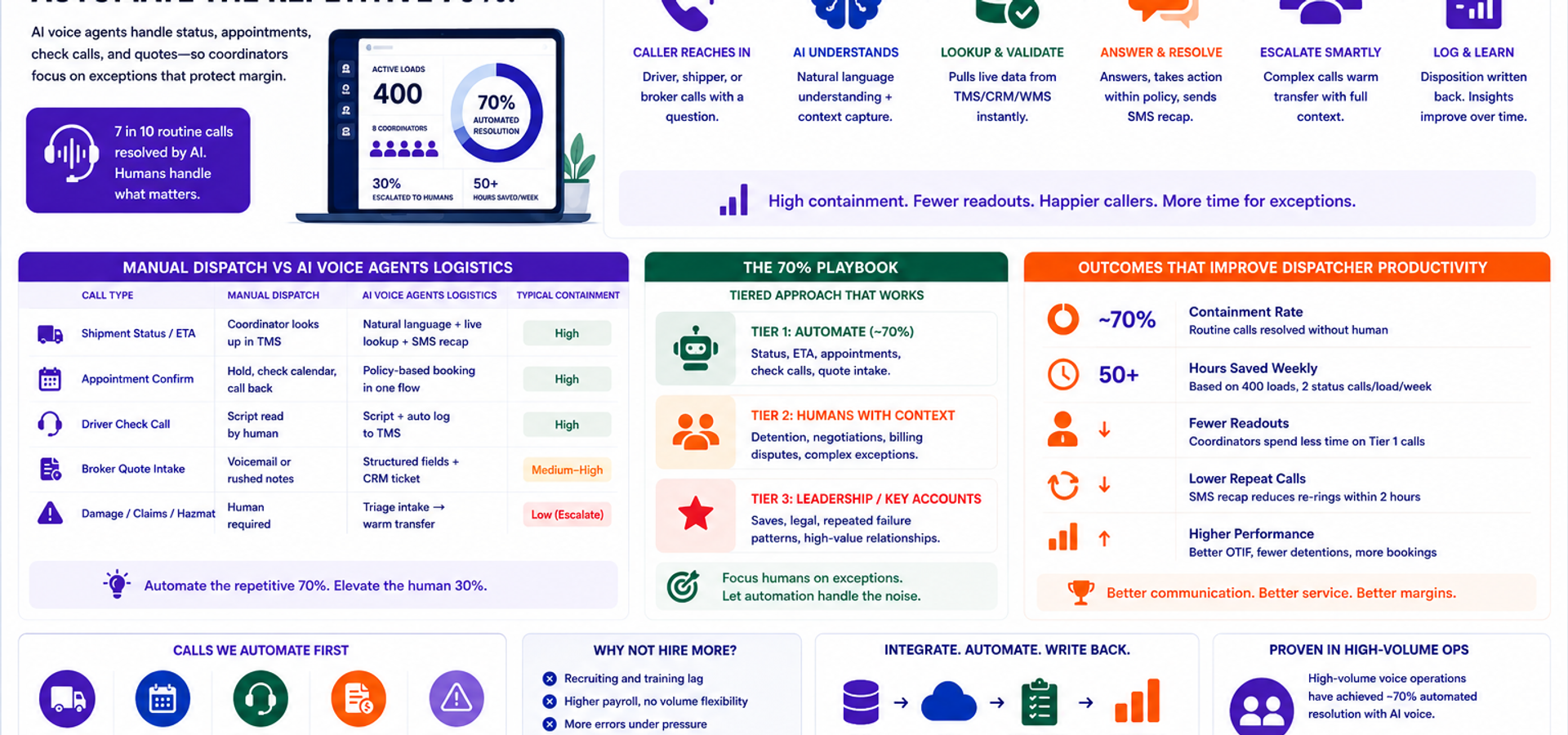
Eight coordinators. Four hundred active loads. Two status checks per load per week. Do the math before anyone mentions detention or a missed pickup, and you are already fifty hours deep in readouts. That is the logistics operator’s biggest headache: dispatchers drowning in repetitive calls while exceptions wait on hold.
Leading teams do not fix that by hiring faster. They use logistics dispatch automation to absorb tier-one transportation communication so humans protect margin on the hard rings. When voice AI is wired to live TMS data, most routine status, ETA, and appointment calls can be resolved without a dispatcher. This guide shows how to apply that playbook to freight so you can reduce dispatcher workload without pretending AI runs your network.
What cutting dispatcher call load actually means
The goal is not a magic number; it is containment on automatable intents. McKinsey estimates that dispatchers at B2B carriers spend around 70% of their time on issues caused by blind handoffs between shippers, dispatchers, 3PLs, and carriers, and Oliver Wyman's review of 25 logistics AI use cases found AI tools can handle up to 30% of customer inquiries end-to-end and cut handling time by about half. Your containment rate will depend on your intents, your data quality, and how cleanly calls escalate, so set the target per queue and measure it in a pilot.
Neither study is a freight TMS case study, and we are not claiming they are. They point the same way: when most inbound calls are status, scheduling, and repeat questions, conversational voice tied to system data can resolve a large share of them without a coordinator. Logistics dispatch has the same shape, see where is my shipment calls, with different nouns (PRO, BOL, dock) and higher stakes on wrong ETAs.
Why dispatcher workload breaks (the repetitive majority)
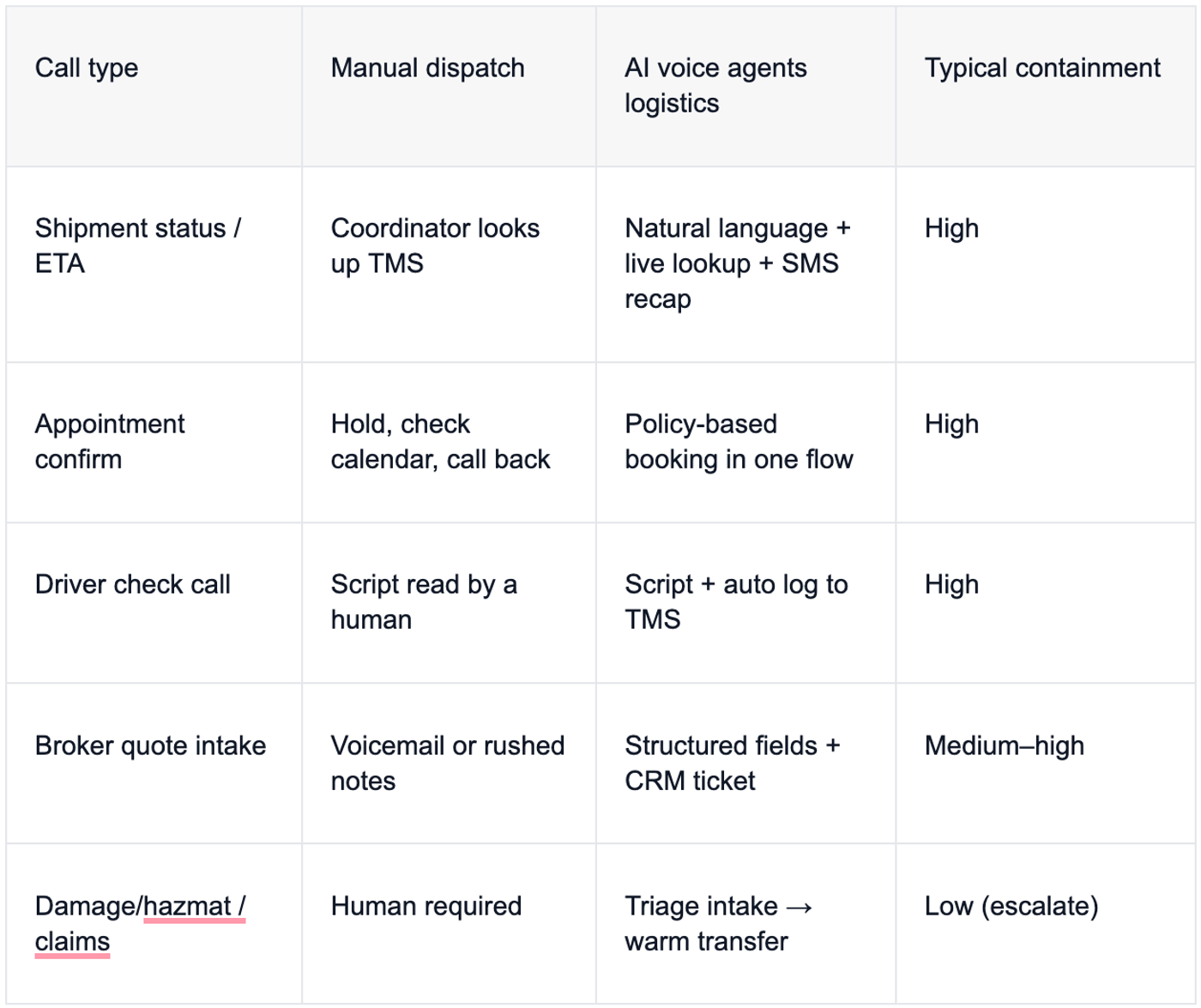
Before you reduce dispatcher workload, classify what rings today. Most mid-market desks see a repeatable mix:
- Status and ETA: “Still on track for today?”
- Appointment confirm or change: windows, lumper, gate codes
- Driver check calls: location, next stop, hours
- Quote intake: spot lane, weight, equipment (brokers)
- Exception anxiety: delay, failed attempt, address fix
Those five buckets often account for the majority of inbound volume, the work that kills dispatcher productivity because it is important but not strategic. Exceptions need judgment; readouts do not. That split is the foundation of freight operations efficiency on the phone channel.
Manual dispatch vs logistics dispatch automation
The playbook: tier one, tier two, tier three
Teams that cut call load materially follow the same funnel:
Tier 1: automate: Status, ETA, appointments, check calls, quote fields. Set your highest containment target here.
Tier 2: humans with context: Detention, carrier negotiation, billing disputes, complex exceptions.
Tier 3: leadership / key accounts: Saves, legal, repeated failure patterns.
That is logistics dispatch automation done honestly, not replacing coordinators, reallocating them. Deeper exception design: reducing delivery exception calls before they reach ops. Phone-tree replacement: why operators replace phone trees with conversational voice AI.
AI voice agents logistics: what to automate first
AI voice agents logistics deployments that move metrics share traits:
- authenticate by PRO, BOL, MC, or account before re-asking
- answer from TMS truth, or escalate when scans are stale
- offer instant human transfer with transcript and load context
- send SMS recap to cut repeat rings within two hours
- write disposition codes to CRM/TMS automatically
Patterns and definitions: conversational services use cases and AI in logistics use cases. Planning AI upstream does not answer the driver at the gate, pair machine learning supply chain optimization with voice at the edge per the logistics decision gap.
Why hiring more dispatchers rarely fixes call load
Seasonal hiring adds seats after the surge starts, recruiting lag, TMS training, error rate under pressure, January layoffs. The American Trucking Associations tracks persistent workforce pressure across freight operations, see ATA news and insights. More phone staff does not add trucks; it adds payroll.
Peak weeks multiply repetitive rings, handling peak season call volume without hiring dispatchers. After-hours misses become morning debt, the hidden cost of missed calls in logistics. Automation scales down when volume normalizes; seasonal headcount often does not.
Freight operations efficiency: measure outcomes, not vanity answer rate
To claim you reduce dispatcher workload, track:
- Containment rate: % of calls resolved without human (set a target for each tier-one intent)
- Coordinator hours on readouts: self-reported or sampled
- Repeat caller rate within 2 hours: spikes mean bad data, not bad tone
- Morning callback queue depth: should shrink
- Quote-to-book ratio on broker lines
- OTIF and detention: ensure automation did not hurt service
Benchmark freight volume context with Bureau of Transportation Statistics data. J.D. Power publishes transportation customer satisfaction research, communication quality shapes retention, J.D. Power business.
Transportation communication that protects dispatcher productivity
The best automation improves transportation communication for callers too: shorter time to answer, honest ETAs, SMS proof, easy escape to a human. Disclose automation where required. Never let voice AI commit on claims, hazmat, or rate concessions outside policy.
Proactive delay texts cut inbound before it rings, pair voice with outbound rules discussed in exception triage guides. Sustainability pressure also favors tighter coordination, how AI makes supply chains more sustainable.
Where Dialflo fits
Dialflo provides AI voice agents logistics teams use to reduce dispatcher workload: natural-language status, appointments, check calls, and quote intake with TMS-aware answers and write-back. Dialflo is voice execution, not a TMS. Use it when coordinators lose days to repetitive transportation communication and you want logistics dispatch automation that targets high containment on tier-one intents while humans own exceptions.
Pilot one queue, measure containment and morning callbacks, then expand. Confirm integrations on dialflo.ai.
FAQ: reduce dispatcher workload
How much dispatcher call load can AI take off the desk?
Most of the tier-one load, if your TMS data is accurate and fresh. Measure containment per intent in a pilot, and keep exceptions escalating to people.
What calls automate first?
Status, ETA, appointments, check calls, structured quote intake.
Does this replace dispatchers?
No, it improves dispatcher productivity by removing readout work.
How fast to see results?
Often within 2–4 weeks on a focused pilot queue.
What must integrate?
TMS, CRM, and disposition write-back, no sticky-note handoffs.
How does Dialflo help?
AI voice for tier-one logistics calls with escalation context, see dialflo.ai.
Closing: automate tier one, not the whole job
Leading logistics companies cut dispatcher call load on automatable transportation communication, not on judgment calls that win or lose margin. The playbook comes from other high-volume phone operations; freight dispatch applies it with PROs, docks, and TMS truth. Invest coordinator time in exceptions; let logistics dispatch automation absorb the rings that never needed a human in the first place.
Ready to measure containment on your busiest queue? Explore Dialflo for AI voice agents logistics built to improve freight operations efficiency and dispatcher productivity, starting with your most repetitive calls.