Reduce Delivery Exception Calls Before They Hit Operations

Dialflo: AI Voice Agent
June 4, 2026
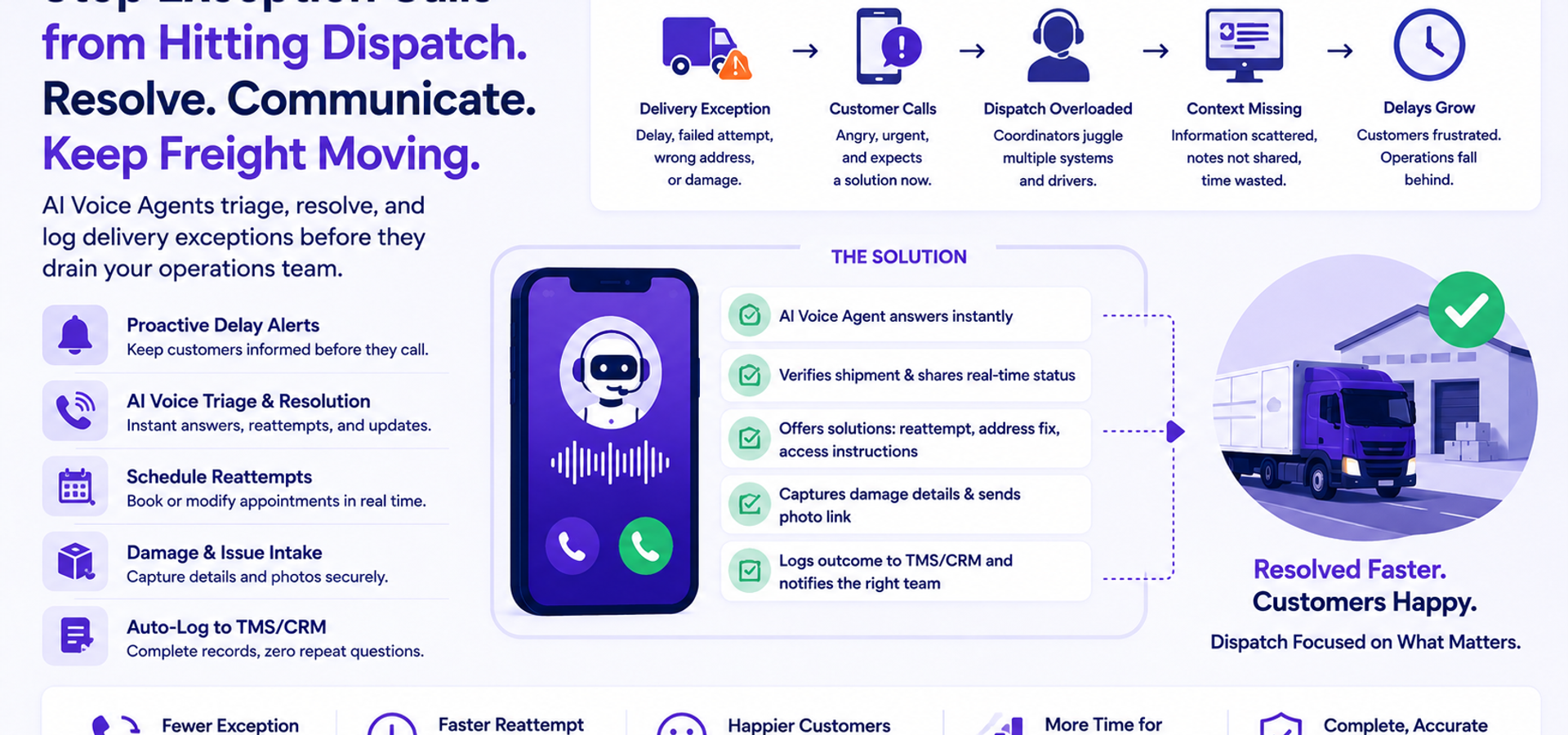
The portal still says “out for delivery.” The consignee already got a failed attempt notice. By the time they call, they are not asking politely, they want a person who can fix today. That call lands on your busiest coordinator, who pulls up three systems while a driver holds on line two. This is what weak delivery exception management looks like: every delay, wrong address, and damage report becomes operations work by default.
Customers calling about delays, damaged shipments, and wrong addresses is predictable. What is optional is whether those failed delivery calls reach your core ops team, or get triaged, resolved, and logged before they burn dispatch capacity. This guide explains how to structure freight exception handling, improve shipment delay communication, and use voice AI logistics so logistics customer support handles routine delivery issue resolution without drowning coordinators.
What delivery exception management actually means
Delivery exception management is the full loop from exception event to closed outcome:
- Detect: Carrier scan, geofence, driver app, warehouse alert.
- Classify: Delay, failed attempt, address problem, refusal, shortage, damage.
- Communicate: Proactive shipment delay communication before the customer calls.
- Resolve: Reattempt, redirect, appointment change, claim intake.
- Record: Notes in TMS/CRM so the next touch does not restart from zero.
When any step is missing, logistics customer support becomes the exception system, and failed delivery calls climb straight to operations.
Why exception calls reach operations (the usual gaps)
Most teams have tracking links. Exceptions still escalate because:
- Status lag: Scan events arrive after the customer’s reality changed.
- No proactive message: Nobody told them the window slipped until they called.
- Generic IVR: “Press 1 for tracking” reads the same stale status they already saw.
- No authority on first touch: Front line cannot schedule reattempt or confirm access rules.
- Notes trapped on phones: The next caller gets a different coordinator with no context.
That pattern mirrors why desks drown in status rings, see where is my shipment calls, but exception calls are angrier and more expensive to mishandle.
Failed delivery calls: stop treating every ring as an emergency
Failed delivery calls are high volume and often low complexity: confirm attempt time, verify address line 2, book tomorrow’s window, send access instructions to the driver. Those are not strategist tasks, they are workflow tasks.
Strong freight exception handling routes them to:
- Self-service with truth: SMS with live ETA or reattempt link tied to TMS.
- Voice AI triage: Authenticate, read status, act within rules.
- Human ops: Only when policy, liability, or emotion requires judgment.
When step two is missing, step three inherits everything, including calls that could have closed in ninety seconds.
Shipment delay communication before the angry callback
The cheapest exception call is the one that never happens. Shipment delay communication should trigger on rules, not on coordinator memory:
- appointment window at risk (traffic, warehouse backlog)
- missed inbound connection affecting outbound
- weather hold with revised service date
- customs or linehaul slip on international legs
Proactive SMS or outbound voice beats passive portals. The FTC CAN-SPAM guidance reminds teams to honor opt-outs and identify messages clearly, apply the same discipline to operational texts (consent, sender ID, useful content).
When proactive comms fail, AI inbound should pick up the thread with the same facts, not force the customer to explain the delay twice. Context on peak volume: handling peak season logistics call volume.
Delivery issue resolution for damage and address errors
Delivery issue resolution for damage needs structure, not sympathy alone:
- capture PRO/load reference and delivery date
- record damage type (carton, concealed, temperature)
- send secure link for photos before the freight moves again
- open claim ticket with immutable timestamps
- escalate when value or hazmat thresholds trip
Wrong-address flows need validated fields, suite, gate code, business hours, not free-text chaos in a dispatcher’s notebook. AI can confirm what changed, create a correction task, and read back the updated window while a human reviews interstate redirects.
Logistics customer support tiers that protect operations
Redesign logistics customer support as a funnel:
Tier 0: proactive: Alerts and two-way SMS for known delays.
Tier 1: AI voice: Status, reattempt booking, address validation, damage intake.
Tier 2: coordinators: Carrier escalation, appointment negotiation, billing disputes.
Tier 3: leadership: Key account saves, legal, repeated failure patterns.
Operations should live in tier 2 and 3, not tier 1 by default. Broader automation map: AI in logistics use cases and conversational services use cases.
Voice AI logistics: triage and resolve routine exceptions
Modern voice agents can:
- authenticate by PRO, BOL, phone, or account number
- read exception reason codes from TMS or carrier feeds
- offer honest ETAs when data is stale, and escalate instead of guessing
- schedule reattempts inside your access rules
- capture damage narratives and trigger photo upload links
- warm-transfer to humans with transcript and lookup context
- write dispositions to CRM/TMS automatically
That is how voice AI logistics reduces exception calls to ops without hiding serious problems. Planning AI upstream does not replace the consignee at the dock, pair forecasting in machine learning supply chain optimization with edge coordination described in the logistics decision gap.
Integration: exceptions must not replay at 8 a.m.
Automation fails when morning dispatch re-asks every question. Before pilot, define:
- exception taxonomy synced across TMS, WMS, and phone dispositions
- which fields AI can write (reattempt date) vs read-only until QA proves out
- how damage claims route to insurance or carrier portals
- how sales hears about key-account exceptions
Stack context: technology used in supply chain management, AI supply chain technology trends. After-hours leaks still hurt exception perception, read the hidden cost of missed calls in logistics.
Four-week pilot for exception triage
Week 1: Classify what actually reaches ops
Sample 100 exception calls: tag delay, failed attempt, address, damage, other. Measure repeat callers within 24 hours.
Week 2: Script tier-one resolutions
Delay ETA readout, reattempt scheduling, address confirmation, damage intake. Connect read-only TMS first.
Week 3: Route inbound exceptions to AI
Keep humans on warm transfer for escalations. Compare ops queue depth and average handle time on true exceptions.
Week 4: Add proactive delay comms
Trigger SMS on top three delay codes; measure inbound reduction on those lanes.
Metrics that prove delivery exception management works
- % exception calls reaching tier 2 ops (down is good)
- first-contact resolution on failed attempts
- repeat caller rate within 24 hours
- time from exception scan to customer notification
- time from call to scheduled reattempt
- coordinator hours on readouts vs escalations
- OTIF and damage claim cycle time (ensure triage does not hurt outcomes)
Industry benchmarks on freight performance and reliability are published through the Bureau of Transportation Statistics annual reports, useful when you set year-over-year exception rate targets.
Build vs buy for exception voice workflows
Exception scripts change with carriers, retailers, and season. Maintenance load matters, see build vs buy voice AI stack before committing engineering sprints during a service recovery initiative.
Where Dialflo fits: AI triages routine exceptions
Dialflo provides AI voice agents for delivery exception management: triage failed delivery calls, run shipment delay communication with TMS-aware answers, and complete routine delivery issue resolution, reattempt booking, address intake, structured damage capture, before calls flood your operations team.
Dialflo is voice execution, not a TMS. Use it when freight exception handling defaults to coordinators, when repeat callers spike after delays, and when you need dispositions in your ops stack, not sticky notes. Confirm integrations on dialflo.ai. Sustainability and service pressure also favor proactive coordination, how AI makes supply chains more sustainable.
FAQ: delivery exception management
What is delivery exception management?
The detect-classify-communicate-resolve-record loop for delivery problems, designed so ops is not the default first responder.
Why do failed delivery calls reach dispatch?
Stale tracking, no proactive updates, and first-line teams without authority to schedule reattempts.
Can AI resolve delivery exceptions?
It can resolve routine cases and escalate structured context for damage, liability, and high-value accounts.
What systems should integrate?
TMS, WMS, OMS, and CRM, with automatic notes and disposition codes.
How do we measure success?
Fewer exception calls to ops, higher first-contact resolution, lower repeat caller rate, faster reattempt booking.
How does Dialflo help?
AI voice triage and resolution with ops write-back, see dialflo.ai.
Closing: exceptions are a workflow, not a mood
Delays, damage, and wrong addresses will happen in transportation operations. They only become chaos when every customer learns that calling ops is the fastest fix. Strong delivery exception management pushes shipment delay communication forward, routes failed delivery calls through triage, and saves coordinators for the exceptions that actually need judgment.
Ready to stop exception calls from landing on dispatch by default? Explore Dialflo for AI that triages and resolves routine delivery issues, with context your team can trust on the escalations that remain.