Voice AI vs IVR: Stop Routing Callers, Start Resolving Them

Dialflo: AI Voice Agent
July 20, 2026
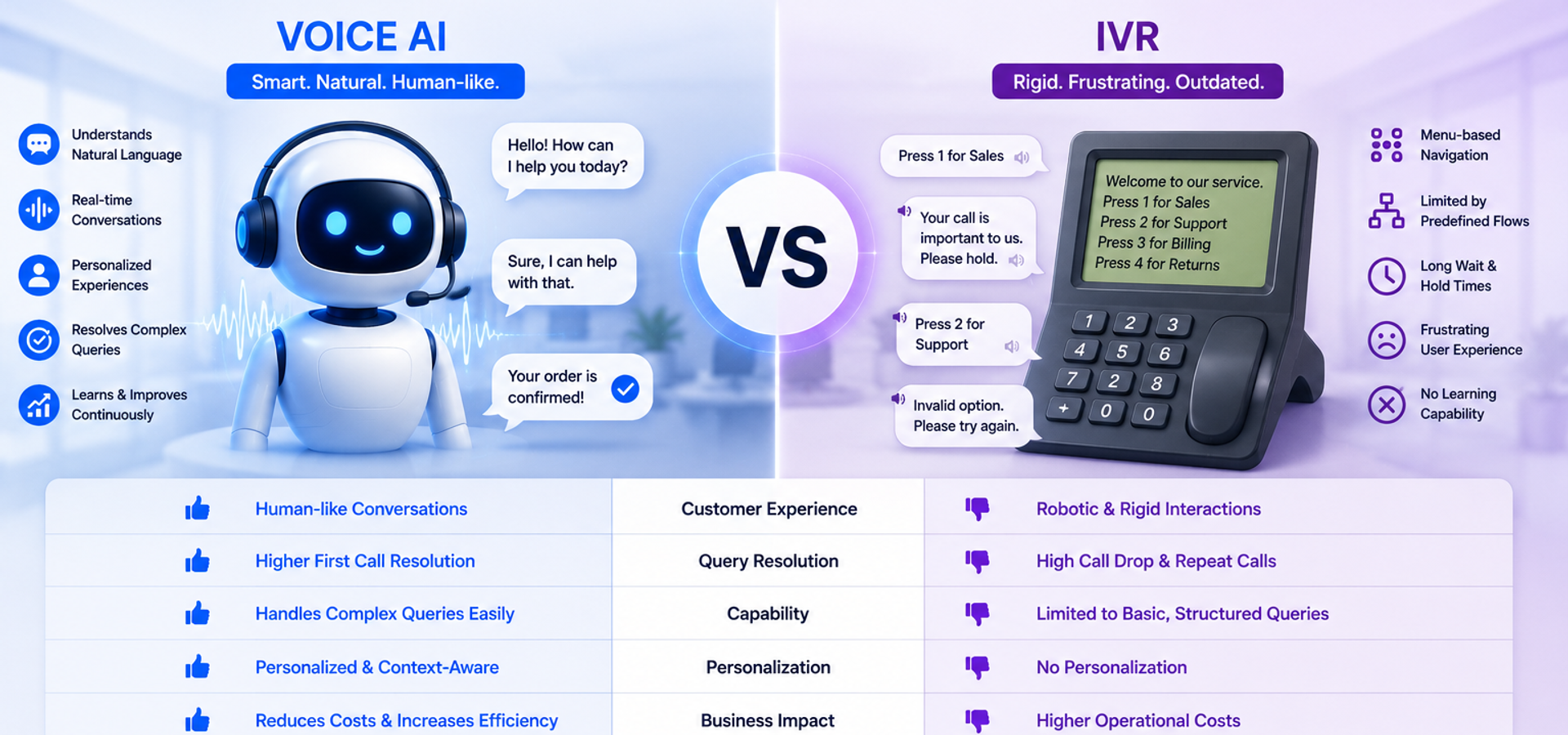
“Press 1 for sales. Press 2 for support. Press 3 to hear these options again.” Your caller already knows how this ends: zero-out, hold music, and repeating their account number to a human who asks why they did not use self-service. That frustration is the real Voice AI vs IVR decision, not which logo sounds more futuristic on a slide.
This guide compares both models plainly: what each is built to do, where IVR still belongs, how Voice AI changes cost and CX, and a migration path that does not require ripping your phone stack overnight. For adjacent context, see conversational services and build vs buy voice AI.
Voice AI vs IVR in one sentence
IVR is a decision tree that moves callers around. Voice AI is a conversational agent that tries to finish the job, look up status, book a slot, capture a lead, then writes the outcome into your system of record.
If your metric is “calls deflected from agents,” both can look busy. If your metric is “caller problem solved without rage,” the architectures diverge fast.
Why IVR won the 1990s, and why it loses now
Interactive Voice Response earned its place when human labor was the only alternative and DTMF menus were “automation.” It still works for:
- simple language selection
- emergency / priority routing
- collecting a single ID before a human queue
- ultra-stable, rarely changing option sets
It fails when intent is messy, options multiply, or callers must remember which number maps to which department. Menus age into archaeology. Agents inherit angry zero-outs. CSAT dies in the lobby.
McKinsey’s contact-center work keeps pushing leaders toward a hybrid of humans and AI, not more layers of navigation theater. Source: McKinsey: The right mix of humans and AI in contact centers.
What Voice AI changes in the same phone call
Modern Voice AI (conversational voice agents) typically adds:
- Natural language: “Where is order 4812?” instead of Press 4 → Press 2 → Enter ID
- Context: multi-turn memory in one call
- Tools: CRM/TMS/ATS lookups and updates
- Judgment gates: escalate when sentiment or policy requires a human
- Write-back: dispositions land where ops already works
Industry analyses also project large labor-cost impact as conversational AI absorbs more contact-center volume, another reason “cheaper IVR minutes” is the wrong comparison unit. Source: CX Today summarizing Gartner conversational AI projections.
Unique angle: routing cost vs resolution cost
Most Voice AI vs IVR debates stall on feature lists. Buyers should compare cost of unfinished work:
- abandoned calls after menu fatigue
- agent time spent re-collecting what the IVR already asked
- wrong-queue transfers
- repeat contacts for the same status question
IVR optimizes for cheap routing. Voice AI optimizes for completed intents. When status, scheduling, screening, and qualification dominate your queue, resolution economics win. Vertical proof points live in AI in logistics use cases, AI agents for recruitment, and lead qualification calls.
Side-by-side: what actually differs
- Input: IVR = keys/forced phrases · Voice AI = natural speech
- Job: IVR = route · Voice AI = resolve + hand off
- Change cost: IVR trees get brittle · Voice AI intents iterate with prompts/tools
- Data: IVR often siloed · Voice AI should write to CRM/TMS/ATS
- Caller feel: maze · conversation with a clear exit to a human
Integration quality decides whether Voice AI becomes “IVR with better acting.” Treat write-back like a product requirement, same discipline as integrating with existing systems.
When to keep a thin IVR (honestly)
You do not need a religious war. Keep a thin IVR layer when you need:
- mandatory legal prompts or consent capture
- life-safety / priority barge-in routing
- a simple “press 9 for emergencies” escape
Then hand the conversation to Voice AI for the work that used to live five menus deep. Hybrid is fine. Maze-plus-bot is not.
Migration path: replace intents, not the whole PBX on Monday
- Audit zero-outs and top intents from call recordings or wrap codes.
- Pick one closed-loop intent (status, confirm, screen, qualify).
- Pilot Voice AI on a percentage of traffic; keep IVR as fallback.
- Measure containment quality, transfer context, CSAT, cost per resolved contact.
- Retire menu branches only after the intent beats baseline for 2–4 weeks.
Platform choice still matters, compare builders and managed options in Vapi vs Bland vs Retell, Retell vs Dialflo vs Vapi, Vapi alternatives for India, and Retell vs Dialflo pricing. Plan exits early via migrate Retell to Dialflo without downtime.
Where Dialflo sits in the Voice AI vs IVR choice
Dialflo is built for production conversational agents, not another press-1 skin. Use it to resolve recruiting screens, logistics status, and lead qualification loops with structured write-back, then escalate exceptions to humans. Related reading: how AI agents transform recruiting, logistics decision gap, and Retell vs Dialflo.
FAQ: Voice AI vs IVR
What is the core difference in Voice AI vs IVR?
IVR routes through menus. Voice AI converses, acts in systems, and aims to resolve, or hand off with context.
Should we delete IVR entirely?
Not on day one. Keep thin routing for emergencies and consent; move high-volume intents to Voice AI first.
Is Voice AI always more expensive?
Not when you count abandonments, repeats, and agent rework. Compare cost per resolved contact.
What should we migrate first?
Status, appointments, FAQs, screening, and qualification, high volume, low ambiguity, clear data.
How do we avoid “smarter IVR” failure?
Require tool calling, write-back, stop conditions, and warm transfers. Ban endless clarification loops.
How does Dialflo help?
Production voice agents that replace dead-end menus with resolved outcomes your CRM/TMS/ATS can trust.
Closing: retire the maze, keep the human
Voice AI vs IVR is a choice between moving callers around and finishing their request. Keep a thin menu if safety or law demands it. Put conversational agents on the intents that burn your queue. Measure resolution, not how clever the greeting sounds.
Ready to replace press-1 fatigue with real containment? Pilot Dialflo voice agents at dialflo.ai.