How Food Manufacturers Automate Delivery Appointments

Dialflo: AI Voice Agent
June 29, 2026
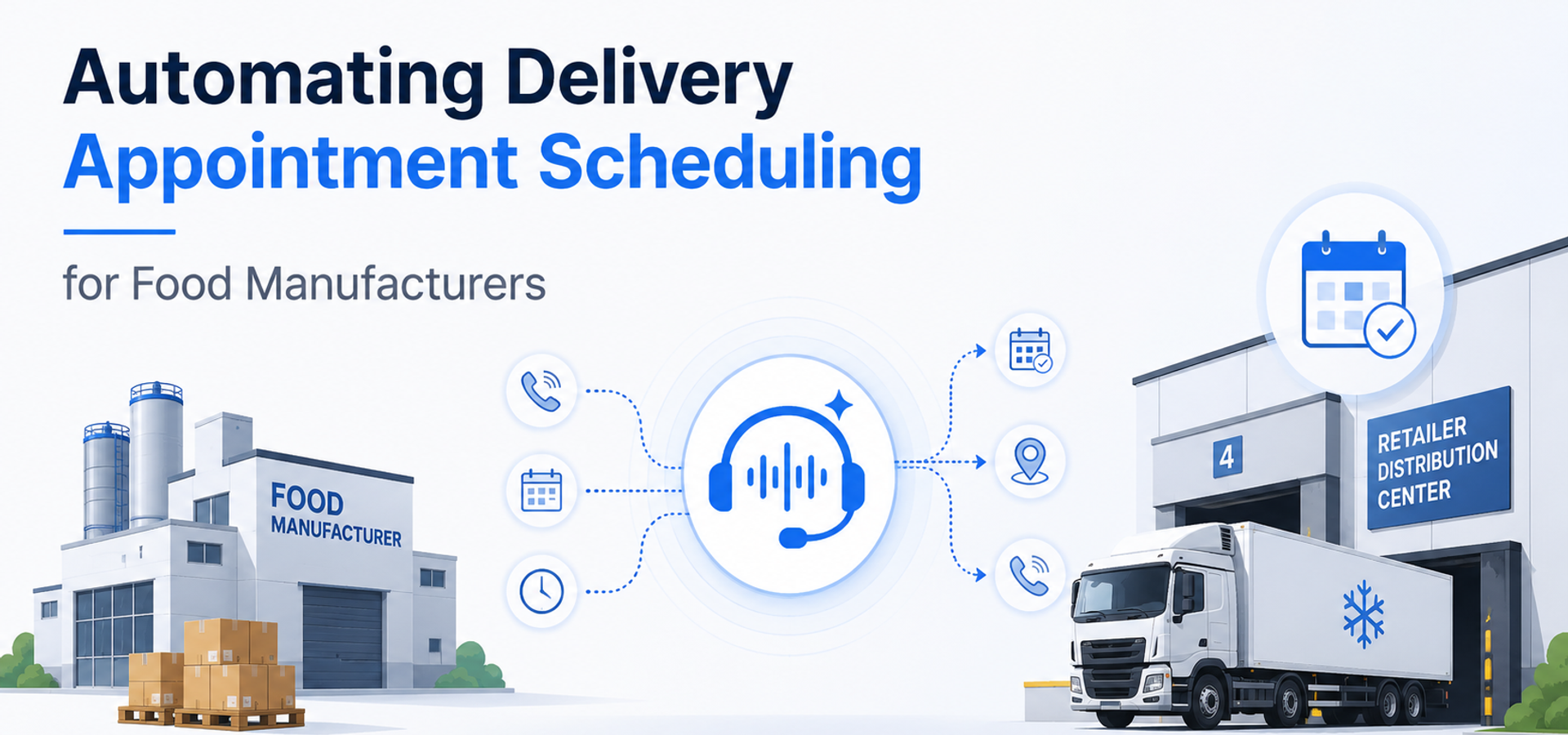
Short answer: Food manufacturers automate delivery appointment scheduling and confirmations by routing tier-one calls, slot confirm, driver check-in, ETA updates, simple reschedule intake, to AI voice agents tied to TMS or WMS data. Coordinators stop playing phone tag with carriers and retailer DC portals; they focus on production slips, detention, and compliance exceptions that actually cost margin.
Thursday at 4:47 p.m.: production finishes two hours late. Your coordinator still has forty outbound calls to make, confirm tomorrow’s dock slots at three retailer DCs, chase two carriers who never acknowledged the appointment window, and answer a driver on I-80 who thinks check-in is at 6 a.m. when the portal shows 8. Nobody picks up at the DC scheduling desk. Voicemail.full. Your OTIF report will remember this week longer than you want.
That is the food manufacturing squeeze. Appointment scheduling & confirmations are not back-office paperwork, they are the gate between your plant and retailer compliance. This guide shows how food and beverage manufacturers automate delivery appointment workflows without hiring seasonal coordinators every peak season.
Why appointment scheduling breaks for food manufacturers
Food logistics runs on time windows, not flexible delivery. Cold chain, shelf life, and retailer OTIF programs mean a missed dock slot is not a reschedule, it is a chargeback, a rejected load, or product you cannot sell. When operations run on phones and portals, appointment scheduling & confirmations break because:
- coordinator desks are sized for average week, not Q4 plus a promo push
- retailer DC portals, email threads, and carrier calls live in different systems
- production delays force reschedules faster than humans can re-confirm
- drivers call from the road while coordinators are on hold with the DC
- every confirmed slot needs a logged outcome, or the next caller starts from zero
- seasonal hiring is slow, expensive, and risky for food safety documentation
The Food and Drug Administration’s FSMA rule on sanitary transportation emphasizes temperature control and documented handoffs across the supply chain, appointment discipline is part of making those handoffs real, not theoretical. Source: FDA FSMA sanitary transportation rule.
Logistics context: AI in logistics: use cases, benefits & tools and logistics decision gap in AI operations.
What appointment scheduling and confirmations actually include
In food manufacturing outbound logistics, appointment scheduling & confirmations is a loop, not a one-time calendar entry:
- Book: request dock slot at retailer DC, 3PL, or co-packer
- Confirm: verify date, time window, door, and reference numbers with carrier
- Reconfirm with driver: cab call or text before transit
- Reschedule: when production, traffic, or receiver capacity shifts
- Check in on arrival: yard, gate, lumper, temperature paperwork
- Log outcome: confirmed, delayed, refused, detention started
Each step generates phone traffic. Multiply by SKUs, lanes, and retail partners, and a team of four coordinators becomes the bottleneck between your plant and on-time delivery.
Supply chain technology backdrop: technology used in supply chain management and AI supply chain technology trends.
The coordinator call load food plants hide in spreadsheets
Before OTIF scores slip, phones show the stress. Warning signs your appointment scheduling & confirmations desk is underwater:
- hold times climb on your carrier and driver lines every Monday morning
- coordinators answer the same PO reference three times without TMS notes
- retailer portals show “confirmed” while the carrier never got the window
- drivers leave voicemail; yard teams learn about delays at the gate
- reschedule work batches to end of day, after detention risk is already live
- peak-season temp hires misquote appointment times or skip logging
That is coordinator talent spent on readouts, not on production-driven rebooking or retailer escalations that protect margin.
The repetitive appointment calls drowning food logistics teams
Most rings during a busy week are not unique. Food manufacturers hear the same intents on repeat:
- “Confirm my appointment for Thursday.”: carrier or driver verifying dock window
- “We need to move the slot.”: production finished late or receiver capacity changed
- “What time is check-in?”: driver en route, needs gate or yard instructions
- “Did you get the portal update?”: retailer DC scheduling desk callback
- “Truck is thirty minutes out.”: arrival notice before detention clock
- “Is the load still on schedule?”: shipper or broker status readout
These are tier-one appointment scheduling & confirmations calls. They do not need a senior coordinator every time, if TMS data is current and a voice layer can speak it clearly, log the outcome, and escalate exceptions with context.
Related voice workflows: low-latency voice AI for truck driver appointment scheduling and reducing delivery exception calls before they reach operations.
How food manufacturers automate appointment scheduling and confirmations
Voice AI is not a replacement logistics team, it is overflow capacity that scales with ring volume. For food manufacturers, AI voice agents handling appointment scheduling & confirmations can:
- answer inbound carrier and driver lines immediately, no hold queue during morning spikes
- read scheduled appointments from TMS or WMS by load, PO, or reference number
- confirm slot date, time window, and dock instructions in plain language
- capture reschedule requests and revised ETAs with structured reason codes
- run outbound confirmation calls to carriers when production releases late
- text appointment details and gate codes via SMS after the call
- warm-transfer detention, temperature exceptions, and refused loads to coordinators
- write call outcomes to TMS notes so the next caller does not restart the thread
Conversational layer primer: conversational services: what they are & use cases. Manufacturing logistics angle: voice AI transforming supply chain logistics in manufacturing.
Seasonal coordinators vs voice AI for appointment confirmations
Seasonal coordinators: weeks to hire and train, quality risk on appointment quotes, January payroll cliff when promo volume drops, and food safety documentation gaps when temps rotate fast.
Voice AI for appointment scheduling & confirmations: live in weeks, scales with call volume, no seat count to unwind after peak, every call logged with transcript and disposition.
Coordinator overtime during Q4: burnout rises, production-driven reschedules still wait, same confirm-and-readout loop all evening.
Voice AI plus core coordinators: humans on retailer chargebacks and cold-chain exceptions, automation on confirm, check-in, and status readouts, sustainable through holiday and summer peaks.
Voicemail when DC lines are busy: missed windows, driver no-shows, morning callback avalanche.
Voice AI with TMS lookup: answered rings, logged confirmations, smaller reschedule queue.
What to automate vs what coordinators keep
Route to voice AI: appointment confirm, simple reschedule intake, driver ETA and check-in, carrier status readouts on reference numbers, outbound “slot still valid?” calls, SMS resend of dock details.
Keep on human coordinators: retailer OTIF chargeback disputes, temperature excursion and refused loads, production-driven multi-stop rebooking, hazmat and food safety escalations, key-account shipper relationships, detention negotiation and lumper issues.
The goal is cutting coordinator load on repeat appointment scheduling & confirmations, not removing the people who protect margin when a promo launch and a cold-chain exception hit the same afternoon.
Connecting voice AI to TMS, WMS, and retailer portals
Automation only works when the voice layer sees the same appointment truth your coordinators do. Start with:
- TMS or WMS read access: scheduled appointment, carrier, reference, status
- Write-back fields: confirm flag, revised ETA, delay code, free-text summary, recording ID
- Escalation rules: production slip beyond X hours routes to human with context
- Portal sync discipline: voice outcome triggers coordinator review if retailer API lags
You do not need a perfect real-time integration on day one, reliable scheduled exports beat voicemail when Monday inbound spikes. Stack decisions: build vs buy voice AI stack. Inventory and planning tie-in: AI inventory optimization tools and strategies.
Four-week pilot playbook for food manufacturers
Week 1: map call intents: Pull coordinator call logs from last peak. Tag confirm, reschedule, check-in, and status readouts. Define escalation for temperature and detention.
Week 2: connect data: TMS appointment fields, reference lookup paths, SMS templates for dock instructions.
Week 3: pilot one line: Route after-hours or overflow inbound to voice AI. Measure answer rate, containment, and morning callback depth.
Week 4: expand: Add outbound confirmation calls when production releases late. Compare OTIF proxy metrics and coordinator hours reclaimed.
Deploy before known peaks, holiday retail, summer beverage push, back-to-school, not mid-surge when coordinators have no bandwidth to train a new workflow. Planning context: machine learning in supply chain optimization helps forecast volume; voice coverage handles the calls forecast creates.
Metrics food manufacturers track on appointment automation
- Answer rate: inbound carrier and driver rings answered vs missed
- Containment rate: appointment calls resolved without human transfer
- Confirmation cycle time: hours from production release to carrier confirm logged
- Reschedule completion rate: slots moved and re-confirmed same day
- Morning callback queue: unresolved voicemails on appointment lines
- Coordinator hours on tier-one confirms: reclaimed time for exceptions
- Repeat call rate: same load, same confirm question, same day
The Grocery Manufacturers Association and retail partners continue to raise the bar on supplier fulfillment performance, on-time appointment discipline is upstream of the scorecard retailers use to rank vendors. Source: Food Industry Association (FMI).
Sustainability tie-in: fewer wasted miles when drivers get confirm-and-check-in answers without hour-long holds, how AI makes supply chains more sustainable.
Where Dialflo fits for food manufacturer appointment scheduling
Dialflo provides AI voice agents built for logistics phone work, TMS-aware appointment scheduling & confirmations, driver check-in, reschedule intake, exception escalation, and write-back to your operations stack. Food manufacturers use Dialflo to absorb tier-one dock calls during peak promo and holiday volume without seasonal coordinator hiring, so logistics teams protect OTIF instead of reading appointment windows aloud all morning.
FAQ: appointment scheduling automation for food manufacturers
What are appointment scheduling and confirmations in food logistics?
Booking dock slots, confirming with carriers and drivers, rescheduling when production or transit shifts, checking in on arrival, and logging outcomes to TMS, so deliveries hit retailer windows.
Can voice AI handle cold-chain appointment calls?
Yes for confirm, check-in, and ETA capture. Temperature exceptions and refused loads should escalate to humans with full transcript context.
How much coordinator call load can automation absorb?
Teams often contain 60–70% of tier-one confirm and status calls when TMS data is accurate. Measure your own containment rate in pilot.
Should we deploy before or during peak season?
Before. Pilots need 2–4 weeks; deploying mid-promo means learning under fire.
Do carriers and drivers accept AI on appointment lines?
They accept accurate answers fast. Load-aware voice beats twenty-minute hold music or voicemail.
Do we need a full TMS API on day one?
Start with reliable appointment lookup, even scheduled exports beat unanswered rings during Monday spikes.
How does Dialflo help?
Voice agents for delivery appointment scheduling and confirmations, see dialflo.ai.
Closing: peak season is predictable, coordinator overload does not have to be
Holiday promos, summer beverage pushes, and retailer OTIF pressure will multiply appointment scheduling & confirmations calls every year. Food manufacturers that automate tier-one confirm, check-in, and reschedule intake with voice AI answer carriers and drivers when rings spike, log every outcome, and keep coordinators on production slips, detention, and the exceptions that actually protect delivery performance.
Ready to handle the next surge without seasonal hiring? Explore Dialflo for voice agents that absorb delivery appointment scheduling and confirmations, with TMS lookup, escalation, and write-back to the systems your logistics desk already runs.