Low-Latency Voice AI for Truck Driver Appointment Scheduling

Dialflo: AI Voice Agent
June 16, 2026
A driver calls from the shoulder ten miles out. They need to confirm tomorrow’s warehouse slot, or move it because traffic ate the window. Instead of a human, they get twelve seconds of silence, then a bot that mishears “PRO” as “proceed.” They hang up and call your competitor’s line.
That is what happens when truck driver appointment scheduling runs on slow phone trees or laggy voice stacks, not when you deploy low-latency voice AI built for cab noise, short attention spans, and dock deadlines.
This guide explains why latency kills driver appointment calls, what low-latency voice AI should do on confirm/reschedule/arrival flows, how it connects to TMS and yard systems, and how brokers and 3PLs pilot automation without betting the whole tracking desk.
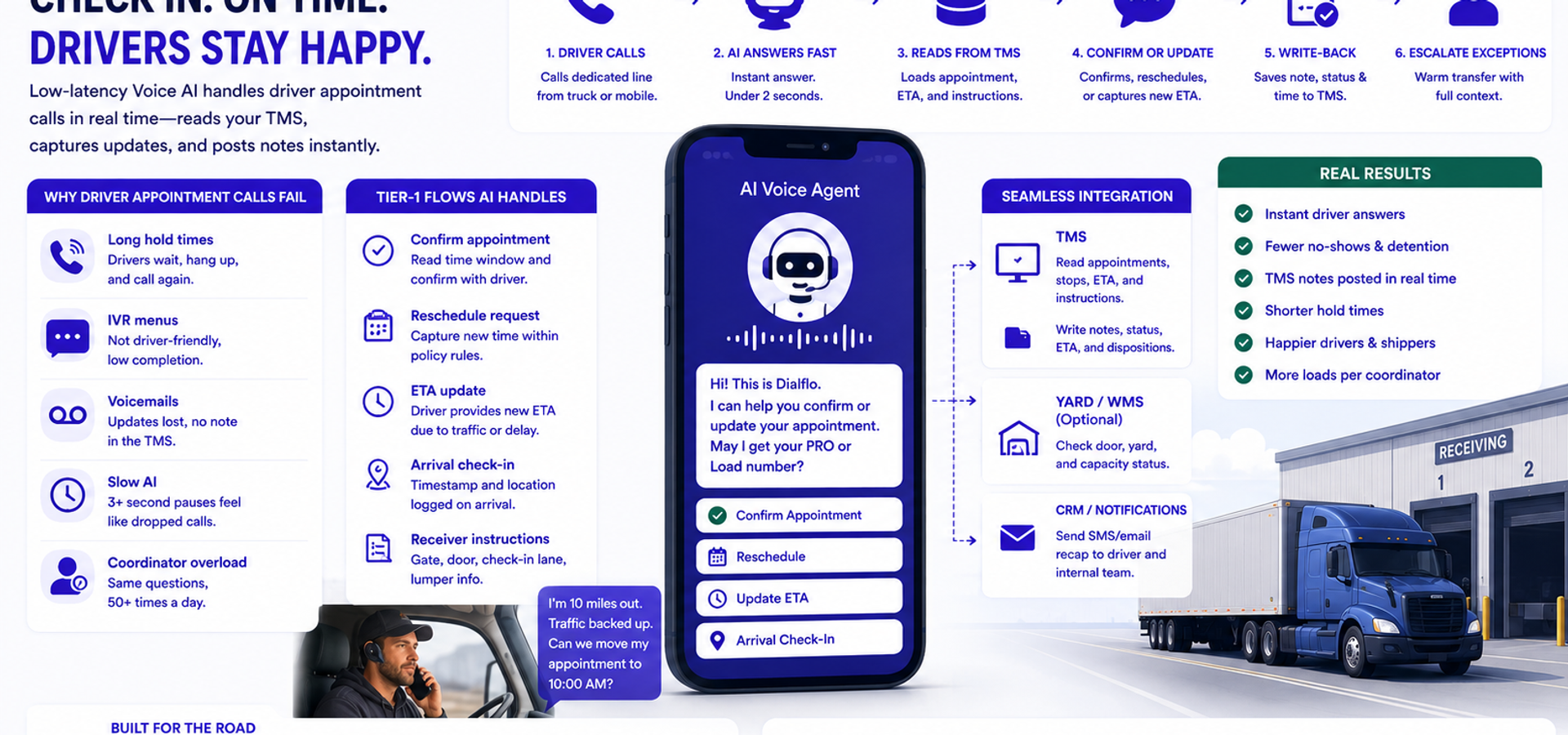
Why truck driver appointment calls fail today
Appointment scheduling is not a back-office task, it is a real-time coordination loop between driver, broker or 3PL, and receiver:
- confirm scheduled date and time window
- reschedule when ETA slips or receiver capacity changes
- check in on arrival for door, yard, or lumper instructions
- report delay before detention clocks start
Most failures are not policy, they are friction:
- hold queues when inbound spikes at 7 a.m.
- IVR menus drivers will not navigate at 65 mph
- voicemail black holes with no TMS note
- slow AI that pauses three seconds per turn, drivers assume the call dropped
- coordinators repeating the same readout fifty times a day
Background on inbound volume: automate inbound carrier tracking queues and scaling freight brokerage load volume without adding trackers.
What “low-latency” means for driver voice AI
Low-latency voice AI is not a marketing adjective, it is whether the call feels conversational under logistics conditions:
- Fast first response , answer on ring one; no thirty-second preamble
- Short turn gaps , agent replies while the driver still remembers the question
- Barge-in support , driver can interrupt “Your appointment is, ” with “yeah confirm it”
- Noisy-environment ASR , cab, wind, Bluetooth; PRO and load numbers captured reliably
- TMS lookup in parallel , status fetch does not add dead air to the caller
Stack decisions matter, see build vs buy voice AI stack and conversational services use cases. For logistics specifically: AI in logistics use cases.
Phone tree vs slow AI vs low-latency voice AI
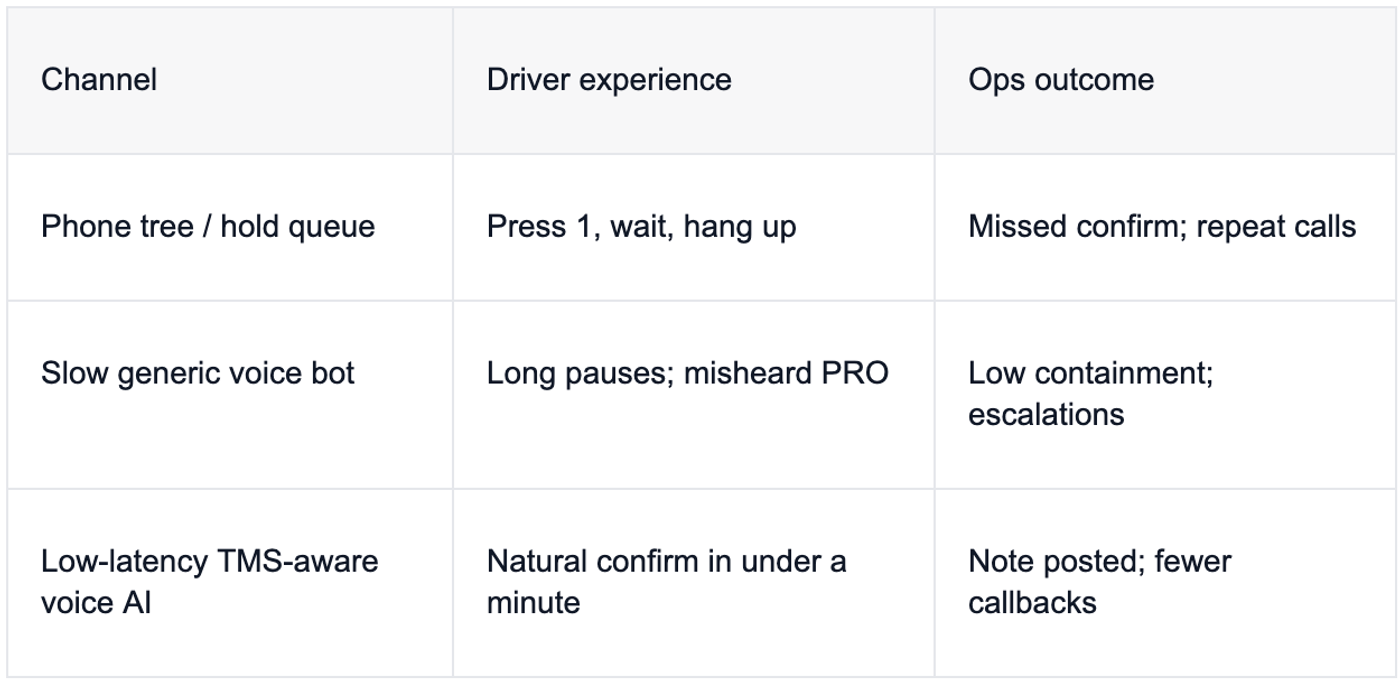
Phone-tree replacement context: replacing phone trees with conversational voice AI.
Tier-one appointment flows voice AI should handle
Tier 1: automate with low-latency voice AI:
- read scheduled appointment from TMS and confirm with driver
- capture revised ETA when driver reports delay
- intake reschedule request within policy windows
- arrival check-in with timestamp and location
- relay receiver notes (gate code, check-in lane) from load record
Tier 2: triage + warm transfer: detention starting, refused appointment, wrong product, lumper disputes.
Tier 3: human only: re-power, rate for extra miles, OS&D, safety events.
Status write-back patterns: automated load status updates in TMS.
Architecture: voice AI + TMS + optional yard system
- Telephony: dedicated driver line; after-hours coverage.
- Low-latency voice AI: authenticate PRO/load/MC; NLU tuned for logistics vocabulary.
- TMS adapter: read appointment, ETA, receiver; write confirm, change, note.
- Rules engine: outbound reminder when appointment risk or no check-in by threshold.
- Warm transfer: human gets transcript + load context on exceptions.
Broader ops map: technology used in supply chain management and the logistics decision gap. 3PL cost angle: reducing 3PL operational cost per load.
Outbound + inbound: both sides of appointment discipline
Inbound , driver calls to confirm or slip appointment; low-latency AI answers instantly and logs.
Outbound , scheduled call or text-to-call when appointment is tomorrow and no confirm on file, prevents 6 a.m. inbound storms.
Dispatcher load: how logistics teams cut dispatcher call load and AI voice agents for thousands of routine calls monthly.
Four-week pilot: one receiver lane or customer
Week 1: Baseline
Count inbound driver appointment calls, average hold time, repeat caller rate within two hours, time from call end to TMS note.
Week 2: Read-only low-latency voice AI
Authenticate and read appointment + receiver notes from TMS; human approves notes before write-back.
Week 3: Confirm, ETA, and reschedule intake
Enable structured capture; warm transfer on detention keywords.
Week 4: Compare and expand
Measure containment, missed-call reduction, appointment-hit proxy on pilot lane. Add after-hours line if metrics hold.
Peak season: peak season without hiring dispatchers. Trends: AI supply chain technology trends.
Metrics for truck driver appointment voice AI
- inbound answer rate (target near 100% on automated line)
- average time to first agent speech
- tier-one containment rate (no human transfer)
- repeat caller rate within two hours
- time from call end to TMS appointment note posted
- appointment confirm rate before arrival window
- OTIF or detention proxy on pilot lane
Missed-call cost: hidden cost of missed calls in logistics. Shipper overflow: where is my shipment calls.
What not to automate on appointment calls
Drivers remember the one bad bot. Keep humans on:
- detention negotiation and rate for wait time
- receiver refusal or closed dock exceptions
- claims, OS&D, and safety events
- strategic shipper accounts with named coordinators
Where Dialflo fits
Dialflo delivers low-latency voice AI for truck driver appointment scheduling, confirm, reschedule intake, arrival check-in, proactive outbound reminders, and TMS write-back with warm transfer on exceptions.
Pilot one receiver lane or customer segment on dialflo.ai when drivers still hit hold music and appointments still live in coordinator heads, not in your TMS.
FAQ: Low-latency voice AI for driver appointments
Why is low latency critical for truck drivers?
They call in short windows with poor audio; long pauses feel like dropped calls and drive hang-ups or unsafe redials.
Can voice AI reschedule warehouse appointments?
It can intake reschedule requests and offer policy-allowed windows; complex receiver negotiation stays human.
Does this work after hours?
Yes, 24/7 inbound capture prevents voicemail backlog when coordinators are off shift.
What TMS fields should update after a confirm call?
Appointment status, confirm timestamp, ETA revision, arrival check-in, and disposition note minimum.
How long to pilot?
Often 2–4 weeks on one high-volume lane with read-only week first.
How does Dialflo help?
Low-latency voice AI for logistics appointment workflows, see dialflo.ai.
Closing: appointments are time-sensitive, voice should be too
Low-latency voice AI for truck driver appointment scheduling wins when confirm, reschedule, and check-in happen in seconds, with TMS truth on the other end, not after hold music and three callbacks.
Measure answer rate, containment, and note lag. Pilot one lane. Keep humans on exceptions. Ready to test driver appointment automation? Explore Dialflo for voice AI built for logistics operations.