How to Automate Inbound Carrier Tracking Calls for Brokers

Dialflo: AI Voice Agent
June 15, 2026
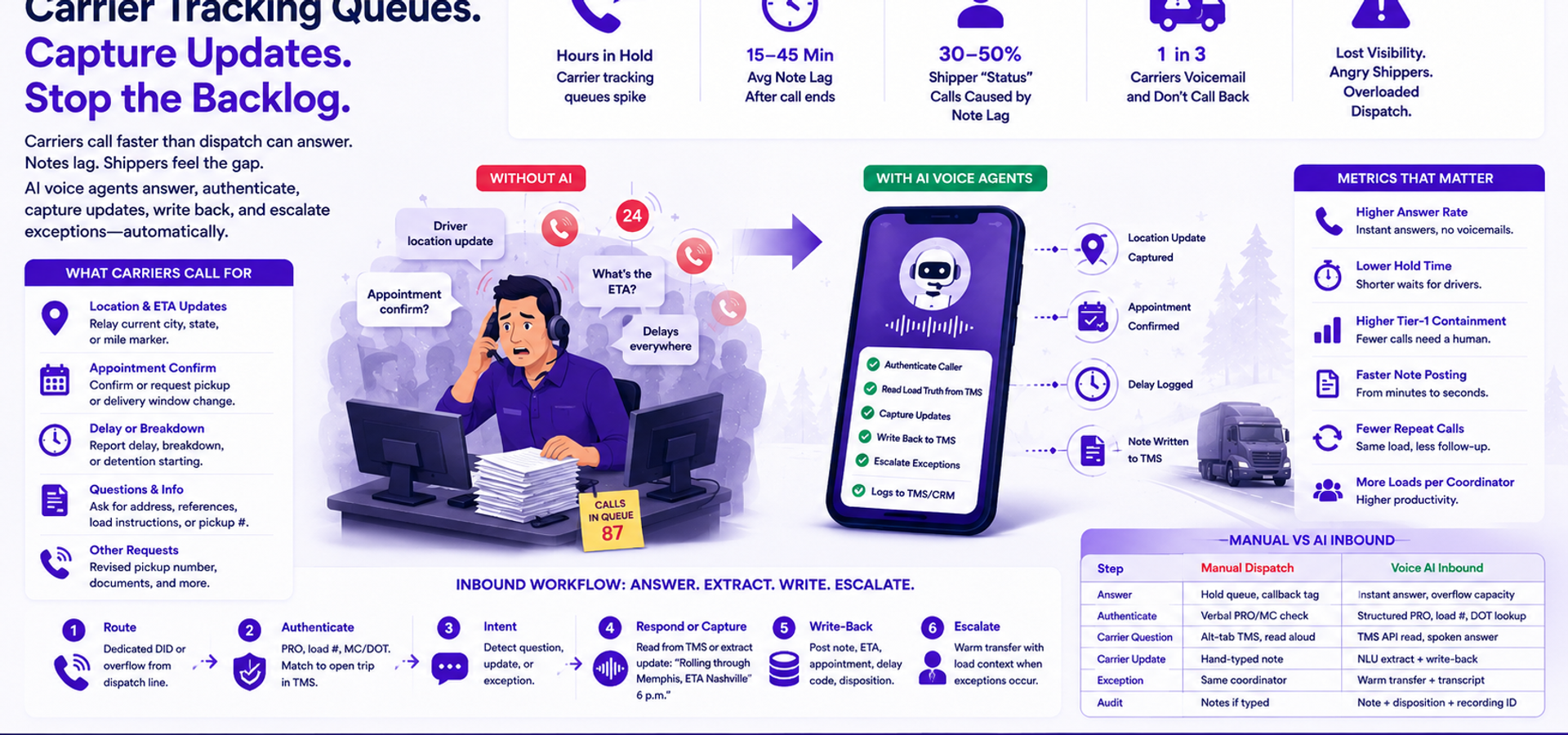
Line three is a driver with a location update. Line four wants appointment confirm. Line five is your shipper asking why the portal still shows yesterday’s ETA, because the inbound carrier call from twenty minutes ago never became a TMS note. Inbound carrier tracking queues are where freight brokerages lose visibility: carriers call in faster than coordinators can answer, log, and callback.
This guide shows how to automate inbound carrier tracking queues with AI voice agents, authenticate the caller, read load truth from your TMS, capture updates, write back, and escalate exceptions, so dispatch stops drowning in repetitive inbound while outbound check calls and shipper service slip.
What inbound carrier tracking queues actually are
In a brokerage, “tracking” is not only outbound dial campaigns. Inbound carrier tracking includes calls carriers and drivers place to your dispatch line:
- relay current city, state, or mile marker
- confirm or change pickup/delivery appointment
- report delay, breakdown, or detention starting
- ask for shipper/consignee address or reference numbers
- request revised pickup number or load instructions
When those calls stack in queue, updates arrive late, or never get logged. Shippers call next. That is the cycle inbound carrier tracking queue automation breaks.
Inbound vs outbound tracking: automate both, prioritize inbound backlog
Outbound check calls are broker-initiated, dispatch dials on schedule. Inbound carrier tracking is carrier-initiated, the driver calls you. Most automation playbooks start outbound; brokerages often bleed visibility on inbound first because hold times push drivers to voicemail and notes lag.
Outbound logging depth: automated carrier check-call logging for McLeod PowerBroker. Full status loop: automated load status updates in TMS via phone bots.
Why inbound carrier tracking queues break at scale
- morning pickup windows cluster inbound location calls
- weather delays trigger simultaneous delay reports
- carriers prefer phone over portals for quick confirms
- same coordinators run outbound check calls and inbound lines
- after-hours voicemails become next-morning inbound carrier tracking queues
Context: where is my shipment calls, missed calls in logistics, and reducing dispatcher call load by 70%.
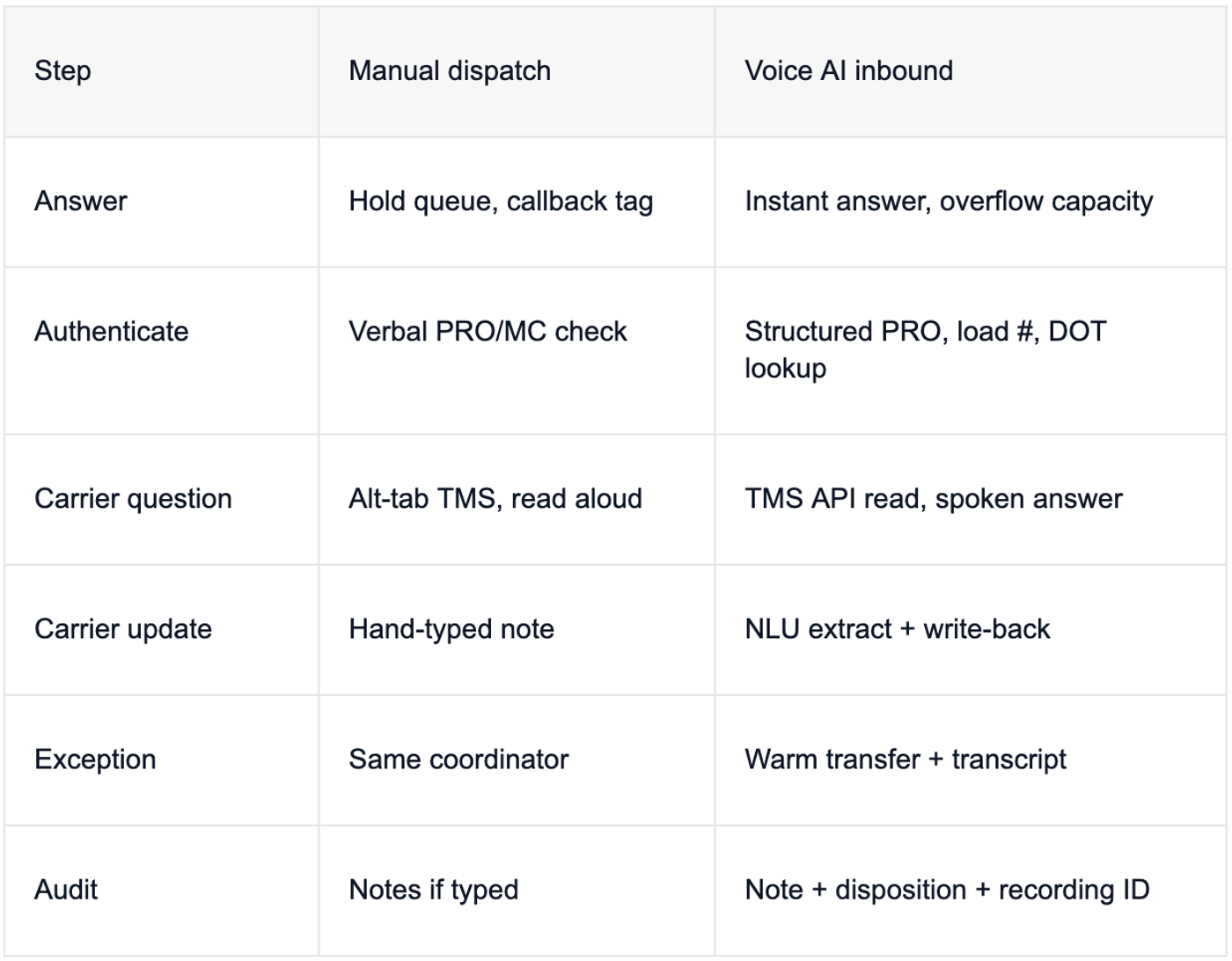
Manual queues vs voice AI automation
Call types to automate first in inbound queues
Tier 1: full automation:
- inbound location and ETA relay
- appointment confirm or requested window change
- standard delay reason intake (traffic, weather, HOS)
- shipper/consignee address readout from TMS
Tier 2: triage then transfer: detention starting, refused load, partial OS&D report, angry shipper on three-way risk.
Tier 3: human only: rate disputes, carrier no-show negotiation, safety events, high-value account escalations.
Conversational design: conversational services use cases and replacing phone trees with conversational voice AI.
TMS integration for inbound carrier tracking
Automation fails if inbound updates die in voicemail. Minimum integration set:
Read: load status, stops, appointments, references, carrier assignment, last check-call note.
Write: check-call or communication note, revised ETA, appointment flag, delay code, disposition.
Platform examples: McLeod PowerBroker, MercuryGate TMS API. Stack planning: build vs buy voice AI stack and technology used in supply chain management.
Inbound workflow: answer, extract, write, escalate
- Route: Dedicated carrier tracking DID or overflow from main dispatch line.
- Authenticate: PRO, load number, MC/DOT, match to open trip in TMS.
- Intent: Question vs update vs exception keyword.
- Respond or capture: Read appointment from TMS, or extract “rolling through Memphis, ETA Nashville 6 p.m.”
- Write-back: Post note and fields before call ends.
- Escalate: Warm transfer with load context on detention, breakdown, refused.
Broader brokerage ops: the logistics decision gap and AI in logistics use cases.
Four-week pilot for inbound carrier tracking automation
Week 1: Queue audit
Log inbound carrier calls by type, location update, appointment, delay, question. Measure average hold time and note lag. Pick one high-volume lane.
Week 2: Read-only TMS voice agent
Answer inbound with status read from TMS; humans approve suggested notes before write-back.
Week 3: Inbound write-back live
Enable structured location and ETA capture with disposition posting. Warm transfer on exception keywords.
Week 4: Expand or fix data
If repeat shipper status calls spike, fix inbound note lag. If containment holds, add after-hours line or second lane.
Peak patterns: peak season call volume without hiring dispatchers. Shipper-side overflow: scaling 3PL customer follow-ups.
Metrics for inbound carrier tracking queues
- inbound answer rate and average speed to answer
- average hold time on carrier tracking line
- tier-one containment (no human transfer)
- time from call end to TMS note posted
- repeat carrier calls within two hours (same load)
- shipper “status” calls within two hours of carrier inbound
- loads per coordinator (productivity proxy)
Industry context: BTS freight data. Voice AI pillar: AI voice agents for routine logistics calls.
Common failure points
Wrong load match on MC only: Require PRO or load number confirmation before disclosing shipper data.
Write-back lag: Shippers still call, note lag is the metric that matters, not calls answered.
Drivers hate IVR trees: Use conversational voice, not “press 1 for tracking.”
Over-automating detention: Escalate on first detention keyword, do not trap drivers in loops.
Exceptions: reducing delivery exception calls before ops.
Where Dialflo fits
Dialflo helps freight brokerages automate inbound carrier tracking queues with AI voice agents that authenticate carriers, read TMS load truth, capture location and appointment updates, and write structured dispositions back, with warm transfer when exceptions need a human.
Pilot your carrier tracking line on dialflo.ai when inbound backlog delays notes and shippers feel the gap before dispatch does.
FAQ: Inbound carrier tracking automation
What are inbound carrier tracking queues?
Backlog of carrier-initiated calls for updates, confirms, and status questions.
Inbound vs outbound automation?
Inbound is carrier-called; outbound is broker-dialed, automate both, fix inbound hold pain first.
What integrates with TMS?
Read load/stop status; write notes, ETA, appointment, delay codes.
Replace dispatchers?
No, tier-one inbound; humans on exceptions.
How long to pilot?
Often 2–4 weeks on one lane with read-only week two.
How does Dialflo help?
Voice AI for inbound carrier tracking with TMS write-back, see dialflo.ai.
Closing: carriers call, you should log before they hang up
Freight brokerages do not lose visibility because carriers refuse to update, they call and wait. Automate inbound carrier tracking queues so every inbound ring becomes a TMS event: location captured, appointment confirmed, exceptions escalated with context. That is how brokerages scale tracking without scaling hold music.
Ready to clear your carrier tracking queue? Explore Dialflo for inbound voice AI built for freight brokerage operations.