Cut Freight Invoice Follow-Up Calls by 80% with Voice AI

Dialflo: AI Voice Agent
June 9, 2026
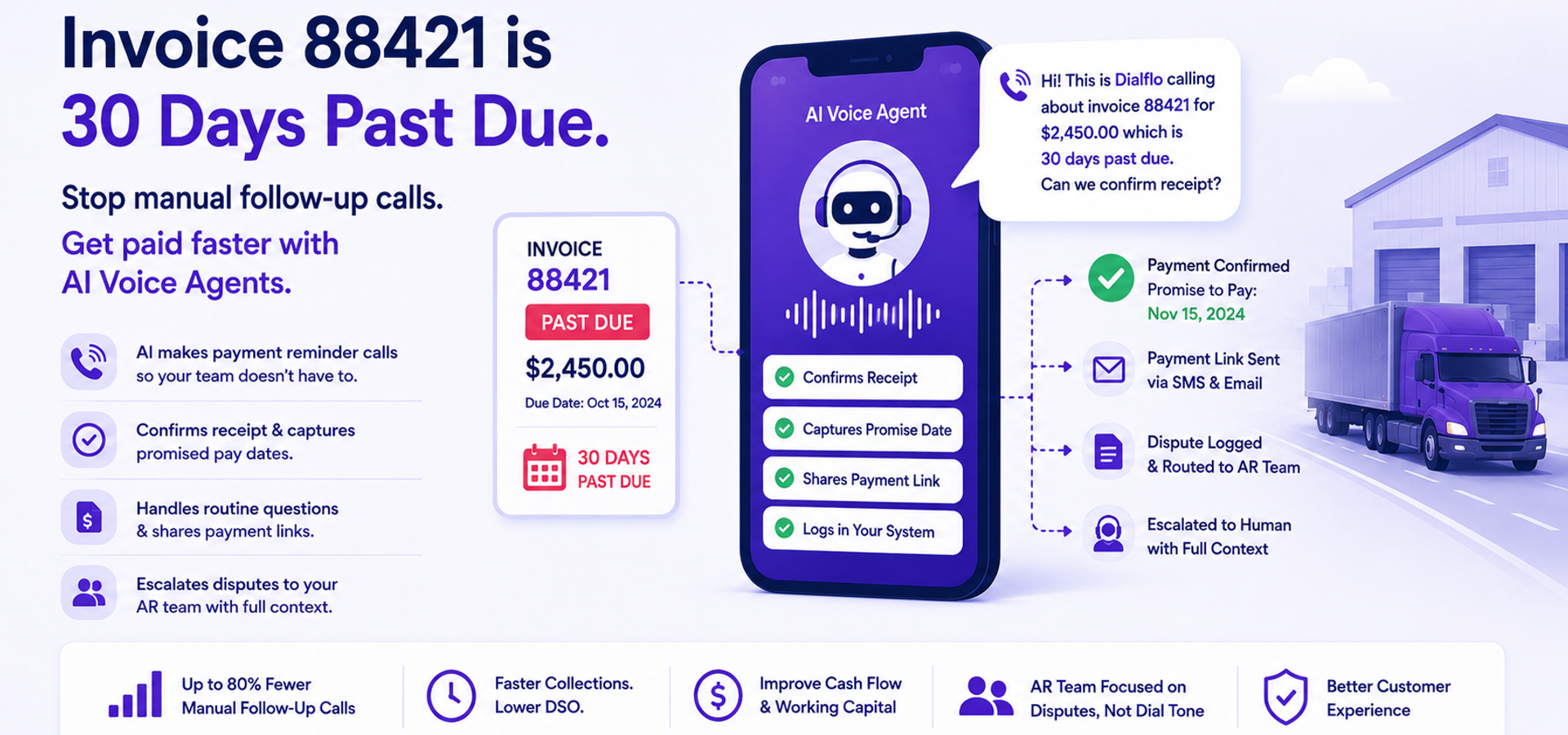
Invoice 88421 is thirty days past due. A collector dials, gets voicemail, tries again, leaves a message, updates a spreadsheet, and moves to the next account. By Friday, half the list is untouched and cash is still stuck in someone else's AP queue. Teams spend hours calling customers about overdue freight invoices, work that feels urgent but rarely needs a senior AR negotiator on the first touch.
Leading logistics operators are cutting that manual loop with AI voice agents that run payment reminders, confirm receipt, and capture promised pay dates, so logistics accounts receivable focuses on disputes and relationships, not dial-tone repetition. This guide explains how to reduce freight invoice follow-up calls handled manually by up to 80% on tier-one collections work, improve freight payment collection velocity, and wire transportation invoicing to voice automation without damaging shipper trust.
Why freight invoice follow up eats logistics AR teams
Transportation invoicing is complex: accessorials, detention, reweighs, multi-stop bills, and POD disputes. Even when invoices are correct, freight invoice follow up volume stays high because:
- AP batch cycles: Shippers pay on their schedule, not yours.
- Missing POD or paperwork: Invoice held until docs arrive, then nobody calls back.
- Dispute ambiguity: "We disagree" without a ticket number stalls payment.
- No proactive reminder: Customers forget until your collector chases.
- Inbound status overlap: The same desk answers tracking and billing rings.
That is logistics collections as a phone problem, not only a ledger problem. The Federal Reserve publishes commercial finance and payment timing context useful for benchmarking working capital, see Federal Reserve commercial paper and finance releases. When DSO drifts, collectors compensate with more dials.
What "80% reduction" means for invoice follow-up calls
The headline is not "AI collects every dollar." It is containment on automatable AR calls, payment reminders, receipt confirmation, promised-date capture, and routing disputes with structured intake. Teams that automate tier-one voice workflows in high-volume phone operations often reach 70–80% resolution on routine calls when data is accurate and escalation is clean, similar to containment patterns documented in conversational voice deployments at scale (see framing in how logistics companies reduce dispatcher call load by 70%).
For freight payment collection, target ~80% automation on:
- friendly past-due reminders (net-15 / net-30)
- invoice receipt confirmation ("did you get INV-88421?")
- promised pay date capture ("we'll pay Friday")
- payment method confirmation (ACH, check, portal link)
- dispute triage intake (reason code + callback ticket)
Keep humans on high-balance disputes, legal risk, bankruptcy, and key-account relationship saves.
Manual collections vs AI voice follow-up
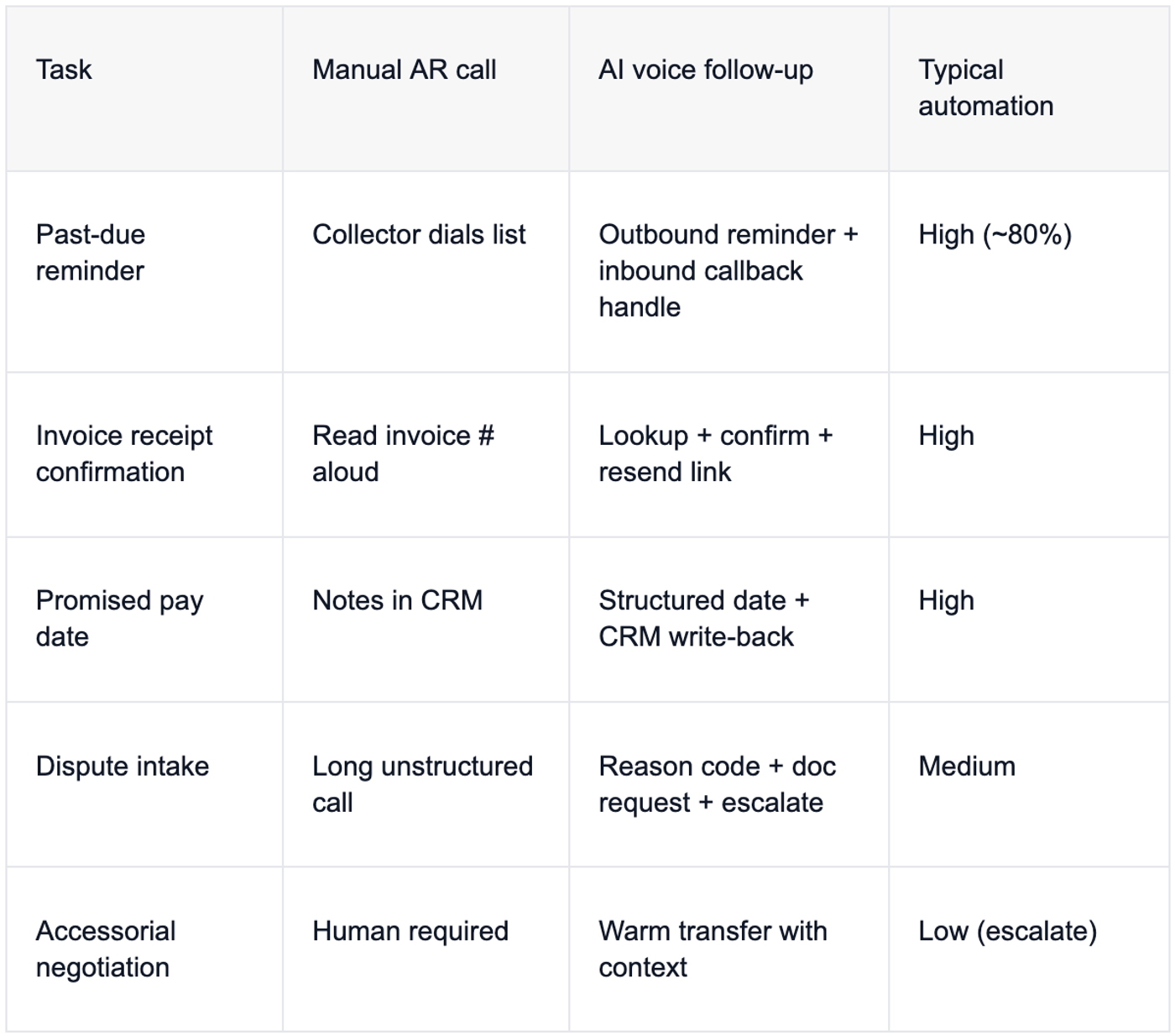
The logistics accounts receivable call funnel
Design logistics collections in tiers, mirror dispatch automation playbooks:
Tier 0: prevent the call: Email + portal link at invoice issue; SMS before due date.
Tier 1: AI voice: Reminders, receipt confirm, promised date, dispute intake.
Tier 2: collectors: Negotiation, accessorial proof, payment plans.
Tier 3: leadership / legal: Strategic accounts, chargeback risk, counsel.
Most overdue freight invoices stall in tier-one territory, chase, confirm, schedule, not negotiation. Free collectors for tier two. Broader voice patterns: conversational services use cases and AI in logistics use cases.
AI voice agents for payment reminder and invoice follow-up
Dialflo-style AI voice agents logistics for AR should:
- authenticate shipper by account, invoice, or PRO reference
- state amount, due date, and days past due from billing system truth
- offer portal or ACH link by SMS after the call
- capture promised pay date and payment method in structured fields
- open dispute tickets with reason codes (rate, accessorial, POD, duplicate)
- warm-transfer to collector with transcript when balance or risk thresholds trip
- log every disposition to ERP/TMS billing, not voicemail
That is natural language freight invoice follow up, not robocall blasts that damage logistics customer experience. Replace phone-tree friction on inbound billing lines too, see replacing phone trees with conversational voice AI.
Transportation invoicing quality reduces follow-up volume
Automation multiplies good data and punishes bad data. Before scaling voice reminders:
- align invoice fields with shipper AP requirements (PO, BOL, PRO)
- attach POD and accessorial backup at billing time
- fix recurring dispute codes (detention proof, reweigh docs)
- sync credit limits with collections priority queues
Ops voice volume drops when billing is clean, status and exception calls overlap AR when customers cannot reconcile invoices. Triage design: reducing delivery exception calls before ops and where is my shipment calls.
Outbound vs inbound freight payment collection
Outbound: Scheduled reminder campaigns on aging buckets (7 / 15 / 30 days). AI places calls, handles callbacks, leaves compliant voicemail when no answer, texts payment link.
Inbound: "Calling about invoice 88421" rings billing queue. AI confirms balance, captures promise-to-pay, routes disputes.
Both directions should write to the same AR work queue. Peak freight weeks spike all phone channels, handling peak season call volume applies to billing desks when month-end invoicing hits.
Compliance and tone on collections calls
Collections voice must respect regulation and brand:
- disclose identity and recording where required
- honor do-not-call and preferred contact windows
- avoid threatening language, state facts, offer payment paths
- escalate bankruptcy or legal mentions immediately
The Consumer Financial Protection Bureau maintains educational resources on debt collection communication rules in the U.S., useful baseline for tone and disclosure discipline: CFPB debt collection resources. Logistics AR is commercial B2B; still treat shippers as long-term partners.
Integration: AR automation must write back
Invoice follow-up fails if collectors re-dial to learn what AI already heard. Integrate:
- invoice master and aging from ERP/TMS billing
- disposition codes (promised pay, dispute, paid, wrong contact)
- promised date fields that drive next-action queues
- SMS payment links tied to invoice IDs
Build vs buy for voice infrastructure: build vs buy voice AI stack. Supply-chain tech context: technology used in supply chain management.
Metrics for logistics accounts receivable voice automation
- Collector hours on routine reminders (should drop)
- Tier-one call containment rate (target ~80%)
- DSO and aging bucket movement
- Promise-to-pay kept rate
- Dispute time-to-first-response
- Repeat contact within 48 hours (bad data signal)
- Cash applied per collector hour
Benchmark freight economic context with Bureau of Transportation Statistics data.
Where Dialflo fits
Dialflo automates freight invoice follow up with AI voice agents: payment reminder calls, invoice confirmation, promised pay date capture, and dispute routing, with write-back to your operations and finance stack. Use it when logistics accounts receivable loses days to overdue freight invoices and you want freight payment collection velocity without doubling collector headcount.
Dialflo is voice execution, not your billing system. Pilot one aging bucket, measure containment and collector hours, then expand. Confirm integrations on dialflo.ai. After-hours billing callbacks still leak, the hidden cost of missed calls in logistics applies to AR lines too.
FAQ: freight invoice follow up
What is freight invoice follow up?
Phone and callback work to confirm, remind, and collect on transportation invoices, core logistics AR.
Can AI reduce follow-up calls by 80%?
On tier-one reminders and promise-to-pay capture, ~80% containment is a realistic target with clean invoice data.
What stays human?
Disputes, negotiations, legal risk, and strategic account relationships.
Outbound or inbound first?
Often outbound on 15–30 day buckets plus inbound billing overflow on one pilot line.
What integrates?
ERP/TMS billing, CRM dispositions, SMS payment links.
How does Dialflo help?
AI payment reminder and invoice follow-up with write-back, see dialflo.ai.
Closing: collections scale when tier one stops living on dial lists
Freight invoice follow up should not mean collectors reading invoice numbers eight hours a day. Automate the reminder and receipt layer with AI voice agents, measure ~80% containment on tier-one logistics collections, and put people on disputes that actually need judgment. Cleaner transportation invoicing plus voice automation turns overdue freight invoices from a phone marathon into a managed freight payment collection funnel.
Ready to cut manual AR dials? Explore Dialflo for payment reminder and invoice follow-up calls that write outcomes back to your stack, so cash moves faster and collectors stop chasing voicemails.