Logistics Service Desk Automation for Dispatcher Questions

Dialflo: AI Voice Agent
July 3, 2026
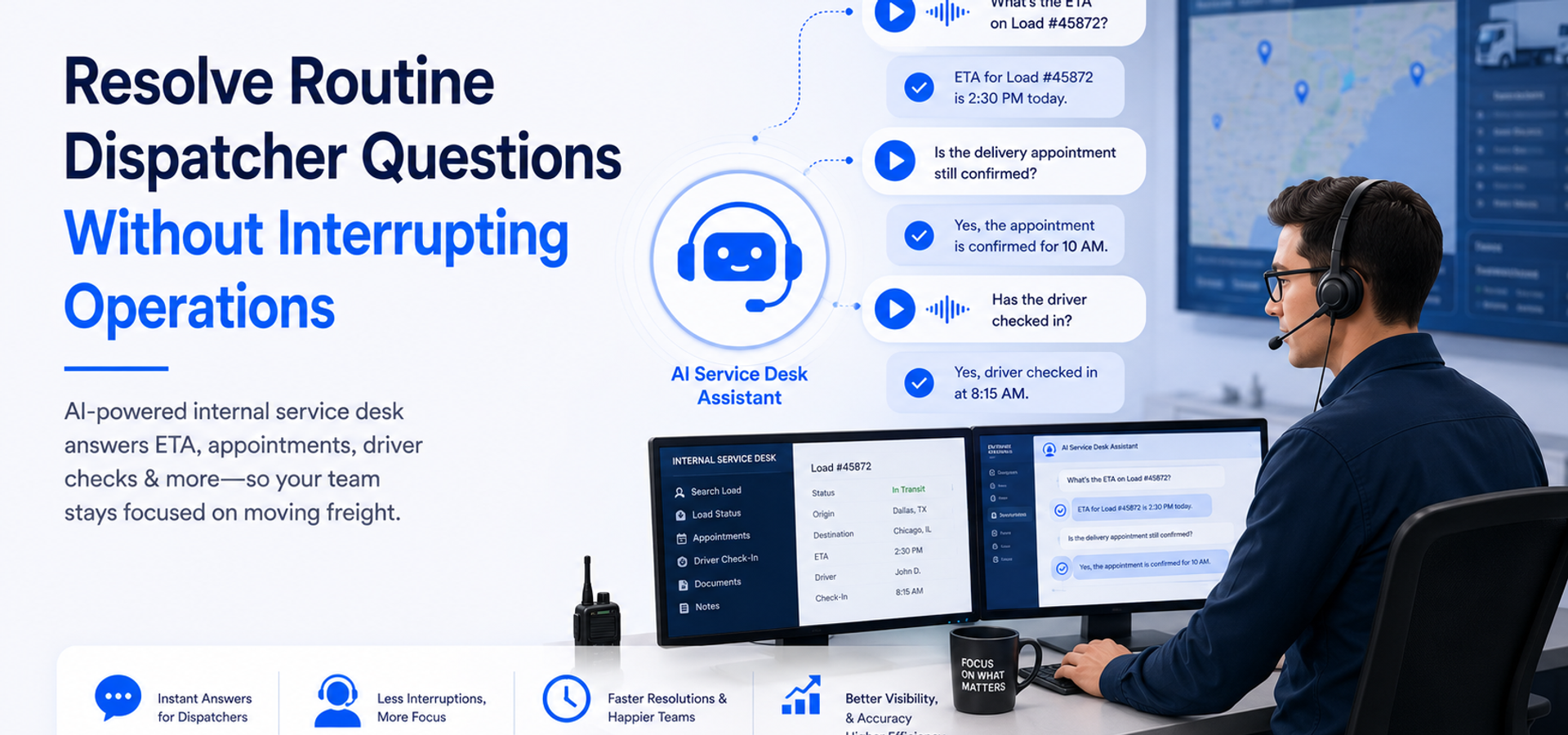
Short answer: Internal service desk automation gives logistics teams a dedicated layer, usually AI voice agents connected to TMS and WMS data, that resolves routine dispatcher questions on the spot: shipment status, ETA windows, appointment confirms, driver check calls, tracking resends. Dispatchers stop acting as the company’s default search engine. Operations keep moving. Callers get answers in seconds instead of interrupting someone mid-exception.
Thursday, 2:47 p.m. Your senior dispatcher is on the phone negotiating detention at a grocery DC. A driver calls on line two. Customer service Slacks “ETA for load 8841?” A shipper emails the same PRO number. The warehouse wants the dock door. Four people need the same answer. Nobody gets it for eleven minutes because the one person who knows is busy keeping a load from billing out wrong.
That is not a staffing problem alone. It is an architecture problem. Logistics companies run world-class TMS platforms, but route every routine question to the dispatch bullpen like it is 1998. Internal service desk automation fixes that gap: tier-one questions get resolved automatically; humans stay on judgment work that actually moves freight.
This guide shows how operators deploy internal service desk automation for routine dispatcher questions, what to automate, what to keep human, how to integrate, and how to measure ROI without wrecking trust on the phones.
The hidden cost of interrupting dispatch during live operations
Dispatch is not a call center. It is air traffic control for freight. Every interruption carries a price:
- missed tender windows while someone reads tracking aloud
- detention clocks running because negotiation paused mid-call
- drivers holding at gates without instructions
- repeat calls on the same PRO because nothing was logged
- morning voicemail avalanches that eat the first two hours
- burnout on coordinators who joined to solve problems, not repeat ETAs
McKinsey frames AI-enabled customer and operations service as a path to faster resolution when automation targets the right intents, not every intent. Source: McKinsey: AI-enabled customer service. In logistics, the intent mix is predictable: shipment-status questions are among the most common contacts in freight and 3PL environments, and Oliver Wyman's review of 25 logistics AI use cases found AI tools can handle up to 30% of inquiries end-to-end.
Freight context: AI in logistics: use cases, benefits & tools. Decision discipline when scaling automation: logistics decision gap in AI operations.
What internal service desk automation means for logistics (not IT tickets)
Enterprise readers hear “service desk” and picture password resets. In logistics, the internal service desk is the operational nerve center for questions that should never reach a senior dispatcher:
- Drivers: “I’m at the receiver. Door number?” “Still on for 4 p.m.?”
- Warehouse / dock: “Truck ETA?” “Can we push appointment one hour?”
- Customer service: “Shipper wants status on reference 4492.”
- Account managers: “Quick check, is load 7710 delivered?”
- Carriers and partners: tracking pulls, appointment confirms, document checks
Internal service desk automation is the system that answers those questions from live operational data, without opening a ticket, without Slack-pinging dispatch, without a three-minute hold while someone alt-tabs through six screens.
Voice-first automation fits because phones still dominate logistics coordination. Gartner’s customer service research consistently ties speed and effort reduction to loyalty when automation reduces friction, not when it adds hoops. See: Gartner: Customer service & support insights. Foundational concepts: conversational services: what they are & use cases.
Why Slack, email, and “just call dispatch” fail at scale
Informal routing worked when you ran forty loads a week. At four hundred, it breaks.
Slack pings have no queue discipline, urgent and trivial look the same, and answers are not written back to TMS notes.
Email averages hours to a day for status checks, unacceptable when a driver is at a gate or a receiver is about to cancel the slot.
Shared inboxes duplicate effort, three agents answer the same PRO because nobody sees the prior reply.
IVR phone trees frustrate callers who know exactly what they need, “press 4 for tracking” is not conversation.
Voicemail creates tomorrow’s problem today, callbacks stack while live freight moves on.
Supply chain stack context: technology used in supply chain management. The fix is not another channel, it is an automated resolution layer with system-of-record truth and escalation when judgment is required.
The tier-one vs tier-two taxonomy: what to automate first
Successful internal service desk automation starts with ruthless intent sorting, not “automate phones” as a vague project.
Route to automation (tier-one)
- shipment status and last scan event readout
- ETA window and appointment confirmation
- driver check calls with structured location capture
- tracking link or POD resend
- simple reschedule intake with required fields validated
- after-hours overflow when dispatch is on exception work
Keep on human dispatch (tier-two)
- detention negotiation and accessorial disputes
- OS&D, damage claims, and freight recovery
- weather rebooking and network re-routes
- hazmat, safety, and compliance exceptions
- key-account escalations and rate-sensitive conversations
The goal of internal service desk automation is uninterrupted operations on tier-two work, not replacing the people who protect margin when the network breaks.
Architecture: how routine dispatcher questions get resolved without interruption
A production-grade internal desk for logistics typically includes five layers:
1. Telephony and concurrency: answer every ring on tier-one lines; no hold queue during surge.
2. Conversational understanding: accept natural language (“status on PRO 8841,” “driver at gate”) instead of rigid menus. Primer: conversational services use cases.
3. TMS / WMS retrieval: load lookup by PRO, BOL, reference, or account; read ETA, appointment, and last event. Without integration, automation guesses, and guessing destroys trust.
4. Workflow completion: confirm appointment, log driver location, text tracking link, open reschedule task with validated fields.
5. Warm escalation + write-back: transfer to dispatch with transcript and captured data; write outcomes to TMS notes so the next caller does not restart the thread.
IBM’s overview of virtual agents applies: NLP plus automation plus retrieval, not scripted trees alone. See: IBM: What is a virtual agent?. Build-vs-buy for voice stacks: build vs buy voice AI stack.
Five routine dispatcher questions to automate this quarter
If you need a prioritized backlog, start here, these five intents recover the most coordinator hours fastest:
1. “Where is my shipment?”: Pickup confirmed, in-transit location, delay reason from last scan. Highest volume intent in most freight desks.
2. “What is the ETA?”: Delivery window, appointment still valid, receiver hours. Stops CS from Slack-pinging dispatch.
3. Driver check call: Location, hours, next stop. Structured capture writes to TMS so dispatch does not re-ask.
4. Appointment confirm or change: Dock time, access code, lumper question. Integrate with scheduling where possible; intake with validation where not.
5. “Did anything change since yesterday?”: Weather hold, relay, cross-dock handoff. Automation reads events; humans rebook when policy requires judgment.
Trend context on proactive ops: AI supply chain technology trends. Optimization tie-in: machine learning in supply chain optimization helps forecast volume; internal service desk automation handles the questions that forecast creates.
90-day deployment playbook for logistics operators
Skip the eighteen-month transformation deck. Run this sequence:
Days 1–14: instrument the interruption tax
Log top ten question types, peak hours, who asks (driver, CS, warehouse), and how long dispatch spends on readouts vs exceptions. Pick one queue, after-hours status, driver check line, or inbound shipper tracking.
Days 15–30: connect one system of record
TMS read access minimum; write-back to notes or tasks when possible. Scheduled exports beat perfect APIs for pilot speed, voicemail beats both.
Days 31–45: shadow mode
AI answers; supervisor monitors transcripts. Tune escalation triggers, confirm fields, fix retrieval gaps before callers see failures at scale.
Days 46–60: live containment with human backup
Measure containment rate, transfer acceptance, and repeat-call rate on the same PRO within 24 hours. If repeat calls spike, fix write-back, not prompts.
Days 61–90: expand hours or intents
Add business-hour overflow when hold times climb. Proactive outbound ETA on delayed lanes reduces inbound panic, another job for the same automation layer.
Migration path if you already piloted dev-centric voice tools: migrate from Retell to Dialflo without downtime. Vendor evaluation: best Retell alternative for India.
Metrics that prove internal service desk automation is working
Executives fund what gets measured. Track outcomes that tie to uninterrupted dispatch:
- Answer rate: tier-one rings answered vs missed
- Containment rate: resolved without human transfer, by intent
- Dispatcher hours on readouts: reclaimed time for tier-two work
- Morning callback queue: size and age of unresolved voicemails
- Repeat-call rate: same load, same question, same day
- Transfer quality: humans should not reject AI handoffs as incomplete
- Time-to-answer for internal askers: CS and warehouse get seconds, not Slack waits
When automation pulls live data from operational systems, tier-one resolution can drop from hours to minutes, which is directional proof that this volume is automatable when data is live. Sustainability angle, fewer wasted miles when drivers get gate instructions without hour-long holds: how AI makes supply chains more sustainable.
Human handoff design: automation earns trust here or nowhere
Callers do not hate automation. They hate friction without exit.
Bad internal service desk automation repeats account details three times, transfers cold, or invents policy. Good design:
- one clear path to a human within two turns
- warm transfer with transcript, PRO, and captured fields
- answers grounded in TMS events, not generic scripts
- disclosure where your legal team requires it
- write-back so the human does not re-ask what AI already learned
Forrester’s customer service research links reduced customer effort to loyalty, automation wins when it removes loops, not when it adds them. See: Forrester: Customer service research.
Build the business case: what one interrupted dispatcher hour actually costs
Finance approves internal service desk automation when you translate coordinator time into freight outcomes.
Model it simply. If six dispatchers each lose ninety minutes daily to tier-one readouts, that is nine coordinator hours per day diverted from exceptions. At even modest loads per coordinator, one recovered hour can mean multiple tenders covered, detention avoided, or a missed pickup prevented.
Compare that to automation that contains 60% of tier-one volume on a pilot line, without a per-seat helpdesk contract that charges the same when January volume drops. Pricing context for voice stacks: Retell vs Dialflo India pricing and Retell AI pricing vs Dialflo pricing.
Inventory and planning teams see parallel gains when status questions stop pulling ops into manual lookups: AI inventory optimization tools & strategies.
Common failure modes (and how operators avoid them)
- Automating before data quality fixes: Garbage TMS timestamps produce confident wrong answers.
- No dispatcher buy-in: Floor leads must design escalation paths in week one.
- Over-automating tier-two: Detention and OS&D need humans; containment targets should be intent-specific.
- No write-back: Repeat calls double; dispatch interruption continues.
- Big-bang rollout: One queue, measured, then scale beats enterprise-wide launch.
- Choosing tools that cannot do live voice: Chat widgets do not solve driver phones at highway speed.
Where Dialflo fits: internal service desk automation built for logistics phones
Dialflo provides production-grade AI voice agents for logistics teams that need internal service desk automation on live phone volume, not FAQ chatbots bolted onto a website. Dialflo answers routine dispatcher questions with TMS-aware lookup, structured capture, warm escalation to coordinators, and write-back to the operations stack you already run.
Operators use Dialflo when dispatch is too valuable to spend on readouts, when drivers, warehouses, and customer service need instant answers and coordinators need uninterrupted time on detention, rebooking, and the exceptions that protect margin.
If your team loses load coverage every time someone asks “ETA on 8841?” you do not need a bigger headcount plan, you need internal service desk automation that resolves tier-one questions before they interrupt the bullpen.
FAQ: internal service desk automation for logistics dispatch
What is internal service desk automation in logistics?
A structured automation layer, typically voice AI plus TMS integration, that resolves routine operational questions from drivers, warehouse staff, CS, and partners without pulling dispatchers off exception work.
How is this different from a customer-facing chatbot?
Logistics coordination is phone-heavy and time-sensitive. Internal desk automation must handle live audio, barge-in, reference-number lookup, and warm handoff, not deflect to a help article.
What percentage of dispatcher questions can automation handle?
Pilot teams often contain 55–70% of tier-one status and check calls when TMS data is accurate. Measure your own intents; do not trust blended industry averages alone.
Do we need a full TMS API to start?
No. Reliable load lookup, even scheduled exports, beats voicemail during pilot. Expand integration depth after containment proves on one queue.
Will drivers and shippers accept AI answers?
They accept fast, accurate answers. Invoice-aware, load-aware voice beats twenty-minute hold music, especially when escalation to a human is one sentence away.
How does Dialflo help logistics teams?
Dialflo AI voice agents for internal service desk automation, TMS lookup, escalation, write-back. See dialflo.ai.
Closing: routine questions should not stop freight from moving
Logistics companies do not lose margin because coordinators lack talent. They lose it because tier-one questions interrupt tier-two work all day long. Internal service desk automation separates the two, resolve routine dispatcher questions in seconds, keep humans on judgment, and run operations without the constant ping of “quick question.”
Ready to stop interrupting dispatch for status readouts? Talk to Dialflo about a pilot on one queue, after-hours overflow, driver check calls, or inbound tracking, with TMS-aware voice agents, warm escalation, and write-back to the systems your desk already runs. Start with tier-one. Measure containment in 30 days. Scale before the next volume spike hits.