Talent AI: How AI is Transforming Hiring

Dialflo: AI Voice Agent
May 25, 2026
Hiring leaders used to ask whether to “use AI.” In 2026 the question is where talent AI belongs in the stack, and what must stay human. Sourcing inboxes are fuller. Phone screens backlog. Hiring managers want shortlists with context, not forty identical resumes. Candidates expect fast replies, not ghosting after a one-way video test.
This guide explains how talent AI is transforming hiring across the funnel: what changed, what actually works in production, how to govern risk, and where voice automation fits without pretending algorithms can replace recruiter judgment. For full-stack context, start with artificial intelligence in recruitment and how AI agents are transforming recruiting.
What talent AI means in practice
Talent AI is not one product category. It is AI applied to talent acquisition workflows, usually layered on ATS, talent CRM, and HRIS systems:
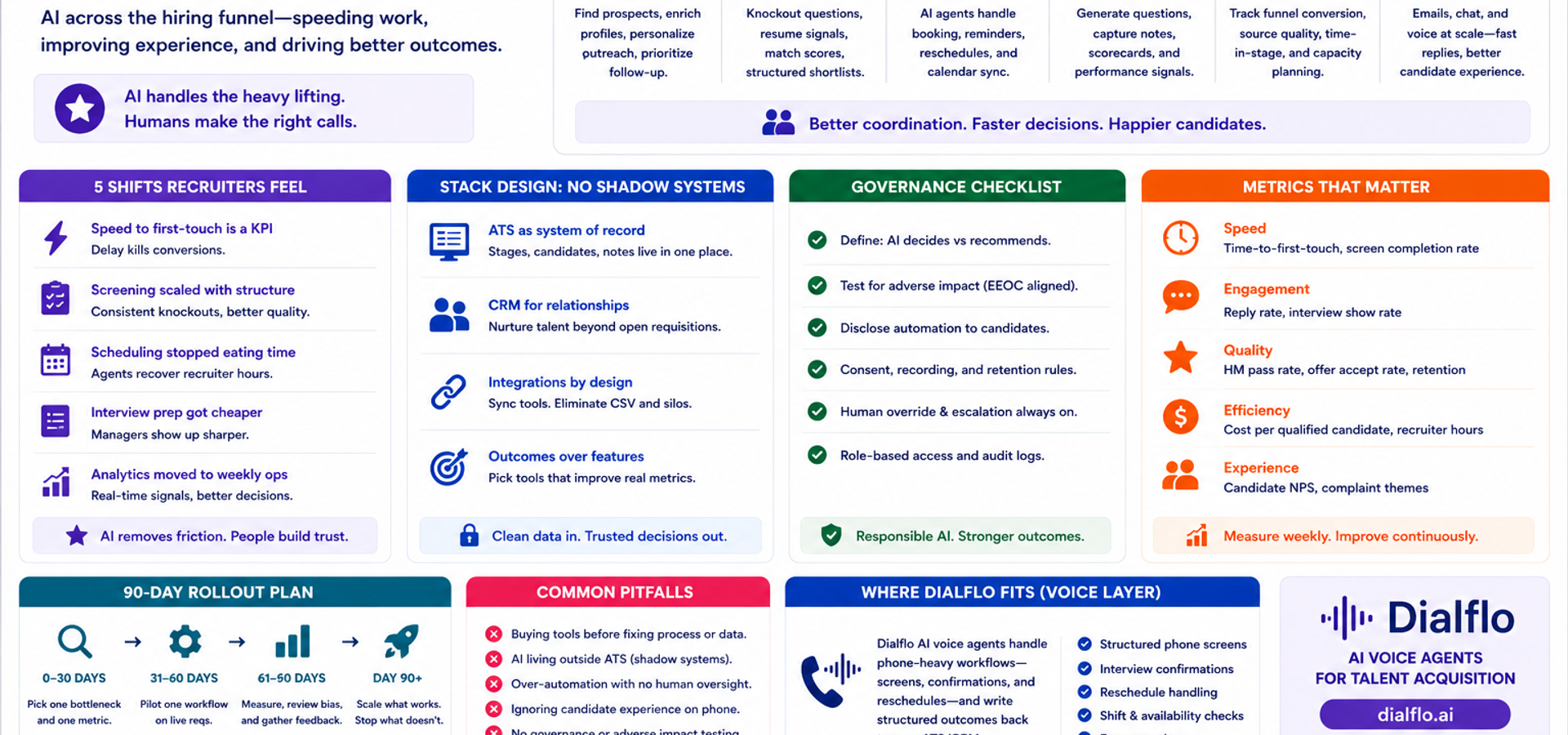
- Sourcing and outreach: finding prospects, personalizing sequences, prioritizing follow-up
- Screening and matching: knockout questions, resume signals, structured shortlists
- Scheduling and coordination: calendar negotiation, reminders, reschedules
- Interviews: prep, question generation, structured notes, performance signals
- Analytics: time-in-stage, source quality, funnel conversion, capacity planning
- Communication: email, chat, and increasingly voice for phone-first candidates
LinkedIn’s recruiting research continues to highlight technology investment for speed and candidate experience, talent AI is how many teams operationalize that pressure. Source: LinkedIn: Future of Recruiting 2025.
Five shifts recruiters actually feel
1) Speed-to-first-touch became a KPI
When outbound and inbound volume rise, delay kills conversion. Talent AI compresses research, drafting, and initial qualification, pair with candidate sourcing services discipline so speed does not become spam.
2) Screening scaled without losing structure
High-volume hiring uses consistent knockouts and shift checks. AI screening works when questions are job-related and outcomes land in the ATS, see automated screening for staffing agencies for agency patterns.
3) Scheduling stopped eating recruiter afternoons
Calendar ping-pong is a top hidden tax. Agents and schedulers that integrate with calendars and ATS stages recover hours weekly.
4) Interview prep got cheaper
Managers show up sharper when question packs and scorecards are generated from the job description, humans still score and decide.
5) Analytics moved from quarterly decks to weekly ops
Recruiting leaders inspect conversion by stage and source in near real time with recruitment analytics software plus clean ATS data.
Stack design: talent AI without shadow systems
The failure mode is not “AI was wrong.” It is “AI lived outside the ATS.” Shadow tools break reporting, compliance, and handoffs.
- ATS remains system of record, see cloud-based recruitment software and agency stacks in ATS for staffing agencies compared.
- CRM holds relationships, candidate relationship management system for nurture beyond open reqs.
- Integrations are contractual, integrate recruiting software with existing systems before buying more modules.
- Compare vendors on outcomes, AI agents for recruitment comparison and machine learning in recruiting for realistic expectations.
SHRM emphasizes cross-functional hiring process discipline, technology only helps when recruiters and hiring managers adopt shared workflows. Source: SHRM: Talent acquisition toolkit.
Governance: what to get right before you scale talent AI
Gartner’s HR technology research repeatedly flags governance and manager effectiveness as adoption drivers, not raw feature count. Source: Gartner: HR technology.
- Document what AI decides vs recommends, especially screening scores.
- Test for adverse impact where selection AI is used, US employers should review EEOC guidance on AI in selection.
- Disclose automation to candidates when material (chat, voice, async video).
- Regional rules, consent, recording, data retention for calls and messages.
- Human override, always allow escalation to a recruiter.
Unique angle: talent AI wins on execution, not hype
Most teams do not fail because their model lacked parameters. They fail because:
- interested candidates hit voicemail during phone screens
- sourced prospects never entered the ATS
- hiring managers never received structured notes
Talent AI transforms hiring when it removes coordination tax and writes results where recruiters already work, especially for phone-first and high-volume workflows. Writing better job posts alone does not fix a broken Tuesday afternoon.
For operating models that treat AI as infrastructure, see agentic hiring organization and AI staffing.
90-day rollout plan (one bottleneck first)
- Pick one metric: time-to-first-touch, screen completion rate, or interview show rate.
- Pick one workflow: sourcing follow-up, knockout screen, or phone confirmation.
- Pilot on live reqs for 4–6 weeks with ATS sync required.
- Review bias and CX with recruiting + legal/compliance.
- Scale or stop, kill tools recruiters bypass.
Where Dialflo fits in talent AI stacks
Dialflo is talent AI for the phone layer: AI voice agents that run structured screens, confirmations, and reschedules, then write outcomes back to your ATS or CRM. It complements sourcing and screening tools, it does not replace your system of record. Context: hire candidates faster with AI tools and sourcing enhancement reviews like GEM ATS review.
FAQ: talent AI
What is talent AI?
AI applied across hiring workflows, sourcing through analytics, integrated with ATS/CRM/HRIS.
How is AI transforming hiring?
Faster coordination, structured screening, better visibility; humans still own decisions and experience.
Will AI replace recruiters?
No for full-cycle recruiting; yes for parts of admin and first-touch coordination when governed well.
What are the main risks?
Bias, opaque scoring, bad CX, shadow data. Govern and measure adverse impact where selection AI runs.
Where should we start?
One bottleneck, 90-day metrics, mandatory ATS sync, expand only after adoption.
How does Dialflo help?
Voice agents for phone-heavy recruiting with structured write-back to your hiring systems.
Closing: transform the work, not just the slide deck
Talent AI is transforming hiring because teams finally automate the coordination work that used to drown recruiters, not because a chatbot wrote a nicer LinkedIn post. Build on your ATS, govern selection AI, measure conversion and candidate experience, and add voice execution where phones are still how real candidates show up.
Designing your 2026 stack? Explore Dialflo for talent AI voice workflows that keep pipelines moving when speed matters.


