What Is a Virtual Receptionist?

Dialflo: AI Voice Agent
July 1, 2026
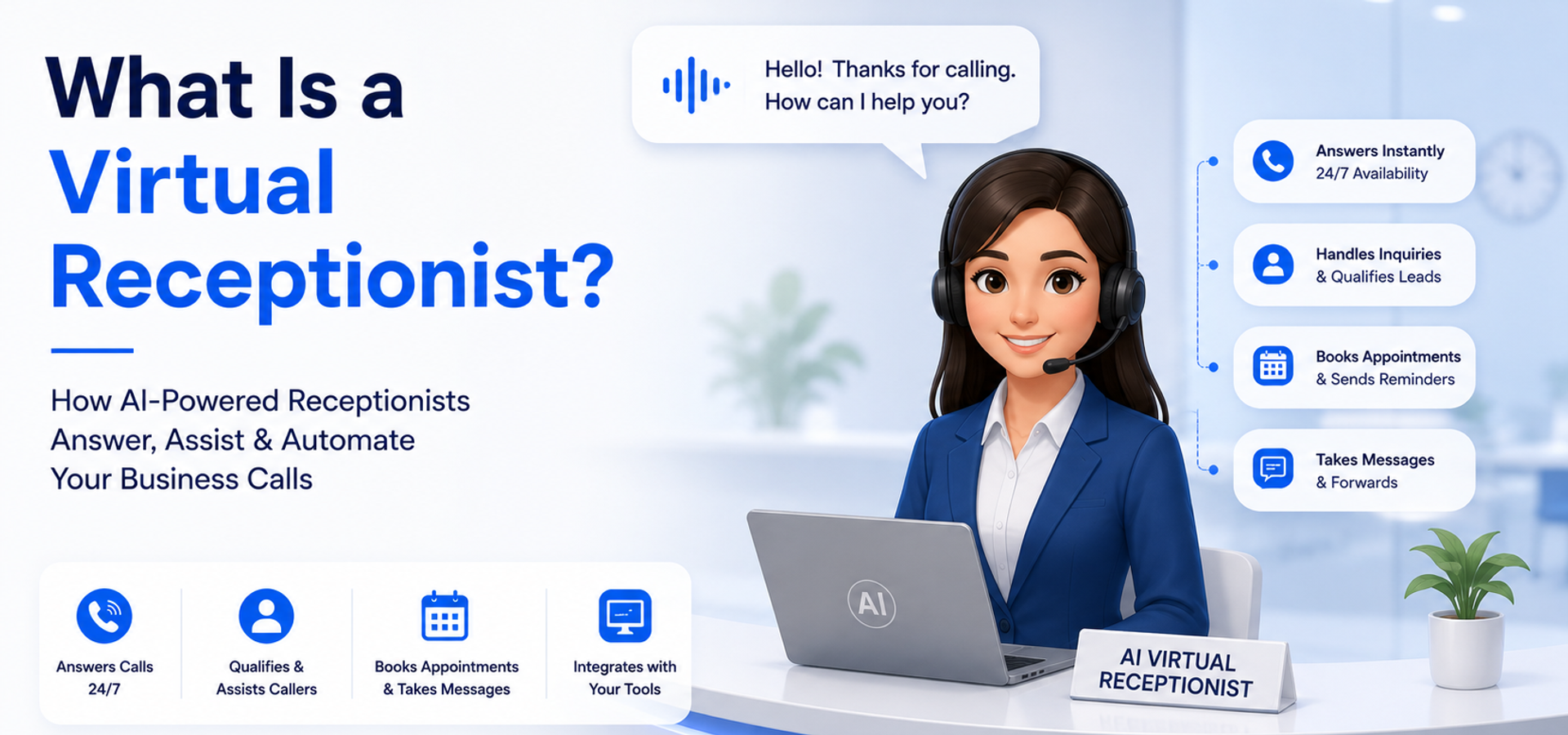
Short answer: A virtual receptionist is a remote person or software service that answers your business phone line, greets callers, routes them to the right team, captures messages, and often books appointments, without someone physically at your front desk. An AI virtual receptionist (also called an automated receptionist or AI phone receptionist) uses voice AI and business phone automation to handle those tier-one calls 24/7, log outcomes to your CRM or scheduling system, and hand off exceptions to humans with full context.
9:14 a.m.: your phone rings while you are on a job site, in the OR prep room, or on the warehouse floor. Caller ID says “new lead.” Voicemail is full. By the time you call back at lunch, they already booked with a competitor who picked up on the first ring.
That gap, between how many calls your business receives and how many a lean team can answer, is exactly what a virtual receptionist closes. Whether you hire a live answering service, deploy an AI virtual receptionist, or blend both, the job is the same: be the reliable front door when your staff is busy, closed, or understaffed.
This guide explains what virtual receptionists are, how automated receptionist technology works, where business phone automation delivers ROI, and how to choose the right model for your call volume and workflows.
What is a virtual receptionist?
A virtual receptionist performs the core duties of an in-house receptionist, answer calls, greet callers professionally, determine why they are calling, route or resolve the request, and take messages, without being on your payroll at a physical front desk.
Historically, that meant a human agent at a remote call center answering as your business. Today it also includes an AI virtual receptionist: software that listens, speaks, understands intent, and completes structured tasks on the phone.
Gartner’s framing of conversational interfaces helps here: a chatbot (or voice agent) is a domain-specific conversational layer that connects users to business systems. A capable AI phone receptionist is not a gimmick, it is a conversational service with guardrails, integrations, and escalation paths. See: Gartner glossary: Chatbot.
IBM distinguishes basic scripted bots from virtual agents that combine natural language processing with search and workflow automation, closer to what modern automated receptionist products deliver. See: IBM: What is a virtual agent?
Broader context on voice and chat automation: conversational services: what they are & use cases.
What does a virtual receptionist actually do?
Regardless of human or AI, a virtual receptionist typically handles a predictable set of front-line phone tasks:
- Answer and greet: branded greeting, business hours messaging, after-hours handling
- Intent capture: why is the caller calling? (new lead, support, billing, scheduling)
- Routing: warm transfer to the right person, department, or on-call rotation
- Scheduling: book, confirm, or reschedule appointments from live calendar data
- FAQ and status: hours, location, order status, case updates when systems are connected
- Message taking: structured fields (name, callback number, urgency) not scribbled notes
- Spam and wrong-number filtering: reduce noise before it reaches your team
The difference between a good and a frustrating experience is not the label “virtual receptionist”, it is whether the caller gets a fast, accurate resolution or a phone tree loop.
Human virtual receptionist vs AI virtual receptionist
Most buyers compare three models. None is universally “best”, fit depends on call complexity, volume, hours, and integration depth.
Live human virtual receptionist (answering service)
A trained agent answers on your behalf, often from a shared pool. Strengths: empathy, judgment on ambiguous calls, handling edge cases. Tradeoffs: per-minute cost scales with volume, consistency varies by agent, and complex lookups still require your systems or callbacks.
AI virtual receptionist (voice automation)
An AI virtual receptionist uses automatic speech recognition, natural language understanding, and integrations to handle tier-one calls without a human in the loop. Strengths: instant answer, 24/7 coverage, consistent scripts, lower marginal cost at high volume, automatic logging. Tradeoffs: needs careful dialog design, clear escalation rules, and connected calendars or CRMs for workflow depth.
Hybrid: AI first, human on exception
The pattern that wins for many growing businesses: an automated receptionist answers immediately, resolves routine intents, and transfers to a live agent, or your staff, with transcript and collected fields. Your team stops replaying “What’s your reference number?” ten times a day.
Build vs buy for voice stacks: build vs buy a voice AI stack in India. Platform comparisons: Retell vs Dialflo and Vapi alternatives for India.
How an AI phone receptionist works (under the hood)
An AI phone receptionist is a pipeline, not a single model. Understanding the pieces helps you evaluate vendors and avoid “demo magic” that breaks on real calls.
1) Telephony and answer latency
The system must pick up within one to two rings. Long pauses before the AI speaks feel like a dead line, callers hang up.
2) Speech recognition and text-to-speech
Speech-to-text converts the caller’s words; TTS speaks responses. Accent handling, background noise, and latency matter on mobile and speakerphone calls.
3) Intent and entity extraction
The automated receptionist identifies what the caller wants (schedule appointment, speak to billing) and extracts details (date, name, order ID).
4) Dialog management
Good conversation design asks one question at a time, confirms critical fields, and knows when to stop probing and escalate.
5) Integrations (where reception becomes service)
Without CRM, calendar, ticketing, or operations system access, you only have a talking FAQ. Business phone automation pays off when call outcomes write somewhere your team already works.
6) Escalation and logging
Every call should end in resolution, scheduled callback, or warm transfer, with disposition codes and transcripts for QA.
HR and ops teams evaluating front-office tooling alongside recruiting stacks often overlap here: HR software solutions: features, types & tools.
Business phone automation: common use cases
Business phone automation spans IVR, call routing, voicemail transcription, and AI voice agents. A virtual receptionist use case usually maps to one of these high-volume patterns:
Appointment scheduling and confirmations
Medical, dental, legal, home services, and logistics dock appointments, callers want to book, move, or confirm slots. An AI virtual receptionist tied to calendar or scheduling software removes phone tag.
Lead intake and qualification
Real estate, agencies, and professional services need structured lead capture (budget, timeline, service area) before a human follows up. Speed-to-lead research consistently shows faster response wins more deals, missed calls are invisible pipeline leakage.
Customer support triage
“Where is my order?” “What’s my appointment window?” “Can I speak to dispatch?” Tier-one questions suit an automated receptionist; disputes and exceptions go to humans.
After-hours and overflow coverage
Nights, weekends, and lunch-hour spikes break small desks. Business phone automation provides always-on first response without overnight staffing. Logistics teams face this pattern on shipment lines: 24/7 shipment support without expanding customer service teams.
Staffing and recruiting front lines
Staffing agencies field high inbound volume from candidates and clients. A virtual receptionist can screen intent, collect role interest, and route hot candidates, complementing deeper automated screening software for staffing agencies and AI in staffing workflows.
Operations and logistics desks
Warehouse gates, carrier lines, and shipper support numbers are receptionist problems at industrial scale, appointment confirm, check-in, status readouts. See: AI in logistics: use cases, benefits & tools and how warehouse operators reduce inbound call volume with voice AI.
Virtual receptionist vs answering machine, IVR, and in-house hire
Buyers often confuse categories. A clear comparison prevents buying the wrong layer.
Voicemail: Cheap, but slow. Callers who wanted immediate help often do not leave messages.
Traditional IVR (“Press 1 for sales”): Routes calls but frustrates users who cannot map their problem to your menu. Good for very stable, high-volume utilities; poor for nuanced service businesses.
In-house receptionist: Best human touch and on-site coordination (greeting walk-ins, mail, access control). Expensive to cover 40+ hours, hard to scale for spikes, and reception duties pull people away from higher-value work.
Human virtual receptionist service: Professional voice without full-time hire. Cost rises with minutes; quality depends on briefing and scripts.
AI virtual receptionist: Best when calls are frequent, somewhat repeatable, and integration-backed. Weak when every call is a novel negotiation with no data to look up.
The U.S. Small Business Administration notes that customer responsiveness and professional presentation materially affect small business competitiveness, phone presence is part of that first impression even when you have no physical lobby. Source: SBA: Customer service guidance for small business.
Who should use a virtual receptionist?
A virtual receptionist, especially an AI phone receptionist, pays off when most of these are true:
- you miss calls weekly because staff is with customers or on the road
- callers ask the same five questions repeatedly
- after-hours demand is real (emergencies, time zones, weekend shoppers)
- you already use a calendar, CRM, ticketing, or operations system worth connecting
- hold times or voicemail callbacks are hurting conversion or satisfaction
- hiring a full-time receptionist is overkill for current volume, or only needed at peaks
It is a weaker fit when every call is a long, unstructured negotiation with no system of record, or when regulatory requirements demand licensed human judgment on every interaction without exception paths.
How to choose a virtual receptionist (checklist)
Use this checklist when comparing human answering services and AI virtual receptionist platforms:
Call coverage and hours
Do you need true 24/7 or business-hours-plus-overflow? Map coverage to your actual ring patterns, not a generic plan tier.
Workflow depth
Can it book from your live calendar? Look up orders? Create tickets? Business phone automation without integrations is an expensive greeting.
Escalation design
Define which intents always reach humans, billing disputes, medical triage beyond scheduling, safety issues, and test warm transfer with context.
Voice quality and latency
Call the demo line from a noisy environment. If it feels robotic or slow, your customers will feel it too.
Compliance and recording
Consent prompts, data retention, HIPAA or regional privacy rules if applicable. Log what was said and what was committed.
Analytics
Containment rate, average handle time, transfer reasons, missed-call recovery, and appointment conversion, not just “calls answered.”
Total cost at your volume
Model per-minute, per-call, and platform fees at peak month, not average month. Include implementation time for integrations.
Recruiting and cloud HR stacks that sit next to front-office phones: cloud-based recruitment software benefits & tools and integrate recruiting software with existing systems.
Implementation: rolling out an automated receptionist without breaking CX
Whether human or AI, rollout beats big-bang. A practical sequence:
- Instrument current calls: Log top intents, peak hours, and where calls die (voicemail, long hold, wrong transfer).
- Start with one line or after-hours: Lower risk than replacing your main sales number on day one.
- Automate two to three intents: Scheduling, hours/location, and status lookup before expanding.
- Connect one system of record: Calendar or CRM write-back so staff trusts the log.
- Run parallel for two weeks: Compare containment, transfer quality, and caller complaints.
- Expand hours and intents: Only after escalation paths prove reliable.
Operations leaders applying AI beyond the front desk: the logistics decision gap in AI operations and technology used in supply chain management.
Metrics: how to measure virtual receptionist ROI
Track outcomes, not vanity “calls answered” counts:
- Answer rate: percentage of inbound rings picked up in under three rings
- Missed-call rate: before vs after, by hour band
- Containment rate: calls fully resolved without human transfer
- Speed to callback: for leads that still need a human
- Appointment show rate: if scheduling is a core job
- Cost per handled call: all-in, including platform and integration maintenance
- Customer satisfaction or complaint rate: on transferred calls especially
Grand View Research estimates the global answering services and virtual receptionist market in the multi-billion-dollar range and growing, driven by SMB cost pressure and always-on customer expectations. Source: Grand View Research: Answering services market.
Risks and how to avoid bad virtual receptionist experiences
The fastest way to lose trust is an automated receptionist that traps callers or guesses wrong.
- Over-automation: Forcing AI through twelve questions before allowing “speak to a person.”
- Hallucinated answers: Generative models without retrieval guardrails invent policy. Constrain FAQs to approved knowledge.
- No write-back: Caller hears “your appointment is moved” but the calendar never updated.
- Opaque transfers: Human agent receives a cold transfer with no context.
- Privacy gaps: Sensitive data spoken on unrecorded or improperly consented lines.
Design for a clear escape hatch: “Press 0” or “say agent” should always work within two turns.
Where Dialflo fits as an AI virtual receptionist
Dialflo provides AI voice agents that operate as an AI phone receptionist for phone-heavy businesses, logistics coordinators, staffing agencies, operations desks, and teams drowning in inbound status and scheduling calls. Dialflo answers immediately, collects structured information, integrates with your workflows, escalates with transcript context, and supports business phone automation without hiring another full-time desk.
If your “receptionist problem” sounds like forty drivers asking the same dock question before 9 a.m., or candidates calling about open shifts while recruiters are in interviews, an AI virtual receptionist tuned to your systems beats a generic answering script.
FAQ: virtual receptionist and AI phone automation
What is a virtual receptionist in simple terms?
Someone or something that answers your business phone professionally when your team cannot, routing callers, taking messages, and often booking appointments.
Is an AI virtual receptionist a real person?
No. It is software that speaks and listens on the phone. Complex or sensitive calls should escalate to your staff or a live agent.
What is the difference between an automated receptionist and a chatbot?
A chatbot is usually text-based (web or messaging). An automated receptionist in this guide means voice-first phone automation, though many platforms support both channels.
Can a virtual receptionist replace my front desk?
For phone coverage, often yes. For greeting walk-in visitors, handling mail, and physical security, you may still need on-site staff, or a hybrid model.
How fast can we deploy an AI phone receptionist?
Simple FAQ and message-taking pilots can go live in days. Calendar-backed scheduling and CRM write-back typically take two to six weeks depending on integrations.
Will callers know they are talking to AI?
Disclosure requirements vary by region and industry. Many businesses disclose at call start; others use natural voice that callers recognize as automated over time. Check counsel for your sector.
How does Dialflo help?
Dialflo AI voice agents function as an AI virtual receptionist for high-volume phone workflows, see dialflo.ai.
Closing: your front desk is whoever answers first
Customers do not care whether the person who picked up sits in your lobby or runs on a server, they care that someone competent answered, understood the request, and moved them forward. A virtual receptionist closes the gap between call volume and team capacity. An AI virtual receptionist adds always-on speed and consistent logging through business phone automation, so your humans spend time on conversations that actually need judgment.
Ready to stop losing calls to voicemail? Explore Dialflo for AI phone receptionist voice agents that answer inbound lines, capture structured details, schedule and route, and escalate with full context, without expanding the front desk.