How Logistics Companies Provide 24/7 Shipment Support Without Expanding Their Customer Service Team

Dialflo: AI Voice Agent
June 29, 2026
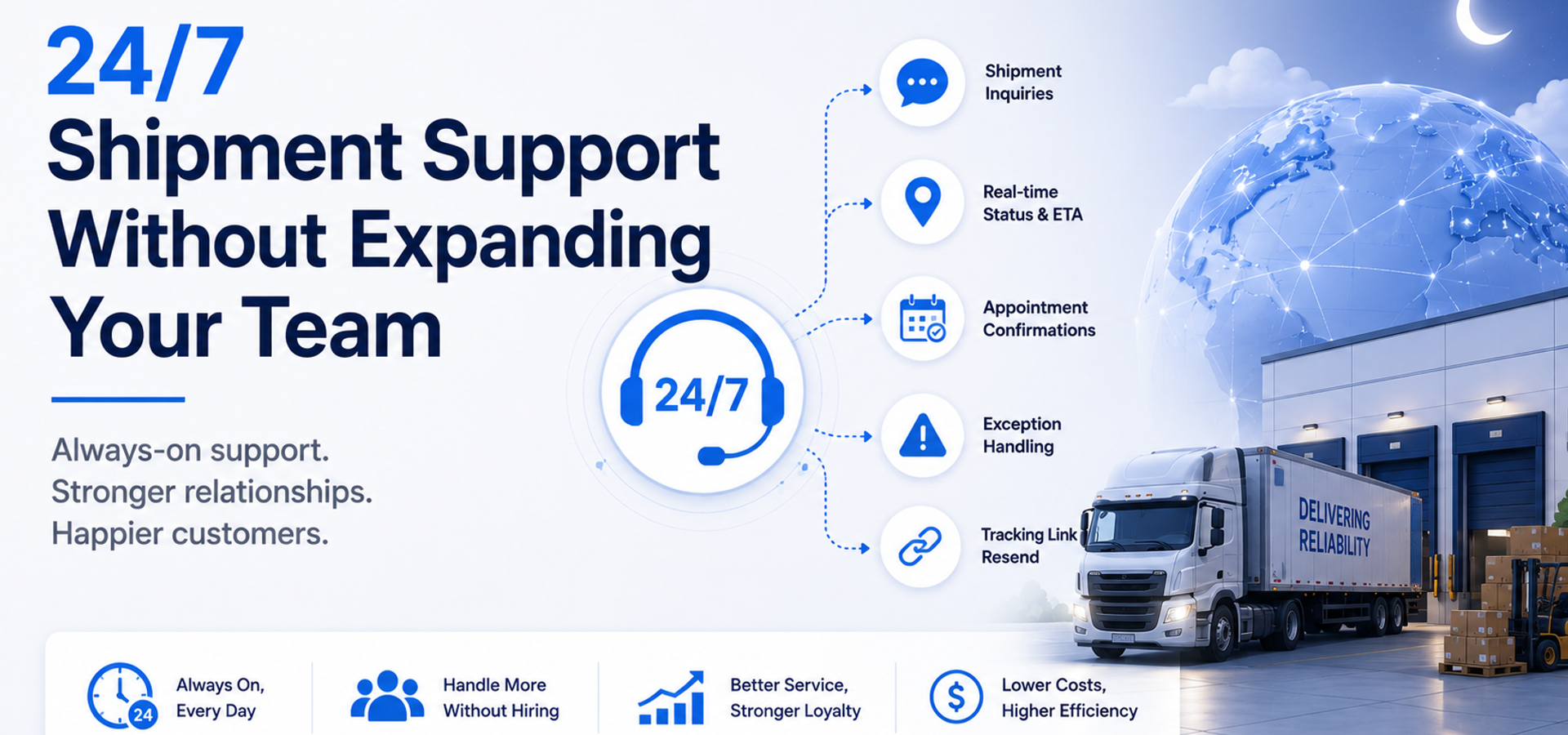
Short answer: Logistics companies provide 24/7 customer support without expanding their customer service team by routing tier-one shipment inquiries, status, ETA, appointment confirm, tracking resend, to AI voice agents tied to TMS data around the clock. Humans stay on-call for exceptions; automation absorbs the repeat questions that used to require overnight coordinators or a morning callback avalanche.
Sunday 9:14 p.m.: your largest shipper’s buyer calls about a Monday-morning delivery window. Your customer service line goes to voicemail. They try your competitor, someone answers, reads the ETA, confirms the appointment. Monday 7:02 a.m.: your team arrives to an angry email, a lost tender conversation, and forty-two voicemails that all ask the same question: where is my shipment?
Freight does not observe office hours. Neither do customer expectations. 24/7 customer support used to mean hiring overnight staff you cannot afford, or pretending voicemail counts as coverage. This guide shows how logistics companies, 3PLs, brokers, and carriers provide always-on shipment support without expanding customer service headcount.
Why logistics companies cannot staff 24/7 customer support the old way
Traditional 24/7 customer support for logistics meant shift rotations, overnight coordinators, weekend temps, and BPO overflow, expensive, hard to train on TMS, and painful to unwind when volume drops. Lean teams hit a wall because:
- freight moves when desks are closed, nights, weekends, holidays
- shipper contracts increasingly expect answered phones, not portals alone
- overnight hiring takes weeks; peak season needs coverage now
- temp agents misquote ETAs or skip TMS notes, creating morning rework
- morning teams spend the first two hours on callbacks, not exceptions
- competitors who answer at 10 p.m. win the relationship conversation
The Bureau of Transportation Statistics publishes freight flow data showing substantial movement outside standard business hours, phones ring when dashboards are dark. Source: BTS freight analysis.
Logistics context: AI in logistics: use cases, benefits & tools and logistics decision gap in AI operations.
What 24/7 customer support means in logistics (not generic call centers)
24/7 customer support in freight is not chatbots on a marketing site. It is operational phone coverage for shipment reality:
- Status and ETA: where is the load, when will it arrive?
- Appointment confirm and change: dock window still valid?
- Driver and carrier check-in: location, hours, gate instructions
- Delay explanation: weather, terminal, production hold
- Tracking link resend: SMS when portal login fails
- Exception escalation: route detention and OS&D to on-call staff
Each inquiry needs a logged outcome in TMS, not a sticky note for tomorrow. That is the bar shippers measure when they compare providers.
Supply chain stack: technology used in supply chain management and AI supply chain technology trends.
Who calls for shipment support when your desk is closed
24/7 customer support serves more than end consumers. Logistics phones ring from:
- Shippers and procurement: production schedules, line-down parts, OTIF pressure
- Receivers and warehouses: dock staffing, detention risk, appointment changes
- Drivers and carriers: revised ETAs, check calls, access instructions
- 3PL client teams: escalations passed through after their desk closed
- Your own operations: cross-dock handoffs when the control tower is thin
FMCSA hours-of-service rules keep many drivers on the road when customer service is offline, another reason always-on coverage matters. Source: FMCSA hours of service.
What broken 24/7 coverage costs logistics companies
When shipment support goes unanswered overnight, costs show up fast:
- shipper churn when a competitor answered the 10 p.m. status call
- detention and layover from drivers waiting without instructions
- missed dock appointments and redelivery fees
- customer service overtime clearing morning callback queues
- repeat calls because nothing logged in TMS overnight
- contract penalties when SLA response times include weekends
Hidden phone cost context: hidden cost of missed calls in logistics operations.
How logistics companies provide 24/7 customer support with voice AI
Voice AI is not a replacement customer service team, it is always-on capacity that scales with ring volume. For 24/7 customer support, AI voice agents:
- answer inbound lines immediately, nights, weekends, holidays, no hold queue
- authenticate callers by account, PRO, BOL, or reference number
- look up load status from TMS, WMS, or carrier API data
- read ETA windows, last scan events, and appointment status plainly
- confirm delivery or capture simple reschedule requests with structured notes
- text tracking links or appointment details via SMS when useful
- escalate exceptions to on-call staff with transcript and load context
- write call outcomes to TMS notes, CRM, or ticketing before morning shift
After-hours deep dive: how logistics companies use 24/7 voice AI for after-hours shipment status calls. Conversational primer: conversational services: what they are & use cases.
The tier-one shipment calls 24/7 voice AI resolves without a human
Strip most overnight and weekend rings and you hear repeatable intents:
- Is the load picked up and moving?
- What is the ETA or delivery window?
- Did anything change since the last update?
- Can we confirm or move the appointment?
- Where is the driver relative to the dock?
- Can you resend the tracking link?
These are tier-one 24/7 customer support calls. They do not need a senior coordinator at 2 a.m., if TMS data is current and voice AI speaks it clearly, logs the outcome, and escalates exceptions with context.
Related automation: automated load status updates with TMS phone bots, low-latency voice AI for driver appointment scheduling, and reducing delivery exception calls before operations.
Overnight staffing vs voice AI for 24/7 shipment support
Overnight customer service hires: weeks to recruit and train, quality risk on ETAs and appointments, payroll cliff when volume normalizes, three-shift management overhead.
Voicemail and portal-only coverage: shipper frustration, competitor wins the relationship call, morning callback avalanche.
BPO overflow without TMS integration: agents read stale data, notes land outside your systems, customers repeat themselves twice.
24/7 voice AI plus thin on-call layer: automation handles tier-one status and confirm calls; humans own detention, OS&D, and key-account escalations, scalable through peak without seat-count math.
Dispatcher parallel: how logistics companies reduce dispatcher call load 70% and handle peak season call volume without hiring dispatchers.
What to automate vs what customer service keeps on-call
Route to 24/7 voice AI: shipment status, ETA readouts, appointment confirm, simple reschedule intake, driver check-in, tracking link resend, standard delay explanations.
Keep on human on-call: detention negotiation, OS&D and damage claims, weather rebooking and recovery freight, hazmat and safety exceptions, key-account relationship escalations, rate and accessorial disputes.
The goal is providing real 24/7 customer support on repeat inquiries, not removing the people who protect margin when the network breaks at midnight.
Connecting 24/7 voice AI to TMS and morning handoff
Always-on support only works when overnight calls write forward to the day shift:
- TMS read access: load status, ETA, appointment, last scan
- Write-back fields: disposition, delay code, summary, recording ID
- Escalation rules: detention and damage route to on-call with transcript
- Morning dashboard: overnight containment rate, open escalations, repeat callers
Start with reliable load lookup, even scheduled exports beat voicemail when Sunday inbound spikes. Stack context: build vs buy voice AI stack. Manufacturing logistics: voice AI transforming supply chain logistics in manufacturing.
Four-week rollout for 24/7 customer support
Week 1: map call intents: Pull logs from nights and weekends. Tag status, ETA, appointment, check-in. Define on-call escalation for detention and damage.
Week 2: connect TMS: Load lookup paths, SMS templates, write-back fields for overnight notes.
Week 3: pilot after-hours line: Route one inbound status number to voice AI when desk closes. Measure answer rate, containment, morning callback depth.
Week 4: expand coverage: Add weekends, then business-hour overflow when hold times climb. Compare shipper satisfaction proxy and CS hours reclaimed.
Planning context: machine learning in supply chain optimization forecasts volume; voice coverage answers the calls forecast creates. Sustainability tie-in: how AI makes supply chains more sustainable.
Metrics logistics leaders track on 24/7 support
- Answer rate: inbound rings answered vs missed (by hour band)
- Containment rate: calls resolved without human transfer overnight
- Morning callback queue: size and age of unresolved voicemails
- Repeat call rate: same load, same question, same night
- Escalation quality: on-call receives transcript and load context
- CS hours reclaimed: day shift time not spent on overnight callbacks
- Shipper retention signals: complaint rate on after-hours coverage
Where Dialflo fits for 24/7 logistics customer support
Dialflo provides AI voice agents built for logistics phone work, TMS-aware 24/7 customer support for shipment status, ETA, appointments, driver check-in, exception escalation, and write-back to your operations stack. Logistics companies use Dialflo to answer shippers, receivers, and drivers around the clock without expanding customer service headcount, so day teams focus on relationships and exceptions instead of replaying overnight voicemails.
FAQ: 24/7 shipment support for logistics companies
Why do logistics companies need 24/7 customer support?
Freight moves nights and weekends; shippers expect answered phones when ETAs shift or appointments change, not voicemail until Monday.
Can voice AI provide real 24/7 coverage?
Yes for tier-one status, ETA, and appointment calls, with humans on-call for detention, damage, and key-account escalations.
Does this replace customer service teams?
No. Voice AI absorbs repeat inquiries at scale; humans own judgment calls and relationship escalations.
How much can automation reduce overnight workload?
Teams often contain 60–70% of tier-one calls when TMS data is accurate. Measure your own pilot.
Should we start with after-hours only?
Yes. Pilot nights and weekends, then expand to business-hour overflow when hold times climb.
Do we need a full TMS API?
Start with reliable load lookup, scheduled exports work for early pilots.
How does Dialflo help?
24/7 voice agents for logistics shipment support, see dialflo.ai.
Closing: shippers remember who answered at 10 p.m.
24/7 customer support is not a branding phrase, it is whether a shipper gets an ETA on Sunday night or a voicemail that becomes your Monday morning fire drill. Logistics companies that provide always-on shipment support with voice AI answer tier-one calls when desks are closed, log every outcome, and keep customer service teams focused on exceptions, not on replaying the same status question fifty times before lunch.
Ready to offer 24/7 shipment support without overnight hiring? Explore Dialflo for voice agents that answer shippers, drivers, and receivers around the clock, with TMS lookup, escalation, and write-back to the systems your team already runs.