How Warehouses Cut Inbound Call Volume with Voice AI

Dialflo: AI Voice Agent
June 29, 2026
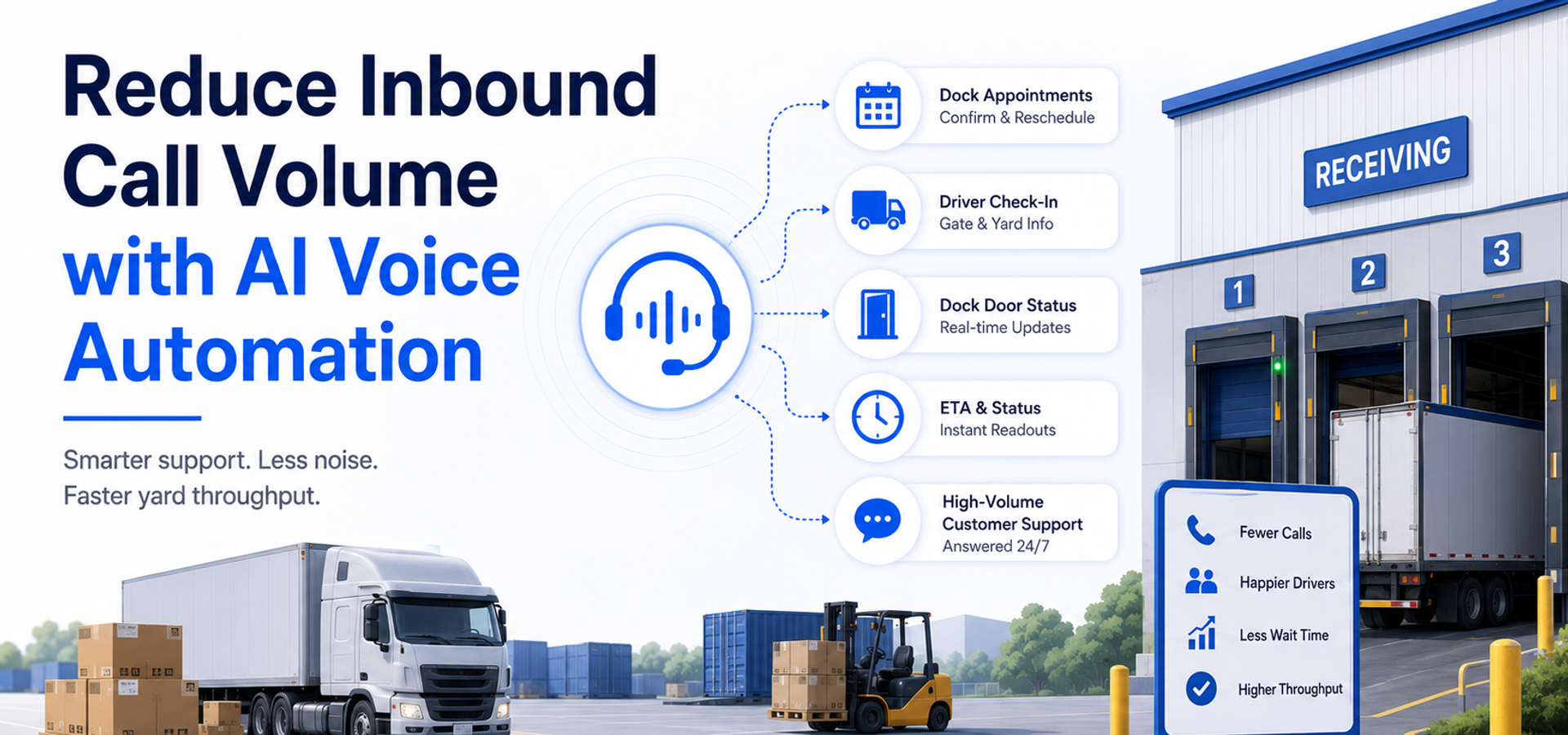
Short answer: Warehouse operators reduce inbound call volume by routing tier-one high-volume customer support inquiries, appointment confirm, driver check-in, dock door readouts, ETA updates, to AI voice agents tied to WMS or yard data. Voice automation answers immediately, logs outcomes, and escalates OS&D and detention to humans, so the operations desk scales without adding coordinators for every morning spike.
6:47 a.m.: your warehouse line rings for the forty-third time. A driver asks which door. A carrier dispatcher asks if the 8 a.m. slot is still valid. A shipper’s customer service rep asks for ETA on a load that left your dock yesterday. Your two coordinators are already on hold with lumpers. Line five goes to voicemail. By 9 a.m. the yard is chaos, and half the morning was spent answering the same four questions.
Warehouses are phone-heavy operations disguised as forklift operations. High-volume customer support at the dock is not a call center problem, it is a throughput problem. This guide shows how warehouse operators and 3PLs reduce inbound call volume with AI voice automation without expanding the customer support desk.
Why warehouse inbound call volume spikes harder than expected
Warehouse desks are sized for average Tuesday. Reality delivers surge patterns. High-volume customer support inbound breaks because:
- gate-open hour concentrates driver check-in calls in thirty minutes
- every delayed truck generates three status callbacks, carrier, shipper, driver
- appointment portals show one time; yard reality shows another
- phone trees trap callers; they redial and inflate inbound volume
- coordinators answer instead of assigning doors, yard queue grows behind them
- peak retail season multiplies rings without multiplying headcount
The Warehousing Education and Research Council documents ongoing labor and throughput pressure on distribution operations, phones compete with the same lean teams moving freight. Source: Warehousing Education and Research Council (WERC).
Logistics context: AI in logistics: use cases, benefits & tools and logistics decision gap in AI operations.
What high-volume customer support looks like at a warehouse dock
High-volume customer support in warehousing is not retail chat, it is operational phone traffic tied to physical movement:
- Appointment confirm: is my dock slot still valid?
- Driver check-in: I am at the gate, where do I go?
- Door and yard instructions: door number, lumper, seal check
- ETA and delay intake: truck running late, need to move window
- Status readouts: has load X been received or shipped?
- Reschedule requests: receiver capacity or carrier delay
Each answered call needs a WMS note, not a verbal answer lost when the coordinator turns to the next ring. Unlogged answers generate repeat inbound volume within the hour.
Technology backdrop: technology used in supply chain management and AI supply chain technology trends.
Warning signs inbound call volume is crushing warehouse throughput
Before OTIF scores slip, phones tell the story:
- hold times exceed five minutes during gate-open window
- voicemail fills before the first shift ends
- drivers circle the yard because nobody answered check-in
- the same reference number generates four inbound callbacks
- coordinators cannot leave the desk during receiving peaks
- shippers escalate because “nobody picks up at your warehouse”
Missed-call cost context: hidden cost of missed calls in logistics operations.
The repetitive inbound calls flooding warehouse lines
Strip a morning spike and you hear the same intents on repeat:
- “I am here for the 8 a.m. appointment, what door?”
- “Is my slot still open if I am thirty minutes late?”
- “Can you confirm pickup number ABC-4421?”
- “Where is the driver on delivery to your dock?”
- “We need to push the appointment to afternoon.”
- “Did you receive our shipment from last night?”
These are tier-one high-volume customer support calls. They do not need a senior warehouse coordinator every time, if WMS data is current and voice AI speaks it clearly, captures changes, and logs before the next ring.
Related workflows: low-latency voice AI for driver appointment scheduling, delivery appointment scheduling automation, and replacing phone trees with conversational voice AI.
How warehouse operators reduce inbound calls with AI voice automation
AI voice automation is overflow capacity, not a replacement yard team. For high-volume customer support, voice agents can:
- answer inbound warehouse lines immediately, no hold queue at gate open
- authenticate by appointment ID, PRO, BOL, or PO reference
- read dock window, door assignment, and check-in status from WMS or yard system
- capture driver arrival, revised ETA, and simple reschedule requests
- deliver gate codes and lumper instructions via SMS after the call
- warm-transfer OS&D, refused loads, and detention to coordinators with transcript
- write disposition, timestamp, and summary to the load or appointment record
When every tier-one call logs an outcome, repeat inbound volume drops, the caller does not redial because the first answer never reached the system.
Conversational primer: conversational services: what they are & use cases. Inbound queue context: automate inbound carrier tracking queues.
Phone trees vs human desk vs AI voice automation at the warehouse
IVR phone trees: drivers press wrong options, abandon calls, redial, inflating inbound volume. Yard teams still get walk-up confusion at the gate.
Human-only desk: coordinators trapped on repeat readouts during receiving peaks; doors assign late; detention risk rises.
Seasonal temp hires: weeks to train on WMS; misquoted doors and missed notes; headcount cliff after peak.
AI voice automation plus core coordinators: tier-one high-volume customer support contained automatically; humans on dock conflicts, damage, and shipper escalations, yard throughput protected.
Noise matters on cab calls, pair with acoustic noise-canceling phone bots for dispatch lines when drivers call from the yard queue.
What to automate vs what warehouse staff keeps
Route to voice AI: appointment confirm, driver check-in, door and gate instructions, ETA capture, simple reschedule intake, status readouts on reference numbers, SMS resend of dock details.
Keep on human coordinators: dock door conflicts and capacity overrides, OS&D and damage documentation, refused loads and seal exceptions, detention and lumper disputes, hazmat and temperature-controlled escalations, key shipper relationship calls.
The goal is reducing inbound call volume on repeat inquiries, not removing the people who resolve dock exceptions when twelve trucks arrive in the same twenty-minute window.
Connecting voice AI to WMS and yard systems
Automation works when voice AI sees the same appointment truth the desk does:
- WMS or yard read access: appointment window, door, load status, check-in flag
- Write-back fields: arrival time, delay code, door note, call summary, recording ID
- Escalation rules: refused load or damage keywords route to human with context
- Repeat-caller detection: same reference within an hour sees prior disposition
Start with reliable appointment lookup, even scheduled exports beat voicemail when Monday gate-open spikes. Stack context: build vs buy voice AI stack. Inventory planning tie-in: AI inventory optimization tools and strategies.
Four-week pilot to cut warehouse inbound call volume
Week 1: map intents: Tag a peak morning’s inbound log: check-in, confirm, status, reschedule. Define human escalation for OS&D and detention.
Week 2: connect WMS: Appointment and load lookup paths, SMS templates for gate and door instructions.
Week 3: pilot gate-open line: Route overflow or full inbound to voice AI during 6–9 a.m. window. Measure answer rate, containment, repeat call rate.
Week 4: expand: Add afternoon receiving spike or weekend coverage. Compare coordinator hours reclaimed and yard wait time.
Always-on option for overflow: 24/7 shipment support without expanding customer service teams. Peak context: handle peak season call volume without hiring dispatchers.
Metrics warehouse operators track on inbound call automation
- Answer rate: inbound rings answered vs missed (by hour band)
- Containment rate: calls resolved without human transfer
- Repeat call rate: same reference, same intent, within 60 minutes
- Average hold time: should fall when voice AI absorbs overflow
- Check-in-to-door time: driver wait in yard after arrival
- Coordinator hours on tier-one readouts: reclaimed time for yard ops
- Missed appointment incidents: slots lost to unanswered inbound
The Council of Supply Chain Management Professionals tracks distribution labor and service expectations rising together, phone capacity is part of warehouse performance. Source: CSCMP State of Logistics Report.
Efficiency tie-in: how AI makes supply chains more sustainable and machine learning in supply chain optimization.
Where Dialflo fits for warehouse inbound call volume
Dialflo provides AI voice agents built for logistics phone work, WMS-aware high-volume customer support for appointment confirm, driver check-in, status readouts, exception escalation, and write-back to your operations stack. Warehouse operators and 3PLs use Dialflo to reduce inbound call volume during gate-open spikes and peak season, so coordinators assign doors and move freight instead of reading appointment windows aloud all morning.
FAQ: warehouse inbound call automation
Why do warehouse phones spike so hard in the morning?
Gate-open hour concentrates driver check-in, appointment confirm, and carrier status calls, often overwhelming a lean desk.
Can voice AI reduce repeat inbound calls?
Yes, when every answer writes to WMS, callers do not redial because the first response never reached the system.
What calls should warehouses automate first?
Check-in, appointment confirm, door instructions, and status readouts, escalate damage and refused loads to humans.
Does this replace warehouse coordinators?
No. Voice AI absorbs high-volume tier-one inbound; humans own dock exceptions and shipper escalations.
Do we need a full WMS API?
Start with reliable appointment lookup, scheduled exports work for early pilots.
How fast can we pilot?
Often 2–4 weeks on one inbound line or gate-open window before broader rollout.
How does Dialflo help?
Voice agents for warehouse inbound call automation, see dialflo.ai.
Closing: fewer repeat rings, faster yard throughput
Warehouse performance is measured in doors turned, not calls answered. High-volume customer support at the dock will spike every peak season; warehouse operators that reduce inbound call volume with AI voice automation contain tier-one inquiries, log every outcome, and free coordinators to run the yard instead of replaying the same appointment answer forty times before lunch.
Ready to cut morning inbound spikes without hiring another desk? Explore Dialflo for voice agents that handle warehouse appointment, check-in, and status calls, with WMS lookup, escalation, and write-back to the systems your team already runs.