CRM for HR: How It Improves Hiring & Engagement

Dialflo: AI Voice Agent
May 25, 2026
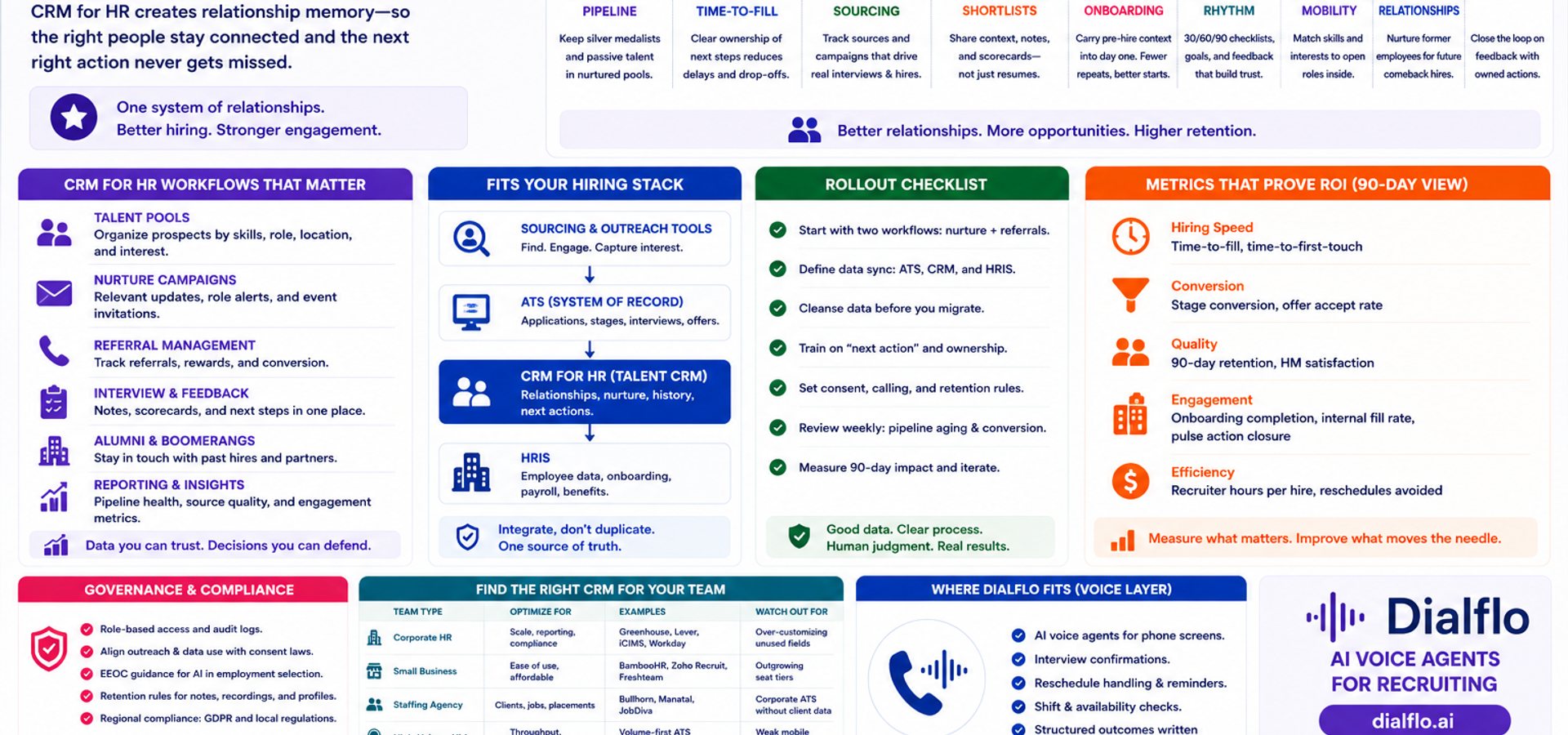
Most HR and talent teams already run an ATS, an HRIS, and at least one spreadsheet labeled “call back later.” The expensive failure mode is not missing software, it is missing relationship memory: who spoke to a candidate, what was promised in the interview process, and what should happen on day 30 after hire. That is where CRM for HR earns its budget.
This guide explains how CRM for HR improves hiring and engagement in operator terms: what to buy, how it fits your stack, which workflows to launch first, metrics that prove ROI, and where voice automation helps without replacing your people systems. For the dedicated talent-CRM lens, start with candidate relationship management system. For stack context, see HR software solutions: features, types & tools.
What CRM for HR means (talent CRM vs employee CRM)
In recruiting, CRM for HR usually means a talent CRM: pipelines for prospects, referrals, silver medalists, event leads, and alumni who might return. In broader people operations, it can also describe relationship views inside HR suites, onboarding tasks, development conversations, internal mobility interest, and manager rituals.
It is not payroll. It is not a compliance system of record. It answers: What is the next human touchpoint, who owns it, and what context do they need? When that answer lives in inboxes, hiring slows and engagement feels transactional after the offer letter.
How CRM for HR improves hiring
1) Stops silver medalists and passive talent from vanishing
When reqs close, “great fit, wrong timing” candidates often disappear into personal inboxes. A talent CRM centralizes tags, touch history, and follow-up tasks so nurture becomes a pipeline, not a memory exercise.
2) Shortens time-to-fill with visible ownership
SHRM frames talent acquisition as cross-functional: recruiters, hiring managers, and coordinators need shared visibility on next steps. Source: SHRM: Talent acquisition toolkit. CRM-style stages make ownership explicit and cut “I thought you were calling them” delays.
3) Improves source and campaign analytics
Segment CRM pools by source, referrals, events, communities, agency feeds, and tie them to interviews and hires. Pair operational CRM hygiene with recruitment analytics software so leaders see conversion, not just activity counts.
4) Makes high-volume hiring humane at scale
Frontline and hourly hiring still needs judgment, but many steps are coordination: confirm interest, collect availability, schedule screens. Outcomes from AI sourcing and AI applicant screening only help recruiters when fields sync back to the CRM they actually open each morning.
5) Gives hiring managers context, not resume avalanches
Managers engage when shortlists include notes, prior conversations, and structured scorecards, especially for niche roles sourced through candidate sourcing services.
LinkedIn’s talent research consistently ties hiring outcomes to proactive engagement and candidate experience, not only job post visibility. Source: LinkedIn: Future of Recruiting 2025. A CRM for HR operationalizes speed and communication at scale.
How CRM for HR improves engagement after the offer
1) Onboarding without the “tell us your life story again” loop
When pre-hire context lives in a CRM and post-hire tasks live only in HRIS, new hires repeat basics for weeks. Integrate handoffs: start date, equipment, buddy assignment, and promises made during recruiting.
2) Manager rhythm beats annual survey panic
Engagement improves with lightweight rituals, 30/60/90 checklists, goal alignment, timely feedback. Gartner’s HR technology themes highlight manager effectiveness as a major adoption driver for people tools. Source: Gartner: HR technology.
3) Internal mobility and referral loops
Your best applicants are often already inside the company. CRM-style talent pools track skills, career interests, and referral graphs, aligned with an agentic hiring organization where internal moves are first-class, not afterthoughts.
4) Alumni and boomerang hires
Former employees who leave on good terms are a premium source. Treat alumni like a nurture segment: policy updates, relevant role alerts, respectful check-ins, not blast campaigns that damage brand.
5) Listening that closes the loop
Pulse surveys without owners and due dates erode trust. Assign actions the same way sales CRM assigns follow-ups, engagement is operations, not a PDF report.
Rollout checklist: CRM for HR without adoption failure
- Start with two workflows: silver-medalist nurture + referral tracking, not every module on day one.
- Define data contracts: which fields sync between ATS, CRM, and HRIS; which system wins on conflict.
- Cleanse before migrate: duplicates destroy CRM trust in week one.
- Train on “next action” discipline: empty pipelines mean empty ROI.
- Govern outreach: consent, regional calling rules, retention for notes and call recordings.
- Review weekly: stage aging, conversion, recruiter activity, not only reqs filled.
For cloud deployment patterns, read cloud-based recruitment software: benefits & tools. For AI context across the funnel, see artificial intelligence in recruitment and how AI agents are transforming recruiting.
Metrics that prove CRM for HR ROI (90-day before/after)
- Hiring: time-to-fill, offer accept rate, pipeline conversion, re-engaged silver medalists hired
- Quality: 90-day retention or performance proxy, hiring manager satisfaction
- Engagement: onboarding completion, internal fill rate, pulse participation with closed actions
- Efficiency: recruiter hours per hire, coordinator reschedules avoided
Interview quality improves when CRM notes feed structured prep, pair with generate interview questions from job description using AI and interview intelligence: AI candidate performance analysis for downstream decision support.
Unique angle: CRM for HR is coordination memory, not feature sprawl
Most vendors sell modules. Operators need memory: who owns the next step, what was promised, what happened on the last call. CRM for HR wins when it reduces coordination tax for recruiters and managers, especially in high-volume, high-growth, or multi-brand hiring environments where spreadsheets silently leak revenue and headcount plans slip.
Where Dialflo fits: voice execution on top of your CRM/ATS
Dialflo is not an HR CRM. It is an AI voice layer for phone-heavy recruiting, screens, confirmations, reschedules, shift checks, that should write structured outcomes back to your ATS or CRM. When CRM for HR defines the relationship record, Dialflo helps keep that record current without recruiters living on hold. Explore hire candidates faster with AI tools and machine learning in recruiting: how it works for funnel context.
FAQ: CRM for HR
What is CRM for HR?
Relationship-focused software for talent pipelines and people touchpoints, typically a talent CRM integrated with ATS and HRIS.
How does CRM for HR improve hiring?
Better nurture, pipeline visibility, ownership, source analytics, and manager-ready shortlists with context.
How does CRM for HR improve engagement?
Smoother onboarding handoffs, manager rituals, internal mobility pools, alumni nurture, and action-linked listening.
Is CRM for HR the same as an ATS?
No, ATS manages applicants per req; CRM manages relationships over time. Use both, integrated.
What metrics prove ROI?
Time-to-fill, conversion by stage, offer accept rate, 90-day retention proxies, internal fill rate, hours per hire.
How does Dialflo help?
Voice agents execute high-volume phone steps and sync structured results to your hiring systems.
Closing: hire faster, stay connected longer
CRM for HR improves hiring when pipelines stop leaking talent, and improves engagement when employees never feel like strangers in their own company’s systems. Start narrow, integrate honestly, measure conversion and retention, and add voice automation only where phone coordination is the bottleneck.
Building your people stack? Review Dialflo for recruiting phone workflows that keep your CRM and ATS truthful.


