How Logistics Companies Handle High-Volume Customer Service Calls During Peak Shipping Seasons

Dialflo: AI Voice Agent
July 6, 2026
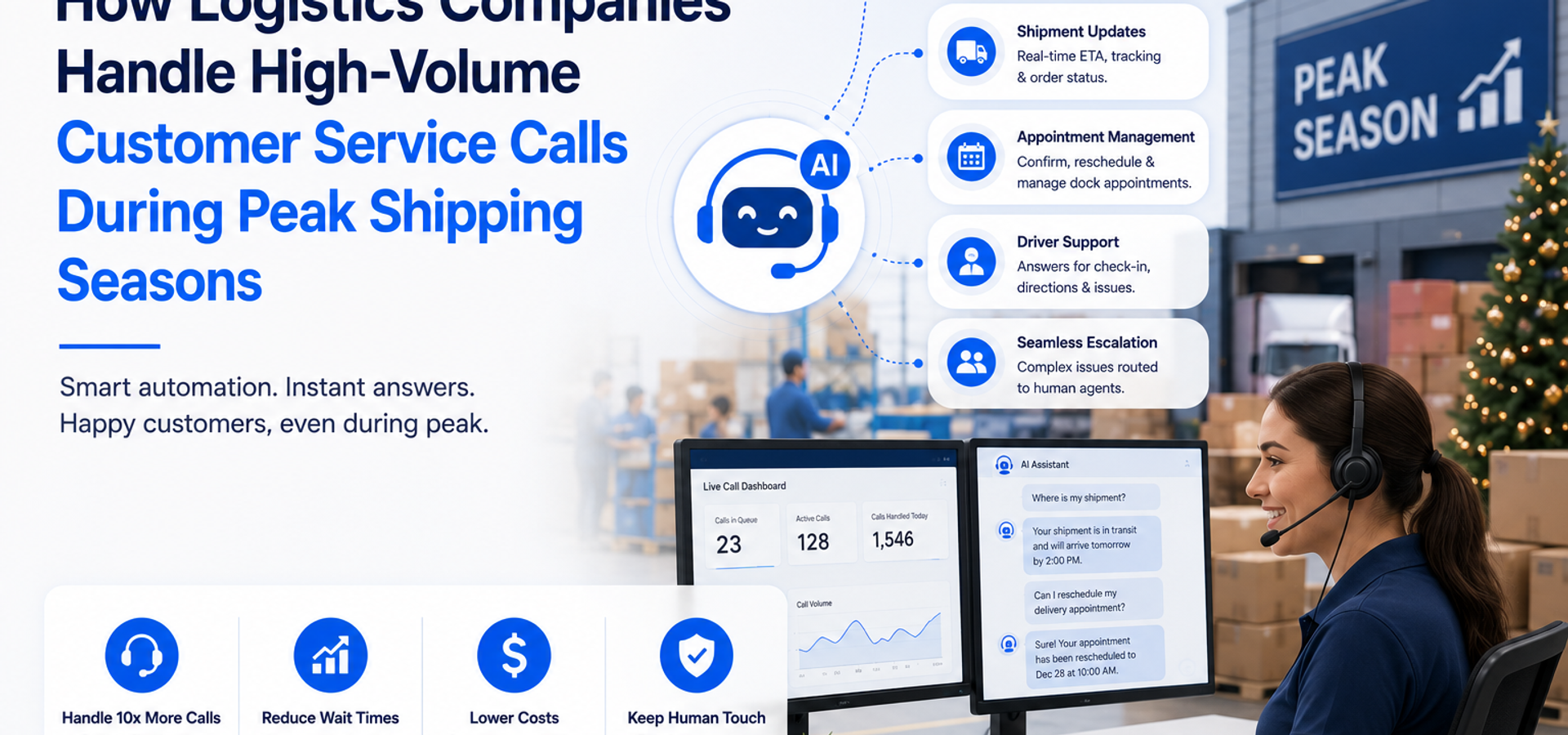
Short answer: Customer support automation lets logistics companies answer high-volume customer service calls during peak shipping seasons without doubling headcount, AI voice agents tied to TMS data resolve tier-one intents (shipment status, ETA, appointment confirm, tracking resend) in seconds while human agents handle detention, OS&D, and key-account escalations. Deploy before Q4 or produce season, measure containment on one queue, then scale overflow before hold times hit double digits.
Monday before Cyber Week. Your customer service line rings nonstop. Average hold time: fourteen minutes. Three seasonal hires started yesterday, they still cannot find loads in the TMS. A shipper on hold tweets about your service. A receiver cancels a slot because nobody confirmed the truck. Volume did not surprise you. The phone queue did.
Peak shipping seasons are predictable. Customer service meltdowns are optional. Logistics companies that handle high-volume calls well do not rely on heroic overtime alone, they deploy customer support automation that scales with ring volume while coordinators focus on the exceptions that decide whether shippers renew in January.
This guide shows how 3PLs, freight brokers, and carriers use customer support automation to survive peak shipping seasons, what breaks first, what to automate, when to deploy, and how to build a business case your CFO will fund before the surge arrives.
Why peak shipping seasons break logistics customer service
Peak is not one event. It is stacked forces that multiply call volume faster than load count:
- Q4 retail and holiday push: compressed delivery windows, more status anxiety
- Produce and agricultural season: appointment pressure, temperature-sensitive urgency
- Fiscal year-end volume: shippers clearing backlog before books close
- Weather and network disruption: ETAs shift hourly; portals show yesterday’s truth
- Warehouse appointment compression: tighter docks, more reschedule calls
Each load generates two to four status checks when networks get tight. Shipment-status questions are usually the largest single category of logistics customer service calls, and their share rises when delays cluster.
Freight operations context: AI in logistics: use cases, benefits & tools. The American Trucking Associations tracks freight economy pressure on operations teams through peak cycles. Source: ATA news and insights.
What customer support automation means in logistics (beyond chatbots)
Customer support automation in freight is not a website widget that deflects to an FAQ. It is production voice and workflow automation connected to your system of record:
- answer inbound shipper and receiver calls immediately, no hold queue on tier-one lines
- look up loads by PRO, BOL, reference, or account in TMS
- read ETA windows, last scan events, and appointment status accurately
- resend tracking links, confirm docks, intake simple reschedules with validated fields
- run proactive outbound ETA updates when TMS flags delays, before the panic call
- escalate detention, damage, and billing disputes to humans with full transcript context
- write call outcomes to TMS notes so repeat callers do not restart the thread
Gartner frames customer service transformation around AI handling routine volume so agents focus on complex work, when deployed on the right intents. See: Gartner: Customer service & support insights. Voice fundamentals: conversational services: what they are & use cases.
The peak-season call anatomy: what floods your queue
When volume spikes, most rings are not unique problems. They are repeat intents at higher frequency:
“Where is my shipment?”: pickup confirm, in-transit location, delay reason. Highest-volume intent in most freight CS desks during peak.
“What is the ETA?”: delivery window still valid? receiver hours? appointment slot?
“Did anything change since yesterday?”: weather hold, relay, cross-dock handoff. Portal green; reality red.
Appointment confirm or change: dock time, access code, lumper, gate instructions.
Tracking link or POD request: shipper needs proof for their customer’s customer.
Exception anxiety calls: delay not yet flagged proactively; caller wants a human because the last automated email was vague.
These tier-one intents are exactly what customer support automation should absorb during peak, freeing agents for tier-two work that protects revenue. Decision discipline when scaling: logistics decision gap in AI operations.
Seasonal hiring vs customer support automation: the real math
Most operators default to seasonal CS hires when peak approaches. That playbook has hidden costs:
Seasonal hiring: three to six weeks to recruit and train, TMS accuracy risk on day one, January layoffs or idle payroll when volume drops, quality inconsistency on appointment and accessorial questions.
Customer support automation: pilot live in two to four weeks, scales with concurrent call volume, no seat count to unwind after peak, consistent answers when TMS data is current.
Overtime on core team: burnout on your best agents, exception work still waits, same repetitive readouts all night.
Automation plus core team: humans on judgment, automation on readouts, sustainable through Q4 and storm weeks.
Voicemail and hold music during peak: missed loads, shipper churn, morning callback avalanches that eat the first two hours of every day.
Voice AI with TMS lookup: answered rings, logged outcomes, smaller morning queue.
McKinsey estimates AI-enabled service can materially improve speed and reduce cost when automation targets high-volume, integration-backed intents, not every intent. Source: McKinsey: AI-enabled customer service. Supply chain trend context: AI supply chain technology trends.
Tier-one vs tier-two: what to automate during peak season
Peak amplifies mistakes. Automate the wrong calls and you lose shippers. Automate nothing and you lose them anyway, to hold time.
Route to customer support automation (tier-one)
- shipment status and last scan readout
- ETA window and appointment confirmation
- tracking link and POD resend
- simple reschedule intake with required fields
- after-hours and overflow when agents are on exceptions
- proactive outbound delay notification on flagged lanes
Keep on human agents (tier-two)
- detention and accessorial disputes
- OS&D, damage claims, freight recovery
- billing exceptions and invoice reconciliation
- key-account escalations and rate-sensitive conversations
- complex rebooking when network capacity is constrained
Customer support automation wins peak season when it removes readout loops, not when it traps angry shippers in bad IVR trees.
Pre-peak deployment timeline: start 8 weeks before the surge
Deploying mid-Black Friday is learning under fire. Run this calendar backward from your known peak:
Weeks 8–7: instrument last year’s peak
Pull call logs, top ten intents, peak hours, average handle time, missed-call rate, and morning callback depth from last season. Identify the one queue that hurt most, usually inbound shipper status.
Weeks 6–5: integrate TMS read access
Load lookup by reference number is non-negotiable. Write-back to notes or tasks when possible. Scheduled exports beat perfect APIs for pilot speed. Stack context: technology used in supply chain management.
Weeks 4–3: pilot with shadow mode
AI answers; supervisor monitors transcripts. Tune escalation triggers, confirm fields, fix retrieval gaps before customers see failures at scale.
Weeks 2–1: expand to overflow routing
When hold times exceed your threshold, often five minutes during peak, route tier-one overflow to automation. Keep tier-two lines human-first.
At peak onset: proactive outbound on delayed lanes
TMS exception flags trigger outbound ETA updates. Shippers who hear about delays first call less. That single workflow can cut inbound panic volume measurably during storm weeks.
Build vs buy for voice infrastructure: build vs buy voice AI stack. Migration if you already piloted dev-centric tools: migrate from Retell to Dialflo without downtime.
Architecture for peak-ready customer support automation
Five layers separate peak-season heroes from peak-season horror stories:
1. Concurrency and telephony: handle simultaneous rings without hold queues on tier-one lines. Peak is a concurrency problem first.
2. Conversational understanding: accept “status on PRO 4492” and “is my grocery load still on for Thursday” without twelve menu options.
3. TMS / WMS retrieval: speak truth from live or near-live events. Wrong answers at peak scale damage more accounts per hour than wrong answers in February.
4. Workflow completion: confirm appointment, text tracking link, open reschedule task, log driver ETA when applicable.
5. Warm escalation + write-back: transfer to agent with transcript and PRO; log outcome so the next caller on the same load does not reset the conversation.
IBM’s virtual agent framework applies: NLP plus automation plus retrieval, not scripted trees alone. See: IBM: What is a virtual agent?. Forecasting tie-in: machine learning in supply chain optimization helps predict volume; customer support automation handles the calls that forecast creates.
Metrics logistics CS leaders track during peak season
Fund what you measure. Track these weekly from week −8 through week +2 after peak:
- Answer rate: inbound rings answered vs missed (peak target: above 95% on tier-one)
- Average speed to answer: should stay under 30 seconds on automated tier-one queues
- Containment rate: tier-one resolved without human transfer, by intent
- Average handle time: human agents should spend less time on readouts, more on resolution
- Morning callback queue: size and age of unresolved voicemails
- Repeat-call rate: same PRO, same question, same day (write-back failure signal)
- CSAT on escalated calls: segment AI-only vs human; watch complaint spikes on handoffs
- Shipper churn signals: account manager escalations, formal complaints, lost tender volume
Forrester’s customer service research links reduced customer effort to loyalty, automation wins when it removes loops, not when it adds them. See: Forrester: Customer service research. Sustainability angle, fewer wasted miles when receivers get accurate windows without callback chains: how AI makes supply chains more sustainable.
Build the business case before your CFO asks
Finance approves customer support automation when you translate hold time into account risk.
Model it conservatively. If peak multiplies daily call volume from 400 to 1,200, and average human handle time on tier-one readouts is four minutes, that is 53 agent-hours daily on work automation can contain. Even at 60% containment, you recover 32 hours, for a core team that should be on exceptions, not ETAs.
Compare seasonal hire cost, recruiting, training, six weeks of salary, January idle time, against automation that scales with December and shrinks with January without layoffs. Pricing context for voice stacks: Retell vs Dialflo India pricing and Retell AI pricing vs Dialflo pricing. Vendor evaluation: best Retell alternative for India and Vapi alternatives for India.
Inventory and planning teams see parallel pressure during peak, status questions pull ops into manual lookups: AI inventory optimization tools & strategies.
Common peak-season failure modes (and how operators avoid them)
- Deploying during the surge: Pilots need tuning time. Start at week −8, not week −1.
- Automating tier-two under pressure: Detention disputes need humans; containment targets must be intent-specific.
- Stale TMS data at peak: Confident wrong answers lose shippers faster than hold music.
- No write-back: Repeat calls double; agents answer the same PRO every hour.
- Cold transfers: Peak callers are already stressed; “what’s this about?” destroys trust.
- Ignoring proactive outbound: Inbound volume is a symptom; delayed proactive comms is often the cause.
- Choosing chat-only tools for phone-heavy peak: Shippers call. Drivers call. Receivers call. Voice-first or you miss the surge.
Where Dialflo fits: customer support automation built for logistics peak volume
Dialflo provides production-grade AI voice agents for logistics customer service teams drowning in peak-season call volume, not FAQ chatbots that shippers never use. Dialflo delivers customer support automation that answers tier-one shipment inquiries with TMS-aware lookup, runs proactive outbound ETA updates on delayed lanes, escalates exceptions to humans with full context, and writes outcomes back to the operations stack you already run.
3PLs, brokers, and carriers use Dialflo when hold times threaten shipper relationships, when seasonal hiring cannot scale fast enough, and when the best agents should protect key accounts instead of reading tracking aloud for the forty-seventh time today.
If your CS queue breaks every Q4, you do not need a bigger seasonal hiring plan alone, you need customer support automation that scales with ring volume before the first holiday surge hits.
FAQ: customer support automation for peak shipping seasons
How much can customer support automation reduce peak call volume?
Teams often contain 55–70% of tier-one status and ETA calls when TMS data is accurate and escalation paths are clear. Measure your own containment rate in pilot, do not trust blended industry averages alone.
Should we deploy before or during peak season?
Before. Start six to eight weeks ahead of known surges. Pilots need two to four weeks to tune; deploying mid-peak means learning under maximum stress.
Will shippers accept AI during busy weeks?
They accept fast, accurate answers. Load-aware voice beats fourteen-minute hold music, especially when escalation to a human is one sentence away.
Can automation handle after-hours peak volume?
Yes. After-hours overflow is often the fastest pilot, clear success criteria, immediate answer-rate improvement, and defined escalation to on-call coordinators.
Do we need a full TMS API to start?
No. Reliable load lookup, even scheduled exports, beats voicemail during pilot. Expand integration depth after containment proves on one queue.
How does Dialflo help logistics teams during peak?
Dialflo AI voice agents for customer support automation, TMS lookup, proactive outbound, warm escalation, write-back. See dialflo.ai.
Closing: peak seasons are predictable, customer service breakdowns are not
Every logistics operator knows when peak shipping season arrives. The ones who handle high-volume customer service calls well deploy customer support automation before the surge, absorb tier-one volume, protect agents for exceptions, and keep shippers from learning about delays on hold.
Ready to enter peak season without fourteen-minute hold times? Talk to Dialflo about a pilot on one queue, inbound shipper status, after-hours overflow, or proactive outbound ETA, with TMS-aware voice agents, warm escalation, and write-back to the systems your CS team already runs. Deploy at week −8. Measure containment at day 30. Scale before the volume chart goes vertical.