How Manufacturers Automate Carrier Confirmation Calls

Dialflo: AI Voice Agent
June 29, 2026
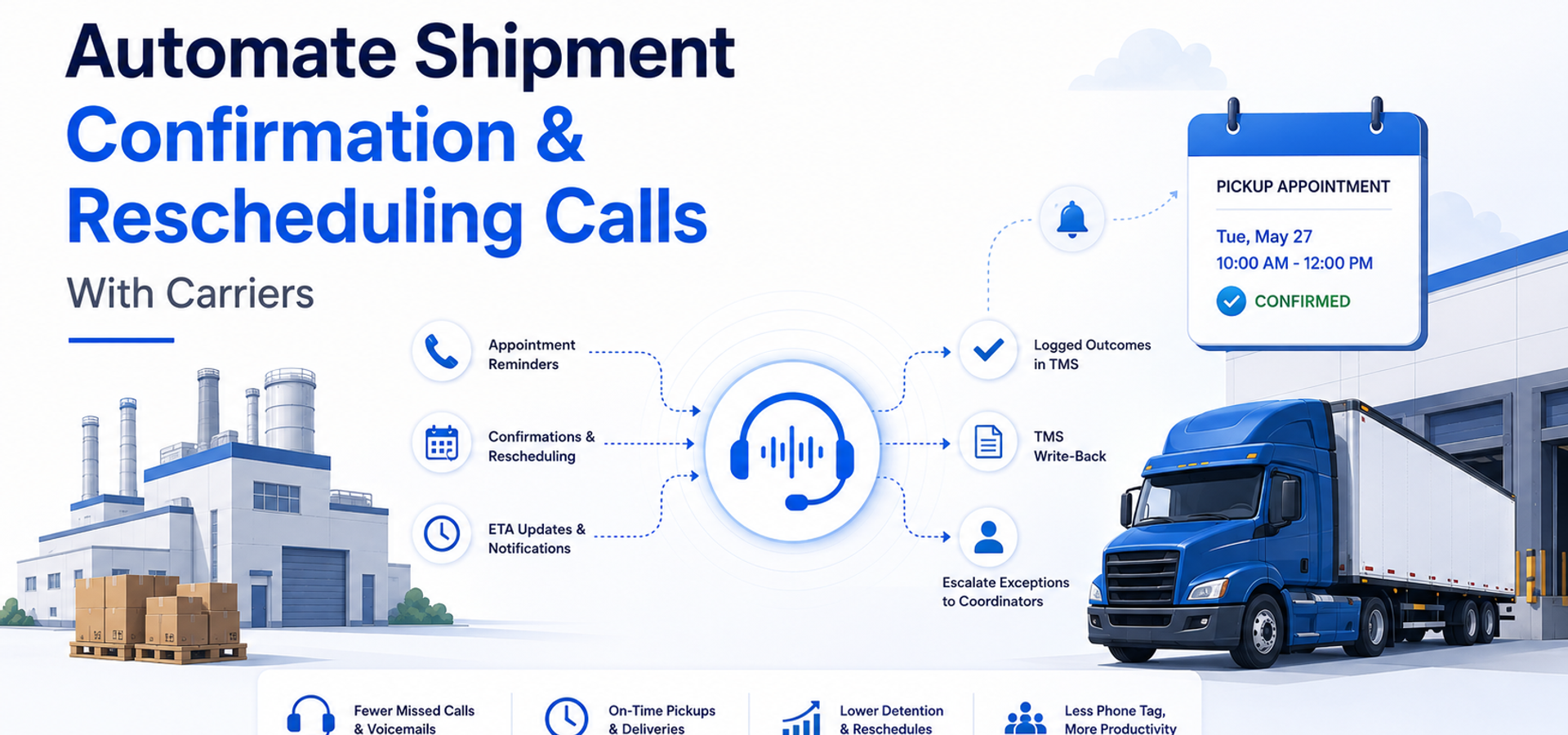
Short answer: Manufacturers automate shipment confirmation and rescheduling calls with carriers by routing tier-one appointment reminders & rescheduling to AI voice agents tied to TMS data, outbound “still on for Tuesday?” calls, inbound carrier callbacks, ETA capture, and logged outcomes, while human coordinators handle production-driven rebooking, detention, and customer escalations.
Monday 6:12 a.m.: line three goes down for four hours. Forty outbound shipments still show tomorrow’s pickup window in the TMS. Your logistics coordinator starts dialing carriers, reminder call one, voicemail. Reminder call two, wrong extension. Call three, the dispatcher says they already sent a truck that is not on your yard list. By 9 a.m. you are not shipping, you are playing telephone tag with twelve carriers while production replans and customers ask if anything is still moving.
That is manufacturing logistics without automation on appointment reminders & rescheduling. Confirm-and-move calls are not admin work, they are the glue between your plant schedule and carrier capacity. This guide shows how manufacturers automate shipment confirmation and rescheduling calls with carriers without hiring seasonal coordinators every surge.
Why appointment reminders and rescheduling break at manufacturing plants
Plants run on production reality; carriers run on appointment windows. When those two clocks diverge, coordinators become a call center. Appointment reminders & rescheduling break because:
- production slips move pickup times faster than humans can re-notify carriers
- inbound raw material and outbound finished goods share the same lean desk
- carriers call back on different lines, nobody sees the full thread in TMS
- reminder calls batch to end of day, after trucks are already en route wrong
- seasonal volume spikes hit the same coordinator count as average month
- voicemail and email threads do not write structured notes to load records
The Council of Supply Chain Management Professionals tracks persistent pressure on manufacturing logistics teams to do more with fixed back-office headcount as shipment complexity rises. Source: CSCMP State of Logistics Report.
Logistics context: AI in logistics: use cases, benefits & tools and logistics decision gap in AI operations.
What appointment reminders and rescheduling include for manufacturers
Appointment reminders & rescheduling is a two-way loop between your plant and carrier networks:
- Outbound reminders: confirm pickup or delivery window 24–48 hours ahead
- Inbound confirmations: carrier or driver verifies slot, reference, and dock
- Reschedule intake: production delay, capacity change, or receiver move
- ETA updates: truck en route, traffic, or yard queue changes
- Cancellation notice: load pulled, order changed, line down
- Outcome logging: confirmed, moved, missed, detention risk flagged
Each step is a phone call someone must make or answer, and manufacturing runs dozens per shift when lines, customers, and carriers all move at once.
Technology backdrop: technology used in supply chain management and AI supply chain technology trends.
How you know carrier confirmation calls are drowning coordinators
Before OTIF or customer chargebacks show up, phones tell the story:
- outbound reminder lists grow faster than coordinators can dial
- the same load number generates three inbound callbacks with no TMS note
- carriers show up outside the window because reminder never connected
- reschedule requests sit in email while trucks are already dispatched
- Monday morning hold queues spike on your logistics line
- temp hires misquote windows or skip logging during quarter-end push
That is coordinator talent on readouts, not on production-driven rebooking or carrier performance issues that protect margin.
The repetitive carrier calls manufacturers hear every week
Most rings are not unique. Manufacturing logistics teams hear the same intents on repeat:
- “Still on for tomorrow at 10?”: outbound reminder or inbound carrier confirm
- “We need to push pickup to Thursday.”: production slip or material delay
- “Truck is ninety minutes out.”: ETA update for yard prep
- “Can we move the delivery appointment?”: customer or receiver change
- “What is the reference for this load?”: carrier dispatch mismatch
- “Did you cancel this pickup?”: order change not propagated to carrier
These are tier-one appointment reminders & rescheduling calls. They do not need a senior coordinator every time, if TMS data is current and voice AI can confirm, capture changes, and log outcomes before the next caller restarts the thread.
Related workflows: low-latency voice AI for truck driver appointment scheduling, food manufacturers automating delivery appointment scheduling, and reducing delivery exception calls before operations.
How manufacturers automate shipment confirmation calls with carriers
Voice AI scales with ring volume, it is not a replacement logistics team. For appointment reminders & rescheduling, AI voice agents can:
- run outbound reminder campaigns 24–48 hours before scheduled pickup or delivery
- answer inbound carrier lines immediately, no hold queue during morning spikes
- read appointment window, reference, and dock instructions from TMS by load or PO
- capture confirm, reschedule request, revised ETA, or cancellation with reason codes
- offer alternate windows where plant policy allows, escalate complex moves to humans
- send SMS summary of confirmed slot, gate code, and reference after the call
- warm-transfer detention, refused pickup, and hazmat to coordinators with transcript
- write disposition, timestamp, and summary to the load record automatically
Conversational primer: conversational services: what they are & use cases. Manufacturing angle: voice AI transforming supply chain logistics in manufacturing.
Manual reminder dialing vs voice AI for carrier rescheduling
Coordinator outbound dialing: forty reminders take half a morning, voicemails pile up, notes land in spreadsheets, production changes invalidate the list by lunch.
Voice AI outbound reminders: parallel confirm calls, structured capture, TMS write-back, coordinators review exceptions only.
Inbound carrier callbacks to voicemail: trucks arrive wrong, morning callback avalanche, customer status requests multiply.
Voice AI inbound with TMS lookup: answered rings, logged confirms and reschedules, smaller callback queue.
Seasonal coordinator hiring: weeks to train, quality risk on appointment quotes, headcount cliff when volume drops.
Voice AI plus core team: automation on tier-one reminders and reschedules, humans on production cascades and key accounts, scalable through quarter-end.
What to automate vs what coordinators keep
Route to voice AI: outbound appointment reminders, inbound “still on?” confirmations, simple reschedule intake, ETA capture, reference readouts, SMS resend of window details, cancellation notifications to carrier dispatch.
Keep on human coordinators: multi-stop rebooking when production replans, detention and layover negotiation, carrier performance and chargeback disputes, hazmat and oversize exceptions, key-account customer calls, rate and accessorial arguments.
The goal is cutting load on repeat appointment reminders & rescheduling, not removing the people who fix the network when a line goes down and twelve carriers need new windows in an hour.
Connecting voice AI to TMS and plant schedules
Automation works when voice AI sees the same appointment truth coordinators do:
- TMS read access: scheduled window, carrier, reference, stop sequence, status
- Write-back fields: confirm flag, new window, delay code, ETA, summary, recording ID
- Production trigger rules: line-down event flags loads for proactive reschedule outreach
- Escalation thresholds: moves beyond policy window route to human with context
Start with reliable load lookup, even scheduled exports beat voicemail when Monday inbound spikes. Stack context: build vs buy voice AI stack. Planning tie-in: machine learning in supply chain optimization and AI inventory optimization tools and strategies.
Four-week pilot for carrier appointment automation
Week 1: map intents: Tag last month’s coordinator calls: reminder, confirm, reschedule, ETA, cancel. Define human escalation for detention and production cascades.
Week 2: connect data: TMS appointment fields, reference lookup, SMS templates for confirmed windows.
Week 3: pilot outbound reminders: One lane or customer group gets automated reminder calls 24 hours before pickup. Measure connect rate, confirm capture, and coordinator hours saved.
Week 4: add inbound: Route overflow carrier line to voice AI. Compare containment rate, repeat call rate, and missed-window incidents.
Deploy before known surges, quarter-end shipping, seasonal demand, new product launch, not mid-crisis when coordinators have no bandwidth to test. The American Trucking Associations documents how freight demand volatility directly impacts carrier scheduling and shipper coordination workload. Source: ATA news and insights.
Metrics manufacturers track on appointment reminder automation
- Reminder connect rate: outbound calls that reach carrier dispatch
- Confirm capture rate: loads marked confirmed same day as reminder
- Reschedule cycle time: hours from production change to carrier re-confirm logged
- Inbound answer rate: carrier callbacks answered vs voicemail
- Containment rate: calls resolved without human transfer
- Missed-window incidents: pickups or deliveries outside agreed slot
- Coordinator hours on tier-one reminders: reclaimed time for exceptions
Efficiency tie-in: fewer wasted yard hours when carriers get confirm-and-reschedule answers without hold queues, how AI makes supply chains more sustainable.
Where Dialflo fits for manufacturer carrier calls
Dialflo provides AI voice agents built for logistics phone work, TMS-aware appointment reminders & rescheduling, outbound shipment confirmation calls, inbound carrier callbacks, exception escalation, and write-back to your operations stack. Manufacturers use Dialflo to automate tier-one confirm and reschedule volume during production swings and seasonal spikes, so coordinators protect OTIF and carrier relationships instead of dialing reminders all morning.
FAQ: carrier appointment reminders for manufacturers
What are appointment reminders and rescheduling for manufacturers?
Outbound confirm calls, inbound carrier callbacks, production-driven window changes, ETA updates, and logged outcomes in TMS, keeping plant and carrier schedules aligned.
Can voice AI run outbound reminder calls to carriers?
Yes. Parallel outbound campaigns confirm windows by load reference, capture reschedule requests, and write results to TMS, coordinators handle exceptions only.
How much coordinator call load can automation absorb?
Teams often contain 60–70% of tier-one reminder and confirm calls when TMS data is accurate. Measure containment in your own pilot.
What about production-driven reschedules?
Voice AI can notify carriers of window changes and capture acceptance; complex multi-stop cascades should escalate to humans with full context.
Do carriers accept AI on logistics lines?
They accept fast, accurate answers. Load-aware voice beats voicemail and long hold times.
Do we need a full TMS API on day one?
Start with reliable appointment lookup, scheduled exports work for early pilots.
How does Dialflo help?
Voice agents for shipment confirmation and carrier rescheduling, see dialflo.ai.
Closing: production moves fast, carrier calls should keep up
Lines slip. Customers move dates. Carriers call back on three numbers. Appointment reminders & rescheduling will multiply every quarter, and manufacturers that automate tier-one shipment confirmation and rescheduling calls with voice AI keep carriers aligned when production changes, log every outcome, and free coordinators for the exceptions that actually move freight.
Ready to stop dialing reminders manually? Explore Dialflo for voice agents that automate carrier appointment reminders and rescheduling, with TMS lookup, escalation, and write-back to the systems your logistics desk already runs.