Mobile Applicant Tracking Systems with AI Voice Screening

Dialflo: AI Voice Agent
June 19, 2026
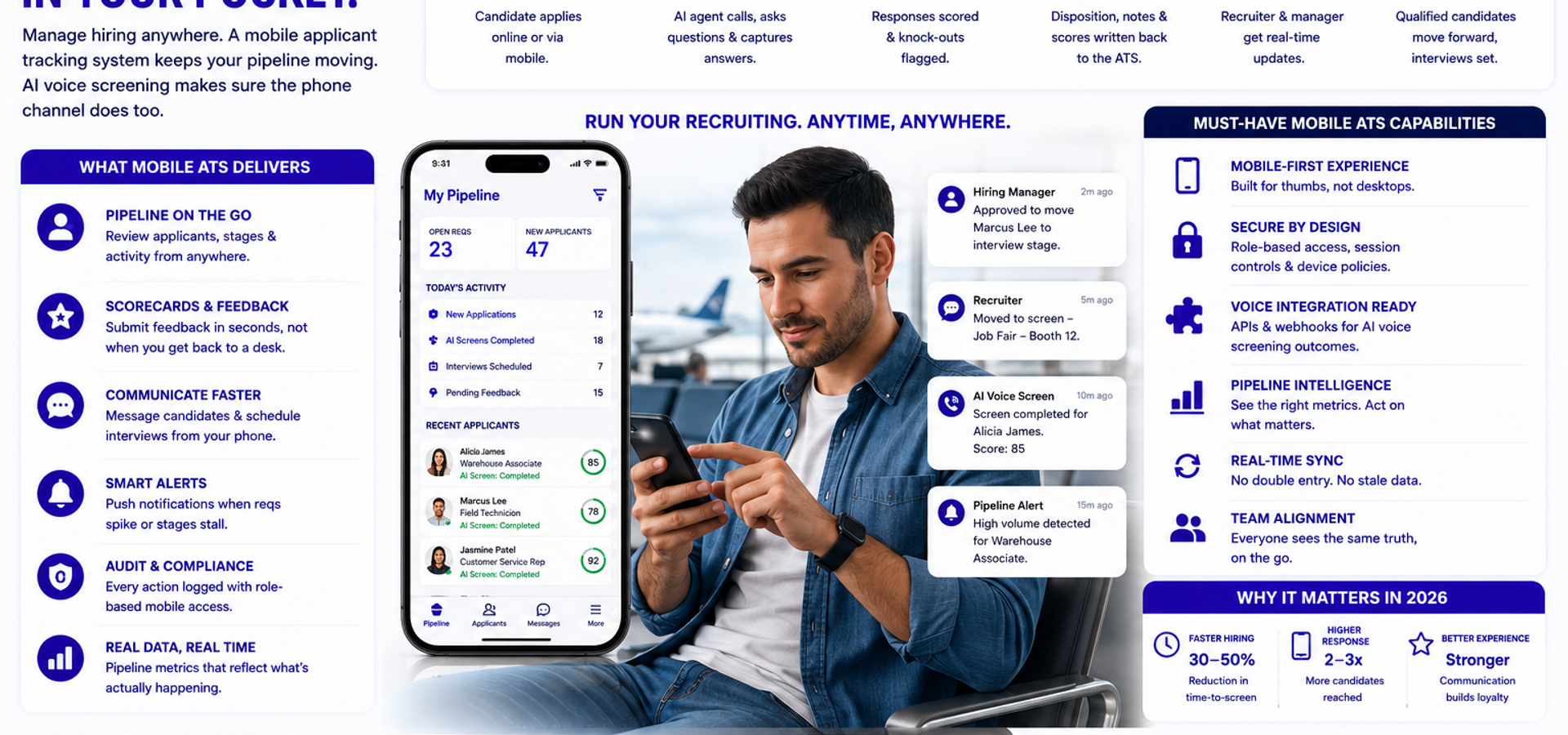
Your hiring manager approves a candidate from an airport lounge. Your recruiter texts “moved to screen” from a job fair floor. Meanwhile, forty applicants still wait for a callback because the only person who runs phone screens is driving between sites. A mobile applicant tracking system fixes half that problem, it puts pipeline control in your pocket. It does not, by itself, clear the phone queue.
This 2026 guide explains what a mobile applicant tracking system should deliver, why AI voice screening integration belongs beside mobile ATS (not years later), how to evaluate vendors, and how to pilot without replatforming your stack.
What is a mobile applicant tracking system?
A mobile applicant tracking system is ATS functionality built for phones and tablets, native apps or responsive web, so recruiting work continues away from a desk. Core mobile workflows include:
- reviewing new applicants and resumes
- submitting scorecards and interview feedback
- advancing or rejecting stages with audit trails
- messaging candidates and scheduling interviews
- push alerts when reqs spike or managers stall
Cloud context: cloud-based recruitment software: benefits & tools. Broader HR stack: HR software solutions: features, types & tools.
Who needs mobile ATS most in 2026
Mobile-first hiring is not a perk for every team, it is operational reality when:
- Hiring managers are rarely at desks: retail, hospitality, healthcare, field services
- Recruiters cover events and job fairs: high-volume intake in short windows
- Decisions must happen same day: seasonal ramps, logistics surges, open interview days
- Approvals bottleneck on email: managers ignore desktop notifications
Event-heavy patterns overlap with open interviews near me today workflows, walk-in volume plus mobile coordination, minus structured phone follow-through.
Mobile ATS vs mobile apply (do not confuse them)
Mobile apply is candidate-facing: frictionless applications from a phone, mobile-optimized careers pages, quick knock-out questions.
Mobile applicant tracking system is recruiter- and manager-facing: pipeline actions on the go.
You need both for field-heavy hiring. Mobile apply fills the top; mobile ATS moves stages; neither replaces a structured phone screen when the role demands voice contact.
Why mobile ATS needs AI voice screening integration
Mobile ATS makes it easy to tap “screen complete.” It does not magically run the screen while recruiters are in transit. Typical leaks:
- applicants apply from phones at night; callbacks happen business hours
- recruiters update stages manually after voicemail marathons
- screen notes never reach ATS fields, pipeline lies on mobile dashboards
- hiring managers see green stages that mean “we meant to call”
AI voice screening integration connects phone execution to your mobile applicant tracking system: voice agents run approved scripts, capture structured answers, schedule next steps, and write disposition back, so mobile pipeline views reflect reality.
LinkedIn’s talent research shows teams investing in hiring technology to improve speed and experience, mobile ATS improves manager velocity; voice integration improves candidate velocity on the phone channel. Source: LinkedIn: Future of Recruiting 2025. Screening depth: AI applicant screening: how it works and best automated screening software.
What to evaluate in a mobile applicant tracking system (2026 checklist)
Recruiter mobile UX
- Can you review, disposition, and message without pinch-zoom hell?
- Resume rendering readable on phone, not PDF attachment roulette?
- Offline or low-signal behavior documented honestly?
Hiring manager adoption
- One-tap scorecards and feedback nudges?
- Push notifications that managers actually enable?
- Clear separation between “view” and “approve” permissions?
Security and compliance
- Role-based access on mobile; session timeout; device policies?
- Structured selection practices when screens automate, SHRM toolkit: SHRM: Assessing and selecting job candidates
Integration readiness for voice screening
- APIs, webhooks, or native partners for voice outcomes?
- Custom fields for screen scores and call recordings metadata?
- Guide: integrate recruiting software with existing systems
Analytics that work on mobile
- Time-to-first-screen and show rate, not only vanity applicant counts
- Recruitment analytics software tied to the same ATS spine
ATS comparisons: ATS for staffing agencies compared and Gem ATS review for sourcing-heavy models.
How AI voice screening integration works with mobile ATS
A practical integration flow in 2026:
- Trigger: new applicant passes knock-out; ATS rule fires voice screen
- Execute: AI voice agent calls or answers on your number with approved script
- Capture: structured answers, availability, knockout failures
- Write-back: disposition, notes, scores, interview schedule hit ATS fields
- Notify: recruiter and manager see updated stage in mobile app
Voice layer context: conversational services: what they are & use cases, AI agents for recruitment compared, and how AI agents are transforming recruiting.
Common mistakes with mobile ATS + voice screening
- Buying mobile ATS for managers while recruiters still screen only from desk phones
- Voice tools that do not write back, mobile pipeline stays fiction
- Automating screens before legal review of questions
- Treating mobile apply success as funnel success while phone SLA kills conversion
- No metrics: time-to-first-screen, callback rate, mobile manager response time
Speed outcomes: hire candidates faster with AI tools. CRM angle for nurture: candidate relationship management system. ML context: machine learning in recruiting.
Four-week pilot: mobile ATS + AI voice screening
Week 1: Baseline. Measure time-to-first-screen, manager mobile feedback latency, and interview show rate on one high-volume req.
Week 2: Configure. Enable manager mobile scorecards. Map ATS fields for voice screen outcomes. Lock script with HR.
Week 3: Run. Route applicants through voice screen after knock-out. Recruiters handle escalations from mobile notifications.
Week 4: Decide. Compare mobile stage accuracy and time-to-interview. Keep workflows used in the field; kill desk-only habits.
Agentic hiring patterns: agentic hiring organization. AI foundation: artificial intelligence in recruitment.
Where Dialflo fits
Dialflo is not a mobile applicant tracking system. It is the AI voice screening integration layer, phone-native screens, confirmations, and scheduling with structured ATS write-back, so your mobile pipeline shows screened candidates, not voicemail intent. When recruiters live on their phones but screens wait for desk time, voice execution is the missing integration.
FAQ: mobile applicant tracking system 2026
What is a mobile applicant tracking system?
ATS workflows optimized for phones, recruiter and hiring manager pipeline actions away from desktop.
Do I need a mobile ATS if I already have cloud ATS?
If managers and recruiters work in the field, yes, desktop-only ATS slows feedback and stage updates.
How does AI voice screening integrate?
Voice agents complete screens and push outcomes to ATS fields recruiters see on mobile.
Is mobile ATS enough to fix slow hiring?
It helps manager velocity. Phone screen bottlenecks still need voice automation or more recruiter capacity.
What metrics prove ROI?
Time-to-first-screen, mobile manager response time, interview show rate, and stage accuracy vs voicemail backlog.
How does Dialflo help?
AI voice agents with ATS write-back for phone-heavy hiring, visit dialflo.ai.
Closing: mobile pipeline truth needs mobile-speed screens
A mobile applicant tracking system in 2026 lets hiring move at the speed of managers in the field. Without AI voice screening integration, mobile dashboards still lie, stages advance on hope while applicants wait for callbacks. Buy mobile ATS for pocket velocity; integrate voice for phone velocity; measure both.
Ready to connect voice screening to your mobile ATS stack? Explore Dialflo for structured phone screens that write back to the mobile applicant tracking system recruiters already carry.


