Conversational AI in HR: Use Cases & Tools

Dialflo: AI Voice Agent
June 17, 2026
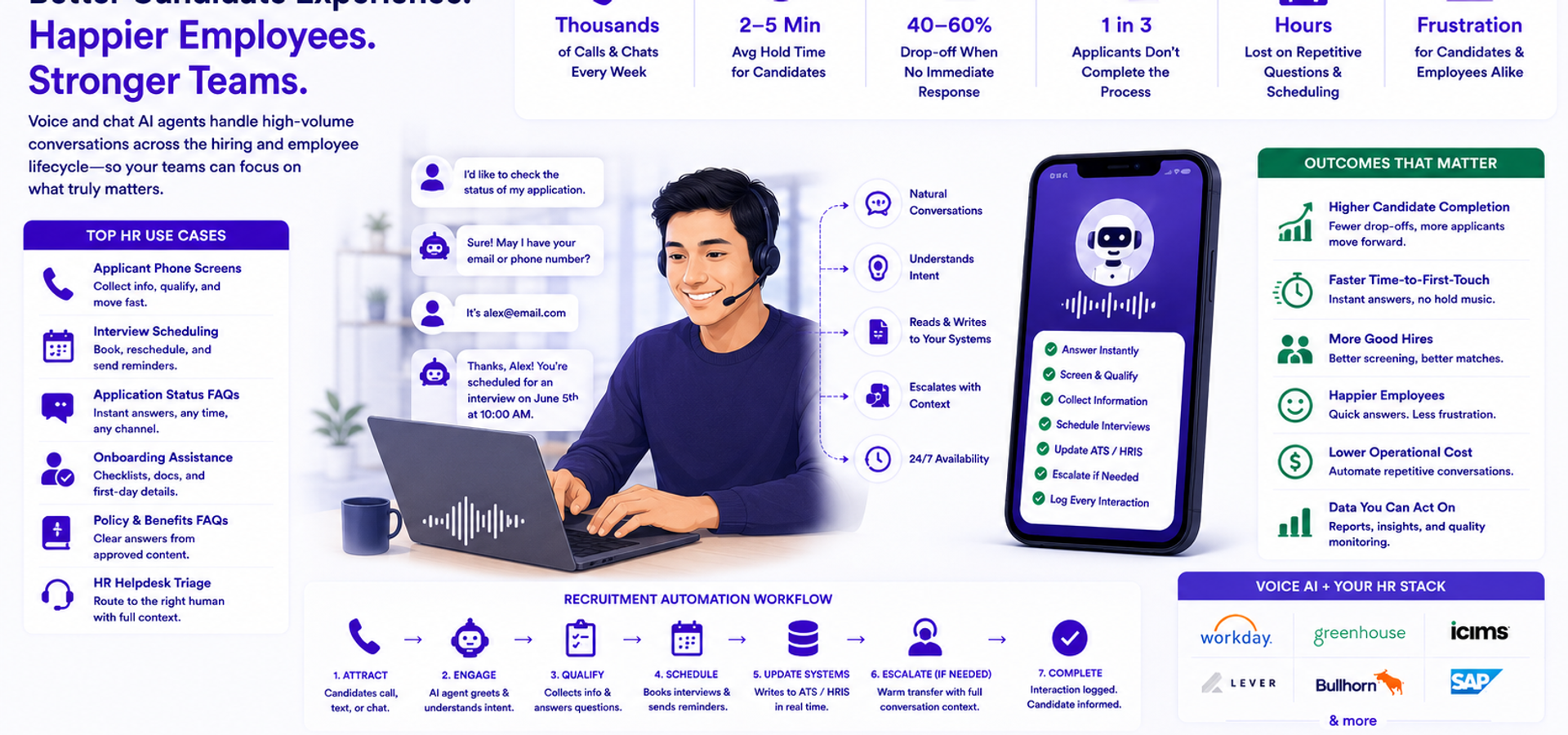
HR teams field two audiences with the same inbox: candidates who need a screen tonight and employees who need a straight answer about PTO policy. Hold music helps neither. Conversational AI in HR is how organizations handle those conversations at scale, voice or chat agents that understand natural language, follow approved scripts, escalate when needed, and write outcomes to ATS, HRIS, or ticketing tools.
This guide maps the highest-value use cases, the tools categories that power them, and practical guardrails so automation speeds hiring and employee service without creating compliance risk.
What conversational AI in HR means
Conversational AI in HR goes beyond static FAQ pages. Agents conduct multi-turn dialogues, by phone or chat, to:
- collect structured answers (screening questions, availability, document status)
- read approved policy snippets from a knowledge base
- route complex issues to the right human with context
- log every interaction for audit and analytics
Foundation: conversational services: what they are and use cases and artificial intelligence in recruitment.
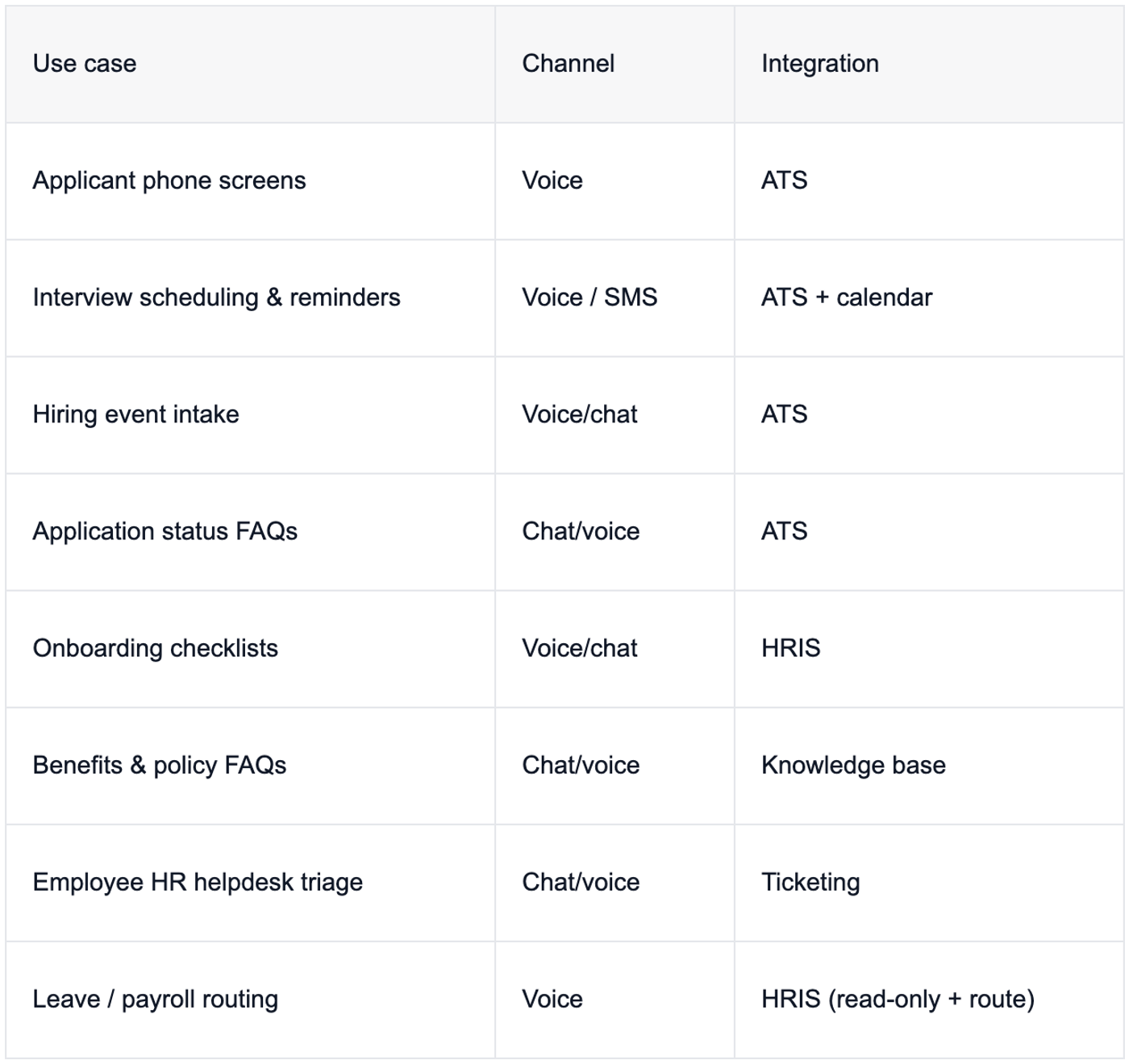
Top use cases for conversational AI in HR
Recruiting and talent acquisition
The fastest ROI is usually candidate-facing voice: structured phone screens, confirm interest, capture shift availability, reschedule interviews. High-volume context: open interviews and walk-in hiring. Automation depth: recruitment process automation, hire candidates faster with AI tools.
Screening and knock-out
Chat or voice collects license, shift, location, and eligibility answers before recruiters invest live time. AI applicant screening, automated screening for staffing agencies.
Employee self-service
Agents answer approved policy questions and open tickets for edge cases, never invent benefits details. Broader HR stack: HR software solutions.
Onboarding and day-one coordination
Reminder calls for I-9 uploads, orientation slots, and equipment pickup reduce no-shows on start dates. Pair with HRIS workflows from your onboarding module.
Tools that power conversational AI in HR
1) Voice AI platforms
Phone-native agents for screens, confirmations, callbacks, best when candidates prefer voice over forms. Agent landscape: AI agents for recruitment comparison, how AI agents are transforming recruiting.
2) ATS and recruiting chatbots
Careers-site chat, apply assistance, knock-out questions. ATS for staffing agencies compared, cloud-based recruitment software.
3) Scheduling automation
Calendar links, interviewer pooling, reminder sequences, often bundled with ATS or voice layers.
4) HRIS and helpdesk integrations
Employee bots read ticket status or policy articles; escalate PII-sensitive requests. Integration planning: integrate recruiting software with existing systems.
5) Analytics and quality monitoring
Containment rate, escalation reasons, mishear samples, funnel conversion. Recruitment analytics software, talent acquisition technology trends (2026).
6) Build vs buy voice stack
Engineering teams sometimes assemble telephony, ASR, and LLM layers; most HR orgs buy execution platforms. Build vs buy voice AI stack.
Voice vs chat: when each fits HR
Voice wins for hourly hiring, driver and field roles, older applicant pools, and anyone applying from a phone without completing long forms.
Chat wins for careers-site questions, employee policy lookup on desktop, and async ticket creation.
Many teams run both, chat for apply, voice for screen, synced to the same ATS fields.
Implementation best practices
- Start with one workflow: phone screen or scheduling, not entire HR.
- Script from approved policy: no improvising benefits or pay answers.
- Define escalation: human queue, hours, and context passed on transfer.
- Require system write-back: ATS/HRIS fields, not free-text-only logs.
- Pilot 2–4 weeks: measure containment, escalation quality, candidate NPS.
- Govern AI: document scored criteria; human override on employment decisions.
Process context: recruitment management: process, tools & best practices. Org model: agentic hiring organization.
What not to automate with conversational AI in HR
- final hire / no-hire decisions without human review
- performance management or termination conversations
- medical or accommodation details without specialist handoff
- compensation negotiation beyond scripted ranges
- answers outside published policy, agents should escalate, not guess
Metrics for HR conversational AI
- containment rate (resolved without human)
- time-to-first-touch for applicants
- screen completion within SLA
- escalation rate and reason codes
- candidate or employee satisfaction on pilot cohort
- recruiter hours saved per req
Where Dialflo fits
Dialflo delivers conversational AI in HR on the voice layer, AI agents for applicant phone screens, confirmations, reschedules, and high-volume intake with structured write-back to ATS or HR workflows. It complements your ATS and HRIS; it does not replace them.
If your HR bottleneck is missed applicant calls and repetitive phone screens, evaluate voice execution on dialflo.ai while keeping final hiring decisions with your team.
FAQ: Conversational AI in HR
What is conversational AI in HR?
Voice or chat agents that handle HR conversations with natural language, escalation, and system logging.
What is the best first use case?
Applicant phone screens or interview scheduling for high-volume roles.
Chatbot vs voice AI?
Chat for web FAQs; voice for phone-first candidates and field hiring.
Is it compliant?
Depends on design, document scripts, consent for recording, human review on employment decisions.
Does it integrate with our ATS?
Strong HR conversational AI should write structured fields to ATS or HRIS, verify before pilot.
How does Dialflo help?
Voice AI for recruiting and HR phone workflows, see dialflo.ai.
Closing: HR conversations at scale still need human judgment
Conversational AI in HR works when it handles repeatable dialogue, screens, schedules, FAQs, reminders, and hands off everything that affects fairness, pay, or employment status to people with context.
Pick one use case. Wire write-back. Measure containment. Ready to add voice to your HR stack? Explore Dialflo for conversational AI built for recruiting phone operations.


