Recruitment Process Automation: Tools & Benefits

Dialflo: AI Voice Agent
June 17, 2026
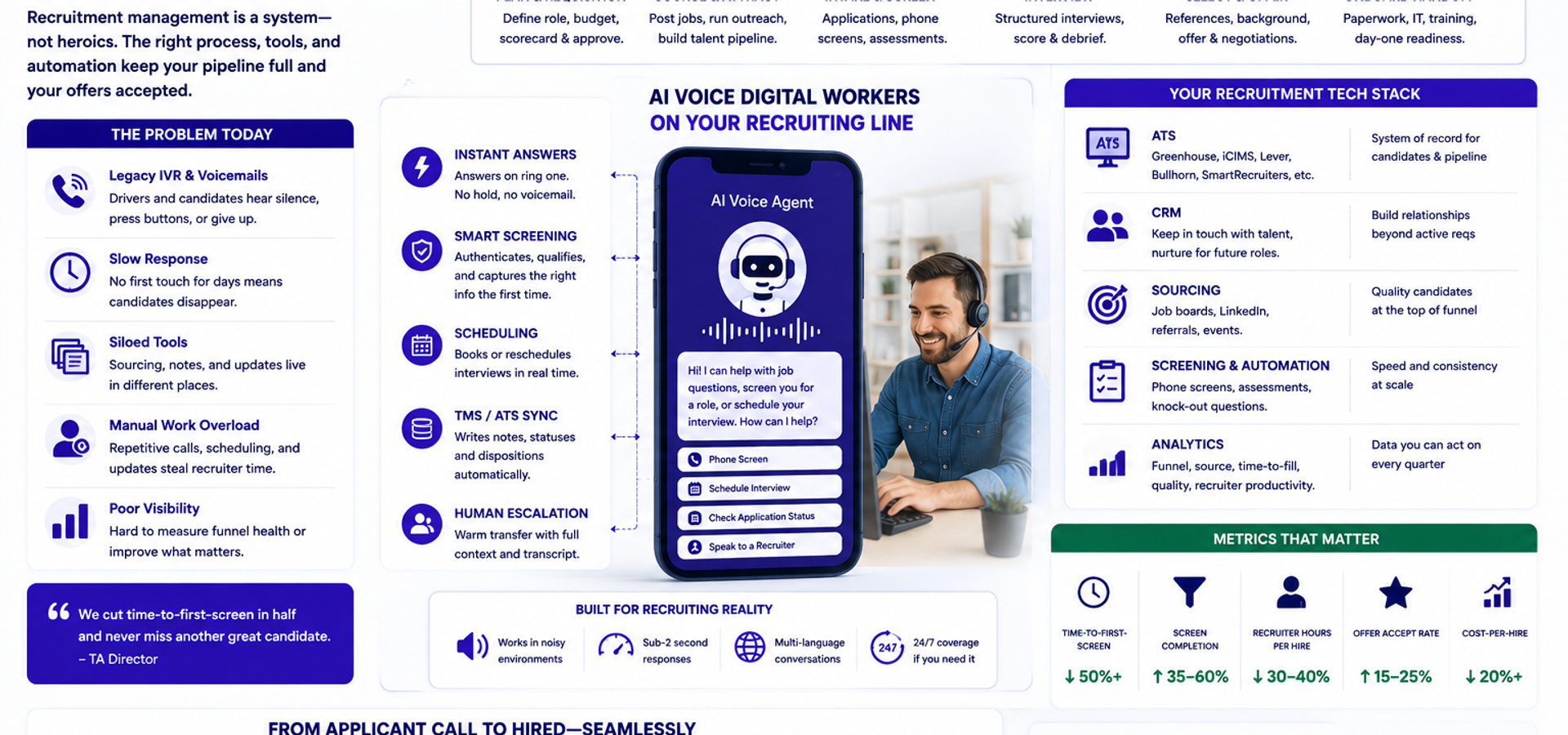
Forty new applicants overnight. Twelve need a phone screen before Friday. Scheduling emails bounce between three time zones. Half the qualified pool ghosts because nobody called back Tuesday. Recruitment process automation is how teams stop losing hires to coordination debt, software and AI running the repetitive steps so recruiters run the conversations that close candidates.
This guide explains the benefits of automating hiring workflows, which tools fit each funnel stage, what to automate (and what not to), and how to pilot without breaking compliance or candidate trust.
What recruitment process automation means
Recruitment process automation connects your hiring steps, apply, screen, schedule, interview, offer, so data moves once and actions fire on rules, not memory. It is not “remove humans.” It is remove:
- manual ATS stage updates after every email
- spreadsheet side lists for phone screens
- missed applicant calls during lunch rush
- identical scheduling ping-pong
- forgotten reminder texts before interviews
Process context: recruitment management: process, tools & best practices. AI overview: artificial intelligence in recruitment.
Benefits of recruitment process automation
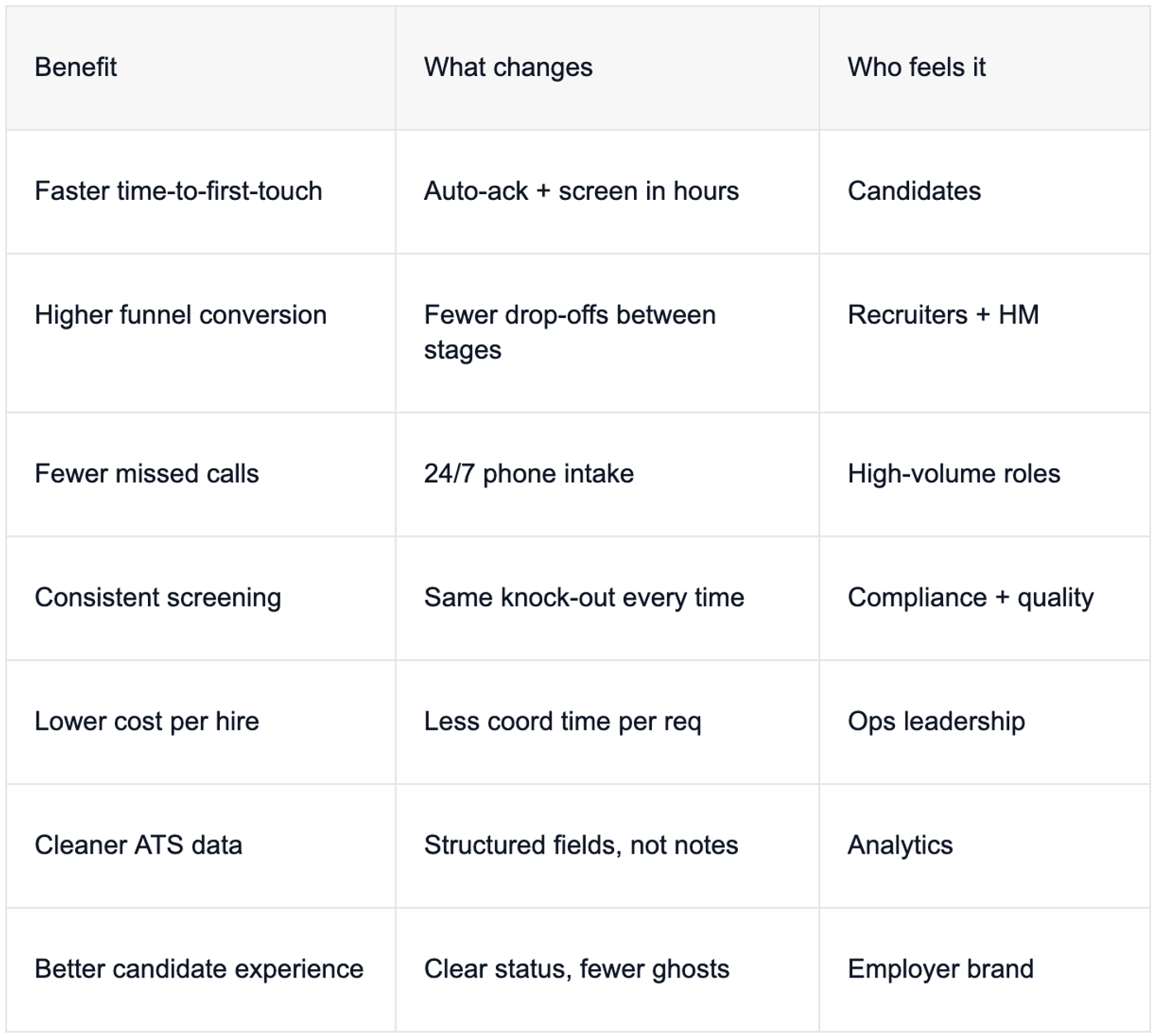
Speed playbook: hire candidates faster with AI tools. Agency lens: best automated screening software for staffing agencies.
Recruitment automation tools by funnel stage
1) Apply and intake
ATS workflows route applicants by location or role; chatbots collect knock-out answers; auto-replies set expectations. Stack: ATS for staffing agencies compared, cloud-based recruitment software.
2) Sourcing and nurture
CRM sequences redeploy silver medalists; AI sourcing surfaces lookalike profiles. Reads: AI sourcing, candidate relationship management system, candidate sourcing services.
3) Screening
Rules-based knock-outs, skills assessments, and AI resume or application scoring, with human review on edge cases. Depth: AI applicant screening: how it works.
4) Phone screens and confirmations
High-volume roles break here first. AI voice agents run structured phone screens, confirm interest, capture availability, and write outcomes to ATS, so recruiters stop playing tag. Agent comparison: AI agents for recruitment comparison and how AI agents are transforming recruiting.
5) Interview scheduling
Calendar integrations, self-serve booking links, automated reminders, fewer no-shows. High-volume events: open interviews and walk-in hiring events (candidate-side view of same-day volume).
6) Interview prep and intelligence
Question generation from job descriptions, scorecard templates, post-interview summarization. Tools: generate interview questions from job description using AI, interview intelligence and candidate performance.
7) Analytics and optimization
Funnel dashboards expose which stage leaks candidates. Guide: recruitment analytics software, machine learning in recruiting.
8) Integration layer
Automation fails when tools do not write back. Plan APIs and field maps early: integrate recruiting software with existing systems, HR software solutions.
What to automate vs keep human
Automate: acknowledgments, knock-out screening, scheduling, reminders, first-pass phone screens, pipeline nudges, CRM nurture sequences.
Keep human: final interviews, compensation negotiation, sensitive rejections, executive search counsel, adverse impact review on AI scores, offer exceptions.
Org design: building an agentic hiring organization. Staffing automation: AI staffing.
How to implement recruitment process automation (without chaos)
- Map the funnel: measure drop-off by stage for one high-volume req.
- Pick one bottleneck: usually screen or schedule, not “automate everything.”
- Define ATS fields: what automation must write back.
- Pilot 2–4 weeks: one role family; compare time-to-first-touch and conversion.
- Audit fairness: document AI rules; allow human override.
- Scale workflows: clone to similar reqs; train recruiters on exceptions.
ATS evaluation: Gem ATS review. Compare platforms: AI agents for recruitment.
Metrics that prove automation ROI
- time-to-first-touch (apply → first human or automated screen)
- screen completion rate within 48–72 hours
- interview show rate
- offer accept rate
- cost per hire and recruiter hours per req
- missed-call rate on applicant lines
- funnel conversion by source and stage
Without baselines, automation looks like software spend, not capacity gained.
Common automation mistakes
- automating final hire decisions with opaque AI scores
- no ATS write-back, recruiters re-type everything anyway
- generic chatbots that cannot escalate to a human
- ignoring mobile-first candidates who prefer phone over forms
- buying five point tools with zero integration plan
- skipping compliance review on recording and consent for voice automation
Where Dialflo fits
Dialflo automates the phone layer of recruitment process automation, AI voice agents for structured screens, confirmations, reschedules, and applicant callbacks with outcomes synced to your ATS or CRM. It is execution for call-heavy workflows, not a replacement ATS.
Pair Dialflo when your bottleneck is applicants waiting on a phone screen, not when you need requisition approval software. Explore dialflo.ai for recruiting voice capabilities and integration scope.
FAQ: Recruitment process automation
What is recruitment process automation?
Software and AI running repetitive hiring steps with rules and ATS write-back.
What are the top benefits?
Speed, conversion, consistency, lower coord cost, and better candidate experience.
What should we automate first?
High-volume screening, scheduling, and phone intake, measure one req family first.
Will automation hurt candidate experience?
Not when it reduces ghosting and adds fast status, bad bots without escalation hurt more than no automation.
Do we need a new ATS?
Often no, add automation and voice layers that integrate with the ATS you have.
How does Dialflo help?
Voice AI for phone screens and recruiting calls, see dialflo.ai.
Closing: automate coordination, protect judgment
Recruitment process automation pays off when recruiters stop re-typing the same screen notes and start running the interviews that decide hires. Pick one funnel leak, wire the tools, measure conversion, then expand.
Ready to automate phone screens without losing ATS discipline? Contact Dialflo for AI voice agents built for high-volume recruiting.


