The Hidden Cost of Manual Accounts Receivable Follow-Ups in Logistics

Dialflo: AI Voice Agent
June 9, 2026
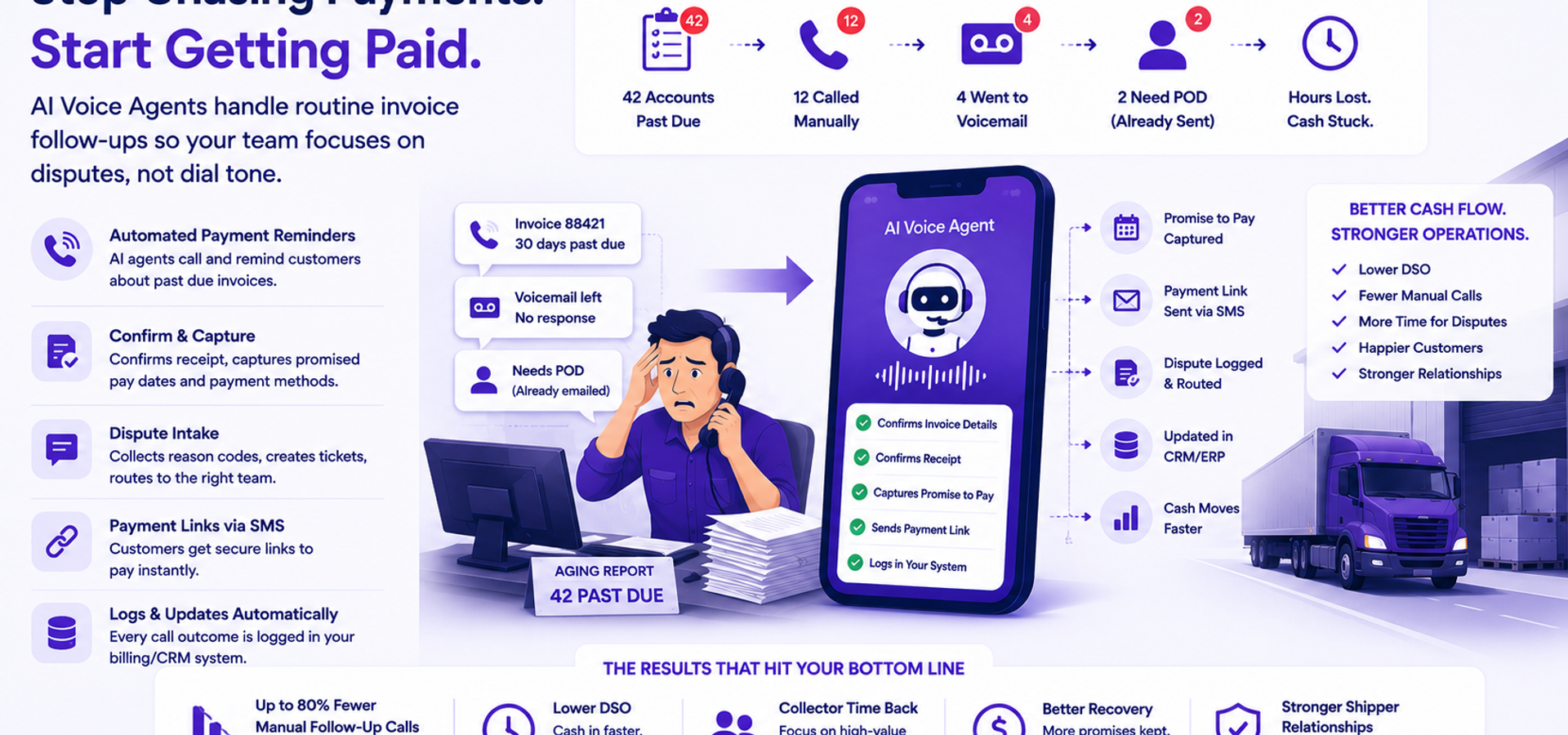
Your aging report says forty-two accounts past due. Your collector has called twelve. Four went to voicemail. Two reached AP and asked for a POD you already emailed. Meanwhile, a dispatcher just spent twenty minutes on a billing call because "nobody in finance picks up." Manual payment follow-ups consume operations and finance resources, and the true bill almost never appears as a single line item.
This article unpacks the hidden cost of manual logistics accounts receivable follow-ups: how the freight collections process bleeds into transportation ops, why invoice reminders by phone do not scale, what delayed transportation payments do to logistics cash flow, and how voice AI handles routine collections outreach at scale without replacing collector judgment.
What manual AR follow-up really costs (beyond collector salary)
Finance leaders budget collector headcount. They undercount the spillover:
- Ops distraction: Dispatch answers billing when AR is busy, see overlap with where is my shipment calls.
- Repeat contact loops: Same invoice called three times because notes live in voicemail.
- Dispute rework: Accessorial proof chased twice, billing and ops both involved.
- Credit exposure: Overdue accounts keep shipping until someone escalates.
- Shipper friction: Aggressive manual dials damage relationships; silence damages cash.
- DSO drag: Cash sits in customer AP while you pay carriers and fuel on your clock.
That is the hidden tax on logistics accounts receivable. The Federal Reserve publishes commercial finance data useful for benchmarking payment cycles, Federal Reserve finance releases. When transportation payments lag, working capital stress compounds.
Where manual follow-ups break the freight collections process
A healthy freight collections process moves accounts through clear stages:
- Clean freight billing at invoice issue (POD, accessorial backup, correct PO).
- Digital delivery: portal, EDI, email with payment link.
- Pre-due reminder: automated, not panic at day 31.
- Past-due outreach: structured, logged, escalated by balance and risk.
- Dispute resolution: human owns proof and negotiation.
- Cash application: match payment to invoice without archaeology.
Manual shops collapse steps 3–4 into "collector calls when they can." Invoice reminders become random. Freight billing errors turn into phone volume. Month-end invoicing spikes collide with peak freight, peak season call volume hits billing lines too.
Hidden cost categories (comparison table)
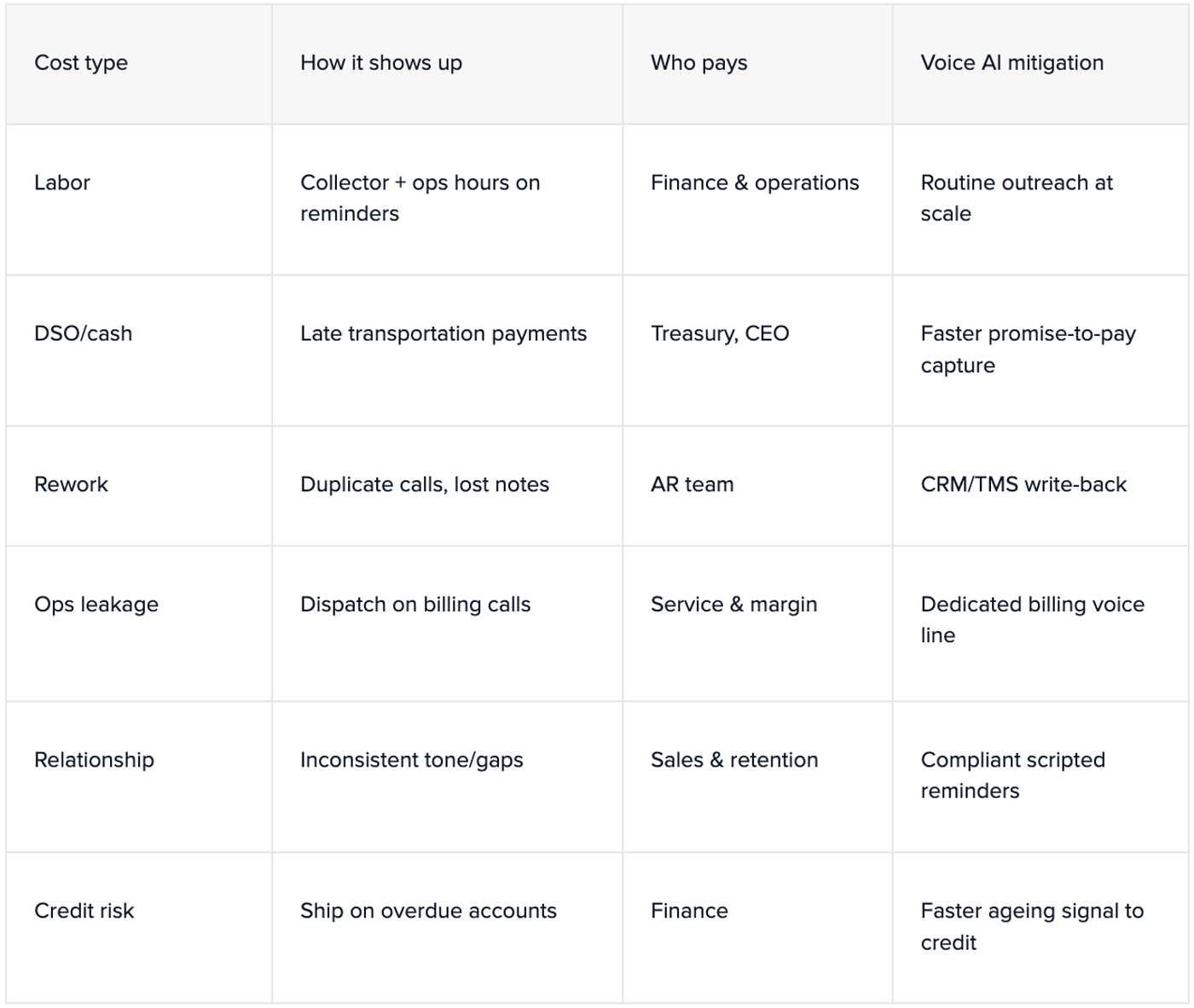
Freight billing quality: the cost you pay before the first reminder
Bad freight billing multiplies follow-up cost. Common triggers:
- missing or late POD blocking customer AP
- accessorial without backup documentation
- invoice format mismatch with shipper AP rules
- duplicate or split invoices on multi-stop loads
Fix billing first; then automate reminders. Otherwise voice AI repeats wrong amounts, a trust killer. Exception calls often precede billing disputes, reducing delivery exception calls lowers downstream AR noise.
Logistics cash flow: DSO is a operations problem
Logistics cash flow is fuel, carrier pay, insurance, and payroll on your timeline, not the shipper's AP batch. Every day of DSO is borrowing against your line. Manual invoice reminders do not shorten DSO if:
- only ten accounts get called daily from a list of two hundred
- promised pay dates are not logged centrally
- disputes sit unassigned because collectors are on voicemail duty
The U.S. Bureau of Transportation Statistics publishes freight economic indicators, BTS statistical data, useful when correlating volume spikes with billing workload.
When operations becomes collections (the invisible overlap)
Small and mid-market logistics companies rarely have a dedicated billing call center. The published number rings dispatch. Coordinators answer "about invoice 4421" because the customer is loud and the load is live. That hour is not free, it is stolen from routing, detention fights, and driver support.
After-hours billing calls hit voicemail, morning replay looks like the hidden cost of missed calls in logistics. Separating billing voice from dispatch voice is step one; automating tier-one billing is step two.
Voice AI handles routine collections outreach at scale
Voice AI logistics for AR is not robodial harassment. It is structured outreach:
- outbound invoice reminders on aging buckets with compliant disclosure
- inbound "calling about invoice" handled with account lookup
- promised pay date and payment method captured in CRM
- SMS portal or ACH link after the call
- dispute reason codes routed to collectors with transcript
- warm transfer when balance or risk thresholds trip
Teams targeting high containment on tier-one AR calls report large reductions in manual dial time, see playbook in reducing freight invoice follow-up calls by 80%. Patterns: conversational services use cases, AI in logistics use cases.
Tiered freight collections process (manual vs automated)
Tier 0: prevent: Clean freight billing, digital invoice, pre-due email.
Tier 1: voice AI: Reminders, receipt confirm, promise-to-pay, dispute intake.
Tier 2: collectors: Accessorial negotiation, payment plans, proof battles.
Tier 3: leadership: Strategic accounts, legal, bankruptcy.
Manual follow-ups mix all tiers into one tired dial list. Automation clears tier one so logistics accounts receivable talent works where margin is won or lost.
Compliance and shipper trust on collections calls
B2B collections still need discipline:
- identify caller and recording rules per jurisdiction
- state amount and invoice reference factually, no threats
- honor do-not-call and contact preferences
- escalate legal or bankruptcy mentions immediately
The CFPB maintains consumer debt collection education, useful tone baseline even for commercial teams: CFPB debt collection resources. Inbound billing lines benefit from conversational voice vs phone trees, replacing phone trees with conversational voice AI.
Integration: stop re-asking what AI already captured
Hidden rework cost dies when dispositions write back:
- invoice aging and balance from ERP/TMS billing
- promised pay date fields driving work queues
- dispute tickets with reason codes
- payment link SMS tied to invoice ID
Build vs buy: build vs buy voice AI stack. Broader stack: technology used in supply chain management, the logistics decision gap.
Metrics finance and ops should share
- DSO and aging bucket dollars
- collector + ops hours on AR calls
- accounts touched per week vs manual baseline
- promise-to-pay kept rate
- dispute time-to-first-response
- cash collected per labor hour
- repeat billing calls to dispatch (should fall)
Where Dialflo fits
Dialflo handles routine logistics accounts receivable outreach at scale, invoice reminders, follow-up calls, promise-to-pay capture, and dispute routing, with natural language and write-back to your billing and CRM stack. It is voice execution, not your ERP. Use it when manual follow-ups consume finance and operations resources and you need transportation payments moving without doubling collector headcount.
Pilot one aging bucket, quantify hidden labor cost, then expand. Confirm integrations on dialflo.ai. Dispatcher relief pairs with AR automation, reducing dispatcher call load when billing stops ringing the ops desk.
FAQ: logistics accounts receivable follow-ups
What are hidden costs of manual AR follow-ups?
Ops distraction, DSO drag, rework, credit exposure, and relationship damage, not just collector salary.
Does voice AI replace collectors?
No, it automates tier-one outreach; humans own disputes and negotiation.
What automates first?
Invoice reminders, receipt confirmation, promise-to-pay, dispute intake.
How does bad freight billing hurt AR?
It creates dispute calls that no reminder volume can fix, clean billing first.
How measure success?
DSO, labor hours, bucket movement, cash per hour, not dial count alone.
How does Dialflo help?
AI collections outreach with write-back, see dialflo.ai.
Closing: the hidden cost has a name, manual tier one
Manual logistics accounts receivable follow-ups tax logistics cash flow, pull operations into billing, and bury labor in overhead. The fix is not more voicemails, it is a freight collections process that automates routine invoice reminders and keeps people on disputes that matter. Voice AI handles that tier at scale; your team protects margin on the rest.
Ready to quantify what manual follow-ups actually cost? Explore Dialflo for collections outreach that writes back to your stack, so transportation payments land faster and freight billing stops owning the ops phone.