What Is IVR? Interactive Voice Response Explained

Dialflo: AI Voice Agent
July 1, 2026
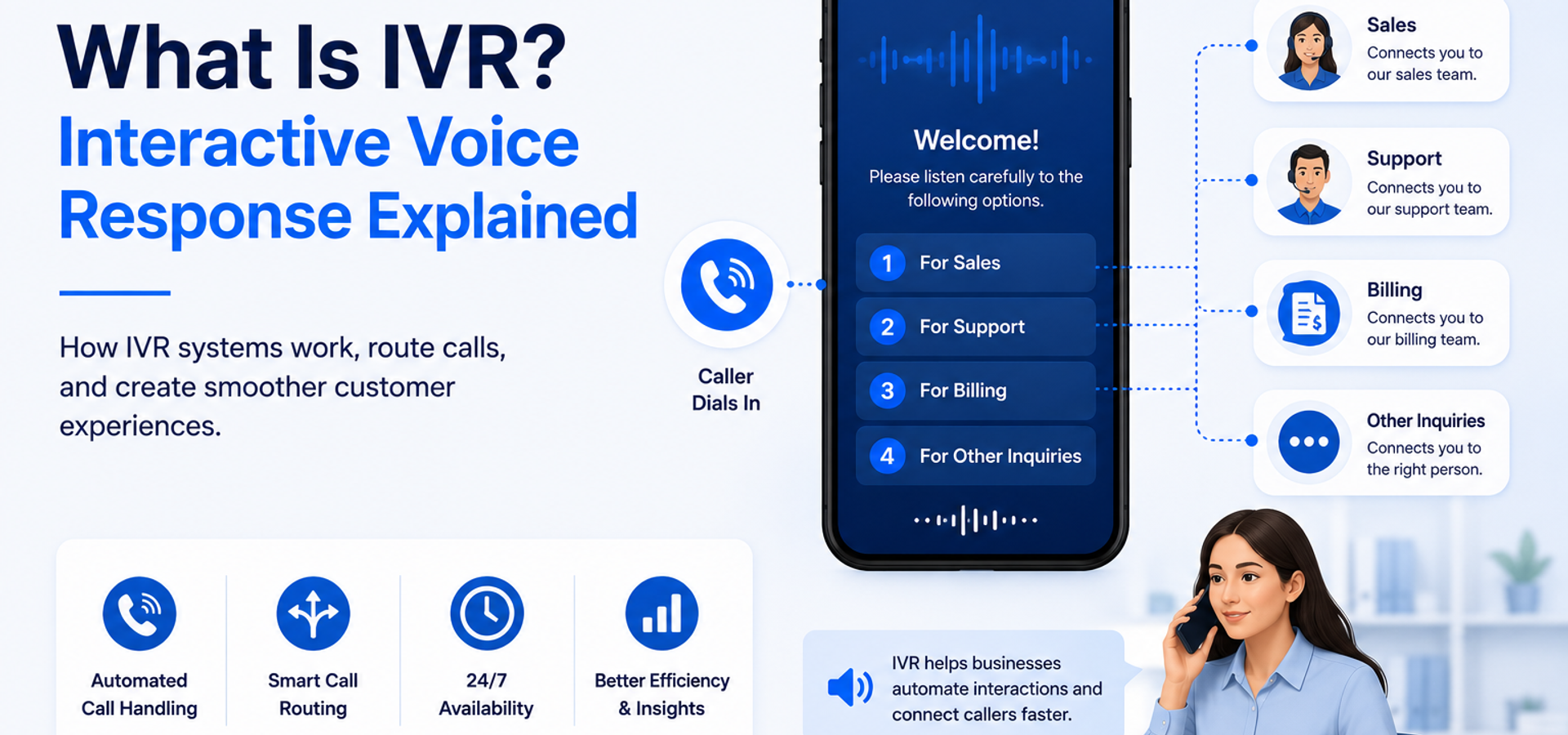
Short answer: IVR (Interactive Voice Response) is phone technology that greets callers, plays a phone menu, collects voice or keypad input, and performs call routing to the right queue or self-service workflow, before a human picks up. A modern IVR system may use touch-tone menus only, or AI IVR that understands natural speech and connects to your CRM, TMS, or calendar. Done right, IVR cuts hold time; done wrong, it is the reason people mash zero and hang up.
You call a business. A recorded voice says: “Press 1 for sales. Press 2 for support. Press 3 for billing.” You need dispatch, but billing is closest to your problem, so you press 2. Wrong queue. Five minutes later you explain everything again to an agent who transfers you. You have met IVR. You have also met why “phone menu” became a four-letter word.
Yet almost every serious business still runs an IVR system. Airlines, banks, hospitals, brokerages, warehouses, Interactive Voice Response is how they absorb volume, route skill-based queues, and offer self-service after hours. The technology is not the enemy. Bad design is.
This guide explains what IVR is, how call routing works, how AI IVR differs from “press 1 for sales,” and how to build a phone menu callers will actually tolerate, or skip entirely when voice agents can resolve the call first.
What is IVR (Interactive Voice Response)?
IVR, Interactive Voice Response, is automated telephony software that interacts with inbound or outbound callers through pre-recorded prompts and caller input. Input is usually:
- DTMF tones: keypad presses (“press 1”, “enter your account number followed by pound”)
- Speech: voice commands recognized by speech-to-text engines
- Hybrid: menu first, then speech for open-ended questions
Based on that input, the IVR system decides what happens next: play another prompt, look up data, queue the call, transfer to an agent, or end with a recorded message.
IBM defines IVR as technology that lets computer systems interact with humans through voice and DTMF, a backbone of contact center automation for decades. See: IBM: What is interactive voice response?
Broader conversational layer context: conversational services: what they are & use cases.
How an IVR system works (step by step)
Whether cloud or on-premise, most IVR systems follow the same pipeline:
- Call arrives: inbound DID, toll-free, or transferred trunk hits the telephony platform.
- Session starts: IVR application loads caller ID, business hours rules, and optional CRM screen-pop data.
- Prompt plays: greeting, disclosure (recording notice), language selection.
- Input collected: menu choice, account number, intent phrase.
- Logic executes: branching tree, API lookup, authentication check.
- Outcome: self-service answer, queue placement, callback offer, voicemail, or transfer.
- Logging: disposition codes, recordings, analytics for QA and tuning.
The invisible work is call routing: skills, priority, geographic rules, overflow to backup queues, and after-hours behavior. Routing quality determines whether IVR feels helpful or like a maze.
What is call routing in IVR?
Call routing is the decision engine inside an IVR system that sends each call to the right destination. Common routing dimensions:
- Intent-based: sales vs support vs billing from phone menu selection
- Skill-based: language, product line, VIP tier, technical certification
- Geographic: region, time zone, nearest service center
- Load-based: shortest queue, weighted round-robin, priority bump for SLA accounts
- Schedule-based: business hours vs after-hours IVR vs on-call mobile
- Data-driven: CRM lookup routes known shippers to dedicated logistics desk
Gartner’s contact center research emphasizes that routing and workforce tools must align with customer intent, or containment metrics look good while satisfaction collapses. See: Gartner: Customer service & support.
Call-center evolution context: AI call center: automation without losing the human touch.
Phone menu design: rules that actually work
A phone menu is the caller-facing layer of IVR. Good menus are short, parallel to how customers think, and honest about what happens next.
Keep depth shallow
Three levels is a warning sign. Two is better. One is ideal when you can route by a single intent question.
Put the most common intent first
Reorder options by volume, not org chart. If 60% call for shipment status, do not bury it behind “press 4.”
Always offer a human escape hatch
“Press 0 for an agent” should appear early, not after a four-minute tree. Repeat-callers will find zero anyway; make it fast.
Short prompts, plain language
Internal department names mean nothing to callers. “Driver check-in” beats “transportation operations group.”
Confirm critical input once
Read back reference numbers and appointment windows before queueing, wrong routing creates repeat calls.
Measure abandon rate by menu node
If everyone drops at prompt three, the menu is wrong, not your customers.
Front-desk overlap: what is a virtual receptionist?, many teams treat IVR as the first gate before live or AI reception.
Traditional IVR vs AI IVR
Traditional IVR is tree-based: fixed branches, DTMF-first, limited speech on narrow grammars (“say yes or no”). It is reliable, predictable, and cheap at scale, for stable intents.
AI IVR adds conversational AI: open-ended speech recognition, natural language understanding, dynamic follow-up questions, and API integrations that change dialog based on live data, not a script frozen in 2019.
Comparison in practice:
- Traditional: “Press 1 if your load is late.” Caller’s issue does not fit → wrong path.
- AI IVR: “How can I help with your shipment today?” → extracts PRO number → reads TMS status → offers reschedule intake.
AI IVR is not magic. It needs guardrails, retrieval for policy answers, and escalation when confidence drops. Twilio’s developer documentation on IVR notes that speech-enabled flows must handle barge-in, timeouts, and fallbacks, the same production realities voice teams learn the hard way. See: Twilio: Voice gather and input.
Voice stack decisions: build vs buy a voice AI stack in India and Vapi vs Bland vs Retell in India.
Common IVR use cases
Call routing and queue placement
The original job of Interactive Voice Response, get callers to the right human faster than a receptionist switchboard.
Self-service FAQs and hours
Location, hours, holiday closures, resolve without an agent when answers are static.
Account and reference lookup
Enter order, ticket, or load number; hear status; optionally receive SMS confirmation.
Appointment scheduling and reminders
Inbound booking and outbound confirmation calls, high volume, structured success criteria.
Payments and renewals
PCI-compliant payment IVR for utilities, insurance, subscriptions, regulated flows with audit trails.
After-hours coverage
When live staff clock out, IVR captures messages, offers callback, or routes emergencies.
Logistics and operations lines
Dock appointments, driver check-in, shipment status, phone-heavy, integration-backed. Traditional phone menu trees struggle in noisy yards; operations teams increasingly layer AI IVR or voice agents. See: AI in logistics: use cases, benefits & tools and 24/7 shipment support without expanding customer service teams.
Staffing and recruiting hotlines
Candidate intake, shift call-offs, interview confirmations, pair IVR or AI IVR with AI in staffing and automated screening for staffing agencies.
Why IVR fails (and how to fix it)
Most IVR hate is earned. Typical failure modes:
- Org-chart menus: options mirror internal departments, not customer problems
- Menu loops: “invalid selection” returns to the same prompt indefinitely
- Hidden agents: zero buried, or disabled during “high call volume”
- No CRM/TMS write-back: caller repeats story after transfer
- Speech IVR without noise handling: misroutes mobile callers in cars and yards
- Stale recordings: promotions from 2022, wrong hours after holiday changes
Fixes are operational, not cosmetic: shallow menus, intent research from call logs, warm transfer with data, quarterly prompt audits, and pilot AI IVR on one high-volume intent before replatforming everything.
Operations angle: the logistics decision gap in AI operations and technology used in supply chain management.
IVR vs AI voice agents: when to upgrade the layer
Not every business should rip out IVR tomorrow. Keep traditional phone menu routing when:
- intents are stable and few (under five top paths)
- callers expect utility-style navigation
- compliance demands rigid scripted flows
Upgrade toward AI IVR or full voice agents when:
- callers describe problems in natural language, not menu numbers
- integrations can answer from live systems (TMS, WMS, CRM, ATS)
- repeat-call rate is high because routing was wrong, not because issues are hard
- after-hours and peak overflow need conversational resolution, not voicemail
Platform path: Retell vs Dialflo, migrate from Retell without downtime, and best Retell alternative for India.
Metrics: how to measure IVR performance
Track more than “calls handled by IVR”:
- Containment rate: resolved in IVR without agent (by intent)
- Transfer rate: and which menu node triggers it
- Abandon rate: by prompt and time-in-IVR
- Repeat call rate: same caller, same issue, within 24 hours
- Average time in IVR: long times often mean confusion, not thoroughness
- First-call resolution: including self-service completions
- Customer effort: post-call surveys on IVR-only paths
Forrester’s customer service research ties low effort to loyalty, every extra menu level adds effort. See: Forrester: Customer service research.
Supply chain tie-in: AI supply chain technology trends and how AI makes supply chains more sustainable.
Implementation checklist for a new IVR system
- Map top ten call intents from logs, not assumptions from leadership.
- Design routing rules before recording prompts, logic first, audio second.
- Prototype the phone menu with real agents; they hear failure modes daily.
- Integrate one lookup: status, balance, appointment, so IVR resolves, not just redirects.
- Record concise prompts: professional voice or TTS with consistent brand tone.
- Test on mobile: cell networks, speakerphone, background noise.
- Launch on one line: pilot before moving the main customer number.
- Review analytics weekly for the first month, tune nodes with high abandon.
HR and recruiting stacks adjacent to phone lines: HR software solutions and how AI agents are transforming recruiting.
Compliance and accessibility considerations
IVR systems touch regulated territory:
- Call recording disclosure: many jurisdictions require notice at call start
- PCI: payment IVR must isolate card data from general recordings
- HIPAA and privacy: healthcare IVR needs minimum necessary disclosure
- Accessibility: DTMF alternatives for callers who cannot easily use speech or menus; clear human escalation
The FCC’s consumer guides on robocalls and telemarketing illustrate how federal rules shape automated phone interactions, relevant when IVR drives outbound as well as inbound. See: FCC: Stop unwanted robocalls and texts.
Where Dialflo fits beyond traditional IVR
Dialflo provides AI voice agents that function as next-generation AI IVR for phone-heavy teams, logistics desks, staffing agencies, and lean support operations tired of “press 1” loops that break in the real world. Dialflo answers in natural language, performs call routing with context, looks up operational data, completes workflows, and escalates to humans with transcripts, so your IVR system stops being a maze and starts being a front door that actually opens.
FAQ: IVR and Interactive Voice Response
What does IVR stand for?
Interactive Voice Response, automated phone interaction via voice and/or keypad.
Is a phone menu the same as IVR?
A phone menu is one part of IVR. Full IVR systems also include lookups, payments, callbacks, and complex call routing.
What is AI IVR?
AI IVR uses speech recognition and natural language understanding so callers speak normally instead of navigating rigid trees, often integrated with CRM or operations systems.
Can small businesses use IVR?
Yes. Cloud telephony platforms offer affordable IVR for main-line call routing, after-hours voicemail, and basic self-service without a call center floor.
Should I replace IVR with a chatbot?
Chat helps async text channels; phone callers need voice. Many teams run IVR or AI IVR on voice and chatbots on web, unified intent design where possible.
How long should a phone menu be?
As short as intent mapping allows, often under 30 seconds to first resolution or human.
How does Dialflo help?
Dialflo AI IVR and voice agents beyond static menus, see dialflo.ai.
Closing: IVR is architecture, not annoyance
IVR is how businesses scale the phone. Interactive Voice Response done well routes faster, resolves simple requests, and protects agent time. Done poorly, the phone menu becomes a wall. The upgrade path is clear: keep smart call routing, fix shallow design, and layer AI IVR where natural language and live integrations beat another round of “press pound to repeat.”
Ready to move beyond rigid phone trees? Explore Dialflo for voice agents that handle real IVR workloads, status, scheduling, check-in, and warm escalation, without trapping callers in menu hell.