AI Call Center Automation Without Losing the Human Touch

Dialflo: AI Voice Agent
July 1, 2026
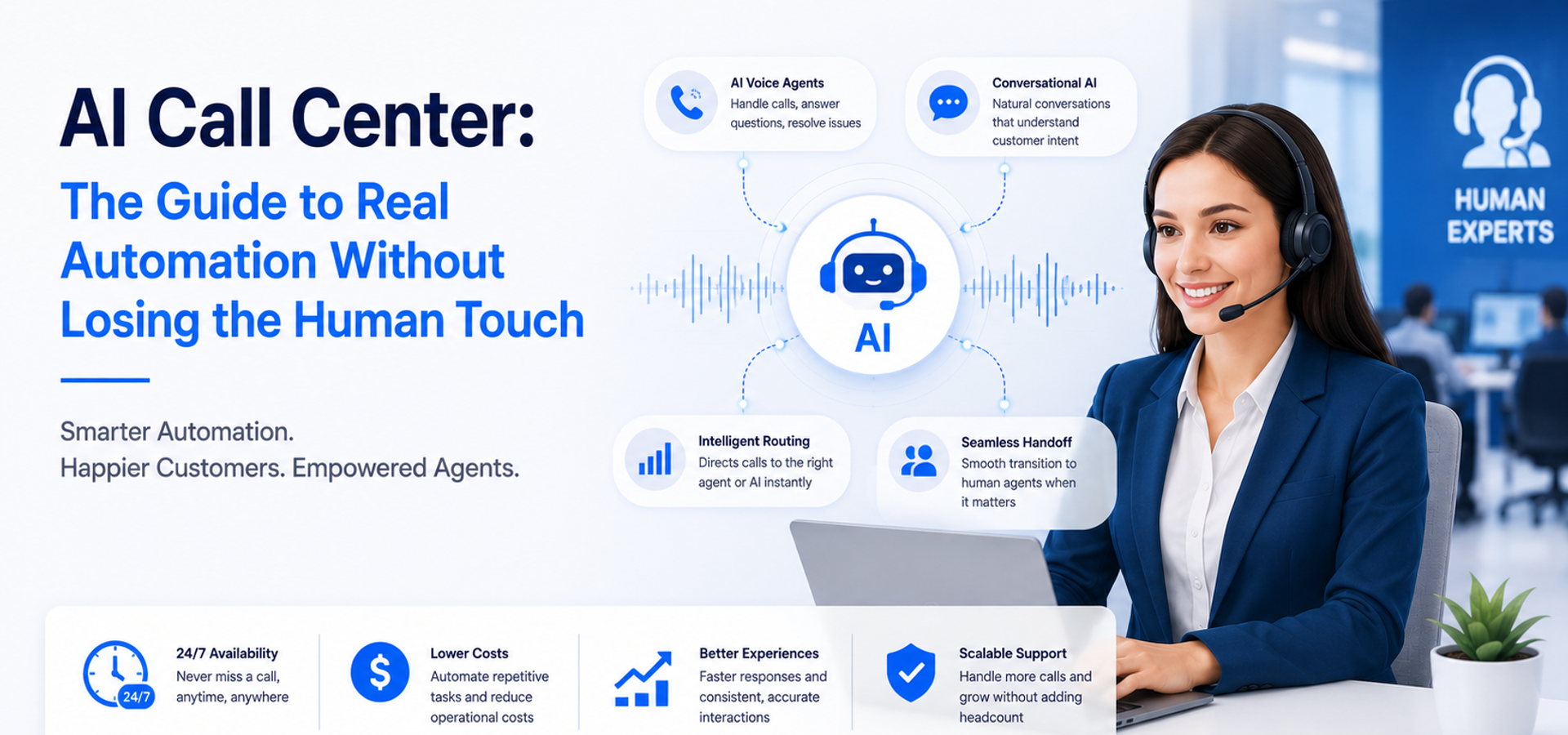
Short answer: An AI call center uses conversational AI and AI voice agents to automate repetitive phone work, routing, FAQs, status lookups, scheduling, reminders, while keeping humans on judgment-heavy calls. A mature AI call center solution (or broader AI contact center stack) does not replace empathy; it removes hold queues and copy-paste data entry so agents spend time on conversations that actually need a person.
Peak hour. Forty-seven callers on hold. Three agents copy reference numbers from scratch into the TMS while a driver repeats “I’m at the gate” for the sixth time. Your supervisor turns down the monitor volume, not because the team is failing, but because the queue is designed to fail.
That is the moment most leaders search for an AI call center. The pitch sounds perfect: automate everything. The fear sounds louder: customers hate bots, agents hate bad handoffs, and your brand cannot sound like a gas-station phone tree.
Both can be true. This guide shows how call center automation actually works in production, what to automate, what to keep human, and how to build an AI contact center layer that makes your team more available, not less personal.
What is an AI call center?
An AI call center is a phone operation augmented by AI that listens, speaks, understands intent, and completes structured tasks on live calls, connected to your CRM, ticketing, scheduling, or operations systems.
It is not one product category. It is an architecture: telephony + speech AI + dialog design + integrations + analytics + human escalation. The AI voice agent is the voice layer; conversational AI is the understanding layer; workflow connectors are what turn talk into service.
Gartner frames the shift as customer service moving from cost center to value driver when AI handles routine volume and agents focus on complex work, see: Gartner: Customer service & support insights. McKinsey estimates generative and traditional AI can materially reduce customer service costs while improving speed, when deployed on the right intents, not every intent. Source: McKinsey: AI-enabled customer service.
Foundational voice and chat concepts: conversational services: what they are & use cases.
AI call center vs AI contact center: what is the difference?
Terms overlap in vendor marketing. A practical distinction:
AI call center: voice-first. Inbound and outbound phone automation: answer, qualify, schedule, remind, status readout, warm transfer.
AI contact center: omnichannel. Same conversational AI core applied to chat, messaging, email assist, and voice, with unified routing and customer history.
Most lean teams start voice-first because phone is where hold time hurts most. You can expand to a full AI contact center once containment and escalation work on calls. IBM’s overview of virtual agents applies across channels: NLP plus automation plus knowledge retrieval, not scripted trees alone. See: IBM: What is a virtual agent?
Why “human touch” fails when you automate wrong
Customers do not hate automation. They hate friction without exit.
Bad call center automation feels like:
- twelve menu options that do not match the real problem
- repeating account details three times, to IVR, to AI, to the human
- confident wrong answers with no way to reach someone
- cold transfers where the agent asks “what’s this about?” again
- after-hours silence when the issue was time-sensitive
Good AI call center design feels like:
- immediate answer, no hold music for tier-one questions
- one clear path to a human within two turns
- warm handoff with transcript and captured fields
- accurate answers grounded in your systems, not invented policy
- humans freed to spend minutes on empathy, not seconds on data entry
The human touch is not the greeting alone, it is judgment, tone, and accountability on hard calls. Automation should protect that bandwidth, not consume it.
The automation tier model: what to automate first
Think in tiers, not “full replacement.”
Tier 0: Infrastructure automation (invisible to callers)
Call routing, queue priority, CRM screen-pop, disposition logging, recording consent, supervisor dashboards. This is table stakes before any AI voice agent speaks.
Tier 1: High-volume, structured intents (AI-first)
Appointment confirm, shipment status on reference number, office hours, queue placement, simple reschedule intake, outbound reminders. These are ideal for call center automation because success is measurable and integrations exist.
Tier 2: Judgment-heavy (human-first, AI-assist)
Billing disputes, damage claims, cancellation saves, upset customers, negotiations. AI can summarize, suggest next steps, and pre-fill forms, but the human leads.
Tier 3: Never automate without explicit policy
Safety incidents, regulated advice, legal threats, medical triage beyond scheduling. Route fast to trained staff.
Logistics desks live in Tier 1 volume with Tier 2 exceptions: AI in logistics: use cases, benefits & tools and the logistics decision gap in AI operations.
What belongs in an AI call center solution
When you evaluate an AI call center solution, map components to outcomes, not feature checklists.
1) Telephony and latency discipline
Answer within one to two rings. Sub-second response gaps between turns. Regional routing if you operate across time zones or countries.
2) Speech stack (ASR + TTS)
Accent handling, noisy environments (yards, highways, warehouses), barge-in when callers interrupt.
3) Conversational AI (NLU + dialog manager)
Conversational AI identifies intent and entities, controls what question comes next, confirms critical fields, and knows when to stop and escalate.
4) Knowledge and retrieval guardrails
Policy answers from approved sources, not generative improvisation on refunds, SLAs, or compliance language.
5) Integrations and write-back
CRM, TMS, WMS, ATS, calendar, ticketing. Without write-back, you automate talk, not work.
6) Human escalation and agent desktop
Warm transfer, whisper context, full transcript, suggested disposition. This is where “human touch” is won or lost.
7) Analytics and QA
Containment, transfer reasons, hallucination flags, repeat-call rate, CSAT on escalated calls.
Build vs buy these layers: build vs buy a voice AI stack in India. Platform comparisons: Vapi vs Bland vs Retell in India and Retell vs Dialflo vs Vapi.
AI voice agents: the workhorse of modern call center automation
An AI voice agent is not a voicemail bot. On a live call it can:
- authenticate by reference, account, or callback number
- read status from connected systems in plain language
- capture structured updates (ETA, reschedule reason, gate code)
- schedule or confirm appointments against live calendars
- place outbound reminders and handle “press 1 to confirm” flows naturally in conversation
- escalate with full context when sentiment or intent crosses thresholds
The difference between demo and production is edge cases: angry callers, bad connections, partial numbers, code-switching between languages. Pilot on one queue before branding it your AI call center.
Front-desk parallel: what is a virtual receptionist?, many teams start there before scaling to full contact-center coverage.
Use cases where AI call centers deliver fast ROI
Logistics and transportation support
Shipment status, appointment confirm, driver check-in, after-hours overflow. Phone-heavy, integration-backed, repeat questions. See: 24/7 shipment support without expanding customer service teams and technology used in supply chain management.
Staffing and recruiting lines
Candidate intake, shift confirmations, interview scheduling, client callback routing. Pair voice automation with how AI agents are transforming recruiting, AI in staffing, and automated screening for staffing agencies.
Customer support triage
Identify product, pull ticket history, resolve FAQ, create case with clean fields, agent joins minute two with context, not minute twelve with “can you repeat that?”
Outbound reminders and proactive service
Appointment reminders, delivery windows, payment nudges. Outbound call center automation reduces inbound volume by preventing the call that would have happened tomorrow.
After-hours and peak overflow
AI absorbs spikes; humans work business hours on tier-two backlog. Same headcount, better coverage curve.
Designing human handoffs that feel human
The make-or-break moment is transfer. Rules that work in production:
- Always-on escape: “Speak to an agent” works within two turns, no penalty loop.
- Warm transfer default: AI stays on the line until the human acknowledges.
- Context packet: intent, entities, system lookup results, sentiment flag on the agent screen.
- No repeat interrogation: human confirms one field, not the whole story again.
- Disclosure where required: regional rules on AI interaction and recording vary; legal review for your sector.
- Feedback loop: agents tag bad transfers; QA retrains dialog weekly, not yearly.
Agents stop fearing AI when AI stops wasting their time. That is the cultural unlock most AI contact center rollouts skip.
HR and ops alignment: HR software solutions: features, types & tools and recruitment analytics software.
Implementation playbook: 90 days to a working AI call center layer
Skip the big-bang rewrite. Run this sequence:
Days 1–14: Instrument and choose one queue
Log top ten intents, peak hours, average handle time, repeat-call rate. Pick one line, after-hours, status, or scheduling.
Days 15–30: Integrate one system of record
Read/write to TMS, CRM, or ATS. If AI cannot see truth, it cannot speak truth.
Days 31–45: Pilot with shadow mode
AI answers; supervisor monitors. Tune prompts, confirm fields, tighten escalation triggers.
Days 46–60: Live containment with human backup
Measure containment, transfer quality, and customer complaints on escalated calls only.
Days 61–90: Expand intents or hours
Add outbound reminders or a second queue. Document playbooks agents actually use.
Migration path from dev-centric stacks: migrate from Retell to Dialflo without downtime and best Retell alternative for India.
Metrics: prove call center automation without gaming the numbers
Track outcomes that matter to callers and agents:
- Containment rate: tier-one resolved without human (by intent, not blended average)
- First-contact resolution: including AI-only resolutions that do not boomerang in 60 minutes
- Average speed to answer: should drop sharply on automated queues
- Transfer rate and transfer acceptance: humans should not reject AI transfers as incomplete
- Agent occupancy on tier-two work: less time on readouts, more on resolution
- Cost per contact: all-in platform, telephony, and integration maintenance
- CSAT / complaint rate: segment AI-only vs human-handled; watch escalated cohort
- Revenue proxies: lead conversion, appointment show rate, churn on support lines
Forrester’s customer service research consistently ties speed and effort reduction to loyalty, automation wins when it reduces effort, not when it adds hoops. See: Forrester: Customer service research.
Supply chain angle on sustainable ops: how AI makes supply chains more sustainable and AI supply chain technology trends.
Common failure modes (and how to avoid them)
- Automating broken processes: Fix routing and data quality before adding conversational AI.
- No agent buy-in: Involve floor leads in escalation design week one.
- Over-promising containment: 80% on status readouts is realistic; 80% on disputes is not.
- Generative answers without guardrails: Retrieval + approved snippets for policy language.
- Cold transfers: Destroys trust faster than hold music.
- Ignoring repeat-call rate: If AI answers but does not write back, volume doubles.
Choosing an AI call center solution: buyer checklist
When comparing vendors for an AI call center solution, ask:
- Can we pilot one queue in weeks, not quarters?
- Does the AI voice agent integrate with our system of record with write-back?
- What does warm transfer look like in a live demo, not slides?
- How do you handle latency, concurrency spikes, and regional telephony?
- What QA tools exist for dialog review and regression after prompt changes?
- Pricing at our peak month, not average month?
- Who owns production incidents at 8 p.m. on a Sunday?
Pricing comparisons for Indian teams: Retell vs Dialflo India pricing and Retell AI pricing vs Dialflo pricing.
Where Dialflo fits in your AI call center stack
Dialflo provides production-grade AI voice agents for phone-heavy teams that need call center automation without losing the human touch, logistics coordinators, staffing agencies, and lean support desks drowning in tier-one calls. Dialflo is an AI call center solution layer built for voice workflows: immediate answer, structured capture, system lookup, warm escalation, and write-back to the operations stack you already run.
If your agents spend mornings reading appointment windows aloud instead of solving exceptions, you do not need a bigger AI contact center suite, you need automation that removes the readout loop and hands humans the hard calls with context intact.
FAQ: AI call center and call center automation
Is an AI call center the same as a chatbot on the phone?
No. Phone demands low latency, barge-in, and telephony integration. A capable AI voice agent is purpose-built for live audio, not a web chat widget on speakerphone.
Will customers know they are talking to AI?
Depends on disclosure rules and your brand choice. Many operations disclose at call start; focus on helpful resolution regardless.
Does call center automation replace agents?
Usually it reallocates them, from repetitive readouts to complex resolution. Most teams keep humans for tier-two and use conversational AI for tier-one volume.
What is the fastest win to pilot?
After-hours overflow or shipment/status on a reference number, high volume, clear success criteria, integration-friendly.
How is this different from traditional IVR?
IVR forces menu navigation. Conversational AI accepts natural language, asks clarifying questions, and integrates dynamically, when designed well.
Can AI run outbound campaigns too?
Yes, reminders, confirmations, and proactive updates. Ensure compliance with local calling rules and consent requirements.
How does Dialflo help?
Dialflo AI voice agents for call center automation with human handoff, see dialflo.ai.
Closing: automation should make you easier to reach, not harder to trust
The best AI call center is invisible on easy calls and seamless on hard ones, callers get fast answers, agents get clean context, and your operation scales coverage without scaling hold music. Call center automation fails when it optimizes containment at the expense of trust. It wins when AI voice agents and humans each do the work only they can do.
Ready to automate tier-one calls without cold transfers? Explore Dialflo for an AI call center solution built around voice, containment, integration, warm escalation, and the human touch where it counts.