AI Bias in Hiring: Risks, Solutions & Best Practices

Dialflo: AI Voice Agent
July 13, 2026
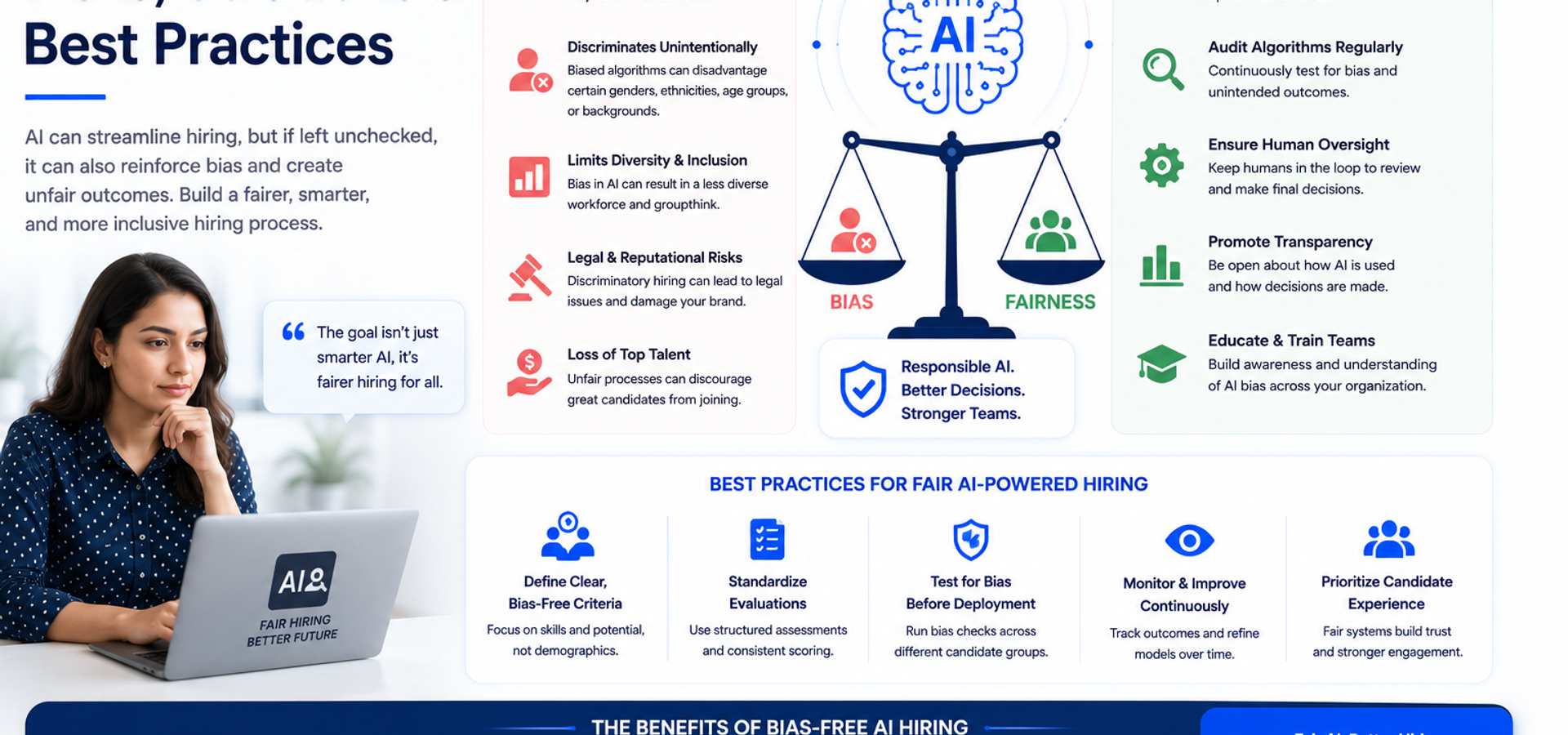
A résumé ranker quietly demotes a career-gap candidate. A chatbot times out a non-native speaker. A hiring manager overrides the model only for people who “feel like a culture fit.” None of those moments look like a scandal in the moment, and that is exactly how a human AI bias hiring system fails: not with one villainous algorithm, but with a loop of data, defaults, and human shortcuts that compounds into unfair outcomes.
This guide breaks down AI bias in hiring for operators who already use, or are about to buy, screening and ranking tools. You will see where risk enters, what “good” governance looks like, and how to keep automation fast without making fairness optional. For the wider AI recruiting landscape, start with artificial intelligence (AI) in recruitment and machine learning in recruiting.
What “human AI bias hiring system” really means
Most teams do not run pure machine hiring. They run hybrids: ATS stages, AI ranking, recruiter judgment, manager scorecards, sometimes voice or chat screens. That whole loop is a human AI bias hiring system, and bias can enter at every handoff.
Three places matter most:
- Data: historical hires that under-represent qualified groups
- Model or rules: proxies correlated with protected traits (zip code, school prestige, tenure gaps)
- Human behavior: selective overrides, inconsistent scorecards, “gut feel” after the model already filtered the slate
If you only audit the model and ignore recruiter overrides, you are not auditing the system you actually use.
Why AI bias in hiring is an operational risk, not just a PR risk
Unfair screening burns candidate trust, shrinks your talent pool, and can trigger legal exposure under equal employment rules. The U.S. Equal Employment Opportunity Commission has published guidance on employers’ use of software and AI in employment decisions under Title VII, treat vendor claims as claims, not shields. Source: EEOC: Select Issues in Assessing Adverse Impact in Software, Algorithms, and AI.
NIST’s AI Risk Management Framework likewise pushes organizations to map, measure, and manage AI risks across the lifecycle, including bias and transparency. Source: NIST AI Risk Management Framework.
LinkedIn’s talent research continues to show teams accelerating technology adoption for speed and experience, which raises the stakes for getting fairness right while you scale tools. Source: LinkedIn: Future of Recruiting 2025.
Where bias enters modern recruiting workflows
Sourcing and ranking
Models trained on “who we hired before” recreate who you hired before. Aggressive keyword matching can punish non-linear careers. Background: AI sourcing: how to find candidates faster and candidate sourcing services.
Automated screening
Knockout questions help when they are job-related. They harm when they encode unnecessary credentials or language fluency traps. See AI applicant screening: how it works & top tools and best automated screening software for staffing agencies.
Interview generation and “intelligence”
AI-generated questions can improve consistency, or smuggle stereotypes if prompts are sloppy. Pair structure with human review: generate interview questions from a job description with AI and interview intelligence: AI & candidate performance.
Voice and conversational agents
Accent, background noise, and turn-taking differences can affect completion rates if systems are brittle. Structured scripts, clear opt-outs, and human fallback reduce risk. Compare agent patterns in how AI agents are transforming recruiting and AI agents for recruitment comparison.
Unique angle: bias is a loop, not a binary
Popular coverage asks “is AI biased?” Operators should ask “where does our human AI bias hiring system amplify unfairness this week?”
A fairer loop looks like this:
- Job analysis defines must-have skills before any model runs
- Automation asks the same job-related questions in the same order
- Humans review edge cases with documented reasons
- Analytics compare pass-through rates by stage and source, not vanity dashboards
- Vendors provide logs you can export, not vibes you must trust
That framing beats both extremes: “ban AI” and “automate everything.”
Risks to watch before you scale automation
- Proxy discrimination: features correlated with protected classes
- Feedback loops: models trained on biased hiring outcomes
- Automation opacity: no explanation for rank changes
- Uneven human overrides: managers only fight for familiar profiles
- Access barriers: tools that fail on mobile, accents, or assistive tech
- Vendor lock without audits: no adverse-impact reporting on demand
Staffing and high-volume environments feel these risks faster because volume multiplies small skews. Context: AI staffing and ATS for staffing agencies compared.
Solutions and best practices that actually travel
1. Start with job-related criteria
Write must-haves vs nice-to-haves before enabling ranking. If “top university” is not required for performance, do not let it dominate a score.
2. Prefer structured over free-form gates
Structured screens and scorecards beat unstructured chat dumps. Consistency is a fairness feature, not only a speed feature. Speed context: hire candidates faster with AI tools.
3. Keep humans accountable, not decorative
A rubber-stamp override is worse than no override. Require short disposition reasons when humans overrule automation. That is how a human AI bias hiring system becomes auditable instead of theatrical.
4. Measure outcomes, not intentions
Track stage conversion by source and role family. Use recruitment analytics software thinking: if women or career-switchers drop off after an AI screen, investigate before you “optimize” further.
5. Demand explainability and data rights from vendors
Ask for feature lists, training-data descriptions, adverse-impact testing cadence, and exportable decision logs. Wire tools so outcomes land in your ATS, see integrate recruiting software with existing systems and cloud stack notes in cloud-based recruitment software.
6. Design candidate experience as an equity control
Clear instructions, reasonable time limits, and alternate paths (human callback) reduce failures that look like “low quality” but are actually access problems. Candidate-side prep tools are rising too, see best AI interview practice tools for candidates, which makes opaque employer-side scoring even harder to defend.
7. Govern agentic workflows before you scale them
Multi-step AI agents that source, screen, and schedule without checkpoints can hide bias in the chain. Read agentic hiring organization with a governance lens before you celebrate autonomy.
A practical fairness checklist for your next pilot
- Document the decision the AI is allowed to make, and what remains human-only
- Map protected-class risk for each input feature you feed the model
- Run a parallel review on a sample of auto-rejected candidates
- Log every automated disposition into the ATS with timestamp and rule version
- Schedule a 30-day adverse-impact review before expanding to more reqs
- Train recruiters on when override is required, not optional
If you cannot complete that list, you are not ready to call your stack a responsible human AI bias hiring system, you are ready for a slower pilot.
Where Dialflo fits
Dialflo is an AI voice layer for phone-heavy recruiting steps, structured screens, confirmations, reschedules, with outcomes written back to your ATS. It should not be a black-box final judge. Used well, consistent questioning plus human review reduces the wild variance of ad-hoc phone screens while keeping your ATS as the system of record.
Fairness still depends on your questions, your knockouts, and your override culture. Automation amplifies whatever you encode.
FAQ: AI bias in hiring
What is a human AI bias hiring system?
It is the combined people-plus-software loop that screens, ranks, and advances candidates, where bias can come from data, models, or human behavior.
Does using AI automatically create illegal discrimination?
No, but employers can still face risk if tools cause unjustified adverse impact. Diligence and monitoring matter. Follow current EEOC and local guidance.
Can structured AI screens reduce bias?
They can reduce inconsistency when questions are job-related and results are audited. They do not erase biased criteria you baked in.
Should we ban AI from hiring?
Most teams will not. The practical path is governed hybrids: clear criteria, logs, human accountability, and vendor transparency.
What should I ask vendors?
Ask how they test for bias, what features they use, how overrides work, and how you export decision logs for audits.
How does Dialflo handle this?
Dialflo focuses on consistent phone execution and ATS write-back so humans review structured outcomes, not opaque end-to-end hiring decisions.
Closing: fix the loop, not the slogan
AI bias in hiring is not solved by a brand promise. It is solved when your human AI bias hiring system uses job-related criteria, structured automation, accountable humans, and measurable outcomes. Speed and fairness are not opposites, unexamined automation is what makes them collide.
Building phone screens that stay consistent and auditable? Explore Dialflo, and keep governance as non-negotiable as time-to-hire.


