Reducing 3PL Operational Cost Per Load with Agentic Voice AI

Dialflo: AI Voice Agent
June 15, 2026
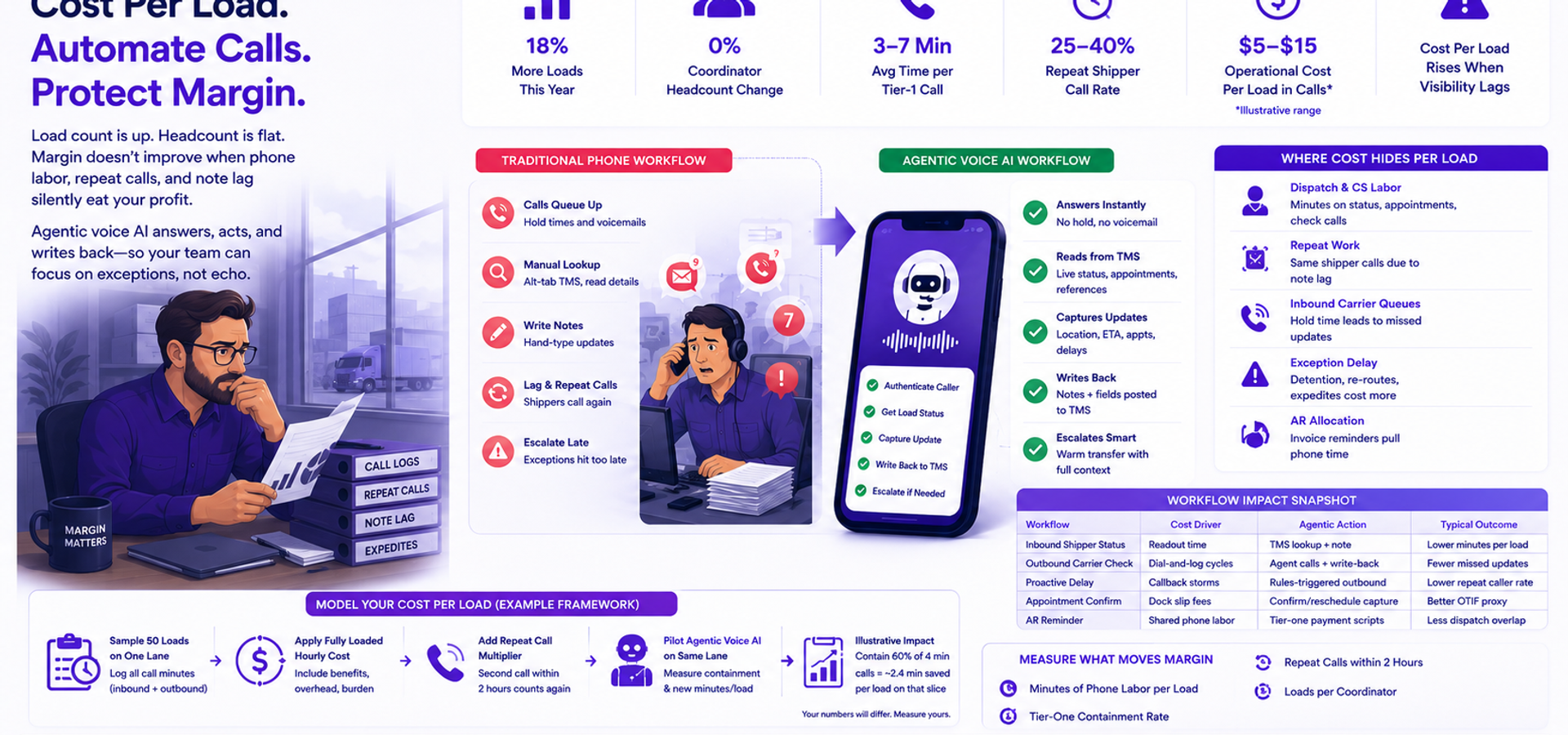
Your load count is up eighteen percent. Your coordinator headcount is flat. Margin did not magically improve, because 3PL operational cost per load is not only warehouse and linehaul. It is phone labor, repeat status calls, note lag, and expedites triggered when visibility arrives too late. Spreadsheets track cost per mile; operations bleeds cost per unanswered ring.
Agentic voice AI targets that bleed: voice agents that query TMS, decide next steps, capture updates, write back, and escalate with context, without a human retyping every conversation. This guide shows where cost hides per load, what agentic automation changes, how to measure ROI honestly, and how to pilot on one shipper lane without breaking SLA trust.
What makes up 3PL operational cost per load
Finance teams often bucket transportation and warehouse. Operators know 3PL operational cost per load also includes coordination tax:
- Dispatch and CS labor: minutes per load on status, check calls, appointments
- Repeat work: same shipper calls twice because notes lagged
- Inbound carrier queues: hold time → missed updates → downstream fire drills
- Exception delay: detention and re-routes cost more when triage starts late
- AR allocation: invoice reminder time attributed across active loads
Call volume scales faster than load count when shipper SLAs tighten. Context: scaling 3PL customer follow-ups, the logistics decision gap, and supply chain automation with AI.
Agentic voice AI vs basic phone automation
Not all voice bots reduce 3PL operational cost per load. IVR trees and rigid scripts still dump work on coordinators. Agentic voice AI for 3PL operations typically:
- authenticates shipper, carrier, or account on natural language
- reads live TMS/WMS status before speaking
- chooses tier-one answer vs warm transfer based on rules
- extracts location, ETA, appointment changes from speech
- writes dispositions and fields back to TMS/CRM
- triggers proactive outbound when appointment risk flags fire
That is action, not a transcript in a shared inbox. Conversational layer: conversational services use cases. Broader agents: AI agents compared (pattern applies across ops domains).
Where agentic voice AI cuts cost per load
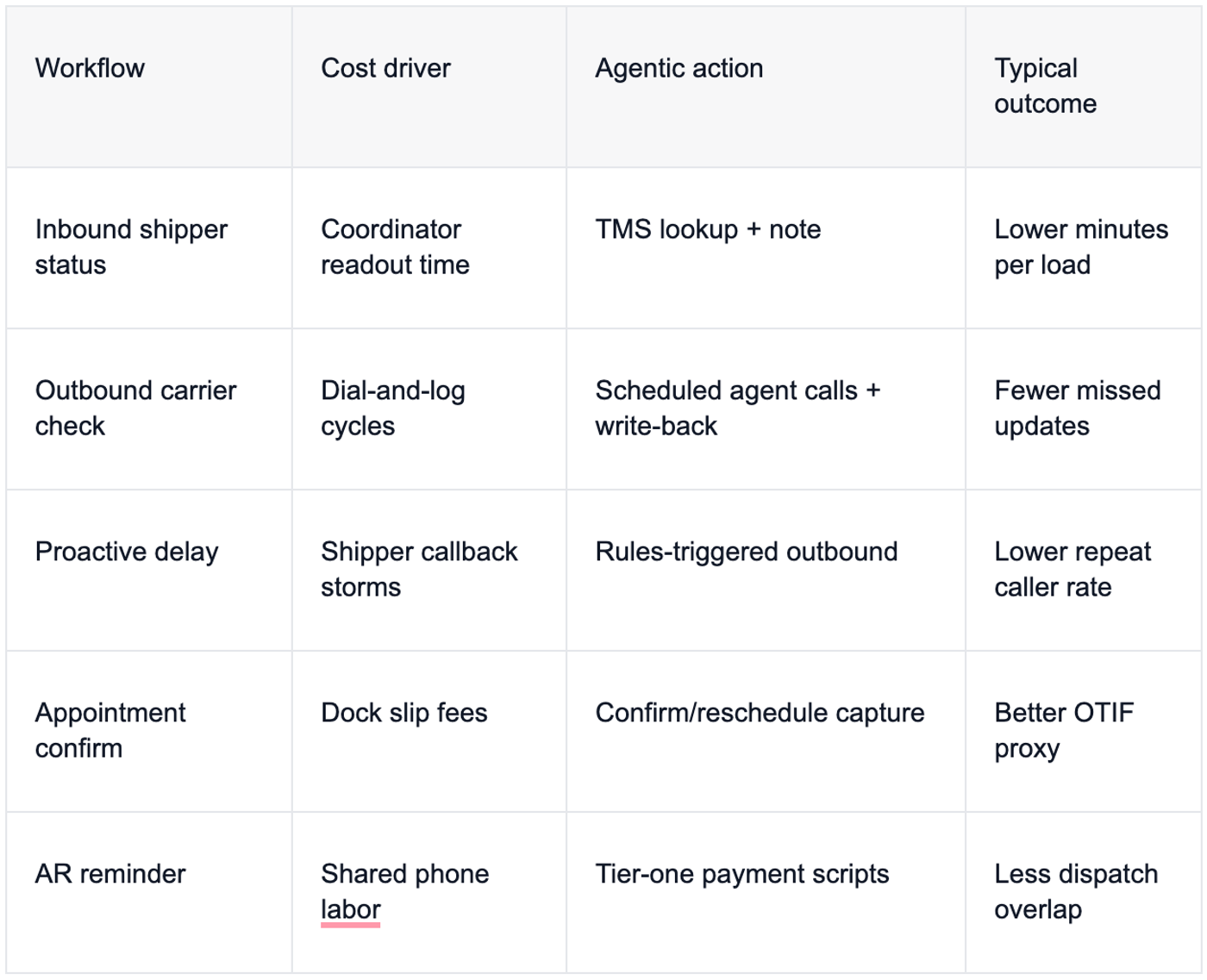
TMS integration: MercuryGate TMS API for 3PL voice agents and automated load status updates in TMS. Inbound carrier queues: automate inbound carrier tracking queues.
Modeling cost per load before and after
Build a simple ops model, honest beats heroic:
Step 1: Sample fifty loads on one lane. Log coordinator minutes on calls tagged to those loads (inbound + outbound).
Step 2: Apply fully loaded hourly cost for dispatch/CS role.
Step 3: Add repeat-call multiplier, second shipper ring within two hours counts again.
Step 4: Pilot agentic voice AI on same lane; measure containment rate and new minutes per load.
Example framing (illustrative only): if tier-one calls average four minutes per load and automation contains sixty percent, you recover roughly 2.4 minutes of labor per load on that slice, before counting fewer expedites from faster delay notice. Your pilot numbers will differ; measure yours.
Tier framework: automate cost, keep margin on exceptions
Tier 1: agentic automate: Status readouts, appointment confirm, standard delay intake, payment reminder scripts.
Tier 2: triage then transfer: Delivery exceptions, partial claims, angry caller start.
Tier 3: human only: Detention negotiation, re-power, key-account relationship, safety.
Related playbooks: how logistics teams cut dispatcher call load and AI voice agents for thousands of routine calls.
Multi-shipper 3PL configuration
Cost per load varies by shipper SLA. Agentic voice AI should support:
- per-shipper scripts and authentication fields
- escalation rules for strategic accounts
- scoped API access so agents never cross shipper data
- reporting cost proxies per shipper for QBRs
Start one mid-volume shipper, enough calls to measure, not enough risk to sink a relationship during tuning.
Four-week pilot to prove cost per load impact
Week 1: Baseline minutes per load
Tag call time to loads on pilot lane. Capture repeat caller rate and note lag.
Week 2: Read-only agentic agent
TMS lookup on inbound; humans approve write-back suggestions.
Week 3: Write-back + outbound check calls
Enable structured posting and one proactive delay or confirm workflow.
Week 4: Compare cost proxy
Recalculate minutes per load, containment, OTIF proxy. Expand lane or add inbound overflow if metrics hold.
Peak surge: peak season without hiring dispatchers. AR overlap: manual AR follow-up hidden costs.
Metrics that tie voice AI to 3PL unit economics
- coordinator minutes per load (pilot lane)
- fully loaded labor cost per load (ops model)
- tier-one containment rate
- repeat caller rate within two hours
- time from call end to TMS note posted
- OTIF or appointment-hit rate on pilot segment
- expedite count attributable to late visibility (qualitative log)
Stack context: AI in logistics use cases, AI supply chain technology trends, build vs buy voice AI stack.
Failure modes that erase savings
Bad TMS data: Agentic AI amplifies wrong ETAs, fix sources before blaming voice.
No write-back: Labor savings vanish if coordinators retype anyway.
VIP over-automation: Strategic shippers need human-first paths.
Measuring calls answered only: Note lag and repeat callers are the cost signals.
Missed calls: hidden cost of missed calls in logistics. Exceptions: reducing delivery exception calls before ops.
Where Dialflo fits
Dialflo helps 3PLs reduce 3PL operational cost per load with agentic voice AI, inbound shipper and carrier calls, outbound check and delay workflows, TMS-aware decisions, structured write-back, and warm transfer on exceptions.
Pilot one shipper lane on dialflo.ai when call labor scales faster than load revenue and margin needs ops leverage, not another coordinator per twenty shipments.
FAQ: 3PL cost per load and agentic voice AI
What is 3PL operational cost per load?
All ops labor and rework attributable to moving one shipment, not only linehaul and warehouse.
What is agentic voice AI?
Voice agents that query systems, decide actions, write back, and escalate, not static IVR.
How fast to see savings?
Often measurable in a 4-week pilot on one lane; validate with your minutes-per-load model.
Replace coordinators?
No, automate tier-one; humans on exceptions and key accounts.
Which TMS platforms work?
Most with API access, MercuryGate, McLeod, others via adapters; pilot read-only first.
How does Dialflo help?
Agentic voice AI for 3PL ops with TMS write-back, see dialflo.ai.
Closing: margin is ops minutes per load
3PLs win contracts on rate and lose margin on coordination. Reducing 3PL operational cost per load with agentic voice AI means fewer minutes of readouts, fewer repeat rings, faster notes in TMS, and coordinators on detention, not hold music. Measure minutes per load honestly, pilot one lane, then scale what containment proves.
Ready to lower cost per load without adding desks? Explore Dialflo for agentic voice AI built for 3PL operations at scale.