Scale Freight Brokerage Loads Without More Tracking Staff

Dialflo: AI Voice Agent
June 15, 2026
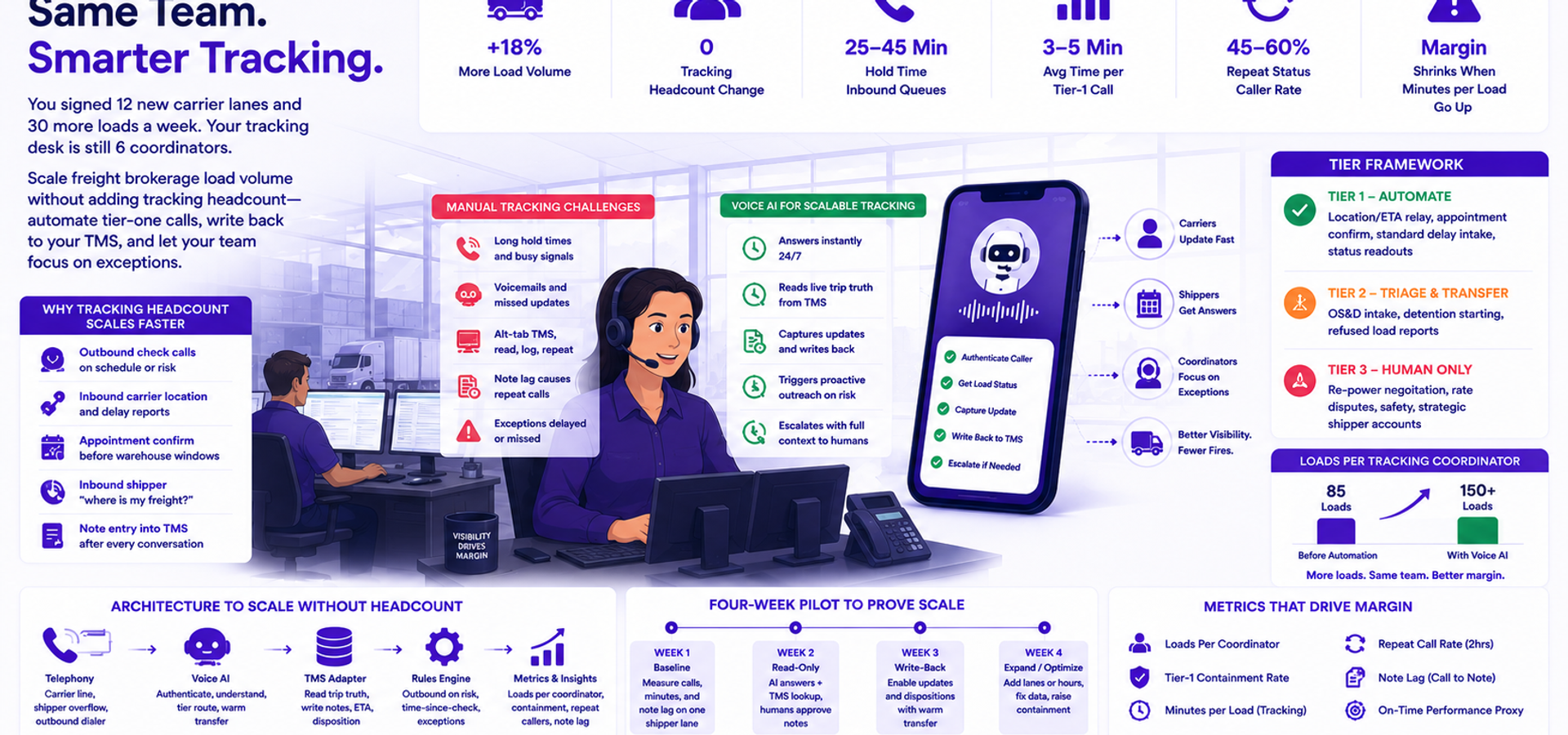
You signed twelve new carrier lanes and thirty more loads a week. Your tracking desk still has six coordinators, and line four has been on hold since breakfast. Scaling freight brokerage load volume without adding tracking headcount is not a headcount freeze fantasy. It is an automation design problem: tier-one calls still eat minutes per load while exceptions wait.
This guide shows how brokerages grow load volume while keeping tracking teams lean, voice AI for inbound carrier queues, outbound check calls, shipper status, and TMS write-back, plus metrics, a four-week pilot, and where humans stay essential.
Why tracking headcount scales faster than load count
Brokerage margin lives on volume and visibility. Each load generates tracking work:
- outbound check calls on schedule or risk
- inbound carrier location and delay reports
- appointment confirm before warehouse windows slip
- inbound shipper “where is my freight?” when portals lag
- note entry into TMS after every conversation
Hire one coordinator per X loads and margin compresses. The alternative is scaling freight brokerage load volume by automating tier-one tracking minutes, not skipping tracking altogether. Background: automate inbound carrier tracking queues and automated carrier check-call logging.
Loads per coordinator: the metric that matters
Leadership tracks loads per rep for sales; operations should track loads per tracking coordinator, active trips divided by coordinators handling check calls and status. When that ratio flatlines while volume rises, you are buying growth with payroll.
Voice AI raises the ratio by cutting:
- minutes spent reading TMS aloud to shippers
- dial-and-log outbound check cycles
- repeat calls caused by note lag
- after-hours voicemail backlog
Dispatcher productivity: how logistics teams cut dispatcher call load and AI voice agents for thousands of routine calls monthly.
Tier framework for tracking automation
Tier 1: automate: Location/ETA relay, appointment confirm, standard delay intake, inbound status readouts.
Tier 2: triage + transfer: OS&D intake, detention starting, refused load reports.
Tier 3: human only: Re-power negotiation, rate disputes, safety, strategic shipper accounts.
Phone-tree replacement: replacing phone trees with conversational voice AI. Status write-back: automated load status updates in TMS.
Architecture to scale tracking without headcount
- Telephony: Carrier tracking line, shipper overflow, outbound dialer.
- Voice AI: Authenticate PRO/load, NLU, tier routing, warm transfer.
- TMS adapter: Read trip truth; write notes, ETA, disposition.
- Rules engine: Outbound when appointment risk or time-since-check fires.
- Metrics: Loads per coordinator, containment, repeat callers, note lag.
Integration planning: build vs buy voice AI stack, technology used in supply chain management, and AI supply chain technology trends. Decision gap: the logistics decision gap.
Outbound + inbound: both sides of scale
Outbound check calls prevent inbound storms, automate scheduled location/ETA scripts with write-back. Inbound carrier tracking queues capture driver updates the moment they call, no voicemail graveyard.
Inbound shipper status stops repeat rings when notes post in real time. Shipper pain: where is my shipment calls. Exceptions: reducing delivery exception calls before ops.
Four-week pilot: prove loads per coordinator gains
Week 1: Baseline
On one high-volume lane, count active loads per tracking coordinator, call minutes per load, repeat caller rate, note lag.
Week 2: Read-only voice AI
Inbound shipper status and carrier questions from TMS; humans approve notes before write-back.
Week 3: Outbound check + inbound write-back
Enable scheduled check calls and structured inbound location capture. Warm transfer on detention keywords.
Week 4: Compare and expand
Recalculate loads per coordinator. Add lane or after-hours line if containment holds.
Peak volume: peak season without hiring dispatchers. 3PL parallel: reducing 3PL operational cost per load.
Metrics for scaling freight brokerage load volume
- active loads per tracking coordinator
- tier-one containment rate (no human transfer)
- inbound answer rate and average hold time
- repeat caller rate within two hours (shipper + carrier)
- time from call end to TMS note posted
- OTIF or appointment-hit proxy on pilot lane
- missed-call count on tracking lines
Broader AI map: AI in logistics use cases, conversational services use cases, and machine learning in supply chain optimization. Missed-call cost: hidden cost of missed calls in logistics.
What not to automate when scaling
Growth without headcount is not zero-touch ops. Keep humans on:
- carrier no-show and re-power decisions
- detention negotiation and rate for extra miles
- claims and OS&D beyond intake
- key accounts that contractually require named coordinators
Automate tier one so your existing tracking team absorbs volume, do not burn them on readouts.
Where Dialflo fits
Dialflo helps freight brokerages succeed at scaling freight brokerage load volume without increasing tracking headcount, AI voice agents for inbound carrier and shipper tracking, outbound check calls, proactive delay, and TMS write-back with warm transfer on exceptions.
Pilot one lane on dialflo.ai when load growth outpaces your tracking desk and margin cannot absorb another coordinator per twenty active trips.
FAQ: Scale loads without more trackers
Can brokerages scale volume without hiring trackers?
Yes, with tier-one voice automation and TMS write-back; humans on exceptions.
What metric proves success?
Loads per tracking coordinator with stable OTIF proxy on pilot lanes.
Automate inbound or outbound first?
Often outbound check on one lane plus inbound overflow, fix note lag either way.
Will shippers accept voice AI?
Yes when answers are TMS-accurate and escalation is instant.
How long to pilot?
Often 2–4 weeks on one high-volume lane.
How does Dialflo help?
Voice AI for brokerage tracking at scale, see dialflo.ai.
Closing: volume scales; hold music should not
Scaling freight brokerage load volume without increasing tracking headcount means every tier-one call becomes a TMS event, inbound captured, outbound scheduled, shippers answered, while coordinators own exceptions that protect margin. Measure loads per coordinator, pilot one lane, then grow volume without growing hold queues.
Ready to scale tracking without another desk? Explore Dialflo for voice AI built for freight brokerage operations.