Top HR AI Tools: Automate Screening Calls with Voice AI

Dialflo: AI Voice Agent
June 12, 2026
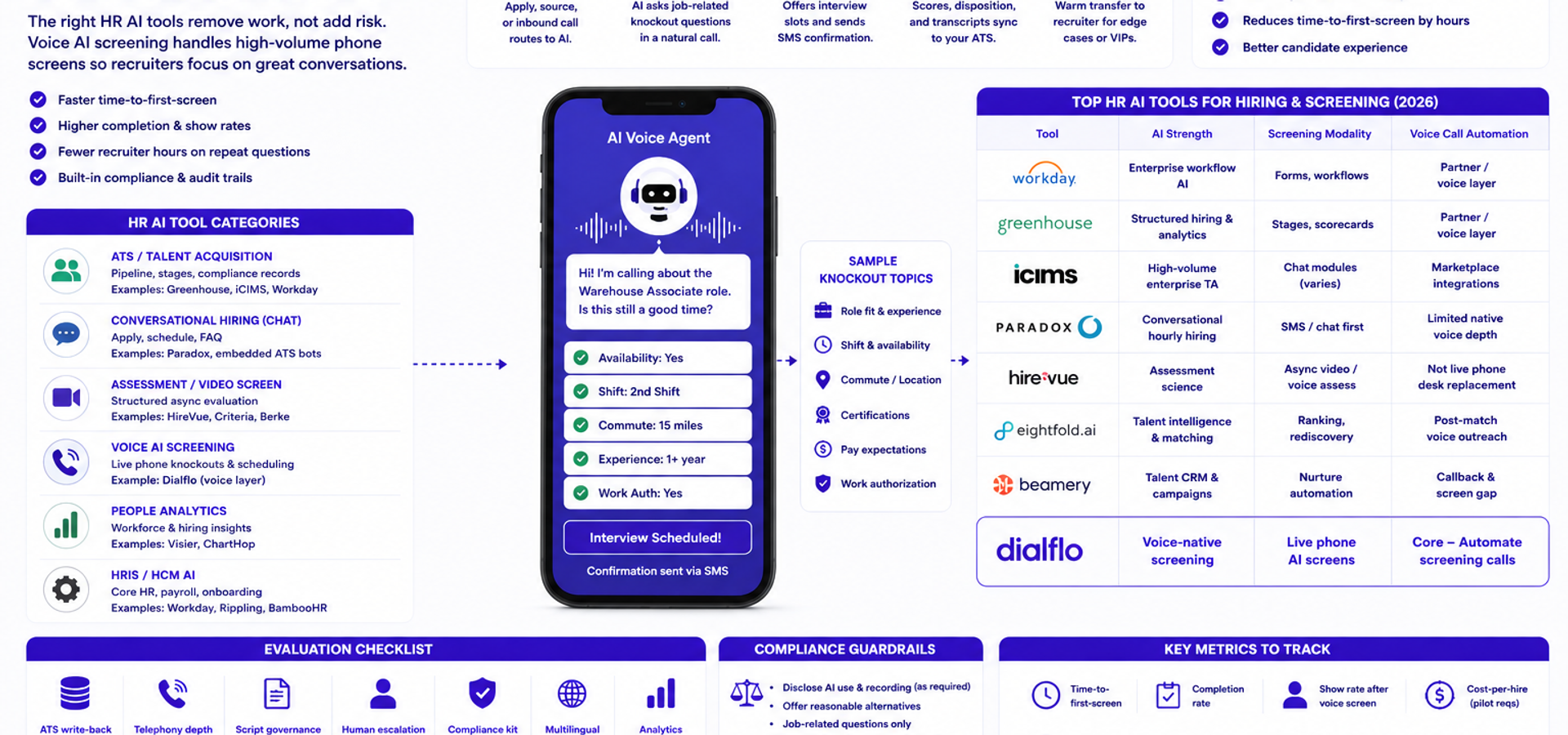
HR teams in 2026 are not asking whether to use AI, they are asking which HR AI tools actually remove work without creating compliance debt. Dashboards that rank resumes are table stakes. The bottleneck on most desks is still the phone: applicants who call instead of finishing web screens, recruiters re-asking the same knockout questions, and voicemails that turn into next-day backlog.
This guide maps top HR AI tools by category, hiring, screening, analytics, service delivery, and shows how to automate screening calls with voice AI as a dedicated layer on your ATS. For broader HR stack context, see HR software solutions: features, types, and tools and artificial intelligence in recruitment.
What HR AI tools cover in 2026
HR AI tools span the employee lifecycle, but hiring and screening see the fastest ROI when volume is high:
- Talent acquisition: sourcing, ATS, scheduling, offers
- Screening & assessment: knockouts, skills tests, voice/video
- Onboarding: document collection, Q&A bots, task automation
- HR service delivery: policy bots, case routing, leave questions
- People analytics: attrition risk, workforce planning signals
- Learning: personalized paths, skills inference
LinkedIn's Future of Recruiting reports accelerating AI adoption as teams chase recruiter capacity. SHRM recruiting benchmarks continue to show long time-to-fill under heavy req load, exactly where phone automation helps if implemented with guardrails.
HR AI tool categories, and where voice screening fits
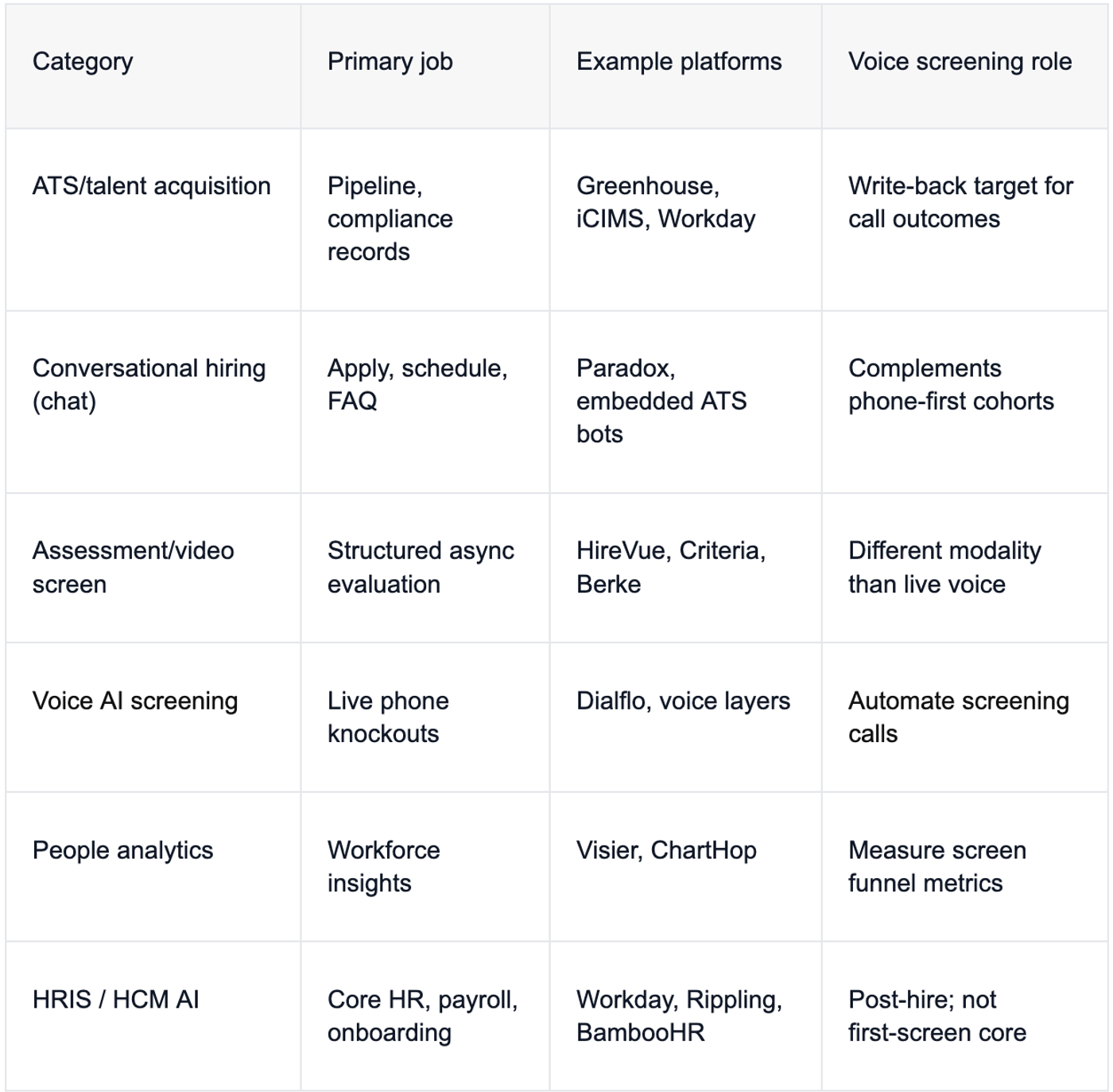
TA stack depth: best talent acquisition software with AI voice screening. Agent landscape: AI agents for recruitment compared.
Top HR AI tools for hiring and screening, by use case
No single vendor wins every HR function. Below is how leading HR AI tools map to 2026 buying scenarios, validate with a pilot on your req types.
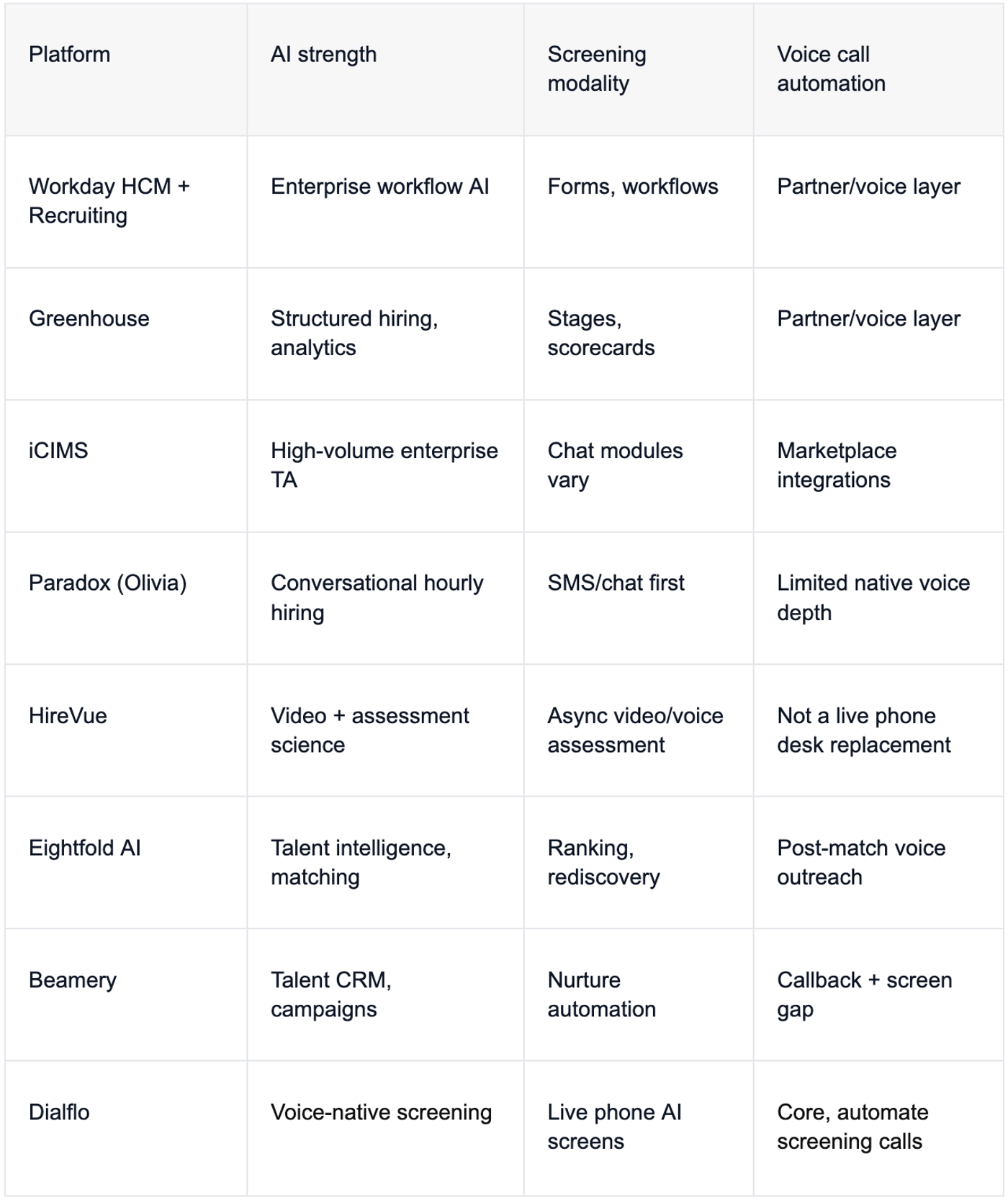
Applicant screening category: how AI applicant screening works. Staffing desks: automated screening software for staffing agencies and AI in staffing.
Why HR teams automate screening calls with voice AI
Form-based and chat screening fail when:
- candidates work shifts and complete screens on break, by phone
- inbound applicant calls exceed recruiter answer capacity
- mobile web screen completion rates stay under 50%
- time-to-first-screen stretches beyond 24–48 hours on hot reqs
- multilingual knockouts are required but recruiter coverage is thin
Voice AI places or answers calls, runs auditable scripts, schedules interviews, and syncs outcomes to ATS, so recruiters interview qualified people, not repeat knockouts. Patterns: conversational services use cases and how AI agents are transforming recruiting.
How voice AI screening calls work in practice
- Trigger: Apply event, sourced lead, or inbound ring routes to voice AI.
- Authenticate: Name, role applied, reference number.
- Screen: Job-related knockouts, availability, commute, certs, pay band, work authorization.
- Schedule: Offer recruiter slots; send SMS confirmation.
- Write-back: Score, disposition, transcript link to ATS fields.
- Escalate: Warm transfer on edge cases, VIP reqs, or candidate request.
Integration: integrate recruiting software with existing systems. Telephony build vs buy: build vs buy voice AI stack.
Evaluation criteria for HR AI screening tools
- ATS write-back: Automatic stage and scorecard updates, not CSV exports.
- Script governance: Versioned, job-related questions HR and legal can audit.
- Telephony: Business caller ID, inbound/outbound, retry, after-hours.
- Human escalation: Transcript-forward warm transfer on keyword or score.
- Compliance kit: Consent, retention, adverse-impact reporting hooks.
- Multilingual: Test production calls, not demo audio only.
- Analytics: Completion rate, time-to-first-screen, show rate, not dial volume alone.
Analytics platforms: recruitment analytics software. ML fundamentals: machine learning in recruiting. Speed plays: hire candidates faster with AI tools.
Compliance: HR AI screening calls
Automated screens are selection procedures. The EEOC uniform guidelines on employee selection procedures frame validation and adverse-impact awareness. Practical HR guardrails:
- disclose AI use and recording where required
- offer reasonable alternatives when applicable
- never use voice models to infer protected-class attributes
- log question versions and outcomes for audit
- route ambiguous cases to human recruiters
Interview design: generate interview questions from job descriptions with AI and interview intelligence.
Four-week pilot: automate screening calls on one req type
Week 1: Baseline
On highest-volume req (warehouse, retail, care, call center), measure time-to-first-screen, completion rate, recruiter screen hours, and show rate.
Week 2: ATS read + parallel review
Connect candidate lookup. Run voice AI screens alongside recruiters on sample cohort; compare disposition agreement.
Week 3: Live voice screens
Enable inbound overflow and outbound no-complete-applicant calls. Write-back to ATS. Warm transfer enabled.
Week 4: Expand or tune scripts
If completion and quality hold, add reqs or languages. If drop-off spikes, fix script length, not add tools.
High-volume events: open interviews near me today, voice AI handles applicant call surges. Cloud TA: cloud-based recruitment software. Future org design: agentic hiring organization.
Metrics HR leaders should track in 2026
- time-to-first-screen (apply or source → completed knockout)
- screen completion rate (started vs finished)
- recruiter hours per qualified candidate
- interview show rate after voice screen
- cost-per-hire on pilot reqs vs baseline
- candidate experience pulse (one question post-screen)
- demographic parity across screened cohorts
Sourcing still feeds the funnel, voice does not fix empty pipelines: top sourcing tools for recruiters with AI voice outreach and AI sourcing.
Where Dialflo fits among HR AI tools
Dialflo is a voice-native HR AI tool for teams that need to automate screening calls with voice AI, structured phone knockouts, inbound applicant handling, scheduling, and ATS write-back. It complements ATS, chat, and video assessment platforms; it is not an HRIS.
Explore recruiting voice workflows on dialflo.ai when 2026 hiring plans assume instant phone screens your team cannot staff manually.
FAQ: HR AI tools and voice screening
What are HR AI tools?
AI across hiring, screening, onboarding, service delivery, analytics, and learning.
Can HR automate screening calls?
Yes, with voice AI, ATS write-back, and human escalation paths.
Voice vs chat vs video screening?
Voice fits live phone-first and high-volume hourly hiring; others fit async desk cohorts.
Is voice AI screening legal?
Yes with job-related questions, disclosure, consent, and human review.
How fast to pilot?
Often four weeks on one high-volume req type.
How does Dialflo help?
Voice-native screening layer with ATS sync, see dialflo.ai.
Closing: HR AI that removes phone work wins
The top HR AI tools in 2026 are not the ones with the longest feature lists, they are the stacks that shorten time-to-qualified candidate. Pair ATS and assessment platforms with layers that automate screening calls with voice AI where your applicants actually engage, measure completion honestly, and keep compliance auditable from week one.
Building your 2026 HR AI stack? Start with HR software solutions, then add Dialflo for the screening calls your reqs already need.


